



October 21, 2026




TL;DR:
- AI in digital marketing offers an average ROI of 3.2 times and is accessible for all businesses.
- It enhances personalization, saving time, increasing engagement, and reducing customer acquisition costs.
- Successful AI implementation requires careful data management, human oversight, and strategic pilot testing.
Generative AI now delivers an average 3.2x ROI in digital marketing, and that number isn’t reserved for Fortune 500 companies with massive tech budgets. The reality is that AI-powered tools are accessible, affordable, and already reshaping how marketing teams attract leads, personalize experiences, and close sales. Yet many marketing managers and business owners still treat AI as a futuristic concept rather than a practical strategy they can use today. This article breaks down what AI in digital marketing actually means, how it drives measurable results, where it works best, and how you can start using it without overhauling your entire operation.
Table of Contents
- What is AI in digital marketing?
- How AI drives real results: ROI, time savings, and engagement
- Key uses of AI: What’s actually working for marketers
- Pitfalls, challenges, and how to succeed with AI
- Getting started: Steps for US marketing managers and business owners
- Why trusting both AI and your marketing instincts matters most
- Ready to elevate your digital marketing with AI?
- Frequently asked questions
Key Takeaways
| Point | Details |
|---|---|
| AI delivers proven ROI | AI marketing strategies can deliver up to 3.2x ROI and major time savings for teams. |
| Prioritize content, email, social | Focusing AI on content, email, and social media produces the fastest, highest-value results. |
| Start small and measure | Begin with pilot projects, track performance, and scale successful AI initiatives. |
| Human oversight is crucial | AI succeeds when paired with human control to avoid pitfalls like bias and brand inconsistency. |
What is AI in digital marketing?
With the big-picture ROI revealed, it’s important to define what AI in digital marketing truly means. Artificial intelligence in marketing refers to software systems that learn from data to make decisions, predictions, or recommendations without being manually programmed for every scenario. Machine learning, a subset of AI, allows these systems to improve over time as they process more information.
In practice, AI shows up across your marketing stack in several ways:
- Chatbots and conversational tools that qualify leads and answer questions 24/7
- Content generation platforms that draft copy, social posts, and email subject lines
- Predictive ad targeting that identifies which audiences are most likely to convert
- Smart segmentation in email platforms that sends the right message to the right person
- Analytics tools that surface patterns in customer behavior you’d never spot manually
The most-used channels for AI right now are content marketing, email automation, and social media advertising. According to the State of AI Marketing 2026, 87% of enterprise marketing teams use AI, and 88% of marketers use it daily. That level of adoption signals a shift, not a trend.
If you want to understand the future of AI marketing and how data-driven systems are evolving, the landscape is moving fast. The Gartner AI marketing overview offers a useful framework for how organizations are categorizing and prioritizing AI capabilities.
Pro Tip: Don’t try to automate everything at once. Start by using AI to assist one task, like drafting email subject lines or generating ad copy variations, before expanding to broader workflows.
How AI drives real results: ROI, time savings, and engagement
With the basics covered, let’s see what AI can actually do for your marketing outcomes. The performance gap between AI-assisted campaigns and traditional ones is significant and growing.
Research shows that AI-driven marketing saves marketers 11 hours per week while delivering 22% higher ROI and 29% lower customer acquisition cost. That’s not a marginal improvement. It’s the difference between a campaign that breaks even and one that funds your next quarter.
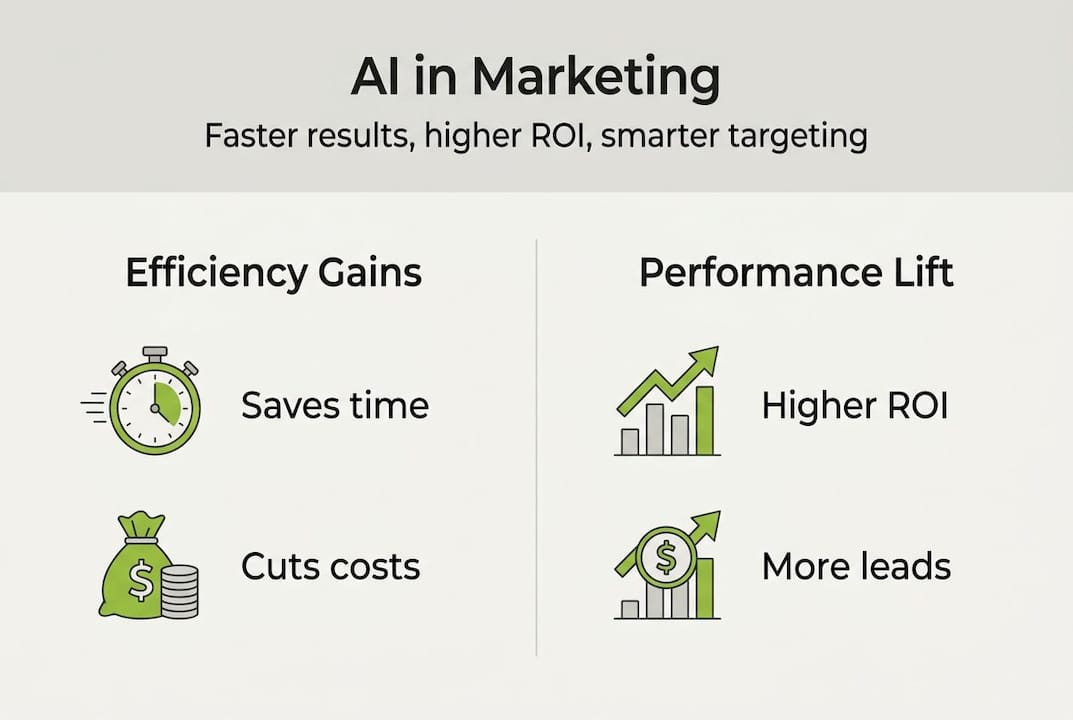
| Metric | AI-assisted campaigns | Traditional campaigns |
|---|---|---|
| Average ROI | 3.2x | 1.0x baseline |
| Time saved per week | 11 hours | 0 hours |
| Customer acquisition cost | 29% lower | Standard |
| Purchase likelihood | 2.3x higher | Standard |
Personalization is where AI really separates itself. AI personalization boosts purchase likelihood by 2.3x, and in one documented case, lead volume increased by 2,930% after implementing AI-driven targeting and content personalization.
“A single AI-powered campaign generated a 2,930% lift in lead volume by combining predictive audience segmentation with personalized content delivery.” — Generative AI ROI Study
For quick wins, focus on these high-impact areas first:
- Email subject line testing using AI to predict open rates before sending
- Retargeting ad optimization that adjusts bids and creatives automatically
- Chatbot lead qualification to capture and score inbound leads in real time
- Social content scheduling based on AI-predicted engagement windows
If you’re evaluating social media ads ROI or looking for step-by-step AI strategies, these resources offer practical frameworks to get started.
Key uses of AI: What’s actually working for marketers
Impressive results are possible when AI is used strategically. Let’s break down where and how marketers succeed with AI right now.
The three highest-performing applications for most US marketing teams are content generation, email automation, and smart audience segmentation. Content generation tools can produce first drafts, social captions, and product descriptions in minutes. Email automation platforms use behavioral triggers to send personalized sequences without manual intervention. Smart segmentation uses purchase history, browsing behavior, and CRM data to group audiences with precision.
Here’s how to pilot AI in your marketing operation:
- Identify one high-volume, repetitive task such as writing ad copy or scheduling social posts
- Select an AI tool that integrates with your existing platform (email, CRM, or ad manager)
- Set a baseline by measuring your current performance metrics before the pilot begins
- Run the AI-assisted version alongside your standard approach for 30 to 60 days
- Compare results using ROAS (return on ad spend) and lead lift as your primary benchmarks
- Iterate and expand only after validating the results from the pilot
Integrating AI with your CRM data is where compounding gains happen. When AI tools access first-party data, like purchase history, support tickets, and form submissions, they can personalize outreach at a scale no human team can match.

For inspiration on content formats that perform well with AI assistance, explore interactive content ideas. For deeper execution support, AI content enhancement and AI-driven SEO are two areas where specialized expertise accelerates results significantly.
The State of AI Marketing 2026 recommends that US marketing managers prioritize AI for content, email, and social while integrating CRM data to maximize personalization and measurable outcomes.
Pro Tip: Measure ROAS and lead lift from day one of any pilot. Small, well-measured experiments give you the data you need to justify scaling AI investment to leadership.
Pitfalls, challenges, and how to succeed with AI
Even with strong results, adopting AI comes with real challenges. Here’s what to watch for and how to set your team up for success.
The most common problems are data quality issues, unintended bias in AI outputs, loss of brand voice, and compliance gaps. If your CRM data is incomplete or inconsistent, AI tools will amplify those errors rather than fix them. Garbage in, garbage out is especially true here.
| AI benefit | Key risk or pitfall |
|---|---|
| Faster content production | Brand voice inconsistency |
| Predictive audience targeting | Algorithmic bias in segmentation |
| Automated campaign management | Reduced human oversight |
| Personalized email sequences | Data privacy compliance gaps |
| Cost efficiency at scale | Over-reliance without validation |
Industry research confirms that CMOs adopt AI slowly due to liability and governance concerns, emphasizing that human oversight is essential to avoid bias and maintain brand integrity.
“Think of AI as ‘agentic with a small a.’ It should handle efficiency tasks, not operate with full autonomy over your brand’s voice or customer relationships.” — Digiday, CMO AI Adoption Report
To reduce these risks, take these practical steps:
- Audit your CRM and data sources before connecting them to AI tools
- Build a simple governance checklist for reviewing AI-generated content before publishing
- Upskill your team on prompt engineering so outputs are more accurate and on-brand
- Start with low-stakes tasks and expand only after establishing quality controls
For a real-world example of how a structured AI workflow supports growth, the AI workflow case study offers useful context. The AI marketing governance framework from Gartner is also worth reviewing as you build internal policies.
Getting started: Steps for US marketing managers and business owners
With pitfalls addressed, here’s how you can build your own AI marketing program with confidence.
The key is to move deliberately. Many teams stall because they try to adopt too many tools at once. A focused pilot with clear success metrics will build internal confidence and produce results you can act on.
Follow these steps to launch your AI marketing pilot:
- Define your goal such as reducing cost per lead, increasing email open rates, or speeding up content production
- Audit your current data to confirm your CRM and analytics platforms are clean and connected
- Choose one AI tool that addresses your goal and integrates with your existing stack
- Train your team on basic prompt engineering and the governance rules you’ve established
- Set a 60-day pilot window with weekly check-ins to review performance against your baseline
- Document what works and use those findings to build the case for broader adoption
For US businesses, keep basic regulatory considerations in mind. Tools that process personal data must comply with applicable state privacy laws, including California’s CCPA. If you’re in healthcare or financial services, additional compliance layers apply.
The State of AI Marketing 2026 recommends that teams start pilots measuring ROAS and lead lift while upskilling on prompt engineering and governance from the start.
Pro Tip: Connect your AI tools directly to your CRM data layer. When AI has access to real customer behavior, not just demographic assumptions, personalization becomes far more effective and the gains compound over time.
For a structured approach, the AI pilot strategy guide walks through how to sequence your efforts for maximum impact without overwhelming your team.
Why trusting both AI and your marketing instincts matters most
Stepping back, the most important lesson from both the success stories and the challenges of AI in digital marketing is this: AI amplifies what already works. It doesn’t replace the judgment that made it work in the first place.
We’ve seen marketing teams chase AI tools because they’re trending, only to get outputs that feel generic and disconnected from their audience. The teams that get the best results treat AI as a force multiplier for their existing strengths, not a substitute for strategy.
Small, high-impact experiments with tight human feedback loops outperform large-scale rollouts almost every time. A single well-designed AI pilot, measured carefully and iterated on, will teach you more than a broad platform overhaul.
The brands winning with AI right now are the ones that stay grounded in their authentic voice and use AI to deliver that voice more efficiently and at greater scale. If you want to explore AI strategy insights that go beyond surface-level tactics, the conversation starts with aligning your tools to your actual business goals.
Ready to elevate your digital marketing with AI?
If this article has shown you anything, it’s that AI in digital marketing is not a distant possibility. It’s a practical advantage available to your team right now. The gap between businesses using AI strategically and those still figuring it out is widening every quarter.
At Idea Stream Marketing, our digital marketing experts help business owners and marketing managers build AI-powered systems that generate real leads and measurable growth. Whether you’re exploring scalable digital marketing strategies or ready to move forward with a specific initiative, we’re here to help you make the right moves. Speak with an advisor today and let’s map out what AI can do for your business.
Frequently asked questions
What are the best first steps to adopt AI in digital marketing?
Start with a pilot project in content, email, or social media, set a clear baseline metric, and upskill your team on AI fundamentals before expanding. The State of AI Marketing 2026 recommends integrating AI with CRM data from the start to maximize personalization.
How much ROI can AI deliver in digital marketing?
AI campaigns deliver an average 3.2x ROI overall and up to 4.1x in content creation specifically, along with significant efficiency gains like 11 hours saved per week.
What’s the biggest risk when integrating AI into marketing?
Poor data quality, unintended bias, and loss of brand consistency are the top risks, all of which require human oversight and a structured governance process to manage effectively.
Does AI in marketing require big budgets?
No. 87% of enterprise teams use AI, and many small businesses allocate as little as 18% of their marketing tech budget to AI tools while still seeing meaningful results.
Recommended
- AI-Driven Marketing Strategies: Step-by-Step Guide for Business Growth | Web Design & Marketing Agency
- AI SEO Services | Idea Stream Marketing
- AI in Marketing: The Future of Smarter, Data-Driven Growth
Located at: 252 Indian Head Rd, Kings Park, NY 11754
Call us: (631) 371-0238
Website: https://ideastreammarketing.com
Learn more about our AI SEO services:
https://ideastreammarketing.com/ai-seo/
Explore our web design services:
https://ideastreammarketing.com/web-design/
Contact our team:
https://ideastreammarketing.com/contact/

