



September 30, 2026




TL;DR:
- More than half of marketers now use AI to enhance content creation and audience targeting, but many SMBs still rely on vanity metrics. Building systems focused on revenue outcomes and trust is essential for growth, especially amid changing search behaviors and KPIs. Effective SMB marketing requires coherent strategies, automation, and understanding benchmarks as context rather than strict targets.
More than half of marketers are now actively using AI to improve how they create content and connect with the right people, yet many small and medium-sized businesses (SMBs) are still measuring success by clicks and impressions alone. That gap is costly. The businesses winning in 2026 are the ones that have stopped chasing vanity metrics and started building systems tied to real revenue outcomes. In this guide, we break down the strategies, benchmarks, and mindset shifts that actually move the needle for growth-focused SMBs navigating today’s AI-powered digital landscape.
Table of Contents
- Why marketing strategies for small businesses are changing fast
- The core fundamentals: SEO, AI, and trust
- Automated lead generation: How workflow drives ROI
- Paid search, email, and digital benchmarks: Context matters more than target
- What most guides on small business marketing miss
- How to take action: Expert solutions for SMB digital marketing
- Frequently asked questions
Key Takeaways
| Point | Details |
|---|---|
| AI transforms SMB marketing | Marketers are shifting priorities to AI-driven personalization and automation for measurable growth. |
| Fundamentals matter most | SEO and digital success depend on helpful, trustworthy, and locally discoverable content. |
| Workflow beats volume | Well-designed lead generation workflows deliver greater ROI than just increasing lead numbers. |
| Benchmarks guide context | Benchmark data should inform strategy but never dictate targets or guarantee outcomes. |
| AI search visitors are high value | AI-search traffic converts at much higher rates, offering SMBs new growth opportunities. |
Why marketing strategies for small businesses are changing fast
The marketing playbook that worked three years ago looks very different today. AI is no longer a buzzword reserved for enterprise companies with massive budgets. It is a practical tool that marketers actively use to personalize content, automate workflows, and sharpen campaign targeting at scale. For small businesses, this shift creates both an opportunity and a challenge.
The opportunity is real. AI tools can level the playing field, allowing a 10-person professional services firm to compete with a much larger competitor if their digital systems are designed correctly. The challenge is that the volume of options, platforms, and tactics is overwhelming. Many SMBs end up spreading their budget thin across too many channels without a clear connection to lead quality or revenue.
Here is what is actually driving the shift:
- AI and automation are reducing the manual labor required for content production, email sequences, and ad optimization
- Search engine behavior has changed, with AI-driven search results now surfacing answers directly, which means your content needs to be structured to be cited, not just ranked
- KPIs are evolving from impressions and traffic to speed-to-lead, lead quality scores, and pipeline contribution
- Local discoverability is becoming more competitive as more businesses invest in their digital presence
Exploring an AI-driven marketing guide is a strong starting point for businesses ready to take this seriously. The businesses that get ahead are not the ones spending the most. They are the ones with the most coherent systems.
Pro Tip: Before launching any new campaign, map out your lead journey from first click to sales conversation. If you cannot draw a straight line between your marketing activity and a conversion event, you have a systems problem, not a traffic problem.
With the context set, let’s explore the fundamentals that make modern SMB digital marketing work.
The core fundamentals: SEO, AI, and trust
There is a common misconception that AI SEO requires a completely different approach from traditional SEO. It does not. What changes is the context in which your content gets used. AI SEO effectiveness still depends on the same core principles: helpful content that is crawlable, trustworthy, and clearly structured. What AI-powered search engines add is an emphasis on how well your content can be excerpted, cited, and surfaced in a summarized answer.
This matters enormously for local businesses. A law firm in Nassau County or a healthcare practice in Suffolk County does not just need to rank on a results page. They need their content to be cited when someone asks an AI assistant for a local recommendation. That is a retrieval problem, not just an SEO problem.
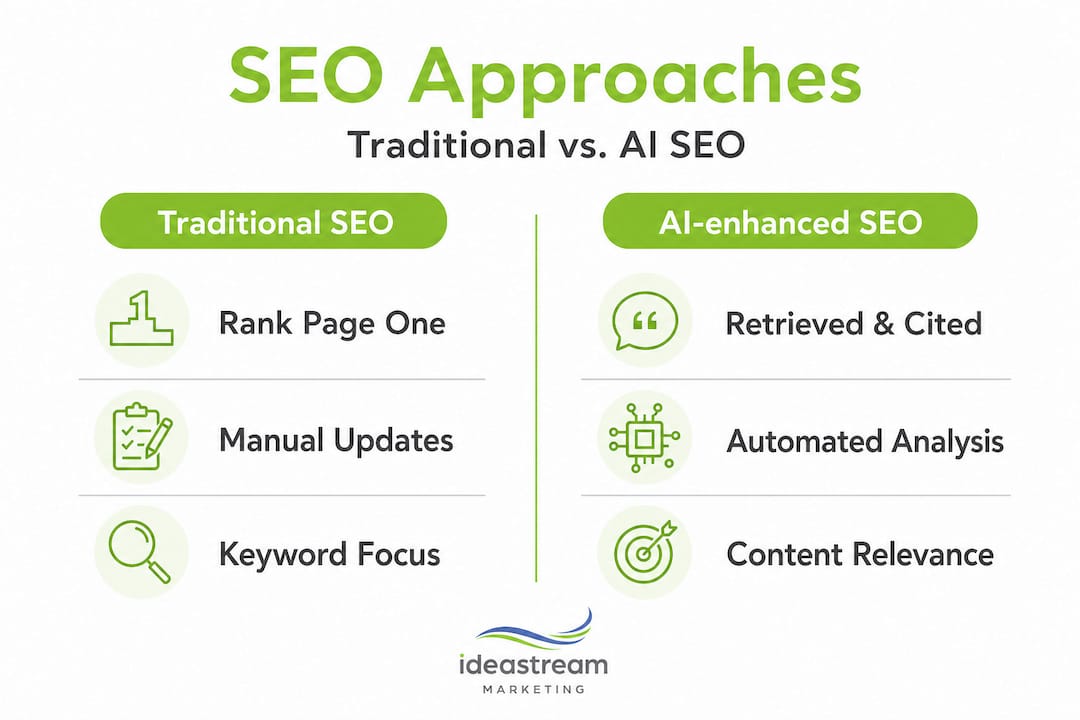
AI SEO vs. traditional SEO: Key differences for SMBs
| Factor | Traditional SEO | AI-enhanced SEO |
|---|---|---|
| Primary goal | Rank on page one | Be retrieved and cited |
| Content format | Long-form keyword targeting | Structured, answerable, citable |
| Local signals | Google Business Profile, citations | Reviews, structured data, NLP clarity |
| Performance metric | Organic traffic | Citation rate, AI referral traffic |
| Trust signals | Backlinks, domain authority | Author credibility, E-E-A-T signals |
Research from Semrush shows that AI search visitors convert at significantly higher rates than traditional organic search visitors. This is because users arriving from AI-generated answers are further along in their decision-making process. They asked a specific question, received a specific answer, and clicked through to learn more. The intent is deeper and the engagement is stronger.
For SMBs, the practical implications are clear:
- Write content that answers real questions your customers ask
- Use schema markup to help search engines understand your page structure
- Build a strong Google Business Profile with consistent NAP (name, address, phone) data
- Focus on local SEO strategies that build geographic relevance in your market
- Earn genuine reviews and testimonials to reinforce trust signals
Our AI SEO services are built around these fundamentals because shortcuts do not survive algorithm updates. Solid structure does.
Pro Tip: Run your most important service pages through Google’s Rich Results Test tool. If your schema markup is incomplete or missing, you are leaving citation opportunities on the table, especially for local searches.
With the fundamentals in mind, let’s look at how automation and lead generation tie into the equation.
Automated lead generation: How workflow drives ROI
Here is a truth that surprises a lot of business owners: generating more leads does not automatically mean generating more revenue. The quality of your follow-up workflow matters just as much as the volume of leads you collect. Often, it matters more.
Automated marketing systems produce measurable improvements in both operational efficiency and lead response time. When a lead comes in at 9pm on a Friday and your automated system sends a personalized acknowledgment within two minutes, qualifies the prospect, and schedules a follow-up call, you are not just being efficient. You are creating a first impression that competitors who respond on Monday morning simply cannot match.
A well-designed lead generation workflow includes:
- Lead capture at multiple touchpoints: contact forms, chatbots, landing pages, and phone tracking
- Immediate response automation: a triggered email or SMS that confirms receipt and sets expectations
- Lead routing: directing the lead to the right team member based on service type, geography, or urgency
- CRM integration: logging every interaction automatically so nothing falls through the cracks
- Follow-up sequences: multi-step email or SMS cadences that nurture leads who are not ready to convert immediately
- Reporting dashboards: real-time visibility into lead volume, response time, and conversion rates
“The businesses that outperform their competitors on lead conversion are not the ones with the most traffic. They are the ones with the fastest and most consistent follow-up systems.”
Speed-to-lead is one of the most underrated metrics in SMB marketing. Studies consistently show that responding within the first five minutes of a lead inquiry increases conversion probability dramatically compared to responding even one hour later. Automation solves this problem entirely. It removes the human bottleneck from the initial response stage without removing the human touch from the sales conversation itself.
Our lead generation practices are designed around this workflow-first approach. We build systems that connect your marketing channels to your sales process so that every dollar spent on advertising has a clear path to ROI.

Knowing the impact of automation, let’s dive into paid search and advertising benchmarks and what the data really reveals.
Paid search, email, and digital benchmarks: Context matters more than target
Benchmarks are useful. They give you a starting point for evaluating your campaign performance. But treating benchmarks as targets is one of the most common and costly mistakes SMBs make. Here is why: industry averages include the full range of performers, from highly optimized campaigns run by experienced agencies to accounts that have never been touched after the initial setup.
Small business marketing benchmarks commonly cited for paid search include median cost-per-lead figures and click-through rate ranges. These numbers are helpful for a sanity check but they do not tell the full story. Your industry, geography, offer quality, and landing page experience all have enormous influence on your actual results.
Key digital marketing benchmarks for SMBs in 2026
| Metric | Typical range | What moves it |
|---|---|---|
| Google Ads click-through rate | 3% to 6% | Ad copy quality, match types |
| Cost per lead (Google Ads) | $50 to $200+ | Competition, industry, landing page |
| Average cost per lead | $70.11 average | Campaign type, bid strategy |
| Email open rate | 25% to 45% | List quality, subject line, send time |
| Email click-to-open rate | 10% to 20% | Relevance, personalization, offer |
| Landing page conversion rate | 2% to 12% | Speed, copy clarity, trust signals |
A comprehensive WordStream Google Ads study revealed something that should give every business owner pause: a significant percentage of Google Ads accounts produced zero conversions in the study period. This does not mean Google Ads does not work. It means that ad spend without proper tracking, landing page optimization, and conversion configuration is money spent on hope rather than strategy.
2025 Google Ads benchmarks from WordStream place the average cost per lead at $70.11 across US-based campaigns, but that number is wildly different across industries. Legal services, financial services, and healthcare typically see much higher costs per lead due to competition. Home services and local retail often perform better when campaigns are tightly geo-targeted.
For email marketing, the most important factors are:
- List hygiene: Remove unengaged contacts regularly to protect your sender reputation
- Segmentation: Sending the same email to every contact on your list is a waste of a powerful channel
- Personalization: Even basic personalization like using the recipient’s first name improves open rates
- Timing: Tuesday through Thursday mornings consistently outperform other send times for B2B
Our SEO firm on Long Island takes a data-first approach to all paid and organic campaigns. We do not set benchmarks as targets. We set them as context and then build systems designed to exceed them.
Pro Tip: Before evaluating your paid search performance against industry benchmarks, make sure your conversion tracking is set up correctly. If you are not tracking phone calls, form fills, and chat inquiries as conversions, your data is incomplete and your optimization decisions will be wrong.
By understanding benchmarks and context, SMBs can make smarter choices and avoid costly traps.
What most guides on small business marketing miss
Most marketing guides for small businesses focus on tactics. Use this platform. Write this type of content. Run this kind of ad. What they miss is the underlying architecture that makes any tactic actually work.
We have worked with dozens of growth-focused businesses across Long Island, New York City, and the broader United States, and the pattern is consistent. Businesses that struggle with their marketing are not failing because they picked the wrong channel. They are failing because they designed their marketing around getting attention instead of earning trust and being retrievable.
AI search optimization in 2026 is best understood as an evidence and retrieval problem. Your pages need to be discovered, excerpted, and trusted. Traffic volume is secondary. A page that receives 500 visitors per month but is consistently cited by AI assistants and converts 8% of those visitors is worth far more than a page that gets 5,000 visitors and converts nobody.
The other thing guides miss is the danger of treating industry benchmarks as goals. When a business owner sees that the average cost per lead for Google Ads is $70.11 and their own cost per lead is $110, they often assume something is wrong with their campaign. But if their leads convert to clients at twice the industry rate, their $110 cost per lead might actually be generating stronger ROI than a competitor paying $50 per lead but converting far fewer.
Systems thinking is the missing ingredient. Align your marketing metrics to your sales outcomes. Ask not just “how many leads did we get?” but “how many leads became revenue, and how quickly?” That shift in framing changes everything from your channel mix to your content strategy to how you evaluate paid advertising.
Strong local SEO strategies fit into this framework naturally because local SEO is already about trust and relevance in a specific geographic community. When you build a local presence that is authoritative, consistent, and helpful, you are creating the conditions for both AI retrieval and human trust simultaneously. Those two outcomes reinforce each other.
How to take action: Expert solutions for SMB digital marketing
The strategies we covered in this article are not theoretical. They are the same frameworks we apply for our clients every day.
At Idea Stream Marketing, we build integrated digital marketing systems that connect AI SEO, lead generation, paid advertising, and content strategy into a single coherent engine. Whether you are trying to understand the difference between AI SEO and traditional SEO or you are ready to implement proven lead generation strategies that tie directly to your sales pipeline, we have the expertise to build and manage it. Our AI SEO services are designed for businesses that want to be found, cited, and trusted by both search engines and real customers. If you are ready to stop guessing and start growing, schedule a consultation with our team today.
Frequently asked questions
What is the average cost per lead for paid search in 2026?
The average cost per lead for Google Ads is $70.11 based on 2025 to 2026 benchmark data from WordStream, though this figure varies widely by industry and campaign quality.
How important is speed-to-lead for SMBs?
Speed-to-lead is critical because automation can reduce lead response time by up to 73%, and faster response rates consistently produce higher conversion rates across industries.
Do AI-driven SEO tactics need special optimization for 2026?
No. AI SEO fundamentals remain the same as traditional SEO: helpful, reliable, people-first content with clear structure and strong trust signals.
Can benchmarks be used as targets for SMBs?
Benchmarks should be used as context rather than rigid targets because industry averages reflect a wide range of campaign quality levels and do not account for your specific offer, audience, or conversion workflow.
Are AI search visitors more valuable than traditional organic visitors?
Yes. AI-driven search visits convert at 4.4 times higher rates than traditional organic search traffic, making AI search citation a high-priority outcome for any SMB content strategy.