



October 5, 2026




TL;DR:
- Most small and mid-sized businesses neglect YouTube due to the lack of a repeatable system, despite its massive potential. Creating targeted, authentic content like problem-solving videos and behind-the-scenes footage, combined with strategic organic and paid approaches, drives measurable leads and brand growth. Regularly tracking key metrics such as watch time, CTR, and completion rates ensures continuous improvement and long-term success.
YouTube reaches more than two billion logged-in users every month, yet most small and mid-sized businesses treat it like an afterthought. They upload a video or two, watch the view count stall, and quietly give up. The real problem is not the platform. It is the absence of a repeatable system. Problem-solution videos convert at 52%, and behind-the-scenes content lifts brand perception by 43%, which means the opportunity is real for professional services, healthcare practices, and hospitality businesses. This guide walks you through preparation, execution, tracking, and scaling so every video you publish does meaningful work for your business.
Table of Contents
- Assessing readiness and setting realistic YouTube goals
- Choosing high-conversion YouTube content formats
- Executing your YouTube marketing plan: organic vs. paid approaches
- Tracking success and scaling with data-driven insights
- Why most YouTube marketing advice fails SMBs and what actually delivers growth
- Ready for next-level results? Amplify your YouTube growth with expert support
- Frequently asked questions
Key Takeaways
| Point | Details |
|---|---|
| Content choice matters | Problem-solution and behind-the-scenes videos drive more leads than generic promotion. |
| Hybrid strategy wins | Mix organic trust-building with targeted paid ads for rapid growth and enduring results. |
| Track what converts | CTR, watch time, and conversions are better success signals than total views. |
| Start small, scale smart | Low budgets and authentic video can deliver strong results—optimize and ramp up with measured data. |
Assessing readiness and setting realistic YouTube goals
Once you see the opportunity, the first step is to prepare. Making sure your business is ready for sustained YouTube marketing before you hit record saves a lot of wasted effort later.
Start by clarifying what success actually looks like for your business. Brand awareness, lead generation, and direct sales all require different content approaches and different measurement frameworks. A law firm trying to attract new clients has very different needs than a restaurant building loyalty among regulars. Write down your primary goal, pick one, and build everything around it.
Next, take stock of what you already have:
- Camera equipment: A modern smartphone shoots 4K video, which is more than adequate to start.
- Microphone: A $40 clip-on lavalier microphone is one of the highest-ROI purchases any SMB can make.
- Lighting: A simple ring light or positioning near a window solves most problems.
- Team capacity: Who will appear on camera? Who will edit? Who will write scripts?
- Publishing cadence: Can you realistically commit to one or two videos per week?
Skill gaps are normal. The key is identifying them early so you can close them before launch, not after you have burned three months on inconsistent output.
The right metrics matter enormously. Most business owners obsess over view counts, but views do not pay the bills. The metrics that actually reveal whether your channel is working are watch time, click-through rate (CTR), and video completion rate. Achieving 85%+ completion rates from your target audience signals quality to YouTube’s algorithm and accelerates organic reach. You can track all of this for free inside YouTube Studio.
| Metric | What it tells you | SMB target |
|---|---|---|
| Watch time (minutes) | Overall content engagement | Increase month over month |
| CTR | How compelling your thumbnail and title are | 3% to 7% |
| Completion rate | Whether viewers are staying through your message | 85%+ from target audience |
| Subscriber conversion | How many viewers become followers | 1% to 3% of unique viewers |
Pro Tip: Before your first upload, set up a simple spreadsheet with these four metrics. Review it every two weeks. Patterns emerge faster than you expect, and you will have real data to guide every decision going forward.
Thinking through lead generation strategies that complement your video content from the very beginning will make your YouTube channel far more effective as a business tool. Understanding video marketing ROI early also helps you make the case internally for ongoing investment.
Choosing high-conversion YouTube content formats
With goals and assets ready, it is time to design content that actually drives results. Different formats deliver vastly different outcomes, and choosing wrong wastes time you simply do not have.
The data is clear about which content types perform for SMBs in services, healthcare, and hospitality. Problem-solution videos, expert guides, behind-the-scenes content, and service demonstrations consistently outperform generic promotional videos. The reason is simple: viewers come to YouTube to solve problems, not to watch ads.
Here is how the major content formats compare:
| Content format | Avg. conversion rate | Best for | Difficulty to produce |
|---|---|---|---|
| Problem-solution videos | 52% | Lead generation, consultations | Medium |
| Behind-the-scenes content | 43% brand perception lift | Trust building, hospitality | Low |
| Expert guide/tutorial | 38% | Authority building, healthcare | Medium |
| Product/service demos | 32% | Sales enablement, closing | Medium |
| YouTube Shorts (under 60s) | Variable, high reach | Awareness, local discovery | Low |
A few things stand out in that table. Behind-the-scenes content is low difficulty to produce and delivers a 43% improvement in brand perception. For a restaurant showing prep kitchen activity, a healthcare clinic introducing staff, or a law firm showing a day in the office, a smartphone and five minutes of shooting can produce genuinely compelling content.
YouTube Shorts deserve special attention for local SMBs. Short-form content surfaces in YouTube’s Shorts feed and increasingly in Google search results, giving smaller accounts reach that would otherwise take months to build organically. A physical therapy clinic answering one common patient question in under 60 seconds can outperform a polished 10-minute video with a fraction of the effort.
- Match format to your primary goal: problem-solution for leads, behind-the-scenes for trust, demos for sales.
- Batch-record content to keep production efficient. Shoot four videos in one session rather than one per week.
- Use chapters (timestamps) in longer videos. They improve watch time and help YouTube understand your content.
- Include a clear call-to-action in every video. Tell viewers exactly what to do next.
Pro Tip: Shoot one Shorts version of every longer video. Pull out the single most useful moment, add a text overlay with the key takeaway, and publish it as a companion piece. This doubles your content output from each production session.
Exploring effective video marketing strategies can help you map formats to specific business outcomes. If you want a deeper view of how video content marketing fits into a broader digital strategy, it is worth reading before you finalize your content calendar.
Executing your YouTube marketing plan: organic vs. paid approaches
After you have chosen your formats, execution comes down to following a proven process and picking the right mix of organic, paid, or both. Most SMBs need both, but understanding each approach separately keeps you from blurring the lines.
Organic YouTube: the foundation
Organic content builds credibility and creates evergreen assets that drive traffic for months after publishing. The tradeoff is time. Most channels take three to six months to gain meaningful traction without paid support. The algorithm favors consistency, so publishing on a reliable schedule matters more than publishing perfect videos occasionally.

Paid YouTube ads: the accelerator
Skippable in-stream ads work on a CPV model, meaning you pay only when a viewer watches at least 30 seconds or clicks your ad. A starting budget of $10 to $15 per day is a realistic entry point. Average cost-per-view runs $0.03 to $0.30, with $0.10 being typical across most SMB niches. The hook in seconds zero through five is everything. If you do not capture attention before the skip button activates, the impression is wasted.
A simple structure that works for SMB ads: problem, solution, proof, CTA. Open with the viewer’s pain point, show your solution, offer one piece of social proof (a quick testimonial or result), then tell them exactly what to do next.
Industry benchmarks for SMB YouTube ads:
| Metric | SMB benchmark range |
|---|---|
| Cost per view (CPV) | $0.02 to $0.07 |
| Cost per thousand impressions (CPM) | $3.50 to $7.00 |
| Click-through rate (CTR) | 0.5% to 0.85% |
| Cost per click (CPC) | $0.80 to $2.50 |
| Median return on ad spend (ROAS) | 3.3:1 |
These SMB YouTube ad benchmarks give you a realistic expectation before you spend a dollar. If your CTR is below 0.5%, your thumbnail or opening hook needs work. If your CPV is above $0.30, your targeting may be too broad.
The hybrid approach wins every time. Organic content builds loyalty and evergreen traffic, while paid ads provide speed and scale. Running both in parallel means your paid campaigns drive immediate leads while your organic library compounds in value over time.
Here is a step-by-step launch sequence that works for most SMBs:
- Publish three to five foundational videos organically to build social proof.
- Identify the best-performing video by watch time and completion rate.
- Run that video as a paid in-stream ad to your target audience segment.
- Use remarketing to retarget viewers who watched 50% or more but did not convert.
- Test one Shorts ad alongside the in-stream ad for awareness at lower CPM.
- Review results weekly and reallocate budget to the best-performing ad set.
Pro Tip: Use remarketing as early as possible. Viewers who watched at least half of your video are already warm leads. Serving them a more direct conversion-focused ad costs significantly less per action than cold targeting.
Our guide to paid YouTube advertising strategies walks through campaign setup in more detail if you want to go deeper on the paid side.
Tracking success and scaling with data-driven insights
Now that your strategies are in motion, you need to know what data to track and how to act on what you learn. Most SMBs skip this step and wonder why their results plateau.
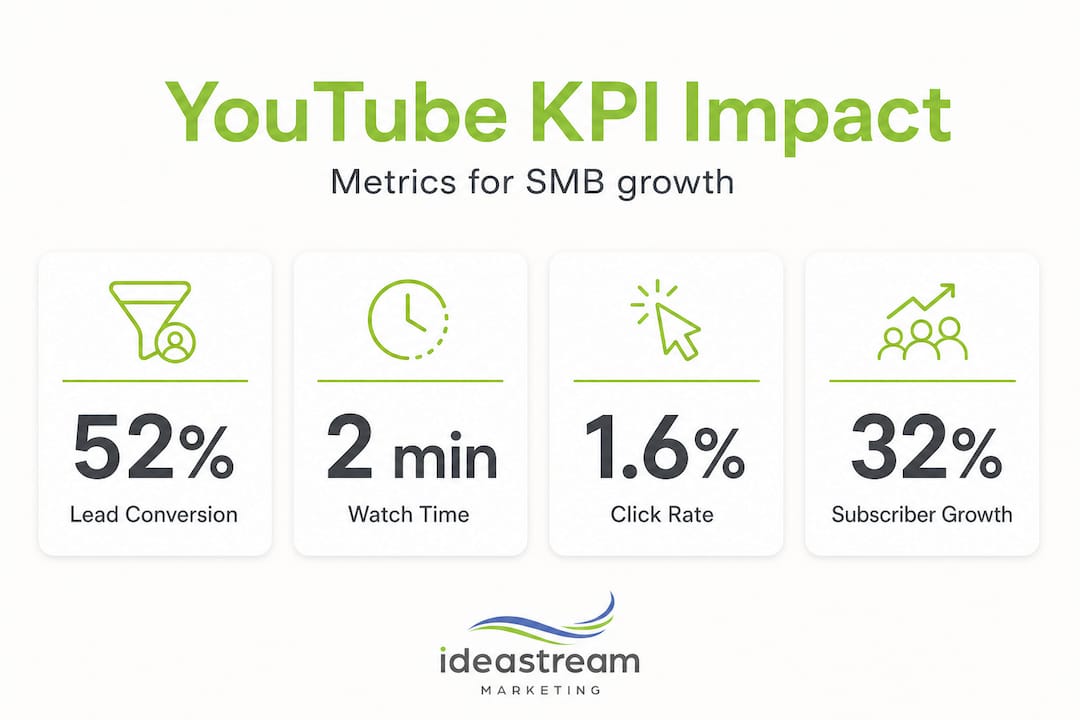
Watch time, CTR, completion rate, and subscriber conversion are the four metrics that drive algorithm performance and business outcomes simultaneously. Raw view counts feel satisfying but reveal almost nothing about whether your marketing is actually working.
| Signal | What to do if it is low |
|---|---|
| Low CTR (under 2%) | A/B test thumbnail and title variations |
| Low completion rate (under 50%) | Tighten the opening 30 seconds; cut filler |
| High views, few subscribers | Add a direct subscription CTA inside the video |
| High watch time, low leads | Strengthen your end-screen and video CTA |
A/B testing does not require a big budget. Publish two Shorts on the same topic with different hooks, then compare completion rates after 72 hours. The winner tells you what your audience responds to, and you apply that insight to your longer content.
“In one documented campaign, a spend of just $12.69 yielded 456 subscribers and 2,024 views in three days, exceeding the campaign’s original stretch goal.”
That example illustrates a principle we see consistently with SMB clients: small, well-targeted budgets regularly outperform larger, unfocused spending. The key is having the data infrastructure in place to recognize what is working quickly.
Common reasons campaigns underperform and their fixes:
- Broad targeting: Narrow your audience by location, interest, and keyword intent.
- Weak hook: Your first five seconds must address the viewer’s specific pain point.
- No remarketing layer: A single-touch campaign misses most of your warm audience.
- Inconsistent publishing: Gaps in your schedule train the algorithm to deprioritize your channel.
Pro Tip: Use YouTube’s “audience retention” graph in YouTube Studio for every video. The points where viewers drop off are telling you exactly where your content loses its value. Fix those moments and your watch time and lead quality will both improve.
You can find more detail on building and sustaining channel momentum in our social media growth tips that tie directly to YouTube channel strategy.
Why most YouTube marketing advice fails SMBs and what actually delivers growth
Here is where most guides lose the thread. They optimize for viral moments and big subscriber counts, which are the goals of creators, not business owners. If you are running a healthcare practice, a professional services firm, or a hospitality business, you need qualified leads and loyal clients, not a million anonymous views.
The conventional advice says production quality is everything. We disagree. Authentic smartphone videos consistently outperform polished productions for local SMBs, particularly in service businesses where personal trust drives purchasing decisions. A doctor answering a real patient question on a phone camera feels more credible than a scripted corporate video. That authenticity is a competitive advantage, not a liability.
“Done is better than perfect” is not just a cliché here. It is a survival strategy for small teams. The businesses we see consistently winning on YouTube are publishing regularly with intention, not waiting until everything is camera-ready. Structure matters far more than polish. A video with a clear hook, a direct answer, and a specific call-to-action will outperform a beautifully edited video with no clear purpose almost every time.
The other trap is chasing vanity metrics. If your 10,000 views do not correlate with any new inquiries, something is misaligned. Subscriber growth and lead conversions are the two numbers that map directly to business outcomes. Everything else is context.
Finally, data feedback loops keep your channel growing past launch week. The businesses that sustain YouTube results are the ones that review their analytics consistently, apply what they learn, and iterate without drama. Fads and algorithm panics derail that process. Steady attention to your core metrics does not. Explore engaging video strategies that focus on audience retention for a practical framework you can apply immediately.
Ready for next-level results? Amplify your YouTube growth with expert support
You now have a clear path from readiness assessment through execution, tracking, and iterative growth. Building a YouTube presence that genuinely drives leads takes time, consistency, and the right mix of organic content and paid amplification.
At Idea Stream Marketing, we help SMBs in professional services, healthcare, and hospitality build video strategies that connect with real audiences and generate measurable results. Our in-house media studio handles video marketing production and campaign management so you do not have to figure it out alone. We combine that with social media marketing and AI SEO services to amplify your reach across every relevant channel. Schedule a consultation and let us map out a YouTube strategy tailored to your business goals.
Frequently asked questions
How much should a small business budget for YouTube ads to see results?
Many SMBs see real engagement starting at $10 to $15 per day, with typical cost-per-view running $0.03 to $0.30 depending on niche and targeting. Starting small and scaling based on performance data is the most efficient approach.
What are the most effective YouTube content types for SMB lead generation?
Problem-solution videos convert at 52%, making them the strongest format for lead generation, while expert guides, behind-the-scenes content, and service demonstrations also deliver consistently high results for professional services, healthcare, and hospitality businesses.
Is organic or paid YouTube marketing more effective for small businesses?
Combining organic and paid approaches delivers the best results for SMBs, using organic content to build lasting credibility and paid campaigns to generate leads quickly. Neither approach works as well in isolation as the two do together.
What YouTube metrics actually matter for driving SMB growth?
Prioritize watch time, CTR, and completion rates alongside subscriber and lead conversion rather than raw view counts. Hitting an 85% or higher completion rate from your target audience actively signals quality to YouTube’s algorithm and accelerates organic distribution.