



October 21, 2026




TL;DR:
- Most law firms neglect strategic marketing, wasting money on superficial advertising instead of building measurable client acquisition systems.
- Effective legal marketing requires clear goals, targeted channels, and ongoing performance tracking aligned with specific business outcomes.
Most law firms treat marketing as an afterthought, spending money on flashy billboard ads or generic directory listings while wondering why the phone stays quiet. The truth is that effective law firm marketing is not about visibility for its own sake. It is about building a documented, measurable system that consistently delivers qualified clients to your door. This guide covers the exact framework decision-makers at law firms need: from setting SMART goals and choosing the right digital marketing strategies to navigating ethical compliance and tracking what actually drives client acquisition.
Table of Contents
- Understanding law firm marketing fundamentals
- Setting measurable law firm marketing goals
- Choosing high-ROI digital marketing channels for law firms
- Navigating ethical and legal compliance in law firm digital marketing
- Implementing and measuring your law firm marketing plan
- Why compliance-focused marketing is your law firm’s competitive advantage
- Partner with Idea Stream Marketing for law firm digital growth
- Frequently asked questions
Key Takeaways
| Point | Details |
|---|---|
| Strategic marketing plan | A documented plan with SMART goals and targeted channels increases law firm client acquisition significantly. |
| SEO and PPC focus | SEO drives sustainable visibility while PPC delivers quick leads, together offering the highest marketing ROI. |
| Compliance matters | Following ethical advertising and review solicitation rules protects your firm and builds genuine client trust. |
| Measure and optimize | Tracking key performance metrics like cost-per-lead and conversion rates enables continual marketing improvement. |
| Partner for growth | Engaging experienced marketing agencies tailored to law firms maximizes digital marketing effectiveness. |
Understanding law firm marketing fundamentals
A law firm marketing plan is not a collection of ads and social posts. It is a documented strategy that identifies who you are trying to reach, what services you are promoting, which channels you will use, and how you will measure results. Without that structure, marketing spend becomes guesswork.
A strong attorney marketing plan includes five core components that work together:
- Practice area targeting: Defining which legal services you are actively marketing, rather than trying to promote everything at once
- Client persona development: Building detailed profiles of your ideal clients, including their demographics, legal problems, how they search for attorneys, and what motivates them to retain one
- Digital channel strategy: Selecting the platforms and tactics best suited to reach your client personas
- Budget allocation: Distributing spend across channels based on expected return and competitive landscape
- Performance metrics (KPIs): Setting measurable benchmarks so you know what is working and what needs to change
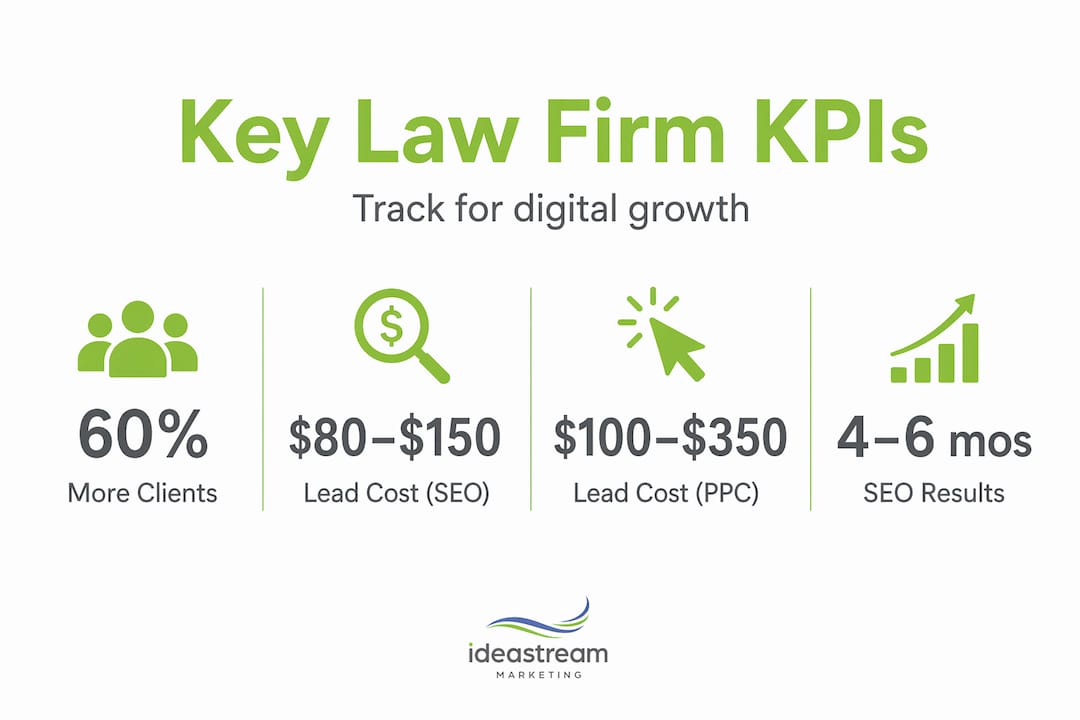
Firms that align their marketing plans with specific business goals see client acquisition improve by as much as 60%. That kind of result does not come from running more ads. It comes from focusing resources on the right clients through the right channels.
SMART goals provide the framework that ties these components together. Specific, Measurable, Achievable, Relevant, and Time-bound objectives replace vague intentions like “get more clients” with targets like “increase personal injury consultation requests by 30% within 90 days through Google Ads.” That clarity changes how you build campaigns and evaluate results. Understanding digital marketing growth for professional services firms starts with this kind of deliberate planning.
Setting measurable law firm marketing goals
Vague goals produce vague results. Effective law firm marketing plans operate on SMART goals that give every tactic a clear purpose and every budget dollar an expected outcome.
Here is what SMART goal-setting looks like in practice for a law firm:
- Specific: “Rank in the top three Google results for ‘divorce attorney [city]’ within six months”
- Measurable: “Reduce cost-per-lead from $180 to $120 by Q3”
- Achievable: “Generate 25 qualified consultation requests per month from organic search”
- Relevant: “Increase estate planning inquiries by 20% to align with our new senior outreach program”
- Time-bound: “Achieve a 15% improvement in consultation-to-retainer conversion within 60 days of implementing the new intake process”
Three KPIs deserve your closest attention. Cost-per-lead, consultation-to-retainer conversion rate, and organic traffic growth are the most direct indicators of whether your marketing is producing real business value. Cost-per-lead tells you channel efficiency. Conversion rate tells you whether your intake process is working. Organic traffic growth tells you how your smart digital marketing investment is compounding over time.
The mistake most firms make is checking these numbers once a quarter when something feels off. Monthly reviews catch problems early and surface wins that can be scaled.
Pro Tip: Block one hour each month to review your top three KPIs side by side. Compare them to the previous month and to your SMART goal benchmarks. If a channel is consistently underperforming after 90 days, reallocate that budget rather than waiting for a turnaround that may not come.
Building lead generation strategies around measurable goals is what separates law firms that grow intentionally from those that simply spend on marketing and hope for the best.
Choosing high-ROI digital marketing channels for law firms
Not every marketing channel delivers equal results for every law firm. Practice area, geography, and competition level all influence which channels deserve budget priority.
SEO and PPC consistently deliver the highest ROI for attorneys, but they work differently. SEO improves organic search rankings for long-term client acquisition, while pay-per-click campaigns drive faster lead generation in competitive practice areas where you cannot wait months to build authority.

Here is how the main channels compare for law firms:
| Channel | Time to ROI | Typical cost | Best use case |
|---|---|---|---|
| SEO | 4 to 6 months | Medium (ongoing) | Long-term authority, organic lead flow |
| PPC (Google Ads) | 60 to 90 days | High per click | Fast lead generation, competitive terms |
| Social media ads | 30 to 60 days | Variable | Brand awareness, remarketing |
| Content marketing | 3 to 9 months | Low to medium | Authority building, SEO support |
Beyond the paid channels, three platforms deserve consistent attention:
- Google Business Profile: For any firm serving a local market, a complete and actively managed Google Business Profile drives significant phone call and direction requests. Reviews, posts, and category accuracy all affect how often you appear in local search results.
- Content marketing: Practice area blog posts, FAQ pages, and legal guides establish authority and capture clients who are researching their situations before calling anyone. Firms publishing two or more practice area blog posts monthly generate 67% more leads than those who publish infrequently.
- Referral networks: Attorney-to-attorney referrals and professional network relationships remain among the highest-quality lead sources in legal, with trust built in before the first call.
Social media marketing works best for law firms when it focuses on education and trust-building rather than direct selling. Platforms like LinkedIn support B2B referral relationships for commercial or employment law practices, while Facebook can reach family law or estate planning audiences effectively through targeted ads.
Pro Tip: Match your channel mix to your practice area geography. A personal injury firm in a major metro will benefit most from aggressive PPC on high-intent keywords. An estate planning firm in a suburban market may see better ROI from local SEO and educational content.
Navigating ethical and legal compliance in law firm digital marketing
Law firm advertising is not like marketing for a restaurant or a retailer. Attorneys operate under ethics rules that govern what they can say, how they can say it, and who they can contact.
ABA Model Rules 7.1 through 7.5 govern attorney advertising across most U.S. jurisdictions. The core requirements are that advertising must not be false or misleading, that in-person solicitation of prospective clients is restricted, and that responsible disclosures are required in certain contexts. Each state bar may layer additional rules on top of these, so always confirm your state-specific obligations.
Online reviews are a separate compliance frontier. Google’s policies and FTC rules prohibit manipulating reviews through gating practices, pressured requests, or incentivizing positive sentiment. Review gating means filtering clients before asking for reviews based on whether they seem satisfied, which violates both Google’s terms and the FTC’s guidelines.
The FTC’s Rule on Consumer Reviews and Testimonials bans deceptive review practices and restricts conditioned incentives. This means you cannot offer a gift card, discount, or any benefit in exchange for a positive review.
Here is what compliant review solicitation looks like:
- Ask every client equally, not only those you believe are satisfied
- Use neutral, open-ended language: “We would appreciate your honest feedback about your experience with our firm”
- Never tie any incentive to the review’s content or sentiment
- Avoid asking for reviews during emotionally charged moments, such as immediately after a difficult hearing
- Send follow-up requests via email or text rather than in-person pressure
The firms that take compliance seriously are not sacrificing their marketing effectiveness. They are building a foundation of trust that no competitor shortcut can replicate.
The digital marketing compliance question is not just legal risk management. It is a reflection of how your firm treats clients, and clients notice.
Implementing and measuring your law firm marketing plan
Strategy only produces results when it is executed consistently and measured honestly. Here is the implementation sequence that works:
- Define your SMART goals for each active marketing channel before spending a dollar
- Launch campaigns starting with the highest-intent channel for your practice area (usually PPC or local SEO)
- Set up analytics in Google Analytics 4 and Google Search Console to track traffic sources and conversion events
- Establish your KPI dashboard with monthly check-in dates on the calendar from day one
- Conduct monthly performance reviews comparing actual results to goal benchmarks
- Adjust tactics based on what the data shows, reallocating budget toward channels exceeding targets
Here is a practical benchmarks table to measure performance by channel:
| Metric | SEO target | PPC target | Content marketing target |
|---|---|---|---|
| Cost per lead | $80 to $150 | $100 to $250 | $40 to $100 |
| Conversion rate (lead to consult) | 15 to 25% | 20 to 35% | 10 to 20% |
| Monthly traffic growth | 5 to 15% | N/A | 8 to 20% |
| Time to measurable results | 4 to 6 months | 60 to 90 days | 3 to 9 months |
Attorneys see measurable lead increases within 60 to 90 days for PPC campaigns and 4 to 6 months for SEO-driven strategies. Plan your budget accordingly so you are not abandoning SEO before it has had time to perform.
You also need to track monthly KPIs including organic search rankings, lead volume by channel, and cost per acquired client to know what to scale and what to cut.
Pro Tip: Legal CRM tools like Clio or Lawmatics allow you to tag leads by source and track them through the entire intake process to retainer signing. That attribution data tells you exactly which campaigns are generating revenue, not just clicks.
Your marketing optimization process should treat each monthly review as a business decision, not a reporting exercise.
Why compliance-focused marketing is your law firm’s competitive advantage
Here is something most marketing advice skips entirely: the firms that treat ethics rules as a constraint are losing ground to the ones that treat them as a brand differentiator.
Think about it from a prospective client’s perspective. When someone needs an attorney, the stakes are high and trust is everything. A law firm with 80 authentic, detailed Google reviews built over two years signals something fundamentally different than one with 200 reviews that appeared in six months. Clients are more sophisticated than marketers give them credit for.
Ethics and platform policies meaningfully shape digital marketing execution for law firms, requiring neutral and sincere review requests that maintain trust and avoid penalties. Firms that follow these rules build a review profile that actually converts visitors into consultations, because authenticity is visible in the specificity and variety of the feedback.
The risk calculation also matters. A bar complaint, a Google review suspension, or an FTC enforcement action does not just cost money. It removes your marketing assets at the moment they are most needed, and it signals to prospective clients that your firm’s judgment cannot be trusted.
We believe that ethical legal marketing built on genuine client experience is the most durable competitive position a law firm can hold. It compounds over time. Authentic reviews attract more authentic reviews. Honest content builds real search authority. Referral relationships grow because peers trust your reputation.
The firms winning on digital in 2026 are not the ones gaming the system. They are the ones who built trust at every touchpoint and let that trust do the marketing.
That is a harder path in the short term. But it is the only one that survives algorithm changes, platform policy updates, and the growing sophistication of legal consumers.
Partner with Idea Stream Marketing for law firm digital growth
Ready to elevate your law firm marketing? Partnering with the right agency makes all the difference. At Idea Stream Marketing, we work with law firms to build data-driven marketing systems that produce measurable results without cutting corners on compliance or integrity.

Our team specializes in law firm SEO services that build lasting organic authority, PPC advertising services that generate qualified leads fast, and social media marketing services that build trust with your local audience. Every campaign we build is tied to KPIs that map directly to signed clients, not vanity metrics. We track what matters and adjust continuously to keep your marketing performing. Contact us to schedule a free consultation and find out exactly where your firm’s digital presence can improve.
Frequently asked questions
What marketing channels provide the best ROI for law firms?
SEO and PPC consistently deliver the highest ROI for attorneys by driving organic visibility and immediate leads, especially in competitive practice areas.
Are law firms allowed to ask clients for online reviews?
Yes. Asking satisfied clients for honest reviews is permitted under bar rules across U.S. jurisdictions, provided solicitation is neutral, not pressured, and not conditioned on a positive rating.
What metrics should law firms track to measure marketing success?
Law firms should monitor cost-per-lead, consultation-to-retainer conversion, and organic traffic growth along with ROI by channel to evaluate which efforts are driving real revenue.
What are the FTC rules about incentivizing client reviews?
The FTC’s Rule bans incentives conditioned on review sentiment and all deceptive review practices; incentives are only permissible when they are not tied to the content or positivity of the feedback.

