



October 16, 2026




TL;DR:
- Growth marketing is a data-driven, experiment-led approach that optimizes the entire customer lifecycle for sustainable revenue growth. It emphasizes continuous testing, cross-functional collaboration, and measuring customer lifetime value rather than just short-term conversions. This discipline produces long-term results through systematic processes, not quick growth hacks.
Growth marketing is defined as a data-driven, experiment-led approach to growing a business across the full customer lifecycle, from first click to long-term retention. Unlike traditional marketing, it treats every stage of the funnel as an opportunity to test, learn, and improve. Companies like HubSpot and Slack have built their growth engines on this discipline, using tools like Salesforce and Benchmark Email to run continuous experiments across acquisition, activation, and retention. If you are a marketing professional or business owner looking to move beyond one-off campaigns and build repeatable revenue growth, this guide covers exactly what growth marketing involves and how to put it into practice.
What is growth marketing and how does it differ from other approaches?

Growth marketing is a systematic discipline that aligns product, engineering, and marketing teams to build the product into the primary growth engine. That definition separates it immediately from traditional marketing, which focuses almost entirely on top-of-funnel awareness through campaigns like TV spots, print ads, or brand awareness pushes. Traditional marketing measures success by reach and impressions. Growth marketing measures success by revenue impact across the entire funnel.
Performance marketing is closer to growth marketing but still distinct. Performance marketing optimizes for measurable actions like clicks, leads, and cost per acquisition. It is precise and accountable, but it stops short of measuring what happens after the lead converts. Growth marketing requires measuring full ROI, including customer lifetime value and retention rates, not just cost per click.
Growth hacking sits at the other end of the spectrum. It describes short-term, often scrappy tactics designed to spike user acquisition fast. Think Dropbox’s referral program or Airbnb’s Craigslist integration. Growth hacking produces results, but it is not a system. Growth marketing is the mature, process-driven version of that same instinct.
| Approach | Focus | Time Horizon | Key Metric |
|---|---|---|---|
| Traditional marketing | Brand awareness, top-of-funnel | Long-term campaigns | Reach, impressions |
| Performance marketing | Clicks, leads, conversions | Short to mid-term | Cost per acquisition |
| Growth hacking | Rapid user acquisition tactics | Short-term | User growth spikes |
| Growth marketing | Full customer lifecycle | Continuous | LTV, retention, revenue |
What are the core principles behind effective growth marketing?
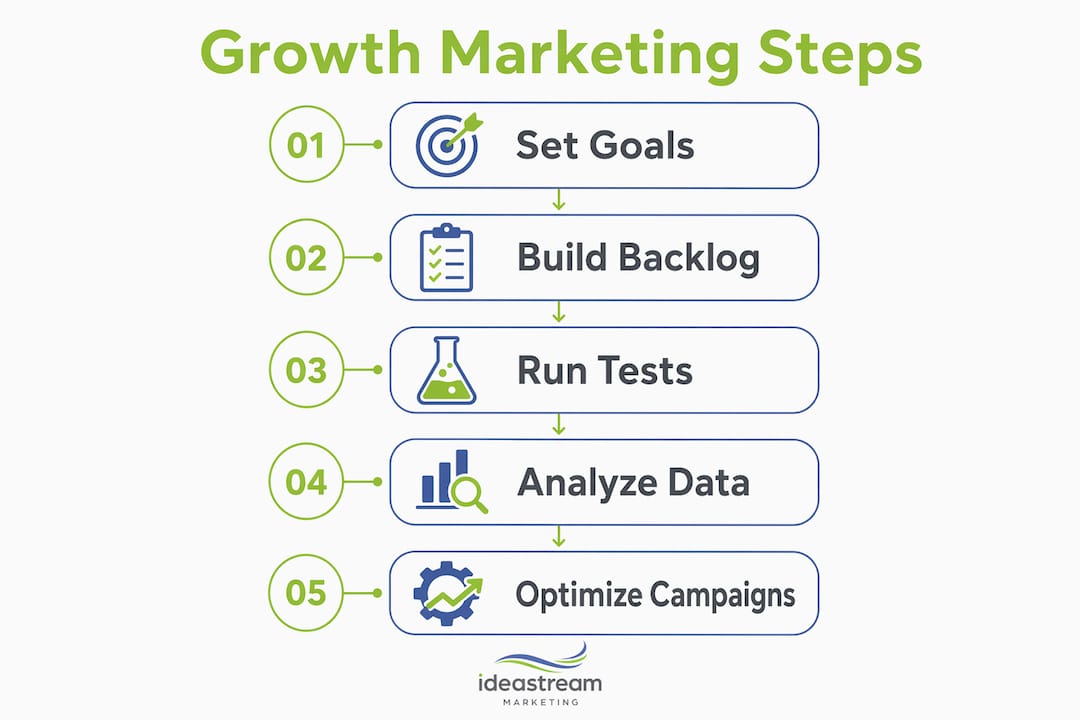
The foundation of growth marketing is what practitioners call scientific marketing. The process mirrors the scientific method: form a hypothesis, run a test, analyze the results, and iterate. This replaces gut-feel campaign decisions with a repeatable system that produces predictable outcomes over time.
The most widely used framework for prioritizing experiments is ICE, which stands for Impact, Confidence, and Ease. The ICE framework scores each growth idea objectively across those three dimensions, preventing personal bias from driving the testing roadmap. A high-impact idea that is easy to execute and backed by existing data scores highest and gets tested first.
Growth marketing also organizes the customer journey using the AARRR framework, sometimes called the Pirate Metrics model. AARRR stands for Acquisition, Activation, Retention, Referral, and Revenue. Each stage represents a lever you can pull and measure independently. Most businesses over-invest in Acquisition and ignore Retention, which is where long-term revenue actually lives.
The shift from “big bet” campaigns to continuous, data-driven testing is the cultural change that makes growth marketing work. Big bets are expensive and slow. Continuous testing is cheap, fast, and compounds over time. A team running 20 small experiments per quarter will outlearn a team running two large campaigns per year.
Pro Tip: Start your ICE scoring with a shared spreadsheet. List every growth idea your team has, score each one from 1–10 on Impact, Confidence, and Ease, then average the scores. Run the top three ideas first. This alone eliminates most of the internal debate about what to prioritize.
How to implement growth marketing strategies in your organization
Implementation starts with setting specific, measurable goals tied to a defined time window. Professionals aiming for measurable growth set goals like improving MQL-to-customer conversion by 15% in 90 days. That kind of specificity forces you to identify the exact lever you are pulling and the exact metric you are moving.
Building the right team structure is the next step. Growth marketing requires cross-functional collaboration between marketing, product, and engineering. A growth team without product input cannot change the user experience. A growth team without engineering cannot ship experiments fast enough to matter. The team structure should reflect the full funnel, not just the marketing department.
Here are the core steps to get growth marketing running in your organization:
- Define your North Star metric. Choose one metric that best represents the value your product delivers to customers. Everything else is a supporting metric.
- Audit your current funnel. Map where customers drop off between Acquisition and Revenue. The biggest drop-off point is your first experiment target.
- Build an experiment backlog. Collect every growth idea from across your team. Score them with ICE and maintain a living backlog.
- Run weekly experiment reviews. Review results every week, not every quarter. Speed of learning is a competitive advantage.
- Integrate your data sources. Connect your CRM, analytics platform, and email tools so you can track the full customer journey in one place.
The most common pitfall is treating growth marketing as a campaign rather than a system. Teams run a few experiments, see mixed results, and revert to traditional campaign thinking. Growth marketing compounds over time. The first 90 days rarely produce dramatic results. The second and third 90-day cycles do.
Pro Tip: Use digital marketing channels like SEO, paid ads, email, and social media as experiment inputs, not as standalone strategies. Each channel is a variable you can test within your growth system, not a silo to manage separately.
What are real-world examples and benefits of growth marketing?
HubSpot built its growth engine on content marketing combined with a free CRM product. The free product created a massive acquisition channel. The content created organic traffic that converted into free users. The free users converted into paid customers over time. That full-funnel thinking is growth marketing in practice.
Slack grew from zero to a billion-dollar valuation in four years by obsessing over activation. The team identified that teams who sent 2,000 messages were highly likely to convert to paid plans. Every experiment focused on getting new teams to that threshold faster. That is a textbook example of optimizing the full customer lifecycle rather than just acquiring new users.
The measurable benefits of applying growth marketing include:
- Higher customer lifetime value. By optimizing retention and referral stages, you increase the revenue each customer generates over their relationship with your business.
- Lower acquisition costs over time. Referral loops and organic channels built through experimentation reduce dependence on paid acquisition.
- Better alignment between marketing spend and revenue. Growth marketing connects every dollar spent to a measurable outcome further down the funnel.
- Faster organizational learning. A team running continuous experiments builds institutional knowledge that compounds quarter over quarter.
The role of AI-driven marketing strategies in growth marketing is growing fast. AI tools now accelerate experiment design, audience segmentation, and result analysis, cutting the time between hypothesis and insight. For business owners without large marketing teams, AI-powered tools make growth marketing accessible at a fraction of the traditional cost.
Growth marketing also aligns marketing spend with long-term revenue goals in a way that traditional campaigns cannot. When you measure scalable growth in digital marketing by lifetime value rather than cost per lead, you make fundamentally different decisions about where to invest.
Key takeaways
Growth marketing is the most accountable form of marketing because it connects every experiment directly to revenue outcomes across the full customer lifecycle.
| Point | Details |
|---|---|
| Full-funnel focus | Growth marketing optimizes Acquisition, Activation, Retention, Referral, and Revenue, not just top-of-funnel awareness. |
| Scientific process | Every growth initiative follows a hypothesis, test, analyze, and iterate cycle to produce predictable results. |
| ICE framework | Score growth ideas by Impact, Confidence, and Ease to prioritize objectively and eliminate bias. |
| Measure lifetime value | Track customer lifetime value and retention rates, not just cost per click or cost per lead. |
| Cross-functional teams | Sustainable growth requires product, engineering, and marketing working from a shared experiment backlog. |
Growth marketing is not a shortcut. It is a system.
The biggest misconception I see from business owners is that growth marketing is just growth hacking with a better name. It is not. Growth hacking is a mindset. Growth marketing is a discipline. One produces spikes. The other produces compounding curves.
The second misconception is that you need a large team to do it. You do not. You need a clear North Star metric, a structured experiment process, and the discipline to review results weekly. I have seen solo marketers outperform entire departments simply because they ran more experiments and learned faster.
What I find most underappreciated is the organizational alignment piece. The cross-functional alignment between product, engineering, and marketing is not a nice-to-have. It is the mechanism that makes growth marketing work. Without it, you are just running campaigns and calling them experiments.
The future of growth marketing belongs to teams that treat data as infrastructure, not as a reporting tool. The companies winning right now are not the ones with the biggest budgets. They are the ones with the fastest learning loops and the most disciplined experiment processes.
— Dean
How Idea Stream Marketing helps you build a growth marketing system
Growth marketing works best when your digital foundation is built to support experimentation and measurement. Idea Stream Marketing helps businesses across Long Island and the United States build exactly that.
Our AI SEO services are designed to drive organic acquisition that compounds over time, feeding your growth funnel with high-intent traffic. We also manage paid advertising, social media campaigns, and content strategies that function as testable growth levers, not isolated tactics. Every service we deliver is built around measurable outcomes tied to your revenue goals. Schedule a consultation with our team to discuss a growth marketing approach built around your business.
FAQ
What is growth marketing in simple terms?
Growth marketing is a data-driven approach to growing a business by running continuous experiments across the full customer funnel, from acquisition through retention. It replaces one-off campaigns with a repeatable system of testing and improvement.
How does growth marketing differ from performance marketing?
Performance marketing focuses on measurable actions like clicks and leads. Growth marketing goes further by measuring customer lifetime value and retention, connecting every tactic to long-term revenue outcomes.
What does growth marketing involve day to day?
Growth marketing involves setting measurable goals, building an experiment backlog, running weekly tests across channels like SEO, email, and paid ads, and reviewing results to inform the next round of experiments.
What are the benefits of growth marketing for small businesses?
Growth marketing reduces reliance on expensive paid acquisition by building referral loops and organic channels over time. It also produces faster organizational learning, which compounds into a durable competitive advantage.
What is the AARRR framework in growth marketing?
AARRR stands for Acquisition, Activation, Retention, Referral, and Revenue. It is the standard framework growth marketers use to map and optimize every stage of the customer lifecycle.

