



September 3, 2026




TL;DR:
- Step-by-step lead generation involves guiding prospects through defined stages to improve conversion rates.
- Businesses must establish a clear ideal customer profile and utilize tools like CRM, automation, analytics, and lead scoring to succeed.
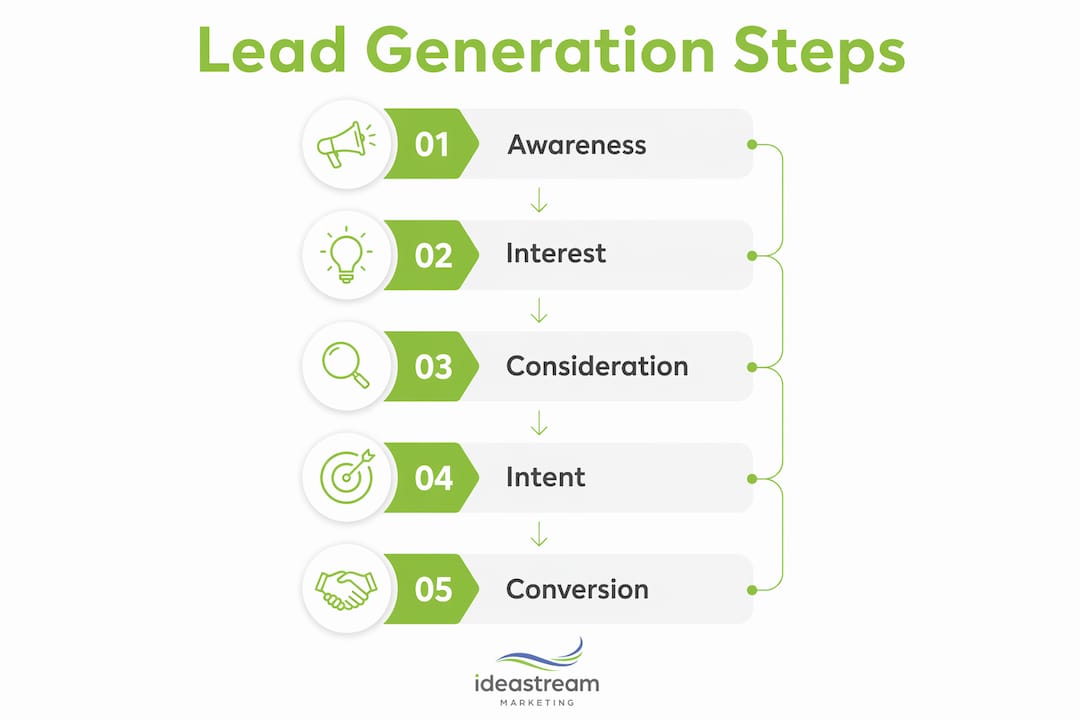
Step by step lead generation is a structured process that moves prospects through five defined stages: awareness, interest, consideration, intent, and conversion. Each stage requires a different tactic, a different message, and a different measure of success. Small and medium-sized businesses that follow this process consistently build predictable pipelines instead of chasing random inquiries. This guide walks you through every stage, from defining your ideal customer to closing the deal, with the tools, frameworks, and timing that actually work in 2026.
What prerequisites do you need before starting lead generation?
The most common reason lead generation fails is that businesses skip the foundation. Before running a single ad or publishing a single blog post, you need a clear Ideal Customer Profile (ICP). Your ICP defines the industry, company size, job title, pain points, and buying triggers of the person most likely to become your best customer. Without it, every channel you use will attract the wrong people.
Once your ICP is defined, three tool categories become non-negotiable:
- CRM platform: Captures and organizes every lead in one place. Without a CRM, leads fall through the cracks between email threads and spreadsheets.
- Marketing automation: Sends the right message at the right time without manual effort. Automation handles volume; your team handles relationships.
- Analytics and tracking: Connects lead sources to revenue. You cannot improve what you cannot measure.
- Lead scoring system: Assigns point values to behaviors and fit criteria. Lead scoring sharpens focus and reduces wasted sales effort on prospects who will never buy.
The table below shows the four tool categories every SMB needs and what each one does.
| Tool category | Primary function |
|---|---|
| CRM platform | Stores, tracks, and segments all leads |
| Marketing automation | Delivers timed, personalized outreach at scale |
| Analytics and tracking | Measures channel performance and cost per lead |
| Lead scoring system | Prioritizes leads by fit and engagement level |
CRM automation for SMBs is one of the fastest ways to reduce manual work and keep your pipeline organized from day one.
How to attract and capture leads step by step
Attracting the right audience requires a multi-channel approach combining SEO, paid ads, social media, and referral partnerships. Each channel serves a different stage of awareness. SEO brings in prospects who are already searching for your solution. Paid ads reach prospects who match your ICP but have not found you yet. Social media builds familiarity over time. Referral partnerships deliver warm leads with built-in trust.

Once traffic arrives, you need a reason for visitors to identify themselves. That reason is your lead magnet. The best lead magnets solve one specific problem immediately. A checklist, a short video guide, a free audit, or a pricing calculator all work because they deliver value before asking for anything in return.
Follow these steps to build your capture system:
- Create a dedicated landing page. Remove navigation menus and distractions. The only action available should be submitting the form.
- Write a headline that names the outcome. “Get 10 more qualified calls per month” outperforms “Download our free guide” every time.
- Keep the form short. Ask for name, email, and one qualifying question. Every additional field reduces completions.
- Set up your thank you page as a conversion asset. Thank you pages that offer a next step such as a calendar booking or webinar invite increase secondary conversion rates by 10–20%. That is free revenue from leads you already captured.
- Connect the form to your CRM immediately. Every submission should trigger an automated welcome message within minutes.
Pro Tip: Test two versions of your landing page headline before spending money on paid traffic. A stronger headline alone can double your form completion rate without changing anything else on the page.
How to qualify and prioritize leads using scoring and segmentation
Not every lead deserves the same attention. Lead qualification is the process of determining which prospects are worth your sales team’s time right now. For B2B businesses, the BANT framework covers the four criteria that matter most: Budget, Authority, Need, and Timeline. B2B companies using BANT can filter out 70% of low-probability leads, which means your team spends time only on prospects who can actually buy.
For B2C businesses, behavioral signals replace formal qualification conversations. A prospect who visits your pricing page three times, opens every email, and clicks a product link is showing buying intent without saying a word.
Lead scoring puts numbers to these signals so your CRM can prioritize automatically:
- +20 points for requesting a demo or consultation
- +10 points for visiting the pricing page
- +5 points for opening an email or watching a video
- +15 points for matching your ICP on company size or job title
- Negative points for inactivity over 30 days
Combining fit, intent, and engagement scores enables precise routing. High-scoring leads go directly to your sales team. Mid-range leads stay in the nurture sequence. Low-scoring leads get a re-engagement campaign before any human time is spent.
| Score range | Lead status | Recommended action |
|---|---|---|
| 60+ points | Sales qualified | Assign to sales rep immediately |
| 30–59 points | Marketing qualified | Continue nurture sequence |
| Below 30 points | Unqualified | Re-engagement campaign |
Pro Tip: Contacting a lead within 5 minutes increases your chance of qualification by up to 10 times compared to waiting 30 minutes or more. Set up an automated alert the moment a lead hits your sales-qualified threshold.
What are the best nurture strategies to convert leads?
Most leads are not ready to buy when they first contact you. Nurturing is the process of staying relevant and building trust until they are. The biggest mistake SMBs make is sending too many offers too soon. Effective nurture sequences use a content mix of 70% educational content, 20% social proof, and only 10% direct offers. That ratio keeps prospects engaged without making them feel sold to.
Structure your nurture sequence around the trigger that brought the lead in:
- Day 1: Deliver the lead magnet and set expectations. Tell them what they will receive over the next few weeks.
- Day 3: Send an educational piece that addresses their most common objection or question.
- Day 7: Share a customer success story or case study that mirrors their situation.
- Day 10: Offer a soft next step, such as a free consultation or a short video walkthrough.
- Day 14: Send a direct offer with a clear call to action and a deadline.
Multi-channel nurturing outperforms email alone. Combine email sequences with social media retargeting ads, LinkedIn connection requests for B2B, and a personal phone call or voice message for high-scoring leads. Automation handles volume efficiently, but human contact remains the deciding factor for qualified leads who are close to a decision.
Personalization matters more than frequency. Use the lead’s name, reference the specific lead magnet they downloaded, and tailor the content to the industry or problem they indicated. Generic sequences get ignored. Specific ones get responses.
You can explore inbound and outbound lead generation strategies to decide which nurture channels fit your business model best.
How to convert nurtured leads and measure success
Conversion is not a single moment. It is the result of every previous step done correctly. When a nurtured lead reaches the decision stage, your job is to remove friction and make the next step obvious. A clear, specific call to action outperforms a vague one every time. “Book a 20-minute strategy call” converts better than “Contact us.”
Track these metrics to know whether your system is working:
- Lead-to-customer conversion rate by source: This tells you which channels produce buyers, not just contacts.
- Cost per lead by channel: Divide your spend by the number of leads generated from each source.
- Time to conversion: How many days does it take from first contact to closed deal? Shortening this number increases revenue without adding leads.
- Email open and click rates by sequence step: Low engagement at a specific step signals a message that needs rewriting.
Auditing lead-to-customer conversion by source identifies your highest-return channels and exposes where budget is being wasted. Most SMBs discover that two or three channels produce the majority of their closed deals. Cutting underperforming channels and reinvesting in top performers is the fastest way to improve ROI without increasing total spend.
Pro Tip: Review your lead source data every 30 days, not every quarter. Markets shift fast, and a channel that worked in january may underperform by march. Monthly audits keep your budget aligned with what is actually converting.
For a deeper look at lead generation best practices that apply across industries, the Ideastreammarketing resource library covers both tactical and strategic approaches.
You can also reference international lead generation benchmarks to see how funnel stage conversion rates compare across markets.
Key Takeaways
A step by step lead generation system works only when every stage, from attraction to conversion, is built on defined criteria, measured consistently, and refined based on real data.
| Point | Details |
|---|---|
| Define your ICP first | Every channel and message performs better when built around a specific customer profile. |
| Score leads by behavior | Assign point values to actions so your CRM routes prospects to the right follow-up automatically. |
| Use the 70/20/10 content ratio | Nurture sequences that lead with education and limit direct offers keep prospects engaged longer. |
| Contact qualified leads fast | Reaching a sales-qualified lead within 5 minutes increases qualification likelihood by up to 10 times. |
| Audit by source monthly | Tracking conversion rates by channel reveals which investments produce buyers and which waste budget. |
What I’ve learned about building a lead system that actually holds up
Most SMBs I work with come in focused on volume. They want more leads. What they actually need is a system that converts the leads they already have. The difference between a business that grows predictably and one that lurches from month to month is almost always process discipline, not lead count.
The single most common failure point is the gap between capture and follow-up. A lead fills out a form, gets an automated email, and then waits three days for a human response. By then, they have already talked to someone else. Speed-to-lead is not a nice-to-have. It is the difference between a closed deal and a lost one.
The second thing I see consistently is businesses treating all leads the same. A prospect who downloaded a checklist six months ago is not the same as one who just visited your pricing page twice this week. Scoring and segmentation are not advanced tactics reserved for enterprise companies. They are basic hygiene for any SMB that wants a sales team focused on the right people.
Build the system first. Measure it honestly. Then scale what works.
— Dean
How Idea Stream Marketing helps SMBs build stronger lead pipelines
Generating leads consistently requires more than a good offer. It requires content that builds trust before a prospect ever fills out a form.
Idea Stream Marketing works with small and medium-sized businesses across Long Island and nationwide to build digital marketing systems that attract, capture, and convert leads at every stage of the funnel. From professional video production that increases engagement to AI-powered SEO that drives qualified traffic, every service is built to produce measurable results. Video in advertising is one of the most effective tools for warming up cold audiences and accelerating the nurture process. If you are ready to build a lead generation system that works, connect with the Idea Stream Marketing team today.
FAQ
What is step by step lead generation?
Step by step lead generation is a structured process that moves prospects through defined stages: awareness, capture, qualification, nurture, and conversion. Each stage uses specific tactics and metrics to advance prospects toward a buying decision.
How many steps does a lead generation funnel have?
A standard lead generation funnel includes four to five stages: awareness, interest, consideration, intent, and conversion. Structured funnels with clear stage definitions produce more consistent results than unstructured outreach.
What is the BANT framework in lead qualification?
BANT stands for Budget, Authority, Need, and Timeline. B2B sales teams use it to qualify prospects quickly and filter out leads that are unlikely to close in the near term.
How fast should you follow up with a new lead?
Follow up within 5 minutes of a lead submitting a form. Speed-to-lead response at that pace increases qualification likelihood by up to 10 times compared to delays of 30 minutes or more.
What content ratio works best for lead nurture emails?
The most effective nurture sequences use 70% educational content, 20% social proof such as case studies and testimonials, and 10% direct offers. This ratio builds trust before asking for a commitment.