
July 8, 2026




TL;DR:
- Branding shapes customer perception and trust, driving long-term growth through experience and authenticity.
- It must be owned at the executive level as a strategic asset to support pricing, valuation, and talent, not just creative efforts.
Branding is defined as the process of creating a distinctive identity that shapes how customers perceive, trust, and choose a business over its competitors. The role of branding in business extends far beyond logos and color palettes. Research shows that 71% of brand equity is built through direct and indirect customer experiences, not paid advertising. That single finding reframes the entire conversation. Branding is not a creative exercise. It is a structural growth driver that touches pricing power, customer loyalty, talent acquisition, and long-term enterprise value.
How does branding build trust and influence customer purchase decisions?
Brand trust is the primary driver of purchase behavior. Empirical research in FMCG food markets confirms that brand trust and quality are the strongest motivators for consumer decisions, with trust and perceived quality operating as the core constructs that move buyers from consideration to purchase. Perceived quality also partially mediates how brand perception translates into actual buying behavior. That means a business can invest heavily in brand messaging, but if the product quality does not match the promise, the trust signal collapses.
Authenticity compounds this effect significantly. Research in nutrition markets shows that brand authenticity strongly influences consumer trust, which in turn drives loyalty. Markets with high information asymmetry, where customers cannot easily verify claims before purchase, are especially sensitive to authenticity signals. A brand that communicates consistently, delivers on its promises, and maintains a clear point of view earns a loyalty premium that paid media alone cannot replicate.
Three behaviors build brand trust at the operational level:
- Consistent messaging across every channel. Customers notice when a brand’s social voice contradicts its customer service tone.
- Transparent communication during problems. How a brand handles a failure matters more than the failure itself.
- Product and service quality that matches the brand promise. Trust erodes the moment the experience falls short of the expectation set by marketing.
Pro Tip: Map your brand promise against your actual customer experience at every touchpoint. The gaps you find are where trust is leaking.
What role does customer experience play in building brand equity?
Customer experience is the primary engine of brand equity. Brands that amplify customer experience grow market share 2.5 times more effectively than those that do not. That is not a marginal advantage. It is a structural separation between businesses that treat branding as a marketing function and those that treat it as an operational commitment.
Only 28% of brand equity derives from paid media touchpoints. The remaining 71% comes from what customers actually experience, including product quality, service interactions, digital interfaces, and word of mouth. Paid advertising can create awareness, but it cannot manufacture the trust that comes from a consistently excellent experience.
“Marketing often overemphasizes brand promise messaging without fulfilling the promise operationally. The result is a widening gap between what customers expect and what they actually receive. That gap is where brand equity goes to die. Businesses that close it grow. Businesses that ignore it spend more on advertising to compensate for declining trust.”
This is the most common and costly mistake in brand management. Organizations pour budget into campaigns that raise expectations, then fail to deliver the experience those campaigns promised. The fix is not better creative. It is operational alignment. Every team that touches the customer, from sales to support to fulfillment, must understand and execute the brand promise. Ideastreammarketing builds this principle into every branding engagement, ensuring that the story told in video and content reflects the experience customers actually receive.
Why should branding be treated as a strategic asset at the C-suite level?
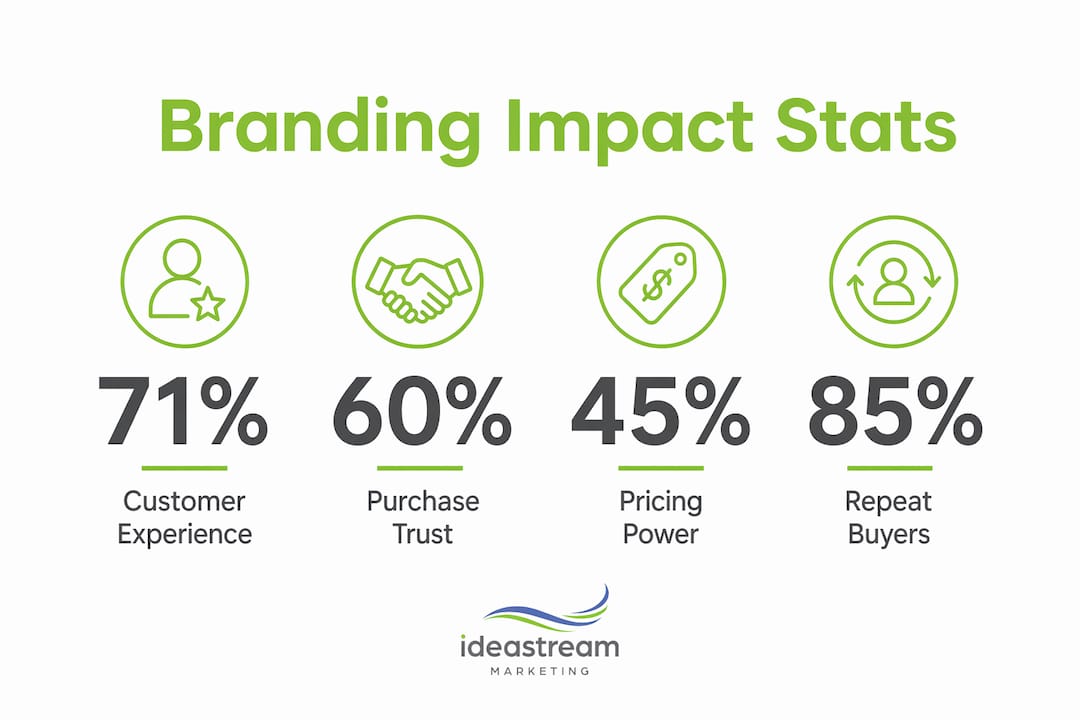
Branding is a capital allocation decision, not a creative department output. Leading boards now treat brand as a capital asset integrated into portfolio strategy, pricing decisions, and talent acquisition. That shift reflects a hard business reality: in markets where AI is rapidly reducing product differentiation, brand is one of the few remaining sources of durable competitive advantage.
CEOs and boards that own brand strategy at the executive level see measurable results across multiple dimensions:
- Pricing power. A recognized and trusted brand commands premium pricing without proportional increases in cost. Customers pay more for brands they believe in.
- Enterprise valuation. Brand equity contributes directly to company valuation. Acquirers pay a premium for businesses with strong brand recognition and customer loyalty.
- Talent acquisition. A strong employer brand reduces hiring costs and accelerates recruitment. Businesses with clear brand identities attract senior talent faster and at lower cost than peers.
- Resilience against commoditization. When competitors can replicate your product features quickly, brand becomes the differentiator that keeps customers from switching.
Brand strategy must be owned at the CEO and board level to influence enterprise decisions. When brand is relegated to the creative or design team, it becomes a visual exercise rather than a strategic one. The businesses winning on brand in 2026 have executives who treat it the same way they treat financial capital: as something to protect, grow, and deploy with intention.
Pro Tip: Put brand performance metrics on your quarterly board agenda alongside revenue and margin. If brand health is not measured, it is not managed.
How can business leaders apply branding strategies to drive growth?
The most effective branding strategies for business combine long-term brand investment with short-term performance marketing. Performance marketing captures immediate demand but does not build lasting trust. Brand strategy creates the sustainable “why” that supports growth beyond clicks and conversions. The businesses that grow consistently run both in parallel, using performance channels to capture demand that brand investment has already created.
Practical execution requires four disciplines:
- Authentic storytelling. Your brand story must reflect what your business actually does and who it actually serves. Generic positioning statements do not build loyalty. Specific, honest narratives do. Video content is particularly effective here because it communicates tone, culture, and personality in ways that text cannot.
- Unique positioning. Identify the one thing your business does better than anyone else and build your brand around it. Trying to stand for everything results in standing for nothing.
- Operational alignment. Every customer-facing process must reflect the brand promise. This includes how your team answers the phone, how your website is designed, and how your products are packaged and delivered.
- Consistent execution over time. Brand equity compounds. Businesses that maintain consistent brand standards across years outperform those that rebrand frequently in response to short-term market pressure.
| Approach | Short-term impact | Long-term impact |
|---|---|---|
| Performance marketing only | High click volume, immediate leads | Low brand recall, price sensitivity |
| Brand strategy only | Slow demand generation | Strong loyalty, pricing power |
| Combined brand and performance | Balanced demand capture | Sustainable growth and differentiation |
Strong brand strategy improves all customer journey touchpoints, increasing engagement through sales cycles and producing conversion-ready leads. The compounding effect is real. Businesses that invest in brand consistently report shorter sales cycles, higher close rates, and stronger customer retention than those that rely on performance marketing alone.

Idea Stream Marketing works with business leaders to build branding strategies that connect authentic storytelling with measurable marketing outcomes. The goal is always the same: create a brand that earns trust before the sales conversation begins.
Key Takeaways
Branding is a strategic business asset that drives trust, pricing power, and market share when it is built on consistent customer experience rather than advertising spend alone.
| Point | Details |
|---|---|
| Experience builds equity | 71% of brand equity comes from customer experience, not paid media. |
| Trust drives purchases | Brand trust and perceived quality are the strongest drivers of consumer purchase decisions. |
| C-suite ownership matters | Brand strategy must be owned at the executive level to influence pricing, valuation, and talent. |
| Authenticity earns loyalty | Authentic brands build deeper consumer trust, which directly drives long-term loyalty. |
| Combine brand and performance | The most effective growth strategy pairs long-term brand investment with performance marketing. |
Branding is not a marketing problem. It is a leadership one.
I have worked with enough business leaders to know the pattern. The company invests in a rebrand, launches a new campaign, and then wonders why nothing changed six months later. The answer is almost always the same: the brand changed on paper, but the experience did not change in practice.
The most common mistake I see is treating branding as a deliverable rather than a discipline. A logo is a deliverable. A brand is a daily operational commitment. When the sales team tells a different story than the marketing team, when the website promises speed and the service delivers delays, the brand is broken regardless of how good the creative looks.
What actually works is simpler than most agencies will admit. Pick a clear position. Deliver on it every single time. Document it, train your team on it, and measure it. The businesses I have seen grow the fastest are not the ones with the biggest ad budgets. They are the ones where every employee understands what the brand stands for and acts accordingly.
The AI-driven market noise of 2026 makes this more urgent, not less. When competitors can generate content at scale and replicate product features quickly, originality and operational authenticity become the only real moat. That is not a marketing insight. It is a business survival insight. If you want to understand how branding drives growth at a structural level, start by auditing the gap between what your brand promises and what your customers actually experience.
— Dean
How Idea streammarketing helps you build a brand that grows
Idea Stream Marketing works with businesses across Long Island and nationwide to translate brand strategy into content that performs. We produce branded video campaigns, corporate storytelling, and digital marketing programs built around the same principle that research confirms: the brand that delivers the best experience wins.
Our branding services cover everything from brand positioning and visual identity to video production, social media content, and AI-powered SEO. We also offer digital marketing programs that combine brand investment with performance marketing so your business captures demand today while building equity for tomorrow. If you are ready to build a brand that earns trust before the sales call, contact us to get started.
FAQ
What is the role of branding in business growth?
Branding creates a distinctive identity that builds customer trust, supports premium pricing, and drives repeat purchases. Businesses with strong brands grow market share 2.5 times more effectively than those without.
How does branding affect sales?
Brand trust and perceived quality are the strongest drivers of consumer purchase decisions. When customers trust a brand, they buy more frequently, pay higher prices, and refer others.
Why does customer experience matter for brand equity?
71% of brand equity is built through direct and indirect customer experiences. Paid advertising creates awareness, but only consistent experience delivery builds lasting equity.
Should brand strategy be a CEO-level priority?
Brand strategy must be owned at the executive level to influence pricing power, enterprise valuation, and talent acquisition. Boards that treat brand as a capital asset outperform those that delegate it to creative teams.
What is the difference between branding and performance marketing?
Performance marketing captures immediate demand through paid channels. Brand strategy builds the trust and recognition that makes performance marketing more effective over time. The best growth programs run both together.