



September 25, 2026


Local citation building means creating and managing consistent business listings, your name, address, and phone number, across directories like Google, Yelp, and Bing. The single highest-priority move is claiming and verifying your Google Business Profile before touching anything else. Citations still shape who shows up in local search results, and they’re increasingly what AI models cite when answering “best business near me” questions.
TL;DR:
- Prioritizing the claiming and verification of your Google Business Profile is essential, as it is the most influential for search rankings and AI citations.
- Building accurate and consistent core citations on Google, Bing, and Yelp should come before expanding to industry-specific or broad directories to prevent costly cleanup later.
- Ensuring your NAP (name, address, phone number) is correct across all listings and updating it promptly when changes occur prevents duplicates and ranking issues.
- Adding schema markup that matches your listings improves search engine understanding and supports AI-driven search features.
- Using managed services can help efficiently maintain multiple locations, but manual control is advised for fewer open sites to ensure accuracy and freshness.
Table of Contents
- Why Local Citation Building Still Matters for Search and AI
- How Do You Build Core Business Citations Step by Step?
- Which Directories Should You Target After the Core Three?
- What Causes Duplicate Listings and NAP Inconsistency?
- How Does Schema Markup Reinforce Your Citations?
- Should You Automate Citations or Hire a Managed Service?
- How Idea Stream Marketing Approaches Citations and Local Discovery
- Get a Listings Audit Before Your Next Location Opens
- Sources
- FAQ
Why Local Citation Building Still Matters for Search and AI
Citations haven’t lost their relevance, they’ve just gotten a second job. They still influence traditional local rankings, and now they’re also feeding the answers ChatGPT, Perplexity, and Google’s AI Overviews give when someone asks for a recommendation near them.
Business directories make up roughly 31 to 37% of organic results for local-intent searches, according to BrightLocal’s research on local citations. That’s not a rounding error. It means a huge chunk of the page one real estate for “plumber near me” or “podcast studio Long Island” belongs to directory listings, not standalone websites. Platforms like Foursquare and Yelp also function as source material for AI-generated recommendations. This is exactly why an outdated or missing profile can quietly erase you from an entire category of search behavior.
Prioritization matters more than volume here. Work through this order:
- Core platforms first: Google Business Profile, Bing Places, Yelp
- Trust-building directories next: Better Business Bureau (BBB), Foursquare
- Industry-specific and local directories after that
- Unstructured mentions (press, blogs, guest features) as a longer-term layer
Skipping straight to bulk directory submissions before locking down the core three is the most common mistake we see among small business owners.
How Do You Build Core Business Citations Step by Step?
Building citations well is less about speed and more about sequence. Get the foundation locked before you expand, or you’ll spend next year fixing what you rushed this year.
- Create one canonical NAP record. Write your exact business name, address, and phone number once, then store it in a spreadsheet or your CMS. This becomes the single source of truth every listing must match.
- Audit what already exists. Search your business name and old addresses to find duplicate, outdated, or incorrect listings before you create anything new.
- Claim and verify Google Business Profile. Google requires ownership verification, usually by phone, email, or postcard, before your listing goes live. This is the platform search engines and AI tools lean on most.
- Claim Bing Places and Yelp for Business. Both let you import much of your Google data, which speeds up setup considerably. Yelp’s page is free to claim and manage, though Yelp offers optional Upgrade Packages and category-specific features like Yelp Guaranteed for businesses that want more visibility.
- Fill out every profile field completely. Categories, services, hours, photos, and a real business email all matter, not just the basics.
- Set your service-area or storefront status correctly. A mobile locksmith and a retail bakery need different profile types, and getting this wrong invites suspension flags later.
- Document your verification proof. Save screenshots and confirmation emails for every claim. You’ll want them if a listing ever gets disputed or merged incorrectly.
Pro Tip: Keep your canonical NAP spreadsheet updated the moment anything changes, even a suite number. Retroactively fixing forty directory listings after a move is a miserable afternoon nobody enjoys.
Our guide on Google Business Profile optimization for local SMBs walks through the field-by-field setup in more depth.
Which Directories Should You Target After the Core Three?
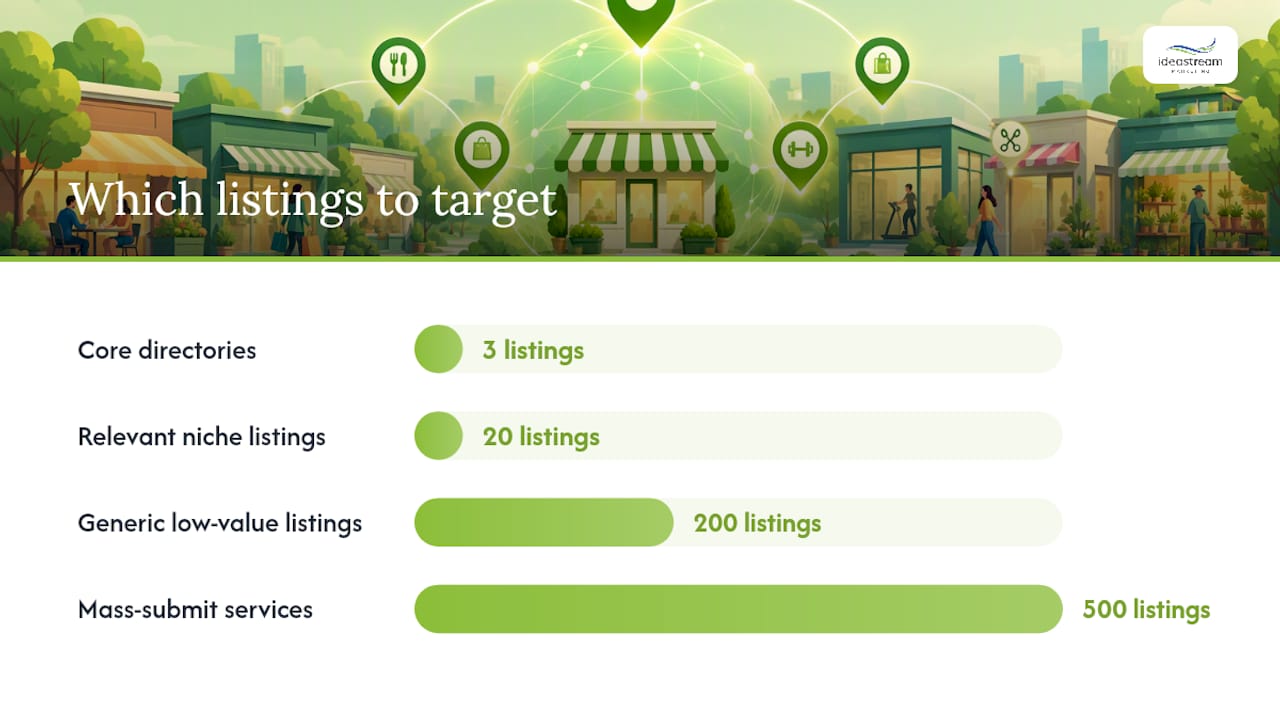
Once Google, Bing, and Yelp are locked down, the return on additional citations drops fast unless you’re selective. Chasing generic “submit to 500 directories” services wastes hours on listings nobody, human or AI, ever checks.
Start by identifying directories your actual customers use. A veterinary clinic benefits from Vetstreet or Healthgrades-style niche sites; a contractor benefits from Houzz or industry association directories. Search “[your city] + [your industry] directory” and see what already ranks.
It also helps to understand that not every citation needs to link back to your website to count. Unstructured mentions, a local newspaper feature, a blog roundup, a chamber of commerce post, still register as citations when your NAP appears consistently, even without a backlink.
A few discovery tactics work better than blind submission:
- Check where competitors are listed by searching their exact business name in quotes
- Use citation-tracking tools that flag gaps between your listings and competitors’
- Search your city plus your service category to surface local blogs and roundups
- Filter by relevance and traffic, not just domain authority
Quality beats quantity every time. Twenty relevant, accurate listings outperform two hundred generic ones that nobody, including AI crawlers, treats as meaningful signals.
What Causes Duplicate Listings and NAP Inconsistency?
Strict NAP consistency doesn’t mean obsessive perfection. “St.” versus “Street” rarely breaks anything. What breaks things is a different suite number, a disconnected phone line, or a business name that doesn’t match across platforms.
Duplicate profiles usually happen for boring reasons: a previous employee created a listing years ago, a franchise location got auto-generated by a data aggregator, or someone moved offices and built a new profile instead of updating the old one. Google’s guidance is clear that relocations should update the existing profile, not spawn a new listing, and its policies address how duplicates get merged or appealed.
Watch for these avoidable pitfalls:
- Virtual office addresses used for a business type that requires a physical storefront
- Inconsistent category selection across Google, Bing, and Yelp
- A website URL or phone number on one listing that doesn’t match any other
- Old employee names still listed as contacts
Pro Tip: Run a quarterly search of your exact business name plus your city. Duplicate listings tend to surface from data aggregators long after you think the cleanup is finished.
Fixing this is a four-part audit: find duplicates through direct search, reclaim any listing you don’t currently own, correct the NAP to match your canonical record, then request merges through each platform’s support process.
How Does Schema Markup Reinforce Your Citations?
Listings tell directories who you are. Schema markup tells search engines and AI crawlers the same thing, in a language they parse instantly.
Adding LocalBusiness or Organization JSON-LD to your homepage or About page gives Google a structured version of your name, address, and phone number to cross-check against your citations. Google explicitly recommends placing this schema where it’s easy to find, and missing required properties can make a page ineligible for rich results entirely.
A few implementation details matter more than they get credit for:
- Match your schema’s address and phone fields exactly to your Google Business Profile, no abbreviations one place and full words the other
- Include a
sameAsproperty linking to your verified social and directory profiles - Add your logo through schema so it’s eligible to appear in Knowledge Panel results
- Build a simple citation hub page on your own site that links out to your key listings, which helps those pages get discovered and indexed faster
Our breakdown of schema for local business covers syncing JSON-LD with your Business Profile and CMS in more technical detail, and our piece on schema for AI search explains why AI models lean on these same structured fields. If you’re troubleshooting indexing delays on a new citation hub page, a resource like TyTe Hosting’s guide to search engine submission covers the basics of prompting faster crawling.
Should You Automate Citations or Hire a Managed Service?
There’s no single right answer here, only the right answer for your bandwidth and location count.
Manual submission gives you full control and catches errors immediately, but it doesn’t scale past a handful of locations. Aggregator and data-feed services push your NAP to dozens of secondary directories at once, saving time, though data freshness and accuracy vary by provider. A managed service adds verification handling, reporting, and ongoing monitoring, which matters most once you’re juggling multiple locations or don’t have a marketing team to spare.
When evaluating any tool or provider, weigh:
- How many directories they actually cover, not just claim to cover
- How current their data feed stays after initial submission
- Whether they help with verification steps like postcard or phone confirmation
- Whether you get a real report, not just a checkmark
Pro Tip: Set a maintenance rhythm: a monthly glance at your core three profiles, a full quarterly audit across all listings, and an immediate update any time you move, change phone numbers, or rebrand.
If you’re managing ten or more locations, or you simply don’t have hours to spend on directory cleanup, that’s the point to bring in multi-location SEO support rather than let listings drift.
How Idea Stream Marketing Approaches Citations and Local Discovery
Most citation guides treat listings as a paperwork exercise. We treat them as a discovery system with moving parts that need to agree with each other.
Our workflow starts with one canonical NAP record, followed by claiming and verifying Google Business Profile, Bing Places, and Yelp, then syncing schema so your website and your listings say the exact same thing. From there, we layer in niche directories relevant to the client’s industry and set up a monitoring routine to catch drift before it becomes a duplicate-listing headache.
The piece most businesses skip is local video. A short profile video or a behind-the-scenes clip on your Google Business Profile does more for engagement than another paragraph of text ever will, and it gives AI-driven search tools richer content to associate with your business.
— Dean Spinato, CEO & Founder of Idea Stream Marketing
Get a Listings Audit Before Your Next Location Opens
Some agencies offer local SEO, Google Business Profile optimization, and schema implementation alongside video and podcast production to help your business get noticed once someone finds your listing.
A listings audit from our team starts with a health check across your core profiles, a duplicate and NAP-mismatch scan, a review of your schema for gaps, and a prioritized action list ranked by impact, not busywork. For businesses expanding to new locations, we pair that with local SEO strategies built for visibility and lead generation, so your listings and your content strategy move together instead of in separate lanes.
If your business is on Long Island or anywhere in New York and you’re not sure how many duplicate or outdated listings are quietly costing you customers, schedule a consultation or request a listings audit through our digital marketing services page and we’ll show you exactly where the gaps are.
Sources
- Why Local Citations Are Key for Local SEO – BrightLocal
- Why Claim Your Business Page on Yelp | Yelp for Business
FAQ
What Is Local Citation Building?
Local citation building is the process of creating and maintaining consistent business listings, your name, address, and phone number, across directories like Google Business Profile, Yelp, and Bing Places. Consistency across these listings helps search engines and AI models verify that your business is legitimate and locatable.
Do Citations Still Affect Local SEO Rankings?
Yes. Business directories account for roughly 31 to 37% of organic results on local-intent searches, and citations remain one of the ranking factors Google weighs for local pack placement. They also increasingly serve as source material for AI-generated local recommendations.
Does a Citation Need to Link Back to My Website?
No. A citation counts even without a backlink as long as your business name, address, and phone number appear consistently. Unstructured mentions in press coverage or local blogs still function as valid citations.
How Do I Fix Duplicate Google Business Profile Listings?
Search your exact business name and past addresses to find duplicates, then use Google’s ownership and merge process to consolidate them. Google’s policy requires updating an existing profile after a move rather than creating a new one, which prevents most duplicate issues before they start.
Does Idea Stream Marketing Offer Local Citation Management?
Yes. Idea Stream Marketing provides local SEO and Google Business Profile optimization services, including listings audits, schema implementation, and multi-location citation rollouts. Current pricing is available by request through the Idea Stream Marketing website.