



October 19, 2026
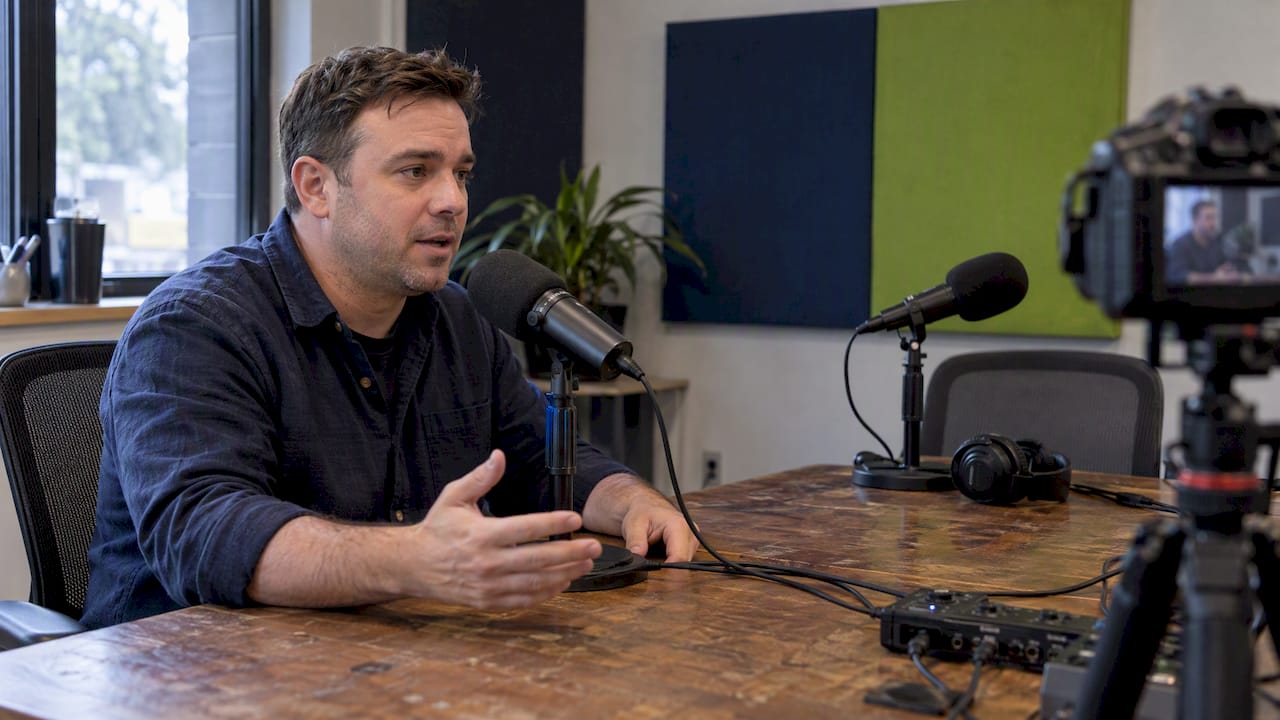


A strong podcast marketing strategy comes down to five decisions: who the show is for, what business result it supports, where episodes are published, how each recording is repurposed into short clips and pages, and which numbers you review each month. Get those right and a podcast becomes a steady source of trust and leads. Skip them and it becomes an expensive hobby. Below is the plan we use with business owners, executives and professional firms on Long Island and across New York.
TL;DR
- Start with one business goal (leads, referrals, recruiting or authority) and one specific listener. Every other choice follows from that.
- Treat video as the default. YouTube is the platform most weekly U.S. podcast listeners use most often, so record in a way that works for both ears and eyes.
- Plan the repurposing before you record: one episode should yield a handful of Reels, TikToks, YouTube Shorts, a transcript-based web page and an email.
- Measure retention and follows, not just downloads, and let those numbers shape the next episodes.
- Commit to a 12-episode first season so you can judge the results fairly.
Table of Contents
- Why a podcast is worth marketing in the first place
- Step 1: Define the goal and the listener
- Step 2: Build a video-first show
- Step 3: Set up distribution the right way
- Step 4: Turn every episode into a content library
- Step 5: Promote beyond your own channels
- Step 6: Measure what matters
- A 90-day launch plan
- Our perspective on podcast marketing
- How we can help
- FAQs
- Sources
Why a podcast is worth marketing in the first place
The audience is already there. According to The Infinite Dial 2025, 73% of Americans age 12 and older, roughly 210 million people, have consumed a podcast in audio or video form, and 55% do so monthly. The same research found that 51% have watched a podcast, which matters for how you produce yours.
There is also evidence that listeners act. Edison Research’s Podcast Consumer 2025 report found that 44% of U.S. weekly podcast listeners age 13+ had purchased a product after hearing a sponsorship or ad, up from 34% in Q1 2020. That figure covers advertising, not business shows like yours, but it shows the format earns attention that people are willing to act on.
For a service business, the value is usually less about download counts and more about depth. A prospect who has spent 40 minutes with your owner, your attorney or your physician has a different level of trust than one who read a landing page. If you want the full case, we cover it in why businesses should start podcasting now.
Step 1: Define the goal and the listener
Most podcasts fail at the planning stage, not the production stage. Before you book a studio, write down answers to these questions:
- What business result should this show support? Pick one primary goal: qualified inquiries, referral partnerships, recruiting, or brand authority in a niche.
- Who exactly is the listener? “Small business owners” is too wide. “Long Island contractors with 5 to 25 employees” is a show you can book guests for and write titles for.
- What do they get that they can’t get elsewhere? Local market knowledge, access to your clients’ stories, or your professional point of view.
- What should they do after an episode? One call to action per episode, such as booking a consultation, downloading a checklist or visiting a specific page.
If you are a B2B company, the show is often a relationship tool as much as a media property. Inviting your ideal customers, referral sources and industry partners as guests gives you a reason to start conversations that would otherwise feel like cold outreach. Our guide on starting a business podcast for marketing leaders walks through that planning in more detail.
Step 2: Build a video-first show
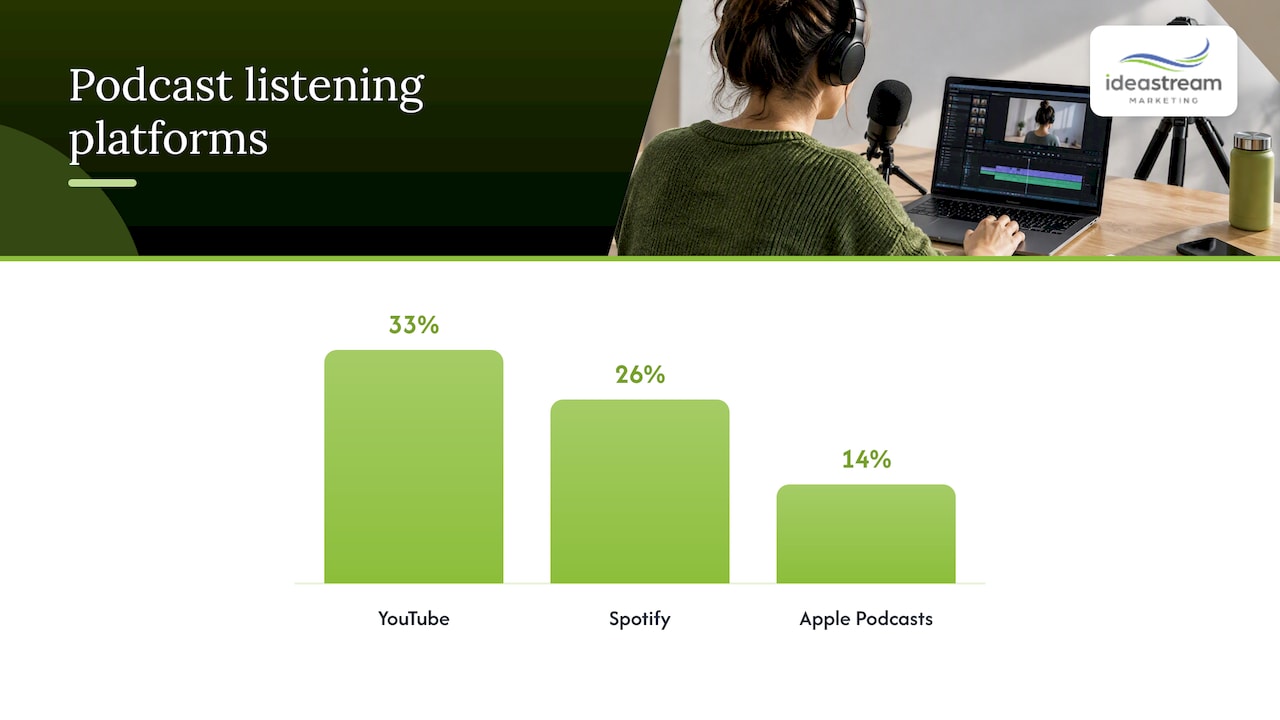
If you only record audio, you are leaving the largest podcast platform on the table. Research from SSRS and Edison shows 33% of U.S. weekly podcast listeners age 13+ use YouTube most often, ahead of Spotify at 26% and Apple Podcasts at 14%. A video-first setup also gives you the raw material for social clips.
What that means in practice:
- Two or three camera angles so the edit does not feel static.
- Clean audio first. Viewers forgive average video far sooner than bad sound.
- A set that looks like your brand, not a generic backdrop.
- Consistent episode length and structure so listeners know what they are getting.
- Marked moments. Note timestamps during recording when a guest says something quotable. It saves hours in editing.
You can record in a professional studio or on location at your office or event. Our podcast production services cover recording, editing and delivery, and our post-production workflow for podcast video explains what happens after the last take.
Step 3: Set up distribution the right way
Distribution is not a final step. It shapes how you name the show, format the artwork and structure each episode. Our overview of podcast distribution platforms for brands goes deeper; here are the essentials.
Apple Podcasts and Spotify
Submit your RSS feed to the major audio directories on launch day, with at least three episodes already live so new listeners have something to binge. Apple offers promotional tools for creators, including a customized marketing kit with social posts, web embeds and QR codes. Getting featured typically involves a formal pitch and polished assets, so prepare your artwork and show description with that in mind.
YouTube
YouTube handles podcasts differently from regular video. YouTube’s help documentation explains that a podcast show is a playlist and each episode is a video in it. The playlist should contain only full-length episodes, in the order you want them consumed. Do not mix clips or other uploads into it. Put your Shorts and highlights on the channel, but keep them out of the podcast playlist.
Naming matters too. YouTube’s guidance advises using the same name for the show and the podcast title, and avoiding extra words like “podcast” unless they are part of the actual name. A detailed description helps new viewers find the show through search. If you want the setup explained step by step, YouTube’s page on distributing podcasts is the place to start.
Your own website
A podcast that lives only on third-party platforms leaves search visibility to someone else. Publish every episode on your site with a summary, the full transcript, guest details and structured data. That is the core of podcast SEO, and it is also what helps your content get picked up by AI-powered search tools, which tend to cite pages with clear, extractable text.
Step 4: Turn every episode into a content library
This is where most of the marketing happens. A 45-minute conversation contains far more than one post. Plan for a repeatable pipeline:
| Asset | Where it goes | Purpose |
|---|---|---|
| Full video episode | YouTube, your website | Depth and search visibility |
| Full audio episode | Apple Podcasts, Spotify, other apps | Reach commuters and listeners who prefer audio |
| 3 to 6 short clips (30 to 60 seconds) | Instagram Reels, Facebook Reels, TikTok, YouTube Shorts | Discovery by people who don’t know you yet |
| Transcript-based article | Your website blog | Organic search, AI search citations |
| Quote graphics and audiograms | LinkedIn, Instagram, Facebook | Low-effort daily presence |
| Email recap | Your subscriber list | Brings warm contacts back to the episode |
The most efficient way to find clips is to work from the transcript. Read it, mark the moments with a clear point, a short story or a strong opinion, then cut around them. We lay out the method in our transcript-first workflow for podcast clips.
A few clip rules that hold up:
- Lead with the point. The first two seconds decide whether someone keeps watching.
- Add captions. Many people watch with the sound off.
- Crop vertically for Reels, TikTok and Shorts, and keep the speaker’s face in frame.
- End with one prompt, such as “Full episode on YouTube,” not five.
- Adapt the caption per platform. Instagram, Facebook, TikTok and YouTube Shorts each reward slightly different framing, so avoid pasting the same text everywhere.
For wider social planning around this pipeline, see our social media marketing strategies that drive real growth and the social media content creation guide for SMBs.
Step 5: Promote beyond your own channels
Owned channels reach people who already know you. To grow, you need other people’s audiences too.
- Guests are distribution. Every guest has a network. Give them a ready-to-share clip and a graphic the day the episode goes live.
- Cross-promotion. Trade appearances with hosts whose listeners match yours, such as a local business show, a trade association podcast or an industry newsletter.
- Local relationships. On Long Island, chambers of commerce, business improvement districts, local press and industry groups are natural partners for guest swaps and event tie-ins.
- Email. Add the latest episode to your signature and your regular newsletter. Your existing customers are your most likely first listeners.
- Paid support. Short clips are good candidates for modest social ad budgets once you know which ones perform organically.
- QR codes and smart links. Use them on print materials, trade show booths and slides so people can jump straight to a follow button. Apple’s promotional tools generate QR codes for your show.
Step 6: Measure what matters
Downloads are easy to count and easy to misread. Apple’s own guidance for creators is to talk first, then listen: use analytics to see where your audience is located by region and which episodes drive the most follows, then structure future content around it.
A useful monthly review covers:
- Retention. Where do listeners and viewers drop off? If it is the first three minutes, tighten your intro.
- Follows and subscribers per episode. Which topics earn a repeat audience?
- Clip performance. Which hooks earn watch time, and which episodes produced the best clips?
- Website traffic from episode pages. Are transcripts and summaries bringing in search visits?
- Business outcomes. Inquiries, booked calls and referrals that mention the show. Add a simple “How did you hear about us?” question to your forms.
There is a reason to care about depth over breadth. Edison Research and Wondery found that podcast fans spend an average of 9 hours and 24 minutes a week listening, against 5 hours and 33 minutes for casual listeners, and they are more likely to engage with a brand’s other media. A small, loyal audience of the right people can outperform a large, indifferent one.
A 90-day launch plan
Days 1 to 30: Foundation. Define your goal, listener and format. Name the show, design artwork, choose a studio or on-location setup, and book your first six guests. Record at least three episodes before launch.
Days 31 to 60: Launch. Publish three episodes at once, then move to a weekly or biweekly schedule. Submit to Apple Podcasts, Spotify and YouTube. Publish transcript pages on your website. Release the first batch of clips on Reels, TikTok and Shorts.
Days 61 to 90: Optimize. Review retention and follow data. Double down on formats and topics that earn attention. Email guests with clips. Pitch two or three cross-promotion swaps. Decide on season two topics based on the numbers, not hunches.
Our perspective on podcast marketing
We produce video and run digital marketing under one roof, and that changes how we think about podcasts. Most shows are planned as audio products and then marketed as an afterthought. We plan them the other way around: start with where the business needs to be found, then design the recording to feed those places.
That means every episode is built for discoverability. The video supports YouTube, the transcript supports Google and AI search, the clips support social platforms, and the episode page converts visitors into inquiries. A podcast that is produced well but invisible does nothing for the business behind it.
Our other firm view: consistency beats ambition. A simple, well-lit, well-edited show released every two weeks for a year will outperform a lavish show that stops after episode five. Choose a format your team can sustain.
— Dean Spinato, CEO & Founder of Idea Stream Marketing
How we can help
If you would rather spend your time on the conversation than on cameras, edit timelines and publishing checklists, we handle the full process: planning, recording, video editing, distribution, episode pages with transcripts and schema, and short-form clips for Instagram Reels, Facebook Reels, TikTok and YouTube Shorts. See how our Long Island podcast partnership works, or explore our digital marketing services to connect the show to your broader search and lead generation plan.
SCHEDULE A CONSULTATION OR STUDIO SESSION and we will map out your first season with you.
FAQs
How long does it take for a podcast marketing strategy to work?
Plan on at least 90 days and 12 episodes before you judge results. Search visibility and referral relationships build gradually, while short clips can show traction within weeks. Track retention and follows early, and business inquiries over the longer term.
Do I need video to market a business podcast?
You don’t strictly need it, but it helps a great deal. YouTube is the most-used podcast platform among U.S. weekly listeners, according to SSRS and Edison Research, and video gives you the clips that feed Reels, TikTok and Shorts.
How many clips should I make from each episode?
Three to six strong clips is a workable target for most business shows. Choose moments with a clear point or story rather than cutting at fixed intervals. Quality and a strong first few seconds matter more than volume.
Should my podcast be on my website too?
Yes. Publishing each episode with a transcript, summary and structured data gives search engines and AI tools text they can read and cite. It also gives listeners a place to take the next step with your business. Our podcast SEO guide explains how.
Is a podcast worth it for a local or B2B service business?
Often, yes, if it has a defined listener and a clear goal. Local and B2B shows tend to work as relationship and authority tools, so success is measured in conversations, referrals and booked calls more than in raw audience size.
Sources
- The Infinite Dial 2025, SSRS
- The Infinite Dial 2025 (full report), SSRS
- The Podcast Consumer 2025, Edison Research
- Create a podcast in YouTube Studio, YouTube Help
- YouTube podcast best practices, YouTube Help
- Distribute podcasts on YouTube, YouTube Help
- Measure podcast analytics and stats, Apple Podcasts for Creators
- Promotional tools, Apple Podcasts for Creators

