



October 16, 2026




TL;DR:
- AI chatbots use NLP and large language models to understand questions, generate context-aware responses, and connect to business systems. They improve customer engagement through memory retention, seamless integration, and autonomous task completion, delivering scalable and personalized support. Success depends on resolving issues effectively, establishing escalation paths, and securing systems against AI-specific risks.
AI chatbots are software systems that use artificial intelligence, specifically natural language processing (NLP) and large language models (LLMs), to understand customer questions and generate accurate, context-aware responses automatically. Unlike the scripted, menu-driven bots of the early 2010s, today’s conversational agents handle open-ended questions, remember context across a session, and connect directly to your business systems. Tools like ChatGPT and Zendesk AI agents have moved this technology from novelty to operational necessity. For business owners evaluating automation, understanding what these systems actually do, and where they fall short, is the difference between a smart investment and a frustrating one.
How do AI chatbots work to understand customer queries?
AI chatbots process input through layered pipelines rather than fixed decision trees. When a customer types a message, the system captures that text, runs it through a natural language understanding (NLU) module to detect intent, extracts key entities like order numbers or dates, and then routes the request to a response generator. The LLM produces a reply that fits the conversation context, not just a canned answer pulled from a lookup table.
The difference between rule-based chatbots and AI-powered ones is significant enough to affect your entire customer service strategy:
| Feature | Rule-based chatbot | AI chatbot |
|---|---|---|
| Response method | Fixed scripts and menus | Dynamic, generated responses |
| Handles open-ended questions | No | Yes |
| Learns from interactions | No | Yes, via machine learning |
| Context retention | Session-limited or none | Session and long-term memory |
| Integration capability | Limited | APIs, CRM, ERP, knowledge bases |
Memory is where modern chatbots separate themselves. Session memory lets the bot remember what was said earlier in the same conversation, so a customer does not have to repeat themselves. Long-term memory, available in more advanced deployments, allows the system to recall past interactions and personalize future ones. This is the foundation of genuine customer engagement rather than just automated deflection.
Pro Tip: Before selecting a platform, ask vendors specifically how their system handles intent disambiguation. A bot that confidently gives the wrong answer is worse than one that says “I’m not sure, let me connect you to someone who can help.”
What business benefits do AI chatbots deliver across industries?
Zendesk describes AI agents as systems that autonomously resolve issues and integrate with APIs, freeing human agents for complex, high-value interactions. That single capability reshapes staffing economics. A chatbot handling 60% of routine inquiries means your human team spends more time on problems that actually require judgment.
The practical benefits business owners report most consistently include:
- 24/7 availability without overtime costs or shift scheduling
- Scalability during peak periods, handling thousands of simultaneous conversations
- Consistent response quality regardless of agent mood or experience level
- Multilingual support without hiring bilingual staff
- Data collection on common questions, friction points, and unmet needs
- Faster resolution for routine requests like order status, appointment booking, and FAQs
The industry applications are broader than most owners initially expect. In ecommerce, chatbots handle order tracking, return initiation, and cart recovery messages. In travel and hospitality, they manage booking changes and itinerary questions at 3 a.m. when no agent is available. HR departments use them to answer applicant questions about open roles, benefits, and hiring timelines, reducing recruiter workload during high-volume hiring seasons.
Pro Tip: Map your top 20 customer service inquiries by volume before you deploy. If 15 of those 20 are routine and repeatable, a well-configured AI chatbot will handle them without human involvement, and that is where your ROI calculation starts.
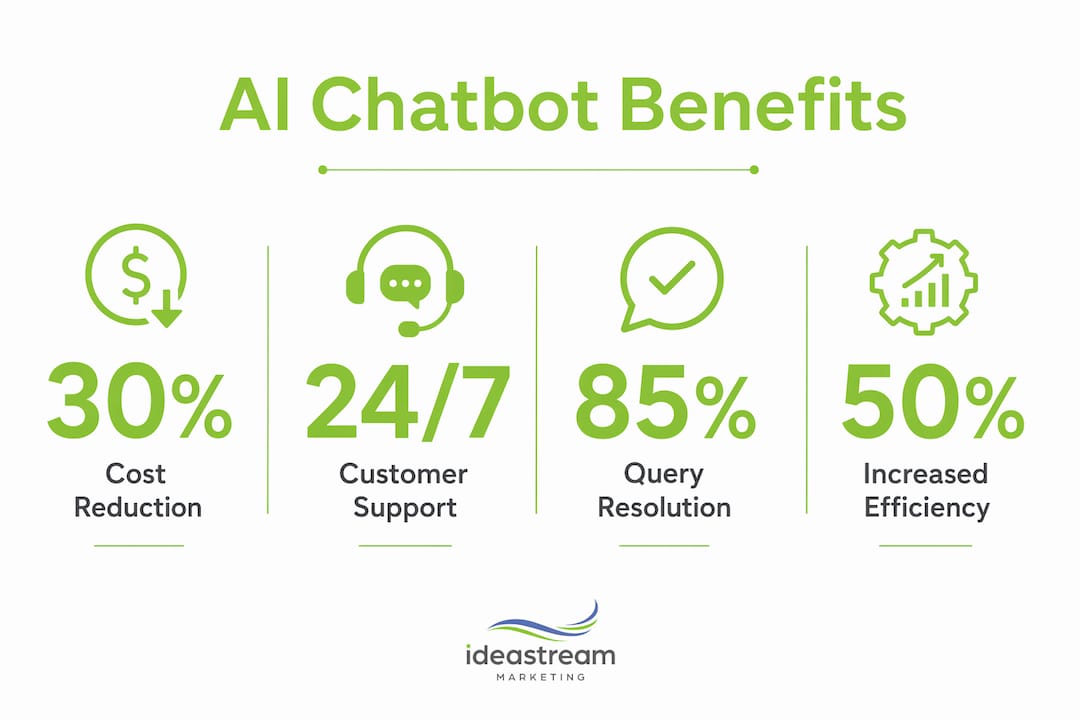
The data insight angle is underappreciated. Every conversation your chatbot has is a structured data point. Over time, you can identify which questions spike after a product launch, which topics generate the most escalations, and where your website or documentation is failing customers. That intelligence feeds back into your marketing, product, and content strategy.
How do AI chatbots integrate with backend systems?
Most production AI chatbots use hybrid architectures that combine rule-based workflow logic, LLMs for natural language handling, and orchestration layers that manage multi-step tasks. This structure is not accidental. Pure LLM deployments are flexible but unpredictable. Pure rule-based systems are predictable but brittle. The hybrid model gives you both.

Here is how the architectural layers typically work together:
| Layer | Function | Example |
|---|---|---|
| Rule-based gates | Enforce compliance and routing logic | “If order is under $50, auto-approve refund” |
| LLM engine | Understand and generate natural language | Interprets “where’s my stuff?” as order status request |
| Orchestration layer | Manages multi-step task sequences | Checks CRM, pulls order data, formats reply |
| API integrations | Connects to external business systems | Salesforce, Shopify, Zendesk, ServiceNow |
Integration with your existing systems is where chatbot value multiplies. A bot connected to your CRM can greet returning customers by name, reference their last purchase, and resolve account questions without any human involvement. Connection to an ERP system lets it check real-time inventory. A ticketing system integration means unresolved issues automatically generate support tickets with full conversation history attached.
AI agents go further than standard chatbots by completing multi-step tasks autonomously. The distinction matters for business owners: a chatbot answers questions, while an AI agent can initiate a refund, update an address, reschedule a delivery, and send a confirmation email, all within one conversation. Choosing between the two depends on how complex your customer workflows actually are.
What challenges and security risks come with AI chatbot deployment?
The most common deployment failure is treating chatbot success as a deflection metric rather than a resolution metric. 42% of consumers say access to a human agent matters more than speed of response. That number tells you something direct: customers will accept automation if it actually solves their problem, but they will not accept being trapped in a loop that never resolves anything.
AI hallucinations are a real operational risk. An LLM that confidently states incorrect return policy terms or fabricates a product specification creates liability and erodes trust faster than a slow human agent ever would. The fix is not to avoid AI. The fix is to build in factual grounding.
NIST’s generative AI risk profile outlines governance frameworks specifically designed for AI agent deployments, covering threats like tool access misuse and data exfiltration that standard cybersecurity models do not address. This matters if your chatbot has access to customer PII, payment data, or internal systems. Security assessments for AI chatbots require their own threat modeling, not just a checkbox on your existing IT audit.
Best practices for a deployment that holds up over time:
- Factual grounding: Connect responses to a curated, version-controlled knowledge base. Building evaluation probes into your chatbot creates audit trails that link each claim to a trusted source, reducing hallucination risk significantly.
- Clear escalation paths: Every conversation flow needs a defined point where the bot hands off to a human. Make that handoff fast and context-rich.
- Continuous training: Review escalated conversations weekly. Each one is a signal that your bot’s knowledge or intent recognition needs updating.
- Defined success metrics: Track resolution rate, escalation rate, customer satisfaction score (CSAT), and containment rate. Deflection alone is not success.
“69% of consumers say they would switch to automation if their issues were fully resolved.” — Verint State of Customer Experience 2026
That statistic reframes the entire conversation. Customers are not resistant to chatbots. They are resistant to chatbots that do not work. Build for resolution, not just response.
Key takeaways
AI chatbots deliver measurable business value when deployed with hybrid architectures, factual grounding, and clear escalation paths that prioritize resolution over deflection.
| Point | Details |
|---|---|
| AI vs. rule-based chatbots | AI chatbots use NLP and LLMs to handle open-ended questions; rule-based bots cannot. |
| Hybrid architecture wins | Combining rule logic, LLMs, and orchestration produces reliable, scalable deployments. |
| Resolution over deflection | 69% of consumers accept automation when issues are fully resolved, per Verint 2026 data. |
| Security requires its own model | NIST identifies AI agent-specific threats that standard cybersecurity frameworks do not cover. |
| Integration multiplies ROI | Connecting chatbots to CRM, ERP, and ticketing systems transforms them from FAQ tools into full service agents. |
Why resolution quality is the only metric that matters
I have watched businesses deploy chatbots with genuine enthusiasm, measure success by how many tickets the bot deflected, and then wonder why customer satisfaction scores dropped six months later. The deflection number looked great. The customer experience was not.
The uncomfortable truth is that a chatbot deflecting a question is not the same as a chatbot resolving it. When a customer gets a generic response and gives up, that counts as deflection in most dashboards. It does not count as a win for your business. The AI in marketing conversation has moved fast, and a lot of vendors are selling automation as the goal. Automation is the mechanism. Resolution is the goal.
What I have found actually works is treating your chatbot like a junior team member, not a vending machine. You train it, you review its mistakes, you give it access to the information it needs to do its job, and you make sure it knows when to ask for help. The businesses getting real value from conversational agents in 2026 are the ones that built escalation paths before they built the bot. They also invested in connecting the chatbot to live systems so it could actually do things, not just say things.
The security piece is where I see the most complacency. If your chatbot has access to customer data or can trigger transactions, it needs a threat model specific to agentic AI behaviors. That is not optional. NIST has been clear about this, and the businesses that skip it are building on a foundation that will eventually crack.
The future of this technology is memory-enabled, multi-step agents that handle entire customer journeys without human involvement. That future is closer than most business owners realize. Getting your foundation right now, with proper integration, factual grounding, and honest success metrics, is what positions you to scale into that capability rather than rebuild from scratch.
— Dean
Ready to put AI chatbots to work for your business?
At Idea Stream Marketing, we build and integrate AI chatbot systems that connect to your existing tools, reflect your brand voice, and actually resolve customer questions rather than just deflect them. Our team handles everything from chatbot strategy and platform selection to API integration and ongoing performance optimization.
Whether you are a law firm on Long Island looking to automate intake, a retailer managing high-volume customer inquiries, or a service business ready to capture leads around the clock, we design solutions built around your specific workflows. Explore our chatbot marketing services or learn how our AI SEO services complement your chatbot strategy to drive visibility and conversions together. Schedule a consultation and let us show you what the right deployment actually looks like.
FAQ
What is an AI chatbot?
An AI chatbot is a software system that uses natural language processing and large language models to understand customer questions and generate accurate, context-aware responses automatically. Unlike rule-based bots, AI chatbots handle open-ended questions and learn from interactions over time.
How do AI chatbots differ from traditional chatbots?
Traditional chatbots follow fixed scripts and decision trees, while AI chatbots use machine learning and LLMs to interpret intent and generate dynamic responses. AI chatbots also integrate with backend systems like CRM and ERP platforms to complete tasks, not just answer questions.
Are AI chatbots secure for handling customer data?
AI chatbots require security models specific to agentic behaviors, including threat modeling for tool access misuse and data exfiltration. NIST’s generative AI risk profile outlines governance frameworks that go beyond standard cybersecurity practices for safe deployment.
What industries benefit most from business chatbots?
Ecommerce, travel, healthcare, financial services, HR, and professional services all see strong returns from AI chatbot deployments. The highest-value use cases involve high-volume, repeatable inquiries like order status, appointment scheduling, and account management.
How do you measure AI chatbot success?
The most reliable metrics are resolution rate, escalation rate, customer satisfaction score (CSAT), and containment rate. Deflection volume alone is a misleading measure. Per Verint’s 2026 research, 69% of consumers accept automation only when their issues are fully resolved.

