What is digital marketing? Strategies for scalable growth
April 11, 2026

If you’re running marketing for a growing business, you already know the pressure: limited budgets, lean teams, and competitors who seem to move faster at every turn. AI-driven marketing is changing that equation. It gives smaller, growth-focused teams the ability to automate repetitive tasks, personalize campaigns at scale, and make smarter decisions with data. This guide walks you through the essential concepts, tools, and execution steps you need to build an AI-powered marketing strategy that delivers real results, not just promises. Whether you’re just starting out or looking to sharpen what you already have, these steps are practical and actionable right now.
Table of Contents
- Understanding AI in marketing: Essential concepts and current trends
- What you need: Tools, data, and team readiness for AI-driven marketing
- How to execute: Step-by-step AI-driven marketing strategy
- Troubleshooting and maximizing your AI marketing strategy
- Our perspective: Why experimentation beats perfection in AI marketing
- Take your AI-driven marketing to the next level
- Frequently asked questions
Key Takeaways
| Point | Details |
|---|---|
| AI levels the field | AI enables small and medium businesses to compete with larger organizations by automating and optimizing marketing efforts. |
| Start smart, scale up | Begin with manageable AI tools and campaigns, then expand as your team gains experience and confidence. |
| Measure and iterate | Success comes from monitoring AI campaign results and continuously improving strategies based on data insights. |
| Human insight matters | AI tools work best when combined with expert human oversight for creativity and contextual decision-making. |
Understanding AI in marketing: Essential concepts and current trends
Before you invest time or budget, it helps to understand what AI in marketing actually means. At its core, AI marketing uses machine learning (software that learns from patterns in data), automation (systems that execute tasks without manual input), and personalization (delivering tailored messages to specific audiences) to improve how you reach and convert customers.
These aren’t abstract concepts. They show up in tools you may already use: email platforms that predict the best send time, ad systems that automatically adjust bids, and CRMs that flag which leads are most likely to close.
Why now matters for SMBs
The barriers to entry have dropped significantly. Cloud-based AI tools are more affordable, easier to set up, and designed for teams without dedicated data scientists. AI’s impact on marketing is no longer limited to enterprise companies with massive tech stacks.
Over 70% of marketing leaders are already investing in AI to improve campaign performance. That number reflects a real shift in how marketing teams operate, and it signals that SMBs who wait risk falling behind.
The most useful AI applications for marketing managers today:
- Predictive analytics: Identify which leads or segments are most likely to convert based on historical behavior
- Automated content creation: Generate first drafts, subject lines, ad copy, and social posts faster
- Campaign optimization: AI adjusts targeting, bidding, and messaging in real time based on performance data
- Customer segmentation: Group audiences by behavior, not just demographics, for more relevant outreach
- Chatbots and conversational AI: Handle initial lead qualification and customer questions around the clock
Using digital marketing for growth effectively now means integrating at least some of these capabilities into your workflow. The good news is you don’t need to adopt everything at once.
What you need: Tools, data, and team readiness for AI-driven marketing
Knowing what AI can do is one thing. Knowing what you need before you start is what separates successful implementations from wasted investments.
AI tool categories worth exploring for SMBs:
| Category | What it does | Example use case |
|---|---|---|
| CRM automation | Scores leads, triggers follow-ups | Auto-email after form fill |
| Campaign analytics | Tracks and optimizes ad performance | Adjust spend by conversion rate |
| Content generation | Drafts copy, headlines, and emails | Speed up content production |
| SEO and search AI | Identifies keyword gaps and content opportunities | Improve organic visibility |
| Social media tools | Schedules, monitors, and suggests content | Consistent posting without manual effort |
AI-enhanced content tools are a strong starting point for most marketing teams because the time savings are immediate and measurable.
Baseline data you’ll need:
- Website traffic and behavior data (Google Analytics or equivalent)
- CRM data: contact history, lead sources, and conversion rates
- Email engagement metrics: open rates, click-through rates, and unsubscribes
- Sales funnel data: where leads drop off and why
Data quality is the #1 success factor in effective AI marketing deployments. If your data is incomplete or inconsistent, your AI tools will produce unreliable outputs. Cleaning and organizing your data before launch is not optional.
Team readiness checklist:
- Do you have someone who can interpret campaign data and act on it?
- Is there a clear owner for each AI tool you plan to use?
- Does your team understand basic KPIs (key performance indicators) for the campaigns you’re running?
- Have you identified which manual tasks are the biggest time drains?
Pro Tip: Start with one campaign and one AI tool. Prove the value internally before scaling. Teams that try to automate everything at once often stall because the learning curve becomes too steep too fast.
How to execute: Step-by-step AI-driven marketing strategy
With your tools selected and your data in order, here’s how to put an AI-driven campaign into motion.

Step 1: Define your goal and KPIs
Choose one specific, measurable objective. Examples: increase qualified leads by 20%, reduce cost per click by 15%, or grow email open rates by 10%. Vague goals make it impossible to evaluate AI performance.
Step 2: Segment your audience using AI
Use your CRM or analytics platform to build audience segments based on behavior, not just job title or location. AI tools can identify patterns humans miss, like customers who browsed a specific service page multiple times before converting.
Step 3: Create personalized content at scale
Use AI content tools to generate variations of your messaging for each segment. Test subject lines, ad headlines, and landing page copy. Personalized content consistently outperforms generic messaging.
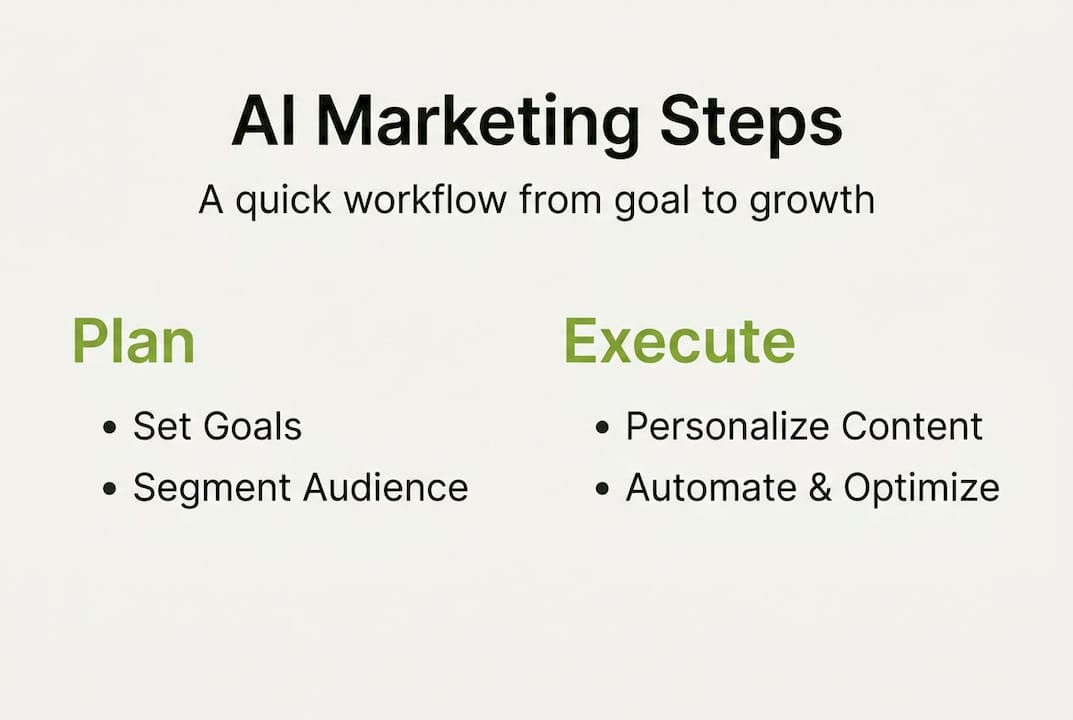
Step 4: Launch and automate
Set up automated triggers: follow-up emails after a download, retargeting ads after a site visit, or chatbot responses after a form fill. Refer to a modern marketing strategy guide to align these automations with your broader goals.
Step 5: Monitor and optimize in real time
Review performance data weekly at minimum. Let AI tools adjust bids and targeting automatically, but keep a human in the loop to catch anything that drifts off-strategy.
Full automation vs. hybrid workflow:
| Approach | Best for | Risk level |
|---|---|---|
| Full automation | Mature campaigns with proven data | Medium, needs monitoring |
| Hybrid human + AI | New campaigns or untested segments | Lower, more control |
Automated AI tools can increase campaign efficiency by up to 50% for SMBs. That efficiency gain is real, but it depends on the hybrid approach early on. Explore content marketing resources to support the content side of your campaigns.
Pro Tip: Choose campaigns with clear, short feedback cycles for your first AI trial. Paid search or email campaigns give you data within days, not months, so you can learn and adjust quickly.
Troubleshooting and maximizing your AI marketing strategy
Even well-planned AI campaigns run into problems. Knowing what to watch for saves time and budget.
Common pitfalls and how to avoid them:
- Low-quality data: AI tools amplify whatever data you feed them. Bad data produces bad targeting and wasted spend. Audit your CRM and analytics setup before launch.
- Unclear KPIs: Without defined success metrics, you can’t tell if AI is helping or hurting. Set benchmarks before you start.
- Over-automation: Letting AI run without human review leads to messaging that feels off-brand or targets the wrong audience.
- Ignoring negative signals: If engagement drops or unsubscribe rates spike, that’s a signal to pause and review, not just optimize further.
- Skipping the feedback loop: AI improves with input. If you’re not reviewing outputs and feeding corrections back into the system, you’re leaving performance on the table.
Many SMBs underestimate the need for oversight and human review in AI marketing. Automation handles the volume, but human judgment handles the nuance.
“The best AI marketing results come from teams that treat their tools as collaborators, not replacements. Review, refine, and repeat.”
Simple optimization tips:
- Run A/B tests on AI-generated content before scaling it
- Review audience segment performance monthly and update criteria
- Compare AI campaign results against your pre-AI benchmarks every quarter
- Use agency news on AI to stay current on tool updates and new capabilities
Pro Tip: Build a structured feedback loop. Schedule a monthly review where your team evaluates AI outputs, flags anything off-target, and updates your tool settings. This single habit separates teams that plateau from teams that keep improving.
Our perspective: Why experimentation beats perfection in AI marketing
Here’s something we see often: a marketing team spends months planning their AI rollout, waiting until every data source is connected and every workflow is documented. By the time they launch, a competitor who started with a simple email automation and a basic segmentation tool has already iterated through three rounds of improvements.
Perfect setups don’t win. Fast learners do.
The teams that get the most out of in-depth AI marketing insights are the ones willing to run a small pilot, measure what happens, and adjust. They celebrate a 10% improvement in open rates because they know it compounds. They don’t wait for a 50% gain before calling something a success.
If you’re managing marketing for a growing business, the most valuable thing you can do right now is pick one low-risk campaign, apply one AI tool, and learn from the results. That’s not a shortcut. That’s the actual strategy.
Take your AI-driven marketing to the next level
You now have a clear framework for building and running an AI-driven marketing strategy. The next step is putting it into practice with the right support behind you.
Idea Stream Marketing works with growth-focused businesses across the U.S. to implement AI marketing solutions that are practical, scalable, and built around your specific goals. From campaign strategy to automation setup, we help teams move from planning to results faster. Explore our digital marketing for small businesses services, or see how you can market smarter with digital strategies today. Ready to talk? Reach out and let’s build a strategy that fits your team and your goals.
Frequently asked questions
What is the biggest barrier to adopting AI in marketing for small to medium businesses?
The top barrier is often uncertainty about data quality and a lack of internal expertise, but accessible cloud-based tools are quickly lowering both hurdles for SMBs.
What types of marketing can AI automate most effectively?
AI excels at automating campaign targeting, personalization, content creation, and analytics, and up to 50% efficiency gains are achievable for SMBs who apply it to the right workflows.
How can I measure the success of my AI-driven marketing efforts?
Track clear KPIs such as conversion rates, engagement growth, and ROI, and compare results to your pre-AI benchmarks. With over 70% of marketing leaders already using AI, having measurable goals is what separates teams that prove value from those that guess.
Is AI marketing only for large companies with big budgets?
No. SMB adoption is accelerating because AI tools are now available through affordable cloud platforms and subscription-based automation tools that scale with your business size.
- What is AI SEO?
- How does AI SEO help small businesses?
Recommended
- AI in Marketing: The Future of Smarter, Data-Driven Growth
- Mastering Lead Generation: The Ultimate Guide for Business Growth | Web Design & Marketing Agency
- Long Island AI Enhanced Content Creation: Revolutionizing
- Mastering Modern Marketing A Guide by Idea Stream Marketing
This article was created by the team at Idea Stream Marketing, specializing in AI SEO and digital growth strategies.