



October 21, 2026




TL;DR:
- Most contractors waste marketing budgets by spending on the wrong channels without tracking their effectiveness.
- A data-driven strategy focusing on organic SEO, local ads, and referral systems ensures sustainable growth and measurable ROI.
- Organizing and monitoring key metrics allows contractors to allocate budgets effectively and build a reliable lead pipeline.
Most contractors who struggle with marketing are not spending too little. They are spending on the wrong things and have no way to tell the difference. Contractor marketing is not about visibility alone. It is about attracting the right clients, in the right service area, for the right project types, and then knowing exactly which channel made that happen. When you cannot trace a job back to its source, you cannot grow with any confidence. This article lays out a practical, data-driven system for building contractor marketing that fills your pipeline with quality leads and gives you the numbers to prove it.
Table of Contents
- Key takeaways
- Contractor marketing strategy starts with a plan
- SEO and Google Local Services Ads for local leads
- Building referrals and online reputation
- Tracking your marketing ROI
- Paid ads, social media, and email as support channels
- My honest take on where contractors go wrong
- How Ideastreammarketing helps contractors grow
- FAQ
Key takeaways
| Point | Details |
|---|---|
| Strategy before spending | Define your ideal client and project type before committing to any marketing channel. |
| SEO beats PPC long-term | Organic search delivers the lowest cost per lead after the initial ramp-up period. |
| Referrals are underrated | Referral leads average just $52 each and close at rates comparable to phone calls from search. |
| Tracking drives real ROI | Unique phone numbers and UTM parameters let you see which channels actually win jobs. |
| Paid ads fill short-term gaps | Google Ads and social platforms bring fast leads but require careful cost monitoring. |
Contractor marketing strategy starts with a plan
Before you spend a dollar on ads or hire someone to build a website, you need a clear plan. Marketing plans provide structure that ties every tactic back to a business goal. Without one, you end up with a collection of marketing activities that do not reinforce each other.
A solid plan for contractors covers these core elements:
- Ideal client profile. Who do you actually want to work with? Homeowners doing full kitchen remodels? Commercial property managers? Nail down the project size, budget range, and location.
- Target market. Which zip codes or neighborhoods are most profitable? Where do your best past clients live?
- Marketing channel mix. Which channels will you use and why? SEO, Google Local Services Ads, referrals, and paid ads each serve different timelines and budgets.
- Lead tracking setup. How will you know where every phone call and form submission came from?
- Performance metrics. What numbers will you review monthly to decide where to invest more or pull back?
Most contractors skip this step entirely. They see a competitor running Facebook ads and copy the tactic without asking whether it fits their business or their goals. That reactive approach creates waste. A construction marketing strategy built around your actual numbers gives you a competitive edge that ad spend alone never will.
Pro Tip: Before setting any marketing budget, spend one hour listing your last ten best clients. Where did they come from? That data is more valuable than any industry benchmark.
SEO and Google Local Services Ads for local leads
These two channels consistently deliver the best results for contractors who want local clients, and they work well together.
Why SEO deserves a serious investment
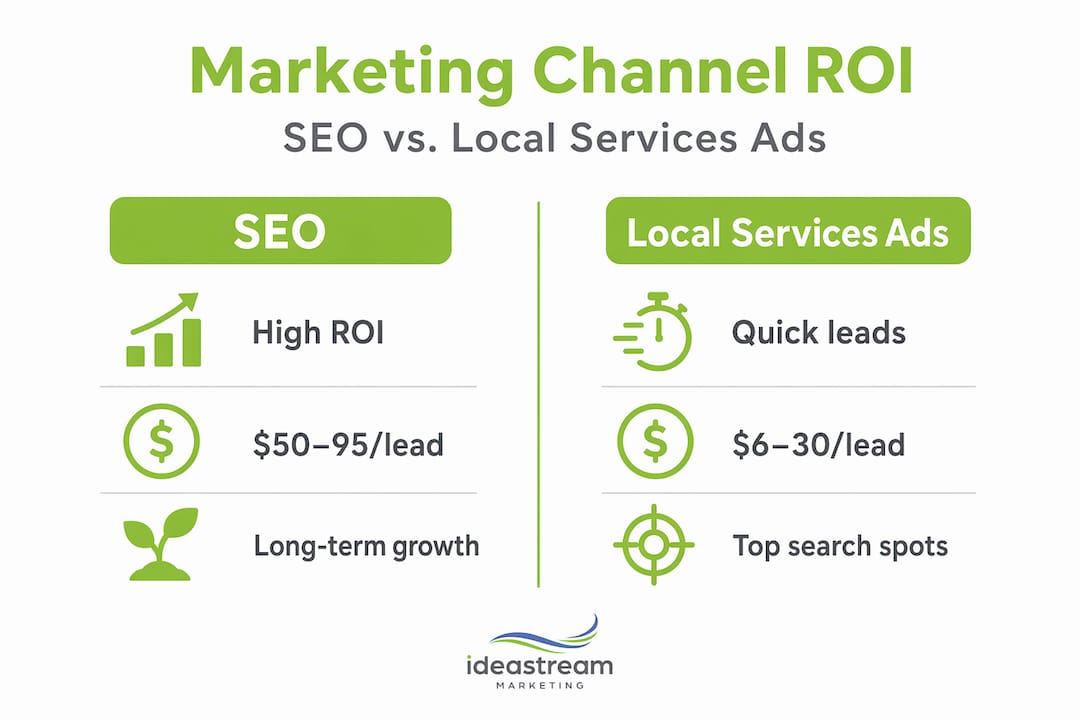
SEO produces the highest long-term ROI among all marketing channels for contractors, with an organic search cost per lead of $50 to $95 after the initial ramp-up. The catch is patience. You will generally wait four to eight months before organic rankings start generating consistent calls. Contractors who stick with it gain a pipeline that keeps producing without a media budget attached to every lead.
Local SEO is a specific discipline within this. Optimizing your Google Business Profile, building local citations, and earning backlinks from community websites all signal to Google that you are the right contractor for searches in your service area. This is where contractor digital marketing gets very specific and very effective.
Google Local Services Ads explained
Google Local Services Ads place your business at the absolute top of search results above traditional paid ads and organic listings. They display a Google Guaranteed badge, which significantly increases trust with homeowners making a first contact. The pricing model is pay-per-lead, not pay-per-click, which is a meaningful difference.
LSA leads cost $6 to $30 per lead for most home services categories, with weekly spend caps and the ability to dispute unqualified leads. That pricing structure makes budget management straightforward.
Here is how SEO and Google Local Services Ads compare across the metrics contractors care about most:
| Factor | SEO | Google Local Services Ads |
|---|---|---|
| Cost per lead | $50 to $95 (after ramp-up) | $6 to $30 |
| Time to results | 4 to 8 months | Immediate |
| Trust signals | High (organic ranking) | Very high (Google Guaranteed badge) |
| Long-term ROI | Highest of all channels | Moderate |
| Budget control | Low ongoing cost | Capped weekly spend |
| Best use | Sustainable lead flow | Fast start, high-intent leads |
Combining LSAs with traditional search ads gives you coverage of buyers at every stage, from early research to ready-to-hire. That combination is how renovation business promotion starts to feel like a system rather than a gamble.
Pro Tip: When setting up your Google LSA profile, upload photos of completed projects in the specific categories Google shows to customers. Profiles with project photos receive significantly more contact requests than text-only profiles.
Building referrals and online reputation
No channel delivers the combination of low cost and high trust that referrals do. Referral leads average $52 per lead and close at conversion rates of 35 to 40%, putting them in the same tier as phone calls from organic search. That is a remarkable number when you realize most contractors treat referrals as something that just happens rather than something to actively build.
Here is a simple referral program framework you can start this week:
- Identify your top 20 past clients. These are the ones who paid on time, had realistic expectations, and were happy with the result. They are your most likely referral sources.
- Call them personally. Not an email blast. A personal phone call asking whether they know anyone who might need your services creates a very different response.
- Offer a referral incentive. A gift card, a discount on future work, or a charitable donation in their name. Keep it simple and consistent.
- Create a follow-up system. Send a handwritten thank-you note after every completed job. This single habit drives more repeat and referral business than most contractors realize.
- Ask for a Google review immediately after project completion. Strike while satisfaction is high and the project is fresh.
Online reviews are public referrals. A contractor with 50 Google reviews and a 4.8-star average communicates trust to every homeowner who finds them online. Respond to every review, including negative ones, with professionalism. Homeowners read the responses as much as the reviews themselves.
Pro Tip: Text a direct Google review link to clients within 24 hours of job completion. Response rates for review requests drop sharply after 48 hours.

Tracking your marketing ROI
Most contractors cannot answer this question: which channel brought in the most profitable jobs last year? If you cannot answer it either, you are making budget decisions based on intuition rather than data. That changes right now.
Tracking cost per lead, conversion rate, and customer lifetime value are the three foundational metrics for accurate marketing ROI. The formula is direct: ROI equals revenue from marketing minus marketing cost, divided by marketing cost, then multiplied by 100.
The two tools that make tracking possible for contractors are:
- Unique phone numbers per channel. Assign a different number to your Google Ads, your website, your LSA listing, and your truck wrap. Software like CallRail or WhatConverts captures exactly which number was called and connects it to a lead record. Unique tracking numbers per channel eliminate the guesswork around source attribution.
- UTM parameters on all digital links. When you send traffic from a Facebook post, an email, or a paid ad to your website, tag the URL with UTM parameters. Your Google Analytics account will show you which sources are producing actual form fills.
Here is what a monthly ROI tracking table looks like in practice:
| Channel | Monthly spend | Leads generated | Cost per lead | Jobs closed | Revenue attributed |
|---|---|---|---|---|---|
| SEO | $800 | 12 | $67 | 4 | $28,000 |
| Google LSAs | $600 | 18 | $33 | 6 | $41,000 |
| Google Ads | $1,200 | 9 | $133 | 2 | $14,000 |
| Referrals | $200 | 5 | $40 | 3 | $22,000 |
This kind of table tells you immediately where to put next month’s budget. It also shows where to reduce spend or improve your follow-up process if close rates are lower than expected. Phone calls from search convert at 40%, which means how fast you answer and how well you handle the intake conversation matters as much as the lead source itself.
Paid ads, social media, and email as support channels
Once your organic and referral systems are working, paid channels serve as accelerators rather than foundations. Think of them as tools to fill short-term gaps or push into a new service area quickly.
Here is how to think about each channel:
- Google Ads. Google Ads average $128 per lead with a 10 to 15% conversion rate. The higher cost is worth it when organic rankings are not yet established or when you are targeting a specific, high-value project type like custom additions or commercial renovations.
- Social media ads. Social platforms average $108 per lead with lower long-term impact than search. They work best for awareness and retargeting rather than capturing active buyers. Short project videos and before-and-after photos outperform static image ads significantly on these platforms. Strong video marketing strategies can lower your cost per engagement on social substantially.
- Email marketing. Past clients represent your most affordable source of new revenue. A quarterly email with seasonal maintenance tips, recent project photos, and a clear call to schedule a consultation reactivates past relationships. For ideas on maximizing this channel, email engagement strategies can show you what works beyond a basic newsletter.
- Brand consistency. Every channel should use the same logo, color scheme, and messaging tone. A homeowner who sees your truck, finds your website, and clicks your Google ad should feel like they are encountering the same company each time.
My honest take on where contractors go wrong
I have worked with enough local service businesses to see a clear pattern. Contractors who struggle with marketing are almost always chasing volume. More clicks, more impressions, more followers. None of those numbers tell you whether the business is growing.
Many contractors mistake vanity metrics like clicks and impressions for success. The contractors I have watched grow consistently are the ones who obsess over two things: which channel is producing jobs, and how much those jobs cost to acquire. They are not the ones with the most active Instagram accounts. They are the ones who pick two or three channels, track them religiously, and shift budget toward what the data proves is working.
What most online marketing for contractors guides miss is this: local client targeting requires patience and specificity. A roofing contractor in a specific county does not need national visibility. They need to own the first page of Google for a handful of high-intent search terms in their service area. That requires discipline, not a bigger ad budget.
I have also seen that managing a disciplined channel mix with clear budget rules prevents the single most common contractor marketing mistake, which is pouring money into a channel that feels active but produces no jobs. If a channel cannot show you revenue, it does not deserve your dollars.
The contractors who grow sustainably are not necessarily the most aggressive marketers. They are the most organized ones.
— Dean
How Idea Stream Marketing helps contractors grow
At Idea Stream Marketing, we build marketing systems for contractors that are trackable from the first click to the signed contract. Our AI-powered SEO services improve your organic rankings in the specific local markets where your best clients live and search. We pair that with conversion-focused web design built to turn visitors into phone calls, and Google Ads management that keeps your cost per lead under control. We also set up lead tracking and reporting so you always know which channels are producing real revenue. If you are ready to build a contractor digital marketing system that actually pays for itself, schedule a consultation with our team today.
FAQ
What is the best marketing channel for contractors?
SEO and Google Local Services Ads consistently deliver the highest ROI for local contractors. SEO produces the lowest long-term cost per lead while LSAs generate immediate, high-intent leads with Google Guaranteed trust badges.
How much should a contractor spend on marketing?
Most contractors invest between 5% and 10% of gross revenue on marketing. The exact amount depends on your growth goals, current market position, and which channels you are using.
How do I track which marketing channel brings the most leads?
Use unique phone numbers for each channel with call tracking software and add UTM parameters to all digital links. This lets you connect every lead to its source and calculate true cost per job won.
Are referrals really worth building a system around?
Absolutely. Referral leads average $52 each and close at 35 to 40%, making them one of the most cost-effective lead sources available to any contractor.
How long does SEO take to produce leads for contractors?
Expect a ramp-up period of four to eight months before organic rankings generate consistent call volume. The investment pays off long-term through a steady pipeline of leads that do not require ongoing ad spend to sustain.

