



September 25, 2026




What integrated marketing really means for your brand
Integrated marketing is the practice of coordinating all your marketing efforts, across every channel, so customers receive one consistent, compelling brand message no matter where they encounter you. It pulls together paid, earned, and owned media into a unified system that builds brand awareness, favorability, and purchase intent more effectively than fragmented efforts ever could.
The formal term you’ll see in academic and professional circles is Integrated Marketing Communications, or IMC. Northwestern University’s Medill School defines IMC as the discipline of aligning every promotional touchpoint so the brand speaks with one voice across advertising, public relations, social media, email, and beyond. The goal isn’t to repeat the same sentence everywhere. True integration means tailoring messages to where the customer is in their journey while keeping the underlying brand promise identical.
Here’s what integrated marketing actually consists of:
- Paid media: Ads, sponsored content, Google Ads, and paid social placements
- Earned media: Press coverage, word of mouth, organic shares, and reviews
- Owned media: Your website, email list, blog, podcast, and social profiles
- Unified messaging: One brand voice, one visual identity, one core promise across all of the above
- Channel coordination: Campaigns planned so each channel reinforces the others, not competes with them
- Customer journey alignment: Messages matched to awareness, consideration, and decision stages
When these elements work together, customers recognize your brand faster, trust it more, and convert at higher rates.

Why adopting an integrated marketing strategy benefits your brand
Consistent, coordinated messaging does something that channel-by-channel marketing simply cannot: it compounds. Each touchpoint reinforces the last, so by the time a prospect reaches your sales page, your brand already feels familiar and trustworthy.
The benefits are concrete and measurable:
- Stronger brand recognition: Customers who see the same visual identity and message across channels recognize your brand faster and associate it with reliability.
- Higher message recall: Repeated exposure through multiple formats, video, email, social, and search, drives deeper retention than any single channel alone.
- Better customer experience: A shopper who sees your Instagram ad, visits your website, and then receives a follow-up email should feel like they’re in one continuous conversation, not three separate ones.
- Improved conversion rates: Coordinated campaigns guide prospects through the funnel more efficiently because each channel does its part without creating confusion.
- Greater marketing efficiency: Shared creative assets, unified messaging, and aligned teams reduce redundant work and wasted budget.
- Stronger ROI: Consistent messaging powered by customer data and analytics drives greater return than siloed campaigns running on separate strategies.
The flip side is equally instructive. Without integration, different members of your marketing team may send conflicting messages, and customers end up confused about what you actually offer. Think of it as a bicycle with all its parts scattered on the sidewalk. Each piece has value, but none of it moves until everything connects.
How to build an integrated marketing strategy step by step
Building a unified marketing plan takes more than telling every team to “stay on brand.” Here’s a practical sequence that works for businesses of any size.
- Map your customer journey. Identify every touchpoint where a prospect encounters your brand, from a Google search to a social media post to a sales call. Note which channels they use at each stage of awareness, consideration, and decision.
- Define your core brand promise. Before you write a single ad, get clear on the one message your brand stands for. Every channel will express this promise differently, but the underlying idea must stay identical.
- Build detailed audience personas. Know who you’re talking to, what problems they have, and where they spend their time online. This shapes which channels you prioritize and how you frame your message on each.
- Select two or three high-impact channels first. Trying to be everywhere at once leads to inconsistent messaging and wasted resources. Start where your audience is most active, then scale once the foundation is solid.
- Develop channel-specific content around one message. A brand video on YouTube, a carousel post on Instagram, and a nurture email can all carry the same campaign idea while being formatted for how people consume each platform.
- Align visual identity and tone across every asset. Colors, fonts, photography style, and copy voice should be immediately recognizable whether someone lands on your website or sees your ad on LinkedIn.
- Coordinate campaign timing. Launch channels in a sequence that makes sense for the customer journey. Awareness ads run first, retargeting follows, and email nurture closes the loop.
- Share data across teams. Your social team should know what your email team is sending, and your paid ads team should know what your SEO content is targeting. Shared dashboards and weekly syncs prevent duplication and gaps.
- Integrate your measurement tools. Use platforms like Google Analytics 4, a CRM, and your email platform together so you can track how customers move across channels, not just how each channel performs in isolation.
- Track cross-channel conversions. Measuring cross-channel connection points, like a website visitor who converts to an email subscriber and then makes a purchase, reveals whether your channels are truly working together or simply coexisting.
- Review and adjust quarterly. Integrated marketing is not a one-time setup. Audience behavior shifts, platforms change, and your business goals evolve. Build a regular review cycle into your plan.
Pro Tip: Before you add a new channel to your mix, ask whether your team can maintain message consistency there. A channel you can’t sustain consistently does more damage to brand perception than no presence at all.

The 4 Ps and 4 Cs frameworks that guide integrated marketing
Two foundational frameworks give integrated marketing its strategic backbone. Understanding both helps you build campaigns that are both internally sound and genuinely customer-focused.
The 4 Ps: the classic marketing mix
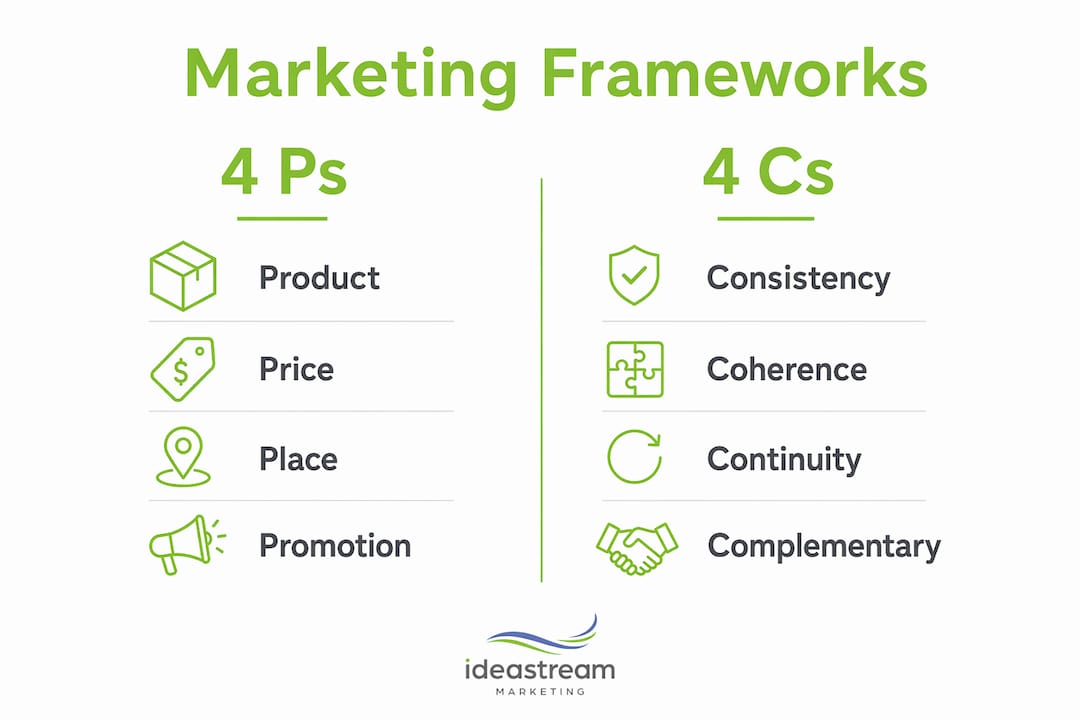
The 4 Ps represent the traditional, business-centric view of marketing strategy: Product (what you sell), Price (what you charge), Place (where you distribute), and Promotion (how you communicate). This model is useful for planning the mechanics of a campaign, but it starts from the inside out, focusing on what the business offers rather than what the customer needs.
The 4 Cs: the customer-centric evolution
The 4 Cs shift the perspective from pushing messages to engaging customers in two-way conversations. Instead of Product, you think about Customer (their needs and wants). Price becomes Cost (the total cost to the customer, including time and effort). Place becomes Convenience (how easy it is to buy). Promotion becomes Communication (dialogue, not broadcast).
The 4 Cs of Integrated Marketing Communications
Separately, the 4 Cs of IMC provide a quality check for your campaign execution: Consistency (the same message across all channels), Coherence (messages that connect logically), Continuity (sustained messaging over time), and Complementary (channels that amplify each other). These four principles prevent fragmented messaging and reinforce brand identity at every customer interaction.
| Framework | Focus | Key Elements | Primary Goal |
|---|---|---|---|
| 4 Ps | Business-centric | Product, Price, Place, Promotion | Plan the marketing mix |
| 4 Cs (Customer model) | Customer-centric | Customer, Cost, Convenience, Communication | Align with customer needs |
| 4 Cs of IMC | Campaign quality | Consistency, Coherence, Continuity, Complementary | Unify cross-channel messaging |
Used together, these frameworks ensure your campaigns are both strategically sound and genuinely relevant to the people you’re trying to reach.
How integrated marketing differs from multichannel and omnichannel marketing
These three terms get used interchangeably, but they describe meaningfully different approaches. Knowing the distinction helps you choose the right strategy for your goals.
- Multichannel marketing means your brand is present on multiple channels, social media, email, print, and paid ads, but each channel operates somewhat independently. The messaging may vary, the creative may differ, and there’s no deliberate effort to connect the customer experience across platforms. Presence is the goal; coordination is not.
- Omnichannel marketing takes multichannel a step further by using technology to create a truly connected customer experience. A customer who adds something to their cart on mobile and then opens your app on a tablet picks up exactly where they left off. The focus is on technical integration and real-time data sharing so the experience feels frictionless regardless of device or platform.
- Integrated marketing is about strategic alignment of messaging, creative, and tactics across channels. It doesn’t require the same level of real-time technical infrastructure as omnichannel, but it demands that every channel tells the same story and serves the same campaign objective. The emphasis is on message coherence and team coordination, not just platform connectivity.
In practice, the most effective marketing programs combine all three: multichannel reach, omnichannel technology, and integrated messaging strategy. For most businesses, integrated marketing is the most accessible starting point because it’s primarily a planning and communication discipline, not a technology investment.
Common challenges in integrated marketing and how to overcome them
Organizational silos are the biggest obstacle
Departmental isolation is the most common reason integrated campaigns fall apart. When your social team, email team, and paid ads team each work in their own lane without sharing objectives or data, the customer experiences three different brands instead of one. Breaking silos requires shared goals, shared dashboards, and a single campaign brief that every team works from.
Trying to be everywhere at once
The instinct to maximize reach by activating every available channel usually backfires. Resources get spread thin, quality drops, and messaging becomes inconsistent. The better approach is to master two or three channels where your audience is most active, then expand once those are running well.
Inconsistent creative and tone
Even with good intentions, creative assets drift when multiple people or agencies produce them without a shared style guide. A brand standards document covering colors, fonts, photography direction, and copy voice is not optional. It’s the operational backbone of any integrated effort.
Measuring the wrong things
Tracking each channel’s performance in isolation misses the point of integration. If your social ads drive email sign-ups and those subscribers eventually purchase, attributing the sale only to email undercounts the value of the full system. Cross-channel measurement, tracking how customers progress from one touchpoint to the next, gives you a far more accurate picture of what’s actually working.
Pro Tip: Use UTM parameters consistently across every campaign link so your analytics platform can show you the full customer path from first touch to conversion, not just the last click.
You can see how real-world brands apply these principles by reviewing integrated campaign case studies that document the full arc from strategy to execution to results.
Key Takeaways
Integrated marketing works because it aligns every channel, message, and team around one brand promise, making each touchpoint reinforce the next rather than compete with it.
| Point | Details |
|---|---|
| Unified messaging is the core | Every channel should express the same brand promise, tailored to format and audience stage. |
| Start with two or three channels | Master message consistency on a few high-impact channels before expanding your reach. |
| Use both the 4 Ps and 4 Cs | The 4 Ps plan your mix; the 4 Cs keep you customer-focused and campaign-coherent. |
| Break silos with shared tools | Shared briefs, dashboards, and goals are what turn separate teams into one integrated effort. |
| Measure cross-channel progression | Track how customers move from channel to channel, not just how each channel performs alone. |
Why integration is harder than it looks, and more worth it than most brands realize
Most marketing teams understand integrated marketing conceptually. The gap is almost always in execution, and it’s wider than people expect.
The real difficulty isn’t getting everyone to agree on a brand color or a tagline. It’s getting a paid ads manager, a content writer, a social media coordinator, and a video producer to operate from the same strategic brief at the same time, without reverting to their individual channel habits the moment the campaign goes live. That kind of coordination requires leadership commitment, not just a style guide.
What I find under appreciated is how much integrated marketing depends on the quality of the content at its center. You can have perfect channel coordination, but if the video, the copy, or the creative is weak, the integration just amplifies mediocrity. The brands that do this well, think of campaigns where a single idea travels from a TV spot to a podcast to a social series to an email sequence without losing energy, invest heavily in the core creative before they think about distribution.
AI-powered analytics are changing the measurement side of this equation in genuinely useful ways. Cross-channel attribution models that once required enterprise-level budgets are now accessible to mid-size businesses. That means you can actually see whether your social media strategy is feeding your email list, and whether that list is driving purchases. The data is there. Most teams just aren’t looking at it across channels yet.
The other thing worth saying plainly: integration is never finished. Audience behavior shifts, platforms evolve, and business goals change. The brands that treat integrated marketing as a one-time campaign setup rather than an ongoing operating model are the ones that end up with fragmented messaging again within six months. Build the review cycle into your calendar from day one.
FAQ
What is the meaning of integrated marketing?
Integrated marketing is the coordination of all marketing channels and messages so that customers receive a consistent brand experience at every touchpoint. It aligns paid, earned, and owned media around a single brand promise.
What are the 4 Ps of integrated marketing?
The 4 Ps are Product, Price, Place, and Promotion. They form the traditional marketing mix that defines what a business sells, at what price, through which distribution channels, and how it communicates that offer to customers.
What are the 4 Cs of Integrated Marketing Communications?
The 4 Cs of IMC are Consistency, Coherence, Continuity, and Complementary. These principles ensure that campaign messages are aligned across channels, logically connected, sustained over time, and mutually reinforcing.
What is IMC in simple words?
IMC, or Integrated Marketing Communications, means sending the same core brand message through multiple channels, like ads, email, social media, and PR, so customers hear a unified story no matter where they find you.
Ready to put integrated marketing to work for your business? Idea Stream Marketing combines professional video production, AI-powered SEO, and full-service digital marketing to help brands on Long Island and across the United States build campaigns where every channel pulls in the same direction. Whether you need branded video content, a podcast series, or a complete cross-channel strategy, we build it with discoverability and conversion in mind.
Connect with Idea Stream Marketing today and let’s build a marketing system that works as one.