



October 16, 2026




TL;DR:
- Patient lead generation involves attracting prospective patients through HIPAA-compliant marketing to ensure ethical and legal compliance. It relies on multichannel outreach, rapid follow-up, and quality data management to optimize acquisition costs and lifetime value. Effective strategies include local SEO, physician referrals, and prompt response times, all built on secure, regulated technology infrastructure.
Patient lead generation is the process by which healthcare providers attract prospective patients and convert them into scheduled appointments through compliant, targeted marketing strategies. In the industry, this is formally called patient acquisition, and it functions as a governed data operation that must protect privacy from the first ad impression through the booked appointment. Unlike standard consumer marketing, healthcare lead generation requires HIPAA-compliant infrastructure, clinical intent scoring, and careful management of protected health information (PHI). Two metrics define whether the process is working: patient acquisition cost (PAC) and patient lifetime value (LTV).
What is patient lead generation and why does it differ from standard marketing?
Patient lead generation is defined as the systematic process of identifying, attracting, and converting prospective patients into booked appointments using multichannel marketing and compliant data management. The industry term is patient acquisition, and it carries regulatory weight that standard business-to-consumer marketing does not. Healthcare lead generation differs fundamentally from B2C marketing by requiring HIPAA-compliant infrastructure and clinical intent scoring at every stage.

The financial stakes are significant. A new primary care patient carries a lifetime value of $1,500–$3,500, while specialty patients can reach $5,000–$15,000 or more. That LTV figure is the benchmark against which every dollar of acquisition spending must be measured. A PAC-to-LTV ratio under 20% is considered sustainable and profitable in healthcare marketing. For example, if a patient’s LTV is $2,500 and the practice spends $200 to acquire them, the ratio sits at 8%, which signals strong return on investment.
Patient acquisition also demands a unified data pipeline. Disconnected systems prevent closed-loop attribution, which means practices cannot trace which ad or channel produced a booked appointment. Without that visibility, marketing budgets get wasted and compliance integrity erodes. Providers who treat patient acquisition as a governed data operation from the start avoid both problems.
What are the core components of effective patient lead generation?
Effective patient acquisition runs on four interconnected components: multichannel outreach, compliant lead capture, performance measurement, and rapid follow-up. Each one fails without the others.
Multichannel outreach covers the channels that bring prospective patients into the funnel:
- Organic search and local SEO: Google Business Profile optimization, location-targeted content, and schema markup that surfaces the practice in local search results.
- Paid advertising: Google Search Ads and social media ads targeted by condition, location, and search intent.
- Physician referral networks: Structured relationships with primary care providers who send patients to specialists.
- Content marketing: Patient education articles, videos, and FAQs that answer health questions and build trust before a prospective patient ever calls.
HIPAA-compliant lead capture means every form, landing page, and tracking pixel must be audited to confirm it does not accidentally collect PHI. Standard marketing setups frequently miss this. Lead routing must also be compliant, sending inquiry data only to authorized staff through secure channels.
Performance measurement requires tracking cost-per-acquisition, conversion rates by channel, and closed-loop attribution that connects ad spend to actual revenue. Without this data, scaling decisions are guesswork.
Pro Tip: Set a response time target of five minutes for new patient inquiries. Leads contacted within five minutes convert at 10 times the rate of those contacted after 24 hours. Most intake teams operate far slower than that.
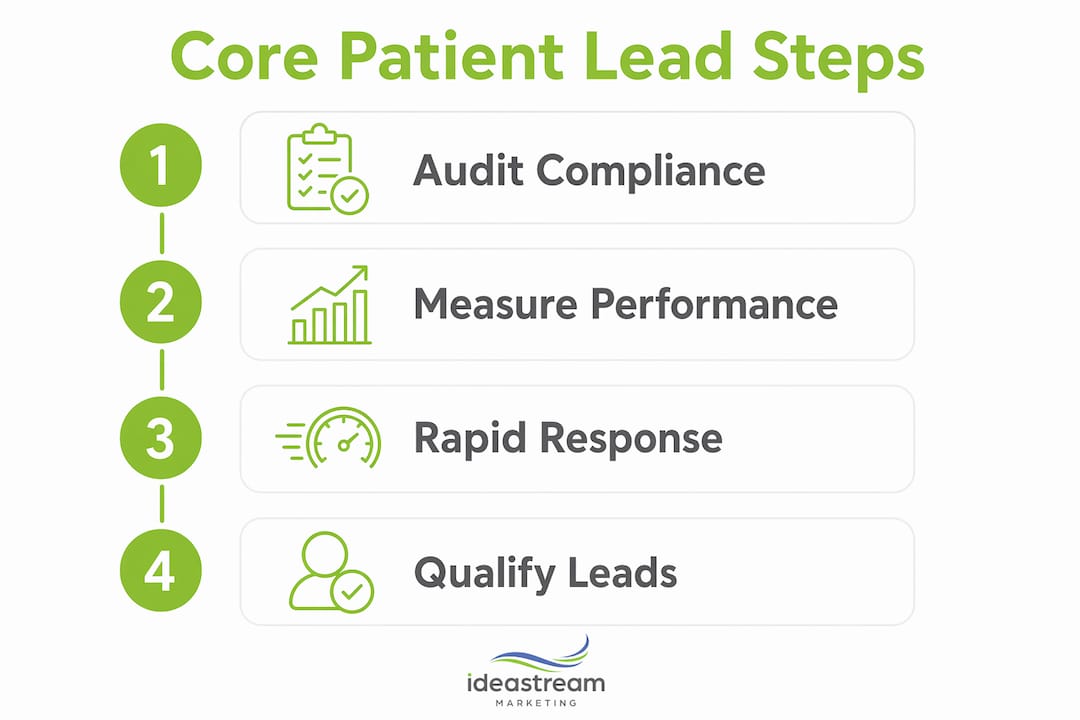
Lead qualification by clinical urgency is the final layer. Not every inquiry carries the same priority. A prospective patient describing acute symptoms needs a different response speed than someone scheduling a routine annual exam. Triage logic built into the intake process protects both the patient and the practice’s conversion rate.
How does HIPAA compliance shape healthcare lead generation?
HIPAA compliance is not a checkbox. It is the architecture that every patient acquisition system must be built on. PHI is defined as any individually identifiable health information, and marketing tools capture it accidentally more often than providers realize.
The most common violations happen through URL parameters and tracking pixels. When a prospective patient clicks an ad for a specific condition and lands on a condition-specific page, the URL often contains the condition name. Marketing systems transmit that PHI accidentally through standard conversion tracking unless the system is specifically configured to exclude health condition parameters. Generic marketing setups almost never include that configuration.
Providers must audit four areas for compliance:
- Lead capture forms: Confirm that form submissions route only to HIPAA-authorized systems, not to generic CRM tools without a Business Associate Agreement (BAA).
- Tracking pixels: Configure Google Ads and Meta pixels to fire on conversion events only, not on page URLs that contain condition names.
- Data flows between platforms: Map every path that patient inquiry data travels, from ad click through CRM to EHR, and confirm each handoff is covered by a BAA.
- Retention policies: Define how long inquiry data is stored and who has access.
The gap between healthcare marketing and standard B2C marketing is widest here. A retail brand can use any CRM, any pixel configuration, and any retargeting audience without legal risk. A healthcare provider cannot. Integrating ad platforms, CRM systems, and electronic health records within HIPAA boundaries requires deliberate technical choices, not default settings.
Pro Tip: Configuring conversion tracking to exclude health condition URL parameters is the single most overlooked technical fix in healthcare marketing. Do this before launching any paid campaign.
The benefits of digital marketing for healthcare providers are real, but they only materialize when the compliance foundation is solid. A data breach or HIPAA violation can cost far more than any marketing campaign generates.
What practical patient acquisition strategies drive growth and ROI?
The highest-return patient acquisition strategies share one trait: they match channel investment to measurable patient value. Here are the six methods that consistently produce results.
- Local SEO and Google Business Profile optimization. Practices ranking in the Google 3-Pack see 3–5 times more appointment requests than those on page two or lower. An optimized Google Business Profile alone can generate 40–60 appointment requests monthly in mid-size markets. This is the highest-ROI channel for most practices because the cost is primarily time, not ad spend.
- Physician referral networks. Physician referrals carry the lowest PAC and the highest LTV of any acquisition channel. Patients referred by primary care providers show better retention and higher follow-through rates on treatment plans. Building a structured referral program with regular outreach to referring physicians is one of the most cost-efficient investments a specialty practice can make.
- Content marketing and patient education. Condition-specific articles, procedure explainer videos, and FAQ pages attract prospective patients who are actively researching their options. This channel builds trust before the first phone call and pre-qualifies patients by intent. A strong healthcare content strategy reduces the time intake staff spend answering basic questions.
- Paid search advertising. Google Search Ads targeting condition-specific and location-specific queries reach patients at the moment of highest intent. Campaigns should be structured around service lines, not the practice name, because prospective patients search for solutions, not providers they have never heard of.
- PAC-to-LTV tracking. Every channel must be evaluated against the sustainable 20% PAC-to-LTV threshold. Channels that exceed that ratio should be reduced or restructured before budget is increased.
- Retention as an acquisition cost reducer. Retaining existing patients reduces the volume of new patients needed to hit revenue targets. Appointment reminders, follow-up care outreach, and patient satisfaction programs all lower the effective cost of growth.
| Strategy | Primary benefit | Cost profile |
|---|---|---|
| Local SEO and Google Business Profile | High appointment volume | Low ongoing cost |
| Physician referral networks | Lowest PAC, highest LTV | Relationship investment |
| Content marketing | Pre-qualified patient intent | Moderate time investment |
| Paid search advertising | Immediate volume at scale | Variable ad spend |
Patients increasingly evaluate providers through online platforms before booking. A practice with strong reviews, accurate listings, and educational content wins that evaluation before a competitor even enters the picture.
How does technology and data integration improve patient lead generation outcomes?
Technology does not replace good marketing strategy. It makes good strategy measurable and repeatable. The most important technology investment in patient acquisition is closed-loop attribution, which connects every ad dollar to actual billable revenue.
Without closed-loop attribution, a practice might see that Google Ads generated 50 form submissions last month but have no way to confirm how many became booked appointments, how many showed up, or what revenue they produced. With it, the practice can calculate the exact PAC for each channel and reallocate budget to what works. Organizations that implement unified, HIPAA-compliant data pipelines typically see a 40–60% improvement in cost-per-acquisition within the first quarter of operation.
Real-time lead routing is the second critical technology layer. When a prospective patient submits an inquiry, the system should route that lead to an intake coordinator within minutes, not hours. Automated routing through a HIPAA-compliant CRM removes the manual delay that kills conversion rates.
AI adds a third layer: clinical intent scoring. AI tools can analyze the language in a patient inquiry to flag urgency, identify the likely service line, and prioritize the lead queue accordingly. A message describing chest pain routes differently than one asking about scheduling a wellness visit. This triage logic protects patients and improves the efficiency of intake staff.
Pro Tip: Breaking down silos between your ad platforms, CRM, and EHR is the hardest part of building a compliant data pipeline. Start by mapping every data handoff on paper before touching any software. Gaps become obvious immediately.
The table below shows how technology investments shift key metrics over time.
| Technology layer | Metric improved | Typical impact |
|---|---|---|
| Closed-loop attribution | Cost-per-acquisition | 40–60% reduction |
| Real-time lead routing | Lead-to-appointment conversion | Significant increase |
| AI intent scoring | Intake staff efficiency | Faster triage, fewer missed leads |
| Unified data pipeline | Marketing budget allocation | Reallocation to highest-ROI channels |
Understanding lead nurturing strategies also matters here. Not every inquiry converts immediately. A well-designed nurture sequence keeps the practice visible to prospective patients who are still deciding, without violating their privacy or overwhelming their inbox.
Key Takeaways
Patient lead generation succeeds when HIPAA-compliant data infrastructure, multichannel outreach, and rapid follow-up work together as a single governed system.
| Point | Details |
|---|---|
| Define your PAC-to-LTV ratio | Keep patient acquisition cost below 20% of lifetime value to stay profitable. |
| Start with local SEO | Google Business Profile optimization generates appointment requests at the lowest cost of any channel. |
| Build compliance first | Audit every form, pixel, and data flow for HIPAA compliance before launching paid campaigns. |
| Respond within five minutes | Leads contacted in five minutes convert at 10 times the rate of those reached after 24 hours. |
| Unify your data pipeline | Closed-loop attribution connecting ad spend to revenue reduces cost-per-acquisition by 40–60%. |
What I’ve learned about patient lead generation after years in healthcare marketing
Most healthcare providers approach patient acquisition the same way a retail brand approaches customer acquisition. They pick a few channels, run some ads, and wait for the phone to ring. That approach fails in healthcare for two reasons: compliance and intent.
Privacy is not a feature you add later. Every campaign I have seen fail in healthcare failed because the compliance infrastructure was built after the marketing was already running. PHI was leaking through pixels, form data was sitting in non-compliant CRMs, and nobody had mapped the data flows. The fix always costs more than building it right the first time.
The second mistake is skipping zero-cost channels to go straight to paid ads. Local SEO and physician referral networks consistently outperform paid search on PAC-to-LTV ratios. I have watched practices spend thousands monthly on Google Ads while their Google Business Profile sat unclaimed and their referring physicians had not heard from them in a year. Fix the free channels first.
Speed of follow-up is the most underrated variable in the entire system. The five-minute rule is not a suggestion. It is the difference between a booked appointment and a prospective patient who called the next practice on the list. Automating that first response, even with a simple acknowledgment message, changes conversion rates measurably.
The practices that grow sustainably are the ones that treat patient acquisition as an ongoing data operation, not a campaign. They benchmark PAC-to-LTV monthly, adjust channel mix based on attribution data, and invest in retention to reduce the volume of new patients they need to acquire. That is the model that works.
— Dean
How Idea Stream Marketing supports healthcare patient acquisition
Healthcare providers need more than a marketing checklist. They need content that builds trust before a prospective patient ever calls, and a digital presence that converts that trust into booked appointments.
Idea Stream Marketing works with healthcare providers to create video marketing content that communicates expertise, builds patient confidence, and supports local SEO performance across Google and AI-powered search platforms. From patient testimonial videos to procedure explainers and branded content, every piece is built with discoverability in mind. Our digital marketing services include Google Ads management, local SEO, content marketing, and Google Business Profile optimization, all structured to support compliant patient acquisition strategies. Contact Ideastreammarketing to build a patient acquisition system that generates measurable results.
FAQ
What is patient lead generation in simple terms?
Patient lead generation is the process of attracting prospective patients and converting them into scheduled appointments through targeted, HIPAA-compliant marketing. It is the healthcare-specific version of customer acquisition.
How does HIPAA affect patient lead generation?
HIPAA requires that all marketing tools, forms, and data flows avoid capturing or transmitting protected health information. Standard marketing setups frequently violate this requirement through tracking pixels and URL parameters.
What is a good patient acquisition cost?
A PAC-to-LTV ratio under 20% is considered sustainable in healthcare marketing. If a patient’s lifetime value is $2,500, spending under $500 to acquire them keeps the practice profitable.
Which patient acquisition channel has the highest ROI?
Local SEO and Google Business Profile optimization consistently deliver the highest ROI because the cost is primarily time. Practices in the Google 3-Pack receive 3–5 times more appointment requests than those ranked lower.
How quickly should a practice respond to new patient inquiries?
Practices should respond within five minutes of receiving an inquiry. Leads contacted within five minutes convert at 10 times the rate of those contacted after 24 hours.

