



September 30, 2026




TL;DR:
- Referrals alone create growth ceilings; digital marketing offers scalable, predictable lead generation.
- Effective digital marketing for professional services includes SEO, content, advertising, and website optimization.
- Combining digital strategies with traditional methods enhances authority, trust, and client conversion.
Referrals have built some of the most successful professional service firms in the country. But here’s the reality: referrals plateau. They depend on timing, personal networks, and luck. If you’re a marketing manager or business owner at a law firm, consulting practice, financial advisory, or similar firm, you already know that word-of-mouth alone can’t guarantee next quarter’s pipeline. Digital scales more predictably than referrals, giving you a repeatable system for attracting, engaging, and converting ideal clients. This article walks you through why digital marketing is no longer optional for professional services, what it actually covers, how it drives measurable growth, and what to watch out for along the way.
Table of Contents
- The changing landscape for professional service firms
- What digital marketing means for professional services
- How digital marketing drives growth and ROI
- Common pitfalls and how to avoid them
- A smarter approach: blending digital with traditional
- Partner with a digital marketing expert
- Frequently asked questions
Key Takeaways
| Point | Details |
|---|---|
| Digital amplifies referrals | Used with referrals, digital marketing delivers scalable and sustainable lead generation. |
| Strategy mix outperforms solo tactics | Combining digital and traditional marketing yields the best results for professional service firms. |
| Design for conversion matters | Prioritizing user experience and conversion-optimized websites maximizes digital ROI. |
| Track and optimize | Measuring results and refining tactics ensure ongoing improvement and higher ROI. |
The changing landscape for professional service firms
For decades, professional service firms grew through referrals, networking events, industry sponsorships, and direct mail. Those tactics still carry weight. But the buyers those tactics once reached have changed how they make decisions. Today, your prospective client has likely Googled your firm, read your reviews, checked your LinkedIn, and visited your website before they ever reach out.
This shift matters more than most firms acknowledge. If your digital presence is thin or inconsistent, you may be losing clients who found a competitor first, not because that competitor is better, but because they showed up online when it counted. The benefits of B2B digital marketing over traditional approaches are particularly clear here: digital puts you in front of buyers during the research phase, before they’ve committed to anyone.
Here’s what’s actually changing for professional service firms right now:
- Buyers research service providers online before making contact, often before a referral is ever made
- Younger decision-makers expect a strong digital presence as a baseline for credibility
- Referral networks shrink over time without active cultivation and new relationship building
- Competitors who invest in digital consistently appear in searches your ideal clients are already conducting
- Digital channels capture intent-driven traffic, meaning people who are already looking for what you offer
“Many firms still rely mainly on referrals, but digital can scale lead generation in ways that referrals simply cannot replicate at volume.”
This isn’t about abandoning what works. It’s about recognizing that relying solely on referrals creates a ceiling. Digital marketing breaks through that ceiling by creating consistent, repeatable lead flow that isn’t dependent on someone else making a phone call on your behalf.
Having set the foundation on why digital is necessary, let’s clarify exactly what digital marketing covers for professional service firms.
What digital marketing means for professional services
Digital marketing is a broad term, and that breadth often creates confusion. For professional service firms specifically, it covers a focused set of strategies that work together to attract and convert the right clients. It is not just social media or running ads. It is a system.
The core components include search engine optimization (SEO, which means improving how your website ranks in Google and other search engines), website optimization, content marketing, pay-per-click advertising (PPC), social media management, and email campaigns. Each tactic plays a different role. Digital should be used in combination with traditional methods for the strongest results, not as a complete replacement.

Here is a quick comparison of traditional versus digital tactics:
| Tactic | Traditional | Digital |
|---|---|---|
| Lead source | Referrals, events, mail | SEO, PPC, email, content |
| Targeting | Broad, geographic | Precise, intent-based |
| Measurement | Difficult | Trackable and specific |
| Cost per lead | Variable, often high | Optimizable over time |
| Scalability | Limited by network | Scales with budget and strategy |
When thinking about how these digital marketing strategies fit together, it helps to group them by function:
- Build brand awareness: Content marketing, SEO, and social media put you in front of new audiences consistently
- Convert leads: Landing page optimization, PPC, and clear calls-to-action turn visitors into inquiries
- Nurture relationships: Email campaigns and retargeting ads keep your firm top-of-mind for prospects who aren’t ready to commit yet
Exploring the most popular digital channels for small and mid-size businesses shows just how many entry points exist for reaching your ideal clients. For professional services, the highest-performing combination typically includes SEO, a well-designed website, and targeted email or paid campaigns working in parallel.
Now that we’ve defined the scope, let’s look at why digital scales lead generation where referrals cannot.
How digital marketing drives growth and ROI
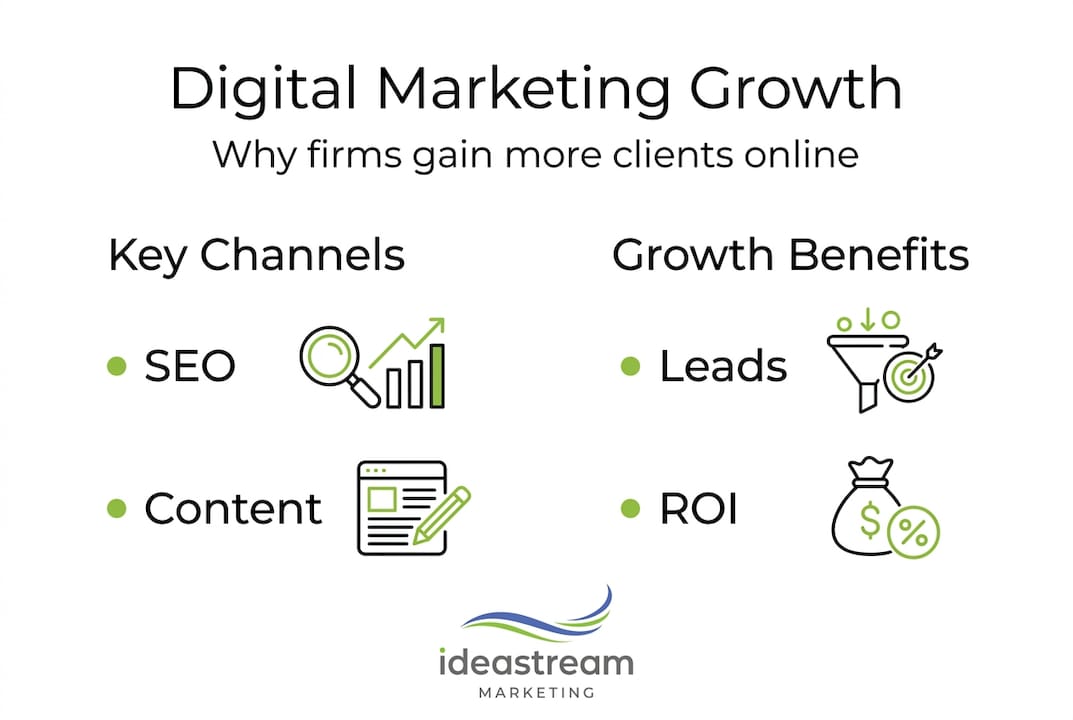
One of the most powerful things about digital marketing is that it compounds. A referral delivers one lead at one moment in time. A well-optimized website or a strong SEO strategy can deliver leads every week, every month, over years, without requiring a new personal introduction each time.
Digital marketing scales predictably and allows you to measure exactly what’s working and what isn’t. That’s a fundamentally different relationship with your marketing spend than most firms are used to.
| Factor | Referral-based | Digital marketing |
|---|---|---|
| Scalability | Limited by network size | Scales with investment |
| Reliability | Inconsistent timing | Consistent with strategy |
| Cost per lead | Difficult to track | Measurable and improvable |
| Data feedback | Minimal | Ongoing and detailed |
Here are the steps most professional service firms should follow to get real ROI from digital:
- Optimize your website for both user experience and search engines. A slow or confusing site loses leads before they contact you.
- Invest in SEO to capture clients searching for your services right now.
- Build a content library that answers your clients’ most common questions and builds your authority online.
- Run targeted PPC campaigns to generate faster results while your organic presence grows.
- Set up email nurturing sequences to stay connected with leads who aren’t ready to buy yet.
- Use retargeting ads to bring back website visitors who left without converting.
- Track KPIs (key performance indicators) like traffic, leads, and cost per acquisition to guide ongoing improvements.
Pursuing scalable marketing growth means building systems that continue working even when you’re focused on delivering client work. That’s the real value of digital: it works for you around the clock.
Pro Tip: Before launching any paid campaign, make sure your website’s landing pages are built to convert. Sending ad traffic to a generic homepage is one of the fastest ways to waste your budget. Using smart digital strategies from the start prevents that waste.
While digital offers strong ROI, many firms still fall short. Let’s look at why, and how to sidestep the most common mistakes.
Common pitfalls and how to avoid them
Even firms that invest in digital marketing often see disappointing results. The problem usually isn’t the channel. It’s how the investment is structured. Understanding where firms go wrong helps you make smarter decisions from the start.
Many firms underinvest in conversion architecture, which means they drive traffic to a website that isn’t designed to turn visitors into leads. Traffic without conversion is just an expensive awareness exercise.
The most common pitfalls to watch for include:
- Weak website experience: Slow load times, confusing navigation, and vague messaging all reduce the chance that a visitor contacts you
- No analytics setup: If you aren’t tracking where leads come from, you can’t improve what’s working or stop wasting money on what isn’t
- No clear conversion path: Every page on your website should have a specific next step. If visitors don’t know what to do, they leave
- Chasing every channel: Trying to be everywhere at once dilutes your budget and focus. Prioritize two or three high-ROI tactics first
- Ignoring content quality: Thin, generic content doesn’t rank in search engines and doesn’t build trust with prospective clients
Pro Tip: Before you increase your marketing budget, avoid these marketing mistakes by auditing your current website. Fix the conversion path first. More traffic to a broken funnel just means more wasted spend.
Taking time to understand the most common marketing mistakes firms make and knowing when to consider choosing the right agency are both smart early steps. Getting the fundamentals right from the beginning saves months of frustration and budget.
With those pitfalls addressed, you can approach digital marketing more strategically. Here’s a practical perspective you don’t often hear.
A smarter approach: blending digital with traditional
Here’s where a lot of conventional advice gets it wrong. The conversation around digital marketing often frames it as a replacement for traditional methods. We don’t believe that’s the right way to think about it, and the data supports that view. Digital doesn’t replace traditional; the best-performing firms use both, each where it excels.
Consider a real-world example. A professional services firm sponsors an industry conference. Digital marketing drives registrations, promotes the event across social media, and captures email signups from attendees. Then, at the event itself, personal conversations build the trust that closes the relationship. Neither side of that equation works as well alone.
The firms that consistently outperform their competitors don’t silo their marketing. They use digital to scale and nurture, and traditional to establish authority and deepen trust. If you haven’t audited your current mix, that’s the most valuable thing you can do today. Look honestly at where your leads come from, where they drop off, and where a blended approach could fill the gaps.
Partner with a digital marketing expert
Knowing what to do and building a system that actually executes it are two different things. If you’re ready to stop relying on unpredictable referrals and build a scalable marketing engine for your firm, working with an experienced team makes the process faster and more effective.
At Idea Stream Marketing, we work with professional service firms across the United States to build strategies that drive real, measurable growth. Whether you need digital marketing services tailored to your firm’s goals, SEO solutions that put you in front of the right clients, or data-driven web design that converts visitors into leads, we align every tactic with your specific strengths and growth targets. Reach out today to talk through what a customized strategy could look like for your firm.
Frequently asked questions
Is digital marketing replacing traditional marketing for professional services?
No. Digital works best as a complement to traditional methods, amplifying your reach and creating consistent lead flow while traditional tactics build authority and trust.
How does digital marketing help professional service firms scale lead generation?
It delivers predictable lead flow beyond what referrals can provide, using strategies like SEO, content marketing, and paid advertising to reach buyers who are actively searching for your services.
Which digital marketing tactics work best for professional services?
The top performers are SEO, a well-optimized website, content marketing, and targeted advertising. These four tactics together build brand visibility, attract qualified traffic, and convert visitors into inquiries.
What is the most common mistake firms make with digital marketing?
Many firms underinvest in conversion design, sending traffic to websites that aren’t built to generate leads, which means even strong traffic numbers produce disappointing results.