



October 16, 2026




TL;DR:
- Digital marketing allows small businesses to target customers precisely and measure results in real time.
- It is more cost-effective and scalable than traditional advertising like TV or print.
- Businesses should start digital marketing early, as waiting can lead to missed growth opportunities.
If you’re still relying on word-of-mouth referrals, print flyers, or occasional radio spots to grow your business, you’re competing with one hand tied behind your back. The way customers find, evaluate, and choose businesses has fundamentally shifted online. Over 80% of consumers research a business online before ever making contact. That single fact changes everything about how you should spend your marketing dollars. This guide breaks down exactly why digital marketing is one of the most powerful investments you can make as a small or medium-sized business owner, and how to get started without wasting your budget.
Table of Contents
- The digital marketing advantage for SMBs
- Cost-effectiveness: Get more from your marketing budget
- Driving measurable growth and ROI
- Adapting to changing markets and customer behavior
- Our experience: The real cost of waiting to invest
- Unlock your growth with expert digital marketing
- Frequently asked questions
Key Takeaways
| Point | Details |
|---|---|
| Targeted reach | Digital marketing helps you reach your ideal customers directly, where they spend the most time. |
| Scalable results | You can start small, measure performance, and invest more as you see positive ROI. |
| Cost efficiency | Digital channels let you spend less to get better results than most traditional marketing methods. |
| Rapid adaptation | Digital marketing enables businesses to pivot plans in response to market and customer changes. |
| Measurable impact | With digital marketing, you can track every dollar and every outcome to focus on what works best. |
The digital marketing advantage for SMBs
Traditional marketing had its place. A well-placed newspaper ad or a catchy radio jingle could build brand awareness in a local market. But those channels come with serious limitations. You can’t easily target a specific customer segment. You can’t adjust your message mid-campaign. And you often have no idea whether the ad actually drove anyone through your door.
Digital marketing flips that model entirely. Digital marketing strategies give you tools that let you reach the right people, at the right time, with the right message. Whether you’re running a Google search ad, posting on social media, or optimizing your website for local search, every action is trackable and adjustable.
Here’s what makes digital marketing stand out for SMBs specifically:
- Precise targeting: Reach customers based on location, age, interests, income, search behavior, and more.
- Scalable campaigns: Start small, test what works, then increase spending where results are strongest.
- Real-time analytics: See what’s working within hours, not weeks.
- Lower barrier to entry: You don’t need a six-figure budget to compete online.
- Brand consistency: Maintain a unified message across search, social, email, and video.
As digital marketing for small businesses continues to grow more accessible, the playing field between large corporations and small businesses is narrowing. A well-run digital campaign for a local service business can outperform a national brand that isn’t investing in local SEO or paid targeting.
The key insight is that precise targeting and higher ROI are not just features for enterprise brands. They’re tools any SMB can use today.
Pro Tip: If you’re just starting out, focus on two channels first: local SEO (so people can find you on Google) and one paid ad platform like Google Ads or Meta Ads. Mastering two channels beats spreading thin across five.
Cost-effectiveness: Get more from your marketing budget
One of the most common objections we hear from business owners is this: “Digital marketing sounds expensive.” The reality is often the opposite. Traditional advertising channels, like television, radio, and print, can cost thousands of dollars for a single placement with no guarantee of results. A 30-second local TV spot can run anywhere from $1,500 to $30,000 depending on your market.

Digital campaigns work differently. Digital marketing channels typically cost less and reach audiences who are already interested in what you offer. That’s a meaningful difference.
| Channel | Avg. Cost | Targeting | Measurability |
|---|---|---|---|
| TV advertising | $5,000+ per spot | Broad | Low |
| Print advertising | $500 to $3,000 | Broad | Very low |
| Google Search Ads | $1 to $10 per click | Very precise | High |
| Social media ads | $0.50 to $3 per click | Very precise | High |
| Email marketing | $0.01 per email | Segmented | High |
Here’s a straightforward way to set your digital marketing budget:
- Identify your revenue goal for the next 12 months.
- Allocate 7 to 10% of target revenue toward marketing (a common benchmark for growing SMBs).
- Split your budget between paid ads (for fast results) and organic strategies like SEO and content (for long-term growth).
- Review monthly and shift spending toward channels that produce the best results.
- Reinvest returns: As digital campaigns generate revenue, increase your budget in the top-performing areas.
For a deeper look at digital marketing cost breakdown by channel, industry benchmarks are a useful starting point. Most SMBs find they can generate meaningful results with $1,000 to $3,000 per month when the strategy is focused and intentional.
Pro Tip: Use platforms that offer built-in analytics, like Google Ads or Meta Ads Manager. When every dollar is tracked, you can cut waste quickly and double down on what’s converting.
Driving measurable growth and ROI
One of the sharpest advantages of digital marketing is accountability. Every campaign tells a story through data, and that story helps you make smarter decisions going forward.
The old saying holds up: “If you can’t measure it, you can’t improve it.” In digital marketing, you can measure almost everything.
Here’s a sample of the key metrics every SMB should be watching:
| Metric | What it tells you |
|---|---|
| Click-through rate (CTR) | How compelling your ad or content is |
| Cost per click (CPC) | How efficiently you’re driving traffic |
| Cost per acquisition (CPA) | How much you’re spending to win a customer |
| Conversion rate | How well your landing page or offer performs |
| Return on ad spend (ROAS) | Revenue generated per dollar of ad spend |
These aren’t just numbers for marketing teams. They’re business health indicators. If your CPA is rising, something in your funnel is broken. If your conversion rate drops, your offer or page may need work. The data tells you exactly where to look.
Digital marketing also allows you to test variations quickly. Run two versions of an ad, compare results, and keep the winner. This kind of testing, known as A/B testing, is nearly impossible to do efficiently with print or broadcast media.
Scalable growth opportunities become real when you tie strategy to performance data. Businesses that monitor digital marketing growth metrics consistently are far better positioned to grow than those that rely on gut instinct alone.
For more on the digital marketing types for SMB ROI, understanding which channels match your goals is the first step toward a coherent strategy. Tracking digital marketing metrics on a regular basis turns your campaigns into self-improving systems.
Adapting to changing markets and customer behavior
Markets move fast. Customer preferences shift. A new platform emerges, a competitor drops prices, or a news cycle changes what your audience cares about. Businesses that can respond quickly have a serious edge.
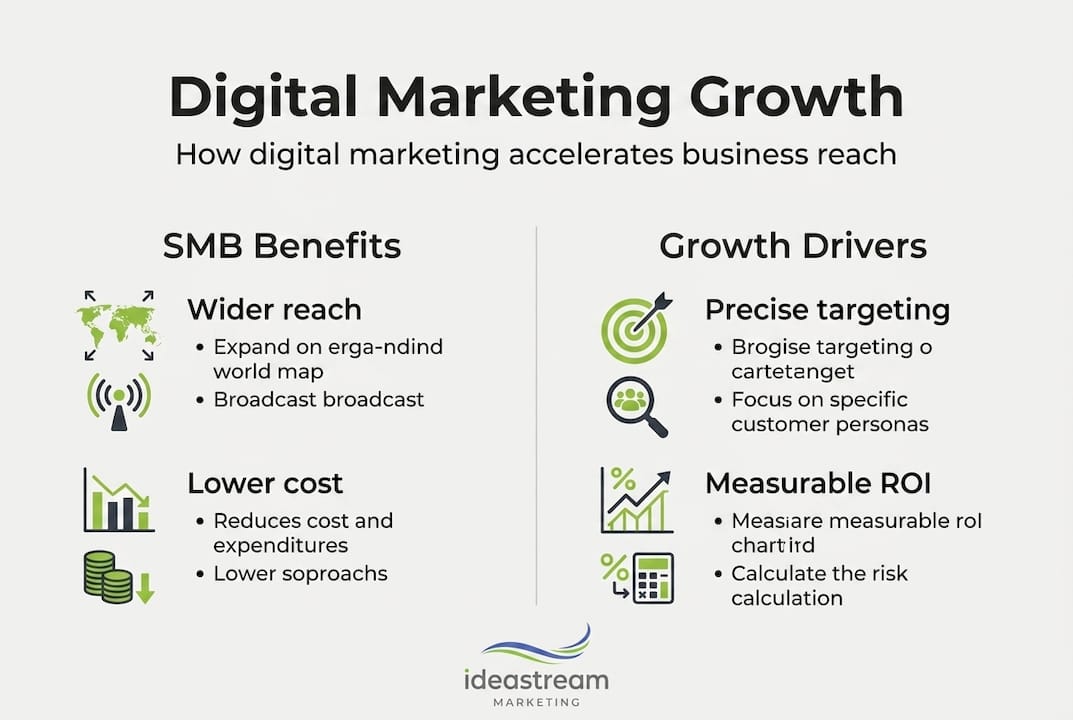
Digital marketing is built for speed. You can pause an ad, update a landing page, or change your messaging within minutes. No waiting for the next print run. No re-booking a radio slot. That kind of agility is increasingly important as digital channels reshape how buyers discover and evaluate options.
Here are the key trends reshaping digital marketing right now:
- AI-powered search: Search engines now surface AI-generated answers, meaning your content needs to be structured for direct answers, not just keywords.
- Voice search: More consumers are searching with voice assistants, which favors conversational, question-based content.
- Short-form video: Platforms like TikTok, Instagram Reels, and YouTube Shorts are driving purchase decisions for younger audiences.
- Mobile-first behavior: More than half of all web traffic comes from mobile devices, making mobile-optimized pages a baseline requirement.
- Personalization: Customers expect messaging that feels relevant to them, not generic broadcast content.
Adaptable businesses understand that social media advertising is not optional anymore. It’s where your customers spend hours every day. The brands that show up consistently and adjust their message as trends shift are the ones that build lasting market share.
According to McKinsey’s analysis on the future of digital marketing, businesses that adopt emerging channels early consistently outperform those that wait for certainty.
Pro Tip: Set a monthly calendar reminder to review your analytics. Look for changes in traffic sources, bounce rates, or audience demographics. Early signals in the data often show where customer behavior is shifting before it becomes obvious.
Our experience: The real cost of waiting to invest
We’ve worked with enough SMB owners to recognize a pattern. Many businesses wait until growth stalls, a competitor steals their customers, or their referral pipeline dries up before they prioritize digital marketing. By that point, catching up is harder and more expensive than starting sooner would have been.
The businesses that invested in SMB digital marketing early built compounding advantages: stronger domain authority, established social followings, and optimized ad accounts with months of performance data. Those advantages take time to build. You can’t buy them overnight.
Here’s what many business owners get wrong: they wait for the “perfect moment” to start. But perfect timing is a myth. The right time to invest in digital marketing was last year. The second best time is now. Every month you delay is a month your competitors are collecting data, building audiences, and refining their strategies. The gap compounds over time. Starting imperfectly today beats starting perfectly next year.
Unlock your growth with expert digital marketing
Understanding the value of digital marketing is step one. Executing it effectively is where most SMBs get stuck, especially when they’re trying to run a business at the same time.
At Idea Stream Marketing, we build tailored digital marketing solutions designed around your goals, your industry, and your budget. From cost-effective strategies that maximize every dollar to full-service campaigns that drive measurable growth, we handle the strategy and execution so you can focus on running your business. If you’re ready to stop guessing and start growing, we’d love to help. Speak with a digital expert on our team and find out what a focused digital strategy could do for your business.
Frequently asked questions
What is the biggest benefit of digital marketing for small businesses?
The biggest benefit is the ability to target the right audience at a lower cost while tracking every result in real time. Precise targeting and measurement make it possible to optimize campaigns continuously rather than guessing what’s working.
How quickly can I see results from digital marketing?
It depends on the channel. PPC delivers fast results within days of launching, while SEO typically takes three to six months to produce consistent organic traffic growth.
How much should my business budget for digital marketing?
Most growing SMBs allocate 7 to 10% of their revenue toward digital marketing. Budget recommendations for SMBs vary by industry and competition level, so starting with a focused strategy beats spreading your budget thin.
Is digital marketing more effective than traditional marketing?
For most SMBs, yes. Digital vs. traditional marketing comparisons consistently show better targeting, scalability, and measurable ROI on the digital side, especially for businesses with limited budgets.
Can digital marketing help my business adapt to market changes?
Absolutely. Digital marketing enables rapid adaptation because you can update campaigns, messaging, or targeting in real time as customer preferences and market conditions shift.

