






Bidding on your branded keywords means paying for Google Ads placement when people search your business name, your products, or your services by name. Done well, it protects the searches that are closest to a sale, lets you control the message at the top of the results page, and gives you clean data on your most valuable audience. This guide covers what branded keywords are, why businesses bid on them, how to structure the campaign, how to set bids, and how to measure the results.
TL;DR
- Branded keywords are searches that include your business name, product names, or close variations. People who type them already know you.
- Bidding on them defends your name against competitors who may bid on it, and it gives you control over the headline, description, and landing page.
- Run brand terms in their own campaign, and add them as negative keywords everywhere else, so reporting and budgets stay clean.
- Judge the campaign on incremental results, not on its ROAS alone. A simple geographic holdout test shows what the ads add beyond your organic listing.
- Pair brand ads with strong video, reviews, and sitelinks to turn high-intent searches into booked calls.
Table of Contents
- What branded keywords are
- Why businesses bid on their own brand
- What about competitors bidding on your name?
- How to structure a branded keyword campaign
- Bidding strategy for brand campaigns
- Measure what the brand campaign adds
- Make the brand ad convert
- Branded bidding by business type
- Our perspective
- Get help building your brand search presence
- A quick checklist before you launch
- FAQ
- Sources
What branded keywords are
Branded keywords are queries directly associated with a brand, its products, or its services, and most of them contain the brand name itself. For a Long Island law firm, that might be the firm’s name, the name of a partner, or the firm name plus “reviews.” For a restaurant group, it could be the restaurant’s name plus “menu” or “reservations.”
It helps to sort them into a few groups:
- Exact brand name: “Smith & Daniels Law”
- Brand plus modifier: “Smith & Daniels Law phone number,” “Smith & Daniels reviews”
- Misspellings and variations: the ways customers actually type or say your name, including voice search
- Product or service names you own: a proprietary program, a named package, a podcast, or a signature dish
- People: founders, doctors, attorneys, hosts
These searchers are further down the funnel than anyone typing a generic phrase like “personal injury lawyer.” They heard about you from a referral, a video, a podcast episode, a billboard, or a social post, and now they are looking for the way in. That is why the page they land on matters so much.
Why businesses bid on their own brand
The most common reason is defense. Bidding on a competitor’s brand name as a keyword is a common practice, and brand owners often bid on their own name to defend against that threat, according to research from the Wharton School. If a rival can show an ad when someone searches for you, you want your own ad, and your own message, in the first position too.
Defense is only one reason. Here is what a brand campaign can do for a business:
- Control the message. Your ad headline can promote a current offer, a free consultation, a new location, or a seasonal service. Your organic listing cannot be edited that quickly.
- Take up more of the results page. An ad plus your organic listing, your Google Business Profile, and your sitelinks leave less room for anyone else.
- Send people to the right page. A branded search for your name does not always belong on the home page. It might belong on a booking page, a service page, or a video-led landing page.
- Capture reliable conversion data. Brand campaigns show how well your offline and word-of-mouth marketing works, because those efforts show up as branded searches.
- Use ad extensions. Call buttons, location details, sitelinks, and promotions give mobile searchers a one-tap way to reach you.
The Wharton research also notes that the right branded bidding decision depends on market factors such as how many competitors are present, product quality, and how many shoppers compare options before they buy. In practice, that means a home services company in a crowded Nassau County market has a different brand-bidding profile than a niche manufacturer with no search competition.
What about competitors bidding on your name?
Competitors can generally bid on your brand terms. The limits fall on the ad copy. According to the same research, Google restricts direct competitors from using trademarked terms in ad text, or using them in a confusing or misleading way. Complaints target the ad copy, not the bid itself.
If you find a competitor using your name in their ads, this is the practical order of operations:
- Capture screenshots with the date, the search term, and your location.
- Check the ad text. Is your trademarked name in the headline or description?
- If it is, file a trademark complaint with Google through its official process, and keep your registration details ready.
- Strengthen your own brand ad in the meantime, with a strong headline, sitelinks, and a clear offer.
A registered trademark helps with step three. If you do not have one, a conversation with a trademark attorney is worth having.
How to structure a branded keyword campaign
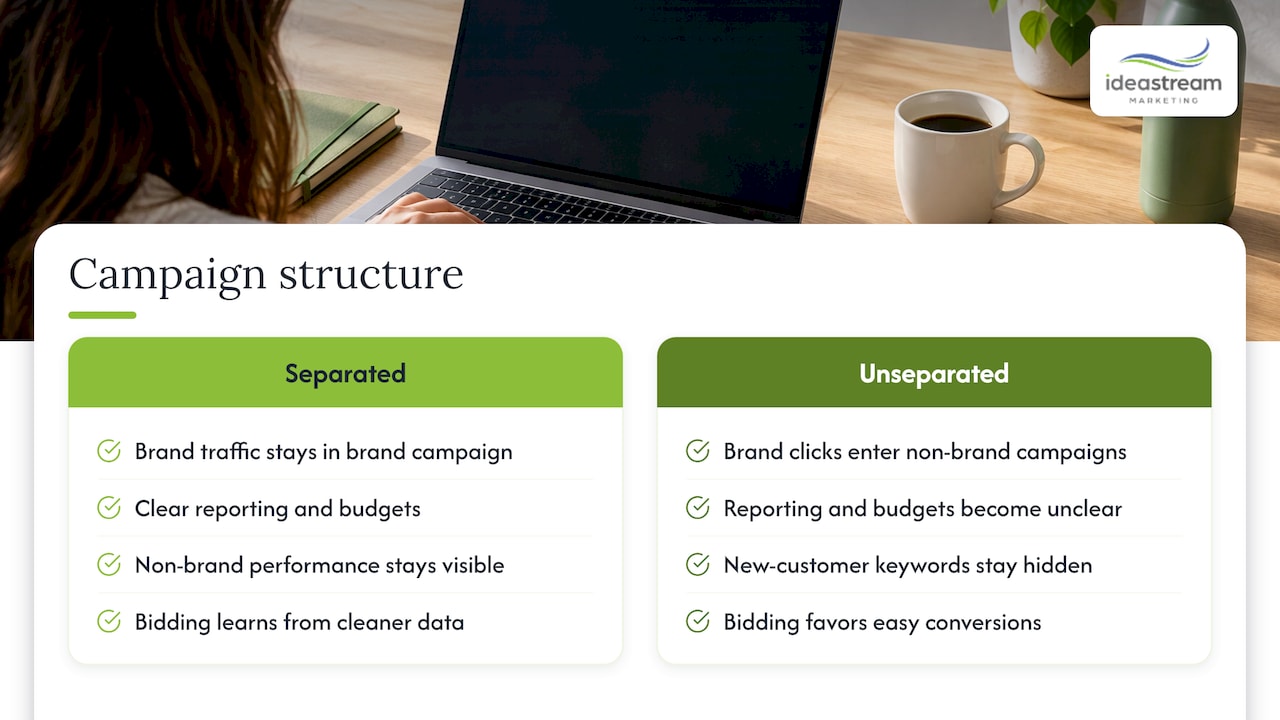
Separation is the foundation. A branded campaign should be separate from non-branded campaigns so reporting and budgeting stay clear, with brand terms added as negative keywords in the other campaigns. That way, brand traffic flows through the brand campaign and nowhere else.
Without this structure, two things go wrong. First, your non-branded campaigns collect cheap, high-converting brand clicks, which makes them look better than they are and hides which keywords are bringing in new customers. Second, automated bidding learns from skewed data and starts to favor the easy conversions.
Here is a clean setup:
Campaign layout
| Element | Recommended setup |
|---|---|
| Campaign | One Search campaign for brand only |
| Ad groups | Group by theme: company name, product or service names, people, “reviews” and “near me” variations |
| Match types | Exact and phrase match for the core name; add misspellings you see in the search terms report |
| Negatives | Add brand terms as negatives in all non-branded campaigns; add job-seeker and unrelated terms to the brand campaign |
| Landing pages | Match the page to the modifier: “pricing” to a pricing page, “reviews” to a testimonial page, “book” to a scheduling page |
| Extensions | Sitelinks, callouts, call, location, promotion, and structured snippets |
| Budget | Set separately so it never competes with prospecting spend |
Performance Max and brand terms
If you run Performance Max or other automated campaigns, keep brand exclusions in place so those campaigns do not quietly take credit for your brand searches. One practitioner guide on brand campaigns explains that brand traffic inflates blended ROAS and can mistrain automated campaigns, which is exactly why brand exclusions exist. Our own guide to Google Ads management for small and midsize businesses walks through how we set up account structure from the start.
Bidding strategy for brand campaigns
Brand terms usually carry lower costs than generic category terms, because quality scores tend to be high when your own site matches your own name. That gives you room to choose a strategy based on your goals instead of fighting for every click.
Three approaches work for most small and midsize businesses:
- Manual CPC with a low cap. This is simple and predictable. It suits quiet markets where nobody bids against you.
- Target impression share with a maximum CPC limit. This aims for the top of the page. The practitioner guide mentioned above notes that impression share targeting only works well with a maximum CPC limit, since otherwise costs can climb in auctions where rivals are actively bidding on you.
- Conversion-based smart bidding. This works once the campaign has steady conversion data, such as calls and form submissions. Make sure conversion tracking is clean first, because duplicate conversions distort what the system learns. We cover that in our guide to Google Ads conversion tracking.
A useful rule: let the competitive picture decide. If you check the auction insights report and see rivals appearing against your name, aim for a high impression share. If nobody does, a modest bid is enough to hold the top spot.
Measure what the brand campaign adds
This is the part many advertisers skip. A brand campaign almost always shows a strong ROAS, because these searchers were already likely to buy. The real question is how many of those conversions happen because of the ad. Some would have come through your organic listing anyway, and some would not have, particularly where competitors are present.
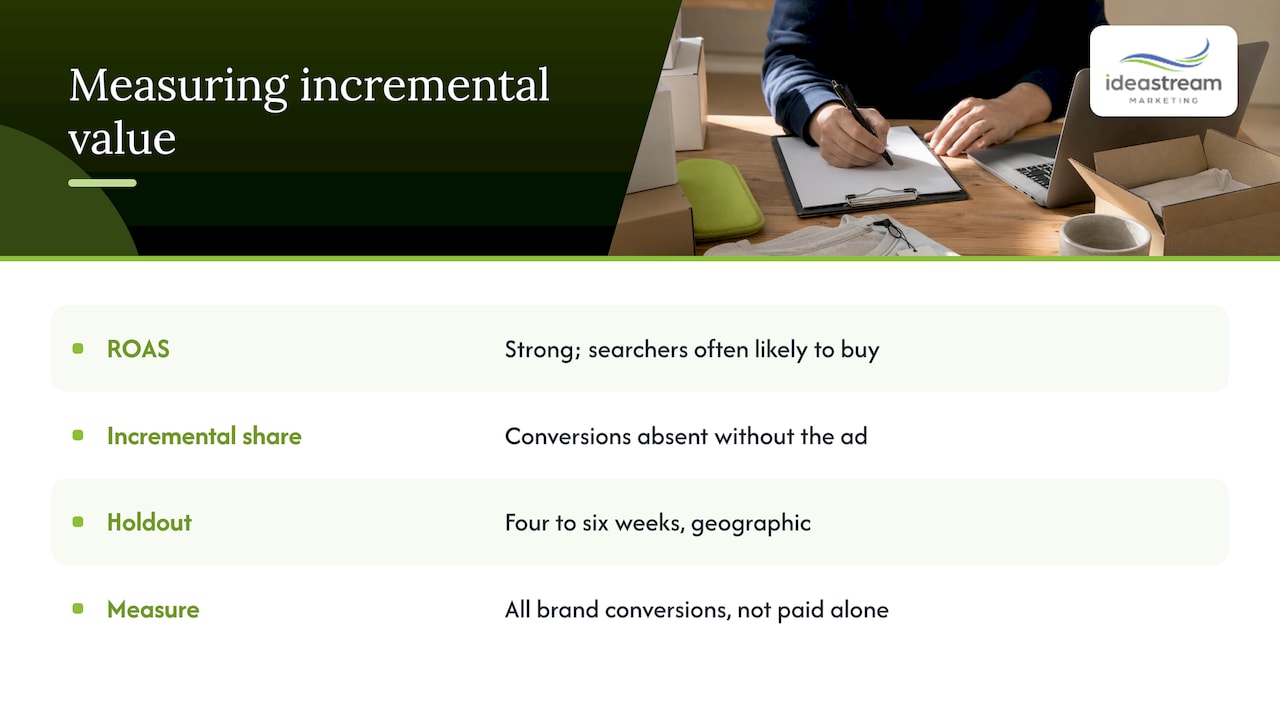
The same practitioner guide frames it this way: the ad’s value is the incremental share, meaning the conversions that would not have happened without it. It also describes a four to six week geographic holdout, measured on all brand conversions rather than paid conversions alone, as an honest way to decide.
A simple test you can run
- Pick two comparable regions. For a Long Island business, that could be two groups of ZIP codes or counties with similar search volume and conversion history.
- Pause brand ads in one region and keep them running in the other.
- Run the test for four to six weeks, long enough to smooth out weekly swings. Avoid launching during a major promotion, a holiday, or a press event.
- Measure total brand conversions in both regions, from every source: paid, organic, direct, and calls. Do not look at paid conversions alone.
- Compare. If total brand conversions hold steady with ads paused, the ads were mostly duplicating your organic result. If they drop, the ads were adding real demand.
- Account for competitors. Check auction insights before and during the test. If a rival picks up the traffic in the paused region, that tells you the ad is doing defensive work.
What you do with the answer depends on the result. If the ads add little in a quiet market, you can lower the bid and move budget toward prospecting. If they add a lot, or competitors are active, you keep them and strengthen them. Either way, you are deciding from data and not from a hunch.
Metrics worth tracking
- Impression share and lost impression share on brand terms
- Cost per conversion, compared with your non-brand campaigns
- Total brand conversions across channels, not just paid
- Auction insights: who else shows up on your name
- Search terms report: new variations and misspellings to add
- Call volume and booked appointments, not just form fills
Make the brand ad convert
A brand click costs money, so the page it lands on should do the selling. This is where our two disciplines meet: paid search and video.
Someone who searches your name wants proof. Consider what they find when they click:
- A short brand video that introduces your team, your process, and your results in under two minutes
- Customer testimonial videos from real clients, which build trust quickly
- A clear booking path with a phone number, form, and scheduling link above the fold
- Reviews and credentials near the call to action
- A page that loads fast on a phone
Video also helps your brand searches grow in the first place. Podcast episodes, YouTube videos, and short social clips introduce people to your name. When those people search for you later, your brand campaign catches them. Our guide to video in advertising covers how we use video across paid channels, and our article on the role of branding in digital campaigns explains why strong brand recognition raises the return on everything else.
Branded bidding by business type
The right level of investment differs by industry. These are practical starting points, not rules.
| Business type | What to prioritize |
|---|---|
| Law firms and professional services | Attorney and partner names, “reviews,” and “free consultation” offers; watch for lead-gen directories that bid on firm names |
| Medical practices | Practice and provider names, “appointments,” and “new patient” pages; follow advertising rules for healthcare |
| Home services and contractors | Company name plus “near me,” call extensions, and service-area landing pages |
| Restaurants and hospitality | Venue name plus “reservations,” “menu,” and “events”; location extensions |
| Ecommerce | Brand plus product names; shopping ads and text ads together |
| B2B companies | Company and product names, “demo,” “pricing,” and “login” separated from sales terms |
Our perspective
We treat branded search as the point where all of your marketing comes together. A viewer watches your video, hears you on a podcast, sees a Reel, or gets a referral from a friend, and then types your name into Google. What they see next decides whether that effort turns into a lead.
That is why we build brand campaigns alongside content and not apart from it. Every video we produce is developed with discoverability in mind, and a well-run branded search campaign is the place where that visibility is captured and measured. We keep brand terms in their own campaign, keep the data clean, and look at incremental results so our clients know what each dollar is doing.
Our goal is a simple one: when someone looks for your business by name, they find a confident, consistent presence with a clear next step. Strong creative, accurate tracking, and thoughtful bidding make that possible.
Dean Spinato, CEO & Founder of Idea Stream Marketing
Get help building your brand search presence
If you want brand campaigns that are set up cleanly, tracked correctly, and supported by video that earns trust, we can help. Our team combines Google Ads management, SEO, and professional video production for businesses across Long Island and New York, and our branded search campaign approach is built around defending your name and proving the lift.
We can also produce the content that drives people to search for you in the first place: brand videos, testimonial interviews, business podcasts, and short-form clips for Instagram Reels, Facebook Reels, TikTok, and YouTube Shorts. A single podcast recording session can be edited into a full episode and a library of social clips. SCHEDULE A CONSULTATION through our home page to talk about your goals, or visit our video production page to plan a studio or on-location session.
A quick checklist before you launch
- Brand terms live in a dedicated Search campaign with its own budget
- Brand terms are added as negatives to every non-brand campaign, including automated ones
- Core name is on exact and phrase match, with misspellings added from search term data
- Each modifier (“reviews,” “pricing,” “book”) goes to the best-fit page
- Sitelinks, call, location, and promotion extensions are active
- Conversion tracking counts each lead once, including phone calls
- You have checked auction insights for competitors on your name
- A holdout test is scheduled so you can measure incremental results
- A trademark registration is on file, or you have spoken with an attorney about one
FAQ
Should I bid on my own brand name?
For most businesses, yes. It lets you control the message, send people to the best page, and defend your name if competitors bid on it. The right bid level depends on how much competition you face, so check auction insights and run a holdout test to see what the ads add.
Is bidding on branded keywords expensive?
Brand terms generally cost less per click than broad category terms because your site is highly relevant to your own name. Cost depends on your market and on whether competitors are bidding against you. Setting a maximum CPC and a separate budget keeps spending predictable.
Can a competitor bid on my brand name?
Competitors can generally bid on your name as a keyword. Google restricts them from using your trademark in ad text in confusing or misleading ways, and complaints focus on the ad copy and not the bid. Keep screenshots, hold a trademark registration if you can, and keep your own brand ad strong.
How do I know if my brand ads are working?
Look beyond the campaign’s own ROAS. Run a four to six week geographic holdout, pause brand ads in one region, and compare total brand conversions across all channels. The difference is the lift the ads provide.
Do I need a separate campaign for brand keywords?
Yes. A separate campaign keeps reporting and budgets clear, and adding brand terms as negatives elsewhere makes sure brand traffic goes through the brand campaign. It also keeps your non-brand results honest.
Sources
- What are Branded Keywords? How to Use them in SEO?
- The Company That You Keep: When to Buy a Competitor’s Keyword (Wharton)
- How to structure PPC campaigns (Search Engine Land)
- Bidding on your own brand: when it pays and how to prove it

