



November 2, 2026



Video content repurposing means taking a video you already own, such as a brand film, a testimonial, a webinar or a podcast recording, and reshaping it into new pieces built for specific channels: short clips, audio, blog posts, email, and more. Done well, one shoot feeds weeks of content. Done badly, it is the same file pasted everywhere. This guide shows business owners and marketing managers on Long Island and across New York how to do it well, from choosing the right source video to publishing, measuring and staying clear of copyright trouble.
TL;DR
- Repurposing is adapting, not copying: change the length, aspect ratio, hook and context so each piece fits the platform it lands on.
- Start with your best material: high-engagement, evergreen videos and podcast episodes with clear takeaways.
- Plan for repurposing before you hit record, then pull clips from a transcript and distribute in batches.
- Check music, guest releases and third-party footage before you publish clips, because clips are new uses of the work.
- Track results per channel so you know which formats deserve more of your production budget.
Table of Contents
- What video content repurposing is (and what it isn’t)
- Why it pays off for local and regional businesses
- How to choose which videos and episodes to repurpose
- A repeatable repurposing workflow
- Repurposing podcast content: one episode, many assets
- Short-form video: Reels, TikTok and Shorts
- Our perspective: plan the repurposing before the shoot
- Copyright, music and permissions: check before you clip
- How to measure repurposed video and podcast content
- Common mistakes to avoid
- Work with a team that plans for repurposing
- FAQ
- Sources
What video content repurposing is (and what it isn’t)
Repurposing adapts existing video into video, audio or text formats for a particular platform, audience, use case or campaign, according to Flockler’s guide to repurposing video. The same source separates it from reposting, which reshares a video on the same platform, and from cross-posting, which publishes the same video on a second platform.
Thinkific draws the same line: cross-posting shares content on another channel without changing its format, while repurposing adapts it for different channels and keeps the essential elements and highlights. In practice, that means a 40-minute interview can become a 45-second vertical clip, a quote graphic, a newsletter segment and a blog post. Each one is made for the place it will live.
Repurposing also goes deeper than trimming. Vimeo’s article on video repurposing says effective repurposing can involve rewriting or tweaking the original script and taking a new angle, rather than copying and pasting the video to another platform. A clip that opens mid-sentence with no context rarely works. A clip with a new on-screen headline, a tighter first line and captions usually does.
What repurposing is not:
- Re-uploading the same file to every account.
- Chopping a video into random 30-second pieces.
- A replacement for new filming. It extends your best footage; it does not fix weak footage.
Why it pays off for local and regional businesses
Most small and mid-sized businesses on Long Island do not have a content team. A single production day, whether it is a brand story, a customer testimonial or a podcast recording, is a real investment of time and budget. Repurposing spreads that investment across more channels. It also helps you stay consistent, which is usually the hardest part of social media for a busy owner.
It also supports discoverability. A podcast episode with a transcript, an episode page and a handful of clips gives search engines and AI search tools more to find than a single audio file does. Our guide to video SEO best practices covers how to structure that, and podcast SEO covers episode pages, transcripts and schema.
How to choose which videos and episodes to repurpose
Not everything deserves a second life. Pick sources with a track record and a reason to be reused.
Look at performance first. Hello Audio recommends starting with podcast episodes that have the highest downloads, the most replays or evergreen topics. Distribution.ai adds that high-engagement content with strong listener retention is the best candidate, along with content that contains clear takeaways such as tips, frameworks and guest insights.
Then test channel fit. Vimeo suggests asking whether the format suits the platform, whether that platform’s audience will value the topic, and whether the content matches the channel’s tone. A detailed how-to may suit YouTube and email. A bold opinion from a founder may suit Reels or TikTok.
Then ask the audience question. Vimeo’s social media lead, Alexis Nash, says she judges an edit from the target audience’s point of view and asks whether it adds value for them rather than just serving the publisher. That is a good filter for any clip you are about to post.
A quick scoring checklist you can run on any video or episode:
- Does it still hold true a year from now?
- Does it contain at least three moments that stand alone without context?
- Did it perform above your average on views, watch time or downloads?
- Does it speak to a question your customers actually ask?
- Do you have the rights to every voice, image and song in it?
If you answer yes to four or five, it is a strong candidate.
A repeatable repurposing workflow
A workflow beats inspiration. Wistia’s video repurposing cookbook describes three phases: plan with repurposing in mind, prepare assets by extracting key moments (for example from transcripts), and distribute while monitoring metrics. It also describes breaking long-form content into smaller clips, snippets or transcripts, and adjusting length, pacing and visual style while adapting the hook and context to each channel.
Here is how we turn that into steps for a small team:
- Plan before you shoot. Decide the main message, the three to five sub-topics and the channels you will publish on. Our video pre-production planning guide walks through this. Frame questions so answers stand alone, and leave a beat of silence between points to make editing cleaner.
- Capture clean source material. Good audio, steady framing and a camera angle that crops well to vertical make every later step easier. For podcasts, see our video podcast setup guide on gear, lighting and layout.
- Transcribe and mark moments. Read the transcript and highlight quotable lines, stories, numbers and answers to common customer questions. Our transcript-first workflow for podcast clips is built for small teams.
- Cut the master edit. Finish the full video or episode first, with captions and a clean audio mix.
- Cut the derivatives. Make short vertical clips, a square or 4:5 version for feeds, an audio-only version, a quote graphic and a written summary.
- Rewrite the hook and caption for each channel. The first line of a clip is not the same as the first line of the original. See our overview of social media video editing for a six-step approach.
- Schedule in batches. Load a week or a month of posts at once so publishing does not depend on anyone’s free afternoon.
- Review the numbers and adjust. Keep what works, drop what does not.
Repurposing podcast content: one episode, many assets
Podcasts are the richest source for repurposing because one conversation holds many topics. If you are recording a business podcast in a studio, the video recording is as valuable as the audio.
Here is what one episode can become:
| Asset | Source | Best channel | Effort |
|---|---|---|---|
| Full video episode | Master recording | YouTube, your website | Medium |
| Audio episode | Master audio | Podcast apps | Low |
| 3 to 5 short vertical clips | Strongest moments from the transcript | Instagram Reels, Facebook Reels, TikTok, YouTube Shorts | Medium |
| Quote graphics | Standalone lines | LinkedIn, Instagram, Facebook | Low |
| Blog post or episode page | Transcript, edited for reading | Your website | Medium |
| Email segment | One key takeaway plus a link | Newsletter | Low |
| Short answer video | A single customer question from the episode | Google Business Profile, FAQ pages | Low |
Thinkific gives similar examples: short social clips, highlights used in email, and expanding the topic into a blog post.
Some practical notes on each:
- Clips. Choose moments with a clear beginning and end, usually one idea each. Open on the most interesting sentence, add burned-in captions, and finish before the point gets diluted.
- Articles. Do not publish a raw transcript as a blog post. Edit it into headings, add context, and answer the question a searcher would ask. This is where podcast content becomes a real search asset.
- Email. Pull one insight, one clip thumbnail and one link. A short email that delivers value gets more attention than a full episode summary.
- Distribution. Where the full episode is published matters as much as the clips. Our guide to podcast distribution platforms for brands explains how video, clips and AI SEO fit together.
For the editing side, our podcast video editing workflow shows how a defined post-production window keeps an episode and its clips on a predictable schedule.
Short-form video: Reels, TikTok and Shorts
Short-form video is where most repurposed clips end up, and each platform rewards slightly different handling.
- Instagram Reels and Facebook Reels. Vertical, captioned, and quick to the point. Because both are Meta platforms, one edit can usually be adapted for both with a different caption and cover image.
- TikTok. Conversational and direct. A founder speaking to camera or a guest telling a short story tends to fit better than a polished corporate cut.
- YouTube Shorts. Link each Short to the full video or episode so viewers who want more can find it. Check the music rules below before you add audio.
Do not upload the same exported file everywhere without checking the details. Remove other apps’ watermarks, keep captions inside the safe area of each interface, and write a caption that suits the audience. For a wider view of this approach, see how to maximize content for multi-platform reach and mastering video marketing on social media.
Our perspective: plan the repurposing before the shoot
Most businesses think about repurposing after the camera is packed away. By then, half the opportunity is gone. The audio is uneven, the framing will not crop to vertical, and nobody wrote down which answers would make strong standalone clips.
We build it in from the start. Every video and podcast we produce is developed to be found: in Google, in AI search, on YouTube and on social platforms. That means scripting and interview questions designed so single answers hold up as clips, framing that works in both widescreen and vertical, captions and transcripts ready for episode pages, and a publishing plan that includes the short-form channels where your customers already spend time.
We also believe production and marketing should not be separate conversations. When the people who film your content also understand SEO, schema, social and lead generation, one recording session becomes a system, not a one-off deliverable. That is the difference between content that gets posted and content that brings in inquiries.
Dean Spinato, CEO & Founder of Idea Stream Marketing
Copyright, music and permissions: check before you clip
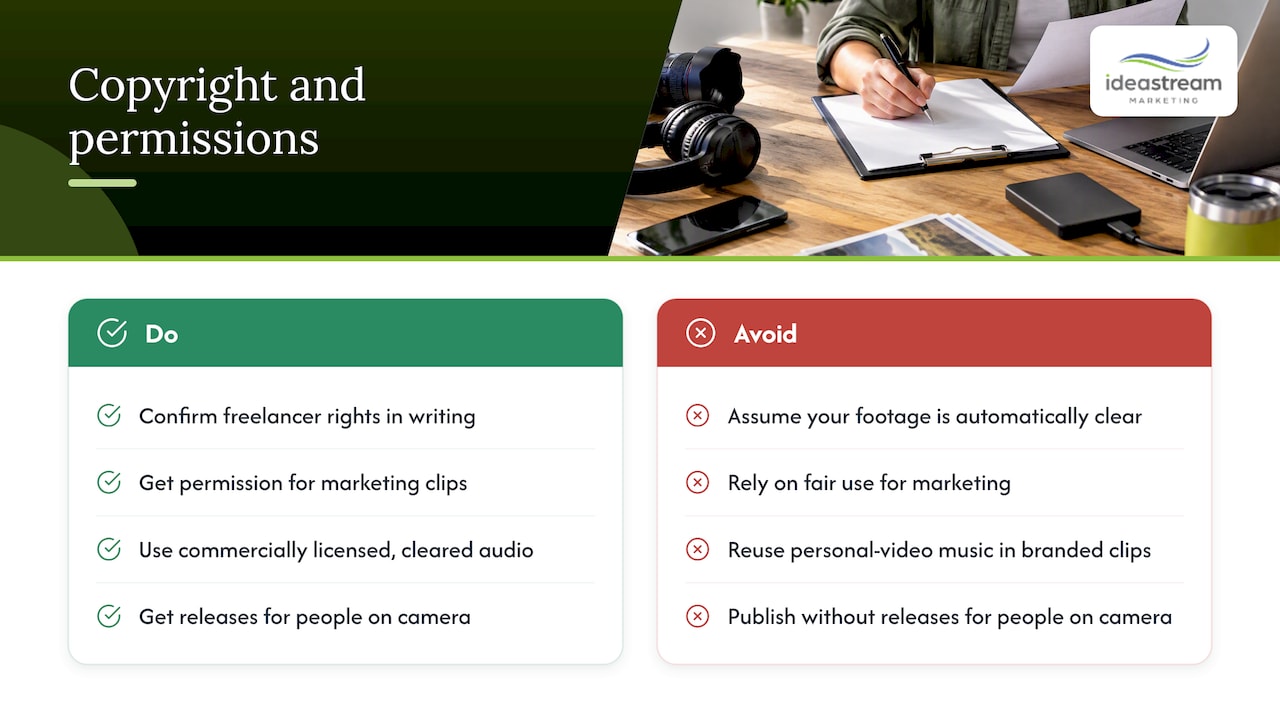
A clip is a new use of the original, so permissions that covered the full video may not cover every version. Run these checks before you publish.
Your own footage is not automatically clear. Under U.S. law, only the copyright owner has the right to authorize a new, derivative version of a work, and using someone else’s work without permission may lead to an infringement action, according to the U.S. Copyright Office fair use FAQ. If a freelancer shot your footage, confirm in writing what you own and what you may adapt.
Do not lean on fair use. The same Copyright Office page explains that fair use permits limited portions of a work for purposes such as commentary or news reporting, and that no rule sets a number of words or a percentage that automatically qualifies. For marketing clips, get permission instead of guessing.
Music needs its own license. When a song is recorded, it can involve two separate copyrights: the musical work and the sound recording. The U.S. Copyright Office guide to musical works and sound recordings notes they are often owned and licensed separately, and that businesses should get a license or rely on a statutory license or applicable exemption. A track that is fine in a personal video may not be fine in a branded one. If you are unsure, use music licensed for commercial use, or ask an attorney who handles intellectual property.
YouTube Shorts has specific rules. According to YouTube’s Shorts rights holder help page, active copyright claims on Shorts longer than one minute result in the video being blocked, and claims tied to the in-product Shorts audio library cannot be disputed by creators. Keep Shorts short and use cleared audio.
Get releases from people on camera. Guests, customers and employees should sign a release that covers clips, social posts and advertising, not only the original episode. This matters most for healthcare, legal and other regulated businesses, where testimonials and client information carry additional rules your own counsel should review.
How to measure repurposed video and podcast content
Track each format against the goal it was made for, not against a single vanity number.
- Short clips: views, average watch time, shares and saves, and profile visits.
- Full episodes and long videos: watch time or downloads, plus click-throughs from clips.
- Articles and episode pages: organic search traffic, time on page and form submissions.
- Email segments: click rate on the episode link.
- Business outcomes: calls, form fills and consultation requests, tagged by source so you can see which clips lead to inquiries.
Review monthly. Look for patterns in topic, length, opening line and platform. If clips about pricing questions outperform clips about company news, make more of them. Our guides to what video marketing is and how to measure ROI and video marketing for small businesses go deeper on this. If you publish music-heavy Shorts, YouTube also offers rights-holder reports such as Shorts Asset Creations and Shorts Asset Views to see how licensed music is being used.
For ideas on structuring the whole program, our video content checklist for marketing pros and video marketing strategies that work are good next reads.
Common mistakes to avoid
- Starting with the tool, not the strategy. Software can find clip candidates, but someone still needs to decide what your customers need to hear.
- Posting clips without context. Add a headline or a first line that tells viewers why they should keep watching.
- Ignoring captions. Many people watch with the sound off, so captions are part of the edit, not an extra.
- Repurposing weak content. A poor video will make poor clips. Start with your best material.
- No call to action. Every clip should point somewhere: the full episode, a service page, a booking link.
- Inconsistent publishing. A batch schedule is more reliable than posting whenever there is time.
Work with a team that plans for repurposing
If you would like one production day to feed your website, YouTube channel, podcast feed, Reels, TikTok, Shorts and email, we can help. Idea Stream Marketing is a Long Island video production and digital marketing agency. We handle podcast production and video editing, short-form social clips and the SEO that helps people find them.
Tell us what you have recorded or what you plan to record, and we will map out how to get the most from it. Visit Idea Stream Marketing to schedule a consultation or a studio session. You can also see our full list of video and marketing services.
FAQ
What is video content repurposing?
It is the process of adapting an existing video into new formats made for specific platforms and audiences, such as short clips, audio, articles or email. It differs from reposting because you change elements like length, aspect ratio, hook and context. The goal is to get more value from footage you already have.
Is repurposing content illegal?
Not when you own or have licensed everything in the content. Problems arise with third-party music, footage, images or guest appearances used without permission, since only a copyright owner can authorize a derivative version. Get written rights from freelancers and releases from guests, use properly licensed music, and consult an attorney for anything unclear.
What is an example of repurposed content?
A 30-minute podcast interview with a local contractor is a good example. You publish the full video on YouTube, cut four vertical clips for Reels, TikTok and Shorts, turn the best answers into a blog post, and send one takeaway in your newsletter. Each version is edited for its channel.
How do I repurpose podcast content?
Start with a transcript and mark the strongest standalone moments. Edit those into captioned clips, publish the full episode with an episode page, and write articles and email segments from the same material. Then schedule everything in batches and review the results each month.
How many clips can I get from one video?
There is no fixed number, because it depends on how many standalone ideas the video contains. A focused interview with several clear answers can often support multiple short clips plus written and email versions. Quality and relevance matter more than volume.
Sources
- 9 Ways to Repurpose Video Content (Flockler)
- How to Repurpose Video Content in 6 Simple Steps (Thinkific)
- Video repurposing: How to transform your longer videos (Vimeo)
- Repurposing Video Content? Here Are 15 Simple Strategies (Hello Audio)
- How to Repurpose Podcast Content: 7 Practical Ways (Distribution.ai)
- The Video Repurposing Cookbook (Wistia)
- Fair Use FAQ (U.S. Copyright Office)
- Musical works, sound recordings and copyright (U.S. Copyright Office)
- Manage Shorts as a rights holder (YouTube Help)

