






If your business flies a drone to shoot marketing video, the FAA’s Part 107 rule applies to you: a certified remote pilot, a registered drone with Remote ID, and airspace authorization wherever the airspace is controlled. In New York City, you also need a city permit to take off or land. We produce drone footage for Long Island and New York businesses, so this guide covers the rules we plan every shoot around.
TL;DR
- Flying a drone for business means flying under Part 107: a remote pilot certificate, a drone under 55 pounds, and a $5 registration valid for three years.
- Core limits: 400 feet above ground level, 100 mph, visual line of sight, and daylight or twilight unless you meet the night-flight requirements.
- Registered drones must broadcast Remote ID, and controlled airspace needs FAA authorization before takeoff.
- NYC requires a permit to take off or land. The application fee is $150 and the review starts 30 days before your first flight.
- A new New York State law takes effect November 27, 2026 and makes flying over certain prohibited locations without approval a misdemeanor.
Table of Contents
- Why a business drone flight is different from a hobby flight
- What Part 107 requires
- Remote ID: the broadcast requirement
- Airspace authorization: where most shoots get delayed
- Are drones legal in New York City?
- New York State drone rules
- A pre-flight checklist for a business shoot
- Where we fit in
- Our perspective
- FAQ
- Sources
Why a business drone flight is different from a hobby flight
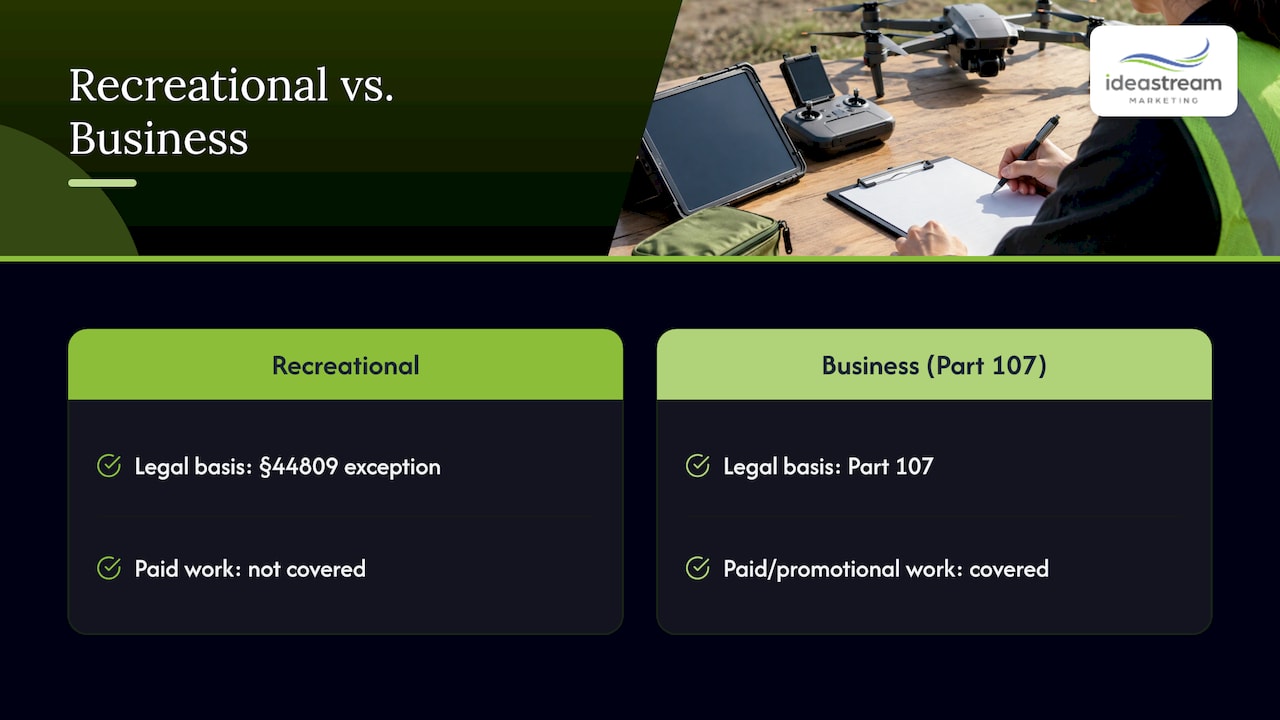
The FAA splits drone flying into two lanes. Recreational flyers operate under a statutory exception, 49 U.S.C. §44809. Anything done for work or business, including shooting a property listing, a restaurant exterior or a promotional video, falls under Part 107, the Small UAS Rule for drones under 55 pounds.
That distinction matters because the recreational exception does not cover paid or promotional work. If your staff member flies a drone for your company’s social channels, treat it as a Part 107 operation.
What Part 107 requires
The pilot
A remote pilot must be at least 16 and pass the FAA knowledge test at an approved testing center. Pilots who already hold a Part 61 certificate and a flight review within 24 months can complete FAA online training instead. Part 107 also allows a person without a certificate to fly under the direct supervision of a certificate holder. For a deeper walk-through, see our guide to Part 107 requirements.
The drone
Each drone is registered for $5, valid for three years. Updating a Part 107 registration to add Remote ID serial numbers is free.
The operating limits
The FAA’s Part 107 limits are:
| Limit | Part 107 rule |
|---|---|
| Altitude | 400 feet above ground level (higher if within 400 feet of a structure) |
| Speed | 100 mph (87 knots) |
| Visibility | At least 3 miles from the control station |
| Time of day | Daylight or twilight, with anti-collision lighting |
| Line of sight | Visual line of sight at all times |
Since the Operations Over People rule took effect on April 21, 2021, Part 107 pilots can fly at night and over people and moving vehicles without a waiver if they meet the requirements. Night flights in controlled airspace under 400 feet still need airspace authorization.
Remote ID: the broadcast requirement
A drone that must be registered must comply with Remote ID, whether it flies for recreation or business. You have three options:
- Fly a drone with built-in Standard Remote ID.
- Attach a Remote ID broadcast module.
- Fly inside an FAA-recognized identification area (FRIA), which is run by community-based organizations and educational institutions.
Enforcement of the broadcast rule began fully on March 16, 2024. The signal does not reveal your name or address. Only the FAA and law enforcement can link it to registration data.
Airspace authorization: where most shoots get delayed
Much of Long Island and nearly all of New York City sits in controlled airspace near major airports. In controlled airspace you need FAA authorization before you fly. You have two routes:
- LAANC. It gives near-real-time approval at pre-approved altitudes on the FAA’s facility maps, and you can request it up to 90 days ahead.
- Manual request through FAADroneZone. This route is for altitudes above the pre-approved limits and can take up to eight weeks to process.
The practical lesson: build airspace approval into the schedule before you lock a shoot date. Our video pre-production planning guide shows where this fits in the plan.
Are drones legal in New York City?
Yes, with conditions. The FAA controls the airspace, but the city regulates where you can take off and land. Under the NYPD’s program, a permit is required to take off or land an FAA-registered, FAA-compliant drone. Designated Model Aircraft Fields are the exception.
The city code makes it unlawful to take off or land an aircraft, drones included, outside designated locations. Administrative fines are commonly $250 to $1,000, per the same source.
What the NYC permit takes
The NYPD permit FAQ sets out these requirements:
- A $150 non-refundable application fee.
- Submission at least 30 days before the first proposed takeoff or landing. Expedited review at 14 days applies when every operator held a non-revoked permit within the past 180 days.
- A Part 107 Remote Pilot Certificate for every proposed operator.
- Insurance naming the City of New York as additional insured.
- The permit, insurance copy, FAA authorization and photo ID on hand for inspection by law enforcement.
If the drone will capture still images, audio or video, you must also notify each affected community board and post notices within 100 feet of each takeoff and landing site on the permit. That applies to nearly every commercial shoot.
New York State drone rules
New York cannot set its own altitude ceiling or pilot license on top of FAA rules. States and cities can regulate takeoff and landing and what people do with a drone.
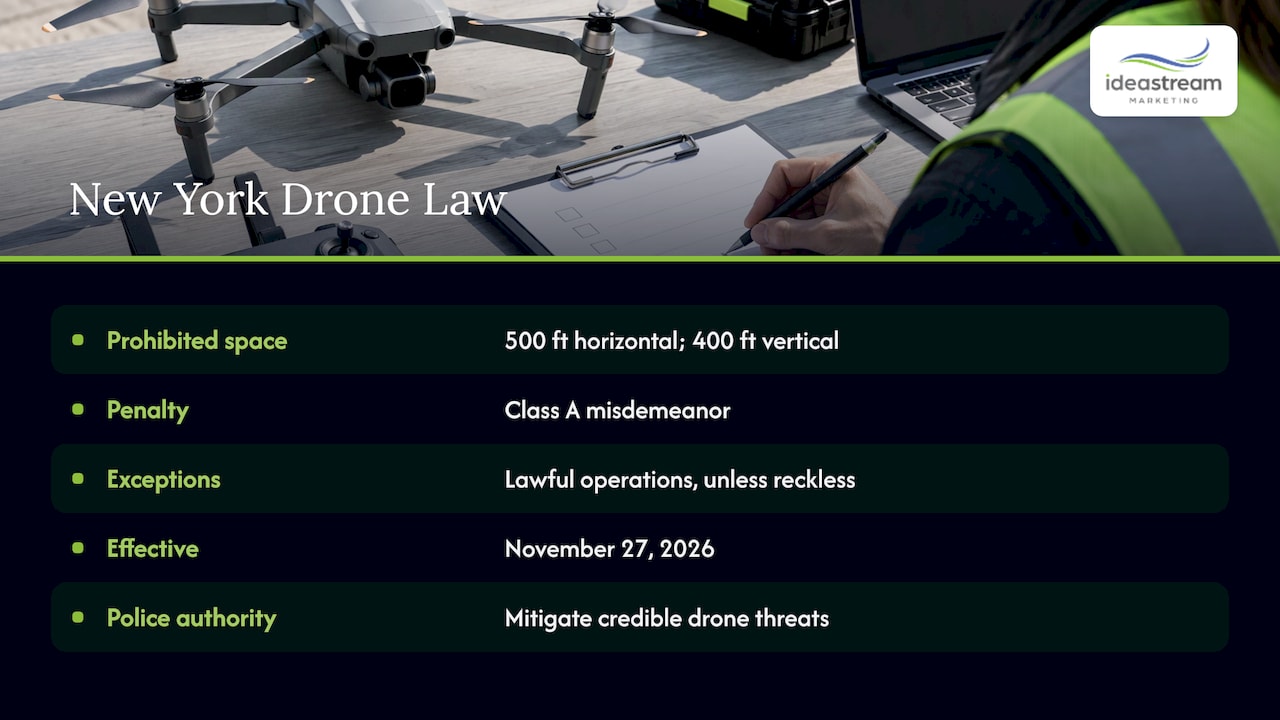
The notable new law is Chapter 55 of the Laws of 2026. It makes unlawful use of a drone a class A misdemeanor when someone flies in a nefarious manner or over prohibited space without express prior approval. Prohibited space covers areas within 500 feet horizontally and 400 feet vertically of listed locations. The law carves out recreational and other lawful operations, subject to a recklessness exception. The same law gives police mitigation authority against credible drone threats, effective November 27, 2026.
For your shoot, check the location list before you scout a site, and get written approval where a site is covered.
State land
On state-managed land, drones are prohibited in Wilderness, Primitive, Primitive Bicycle Corridor and Canoe Area classifications of the Adirondack and Catskill Forest Preserves. Commercial use elsewhere may be allowed with a temporary revocable permit from the DEC.
A pre-flight checklist for a business shoot
- Confirm the pilot holds a current Part 107 certificate.
- Confirm the drone is registered and broadcasting Remote ID.
- Check the airspace and file LAANC or a manual request.
- Check the site against the state’s prohibited-space list.
- In NYC, secure the permit, insurance and community board notices at least 30 days out.
- Plan for visual line of sight, daylight and the 400-foot ceiling.
- Carry the documents on site.
Where we fit in
Drone footage works when the compliance is handled before the camera rolls. We offer drone videography as part of our video production for businesses across Long Island and New York, and we build every video for visibility in Google, AI search, YouTube and social platforms. If you want to see how aerial footage supports marketing results, read our guide to drone video marketing.
To plan an aerial shoot, schedule a consultation with Idea Stream Marketing and tell us the location and timeline.

Our perspective
Most delays on aerial projects come from the paperwork, not the flying. A business that learns the airspace and permit timeline early can plan a shoot with confidence instead of scrambling.
At Idea Stream Marketing, we treat drone footage as one part of a larger content plan. The same clip can anchor a website hero video, a short-form reel for Instagram, Facebook, TikTok and YouTube Shorts, or a highlight in a podcast episode’s video version. When the footage is planned for those uses from the start, it earns its cost many times over.
That is why we build compliance into pre-production and design every video for discoverability across search and social.
Dean Spinato, CEO & Founder of Idea Stream Marketing
FAQ
Do I need a license to fly a drone for my business?
Yes. Business flights fall under Part 107, which requires a remote pilot certificate, or direct supervision by a certificate holder. The pilot must be at least 16 and pass the FAA knowledge test.
Do I need a permit to fly a drone in NYC?
Yes, to take off or land. The NYPD permit costs $150 and should be filed at least 30 days ahead. The FAA also requires airspace authorization in controlled airspace.
What is the maximum altitude for a drone?
The Part 107 ceiling is 400 feet above ground level, or higher if you stay within 400 feet of a structure. Recreational flyers must stay at or below 400 feet in Class G airspace.
Does a drone need Remote ID?
Yes, if it must be registered. You can use a Standard Remote ID drone, a broadcast module or an FAA-recognized identification area.
Sources
- FAA: Recreational Flyers & Community-Based Organizations
- FAA: Small UAS Regulations (Part 107)
- FAA: Certificated Remote Pilots including Commercial Operators
- FAA: Remote Identification of Drones
- FAA Safety Foundation: Remote ID Talking Points
- FAA: Part 107 Airspace Authorizations
- NYC: Unmanned Aircraft Systems Permits
- NYPD: UA Permit Portal FAQ
- NYS Association of Chiefs of Police: Chapter 55 of the Laws of 2026
- NYSDEC: Drone Use on DEC Managed Lands
- Recording Law: New York Drone Laws
- UAS Feed: FAA Reauthorization Act of 2024

