



October 21, 2026




TL;DR:
- Data-driven marketing uses measurable customer behavior to guide decisions, replacing guesswork with evidence. Organizations adopting this approach are significantly more likely to acquire and retain customers, maximizing ROI. Cultural resistance remains the main obstacle, but AI is reshaping the speed and effectiveness of data analysis.
Data-driven marketing is the strategic use of customer and campaign data to guide every marketing decision with clear evidence, replacing guesswork with measurable insight. The role of data-driven marketing has shifted from a competitive advantage to a baseline requirement for any business serious about growth. Organizations that adopt this approach are 23 times more likely to acquire customers and 6 times more likely to retain them. That gap between data-driven and intuition-led businesses is not closing. It is widening.
What is the role of data-driven marketing in modern strategy?
Data-driven marketing, also called evidence-based marketing in academic and research contexts, is the practice of making every campaign, budget, and targeting decision based on measurable customer behavior rather than instinct. The distinction from traditional marketing is not subtle. Traditional approaches rely on broad demographic assumptions and historical precedent. Data-driven strategies rely on real behavioral signals collected in real time.
The core shift is from “we think our customers want this” to “our customers’ actions show us exactly what they want.” That shift changes how budgets get allocated, how messages get written, and how channels get prioritized. Every decision has a data trail behind it.
This approach also changes accountability. When campaigns are built on measurable inputs, their outcomes are measurable too. Marketing stops being a cost center and starts functioning as a revenue engine with trackable performance at every stage.
What are the key components of data-driven marketing?
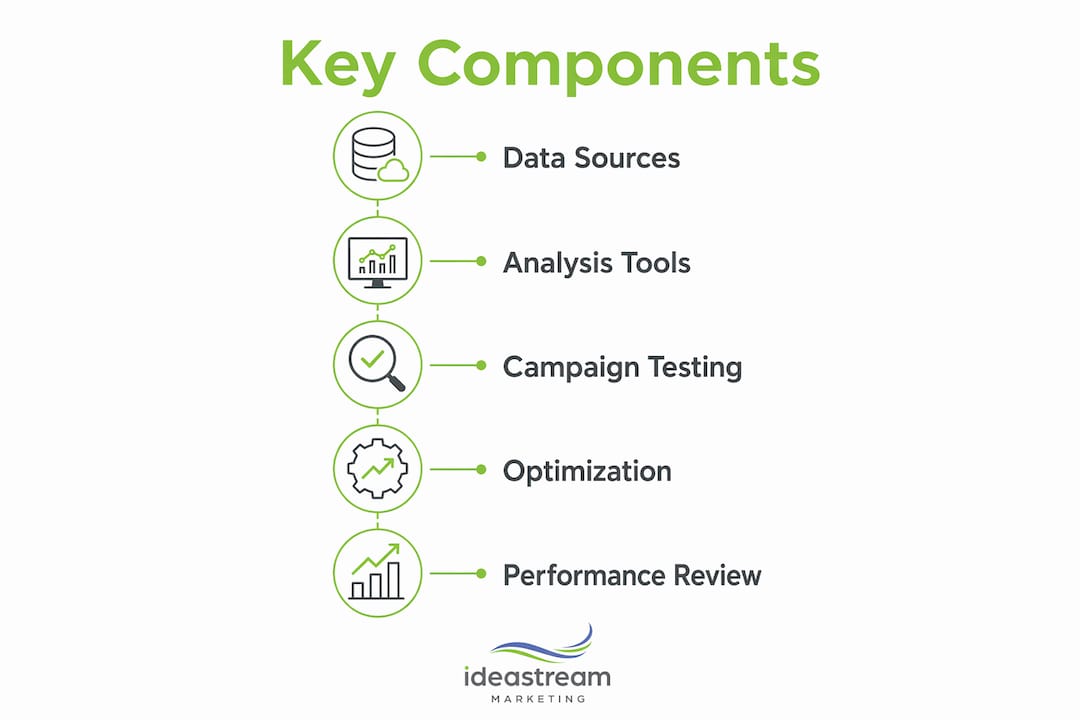
Four foundational elements make data-driven marketing work in practice.
- Customer data collection: Behavioral signals, transaction history, demographic data, and engagement patterns form the raw material. Without clean, integrated data, no analysis is reliable.
- Unified customer profiles: Data from multiple sources, such as CRM systems, website analytics, email platforms, and ad networks, must be merged into a single customer view. Siloed data produces siloed decisions.
- Marketing analytics and attribution: Measurement frameworks connect specific marketing actions to specific outcomes. Multi-touch attribution models show which channels and messages actually drive conversions.
- Automation and real-time activation: Marketing automation tools trigger messages based on customer behavior, not calendar schedules. A customer who abandons a cart receives a follow-up because the data says they are ready, not because a campaign was scheduled for Tuesday.
Continuous experimentation sits underneath all four elements. Hypothesis-driven A/B testing on subject lines, landing pages, ad creative, and audience segments generates the incremental knowledge that compounds over time. Teams that test consistently outperform teams that rely on past performance as a proxy for future results.
| Data Type | What It Reveals |
|---|---|
| Behavioral signals | Pages visited, time on site, content consumed |
| Transaction history | Purchase frequency, average order value, product preferences |
| Engagement patterns | Email open rates, click rates, social interactions |
| Demographic data | Age, location, industry, job title |
Pro Tip: Start with one data source you already trust, such as your website analytics, and build your first attribution model from there. Trying to integrate every data source at once is the fastest way to stall before you start.
How does data-driven marketing improve acquisition, retention, and ROI?
The business case for evidence-based marketing is not theoretical. Companies transitioning from opinion-based to data-driven marketing report 5 to 8 times higher marketing ROI. That is not a marginal improvement. It represents a fundamental change in how efficiently a marketing budget produces revenue.
“43% of marketing professionals reported 6–10% revenue increases over 12 months by incorporating AI into their marketing data analytics workflows.” — CSP Online
Spend efficiency is the most immediate benefit. 40–60% of marketing spend is often wasted or poorly allocated in organizations without data-driven oversight. Redirecting even a fraction of that waste toward high-performing channels produces measurable revenue gains without increasing total budget.
Retention improves because data-driven teams understand the behavioral signals that precede churn. A customer who stops opening emails, reduces purchase frequency, or shifts browsing patterns is showing early warning signs. Automated workflows can trigger re-engagement campaigns before that customer leaves, not after. This is why the customer retention advantage for data-driven organizations is so pronounced.

The compounding effect is what separates mature data-driven programs from early-stage ones. Each campaign generates data. That data informs the next campaign. Optimization is a continuous process where teams benefit from incremental knowledge and tighter campaigns over time. Organizations that start now build an advantage that becomes harder for competitors to close with every passing quarter.
What challenges block successful adoption of data-driven marketing?
The technology is not the hard part. Fewer than 30% of enterprises successfully translate data insights into actual marketing actions, mainly because of organizational and cultural barriers. The data exists. The will to act on it often does not.
The most common obstacles include:
- Intuition bias: Senior marketers with years of experience often trust their gut over a dashboard. When data contradicts a strongly held belief, the data gets questioned rather than the belief.
- Data overload without prioritization: Organizations collect far more data than they use. Without a clear framework for which metrics matter, teams drown in reports and make no decisions at all.
- Siloed teams: When analytics, creative, and media buying operate separately, insights from one team never reach the people who could act on them.
- No leadership modeling: When executives make decisions based on anecdote and override data-backed recommendations, the rest of the organization follows their lead.
Establishing objective truth through data helps overcome bias and enables more thoughtful marketing strategies. But that only works when leadership commits to the same standard. The shift to data-driven decisions requires leaders to model this behavior, including overriding their own intuition when data contradicts it.
Pro Tip: Run a “data audit” before your next major campaign. Identify which decisions were made based on data and which were made based on preference. The ratio will tell you exactly where your cultural gaps are.
What practical strategies help businesses implement data-driven marketing?
Implementation succeeds when it starts with infrastructure, not ambition. Data-driven marketing requires clean data, organizational willingness, and patience to build capability. Buying a new platform without fixing data quality first produces expensive, unreliable outputs.
A practical implementation sequence looks like this:
- Audit and integrate your data sources. Identify every system that holds customer data and map how they connect. Gaps in integration create blind spots in analysis.
- Define your key performance indicators before campaigns launch. Attribution models only work when success metrics are agreed upon in advance, not reverse-engineered after results come in.
- Run structured A/B tests on one variable at a time. Testing subject line and send time simultaneously produces unreadable results. Isolate variables to generate clean learning.
- Build automated triggers from behavioral data. Connect your CRM or marketing automation platform to behavioral signals so messages fire based on customer actions, not arbitrary schedules.
- Review and share results across teams weekly. Data insights that stay inside the analytics team never change marketing behavior. Cross-functional visibility is what drives cultural adoption.
For businesses looking to connect AI-driven marketing strategies to their data infrastructure, the implementation path becomes significantly faster when AI tools handle data interpretation and surface recommendations automatically.
Pro Tip: Assign one person in your organization as the “data advocate” for each campaign. Their job is to translate analytics into plain-language recommendations that creative and media teams can act on immediately.
How is AI reshaping the future of data-driven marketing?
The next phase of evidence-based marketing is not about collecting more data. It is about acting on it faster. Real-time dashboards enable high-performing teams to pivot campaigns quickly, creating a compounding optimization feedback loop that static monthly reports cannot match.
AI is accelerating this shift in three specific ways:
- Predictive audience modeling: AI analyzes behavioral patterns to identify which prospects are most likely to convert before a campaign even launches, reducing wasted impressions.
- Dynamic content personalization: AI tools adjust messaging, imagery, and offers in real time based on individual user behavior, not broad segment assumptions.
- Automated anomaly detection: When campaign performance deviates from expected ranges, AI flags the issue immediately rather than waiting for a weekly report.
Customer behavior now dictates messaging timing and content in real time. This is a fundamental change from campaign-based marketing, where a brand decided when to speak. In AI-augmented data-driven marketing, the customer’s actions decide the timing. Brands that build this capability now will hold a structural advantage in 2026 and beyond.
Understanding how AI transforms digital marketing is no longer optional for marketing leaders. It is the lens through which every data strategy decision should be evaluated.
Pro Tip: Before investing in AI marketing tools, confirm they can connect directly to your existing data sources. An AI layer built on incomplete data produces confident-sounding wrong answers.
Key takeaways
Data-driven marketing produces measurably better acquisition, retention, and ROI because it replaces assumption with behavioral evidence at every stage of the customer journey.
| Point | Details |
|---|---|
| Acquisition and retention advantage | Data-driven organizations are 23x more likely to acquire customers and 6x more likely to retain them. |
| ROI improvement | Companies switching from intuition-led to evidence-based marketing report 5–8x higher marketing ROI. |
| Spend waste reduction | Up to 60% of marketing spend is wasted without data-driven oversight. Redirecting it raises revenue without raising budget. |
| Cultural adoption is the real barrier | Fewer than 30% of enterprises act on their data insights, mainly due to organizational resistance, not technology gaps. |
| AI accelerates the advantage | 43% of marketing professionals report 6–10% revenue growth within 12 months by adding AI to their analytics workflows. |
Why data culture matters more than data technology
After working with businesses across industries, the pattern is consistent. The organizations that get the most from data-driven marketing are not the ones with the most sophisticated tools. They are the ones where leadership actually uses data to make decisions and holds teams accountable to the same standard.
The uncomfortable truth is that most marketing teams already have enough data to make better decisions. They have Google Analytics, CRM records, email performance reports, and ad platform dashboards. What they lack is the discipline to prioritize those signals over the opinions of the loudest person in the room.
I have seen companies invest heavily in customer data platforms and marketing automation, then continue making campaign decisions based on what the CEO liked in a focus group three years ago. The technology sat idle because the culture never changed. The data was there. The willingness to be wrong was not.
The businesses that build a genuine data culture, where being corrected by a metric is treated as useful rather than threatening, are the ones that compound their advantage over time. Every campaign teaches them something. Every test narrows the gap between what they think works and what actually does. That is not a technology story. It is a leadership story.
If you are a marketing leader reading this, the most valuable thing you can do this quarter is not buy a new tool. It is to publicly change one decision based on data that contradicts your instinct. That single act signals to your entire team that the culture has shifted.
— Dean
How Idea Stream Marketing helps businesses put data to work
Idea Stream Marketing works with businesses across Long Island and the United States to build marketing programs grounded in real performance data, not assumptions. Our AI SEO services are built on the same evidence-based principles described throughout this article, connecting behavioral data to search visibility and lead generation outcomes.
We combine AI-powered analytics, schema markup optimization, and conversion-focused web design to help clients improve ROI across every channel. Whether you are building your first data-driven program or looking to sharpen an existing one, we bring the infrastructure, the expertise, and the accountability to make it work. Schedule a consultation with our team to see exactly where your current marketing data is being left on the table.
FAQ
What is data-driven marketing?
Data-driven marketing is the practice of making campaign, targeting, and budget decisions based on measurable customer behavior and analytics rather than intuition. It uses behavioral signals, transaction history, and engagement data to guide every marketing action.
Why use data-driven marketing over traditional approaches?
Organizations using data-driven marketing are 23 times more likely to acquire customers and report up to 8 times higher marketing ROI compared to intuition-led approaches. The measurable improvement in efficiency and outcomes makes it the standard for growth-focused businesses.
How does data-driven marketing improve ROI?
It reduces wasted spend, which accounts for 40–60% of marketing budgets in organizations without data oversight, and redirects resources toward channels and messages that demonstrably convert. Each campaign cycle generates learning that makes the next one more efficient.
What is the biggest barrier to data-driven marketing adoption?
The primary barrier is cultural, not technical. Fewer than 30% of enterprises successfully act on their data insights, mainly because organizational resistance and intuition bias prevent teams from trusting and applying what the data shows.
How does AI fit into data-driven marketing?
AI accelerates data interpretation, enables real-time personalization, and automates campaign adjustments based on live behavioral signals. Businesses that incorporate AI into their analytics workflows report measurable revenue growth within 12 months of adoption.

