



October 21, 2026




TL;DR:
- Branding creates a unique business identity that builds customer trust and offers a competitive advantage.
- Consistent brand trust influences purchasing decisions, increases price tolerance, and fosters loyalty.
Branding is defined as the strategic process of shaping a unique business identity that builds customer trust, drives recognition, and creates competitive advantage. Every business owner faces the same core challenge: getting customers to choose them over every other option. The answer is rarely price. Brand trust drives purchase intent more reliably than any other single factor, and the Edelman Trust Barometer 2025 found that 88% of consumers say brand trust is important to them. Understanding why branding matters is not a marketing exercise. It is a foundational business decision that shapes revenue, loyalty, and long-term defensibility.
Why branding matters for customer trust and purchasing decisions
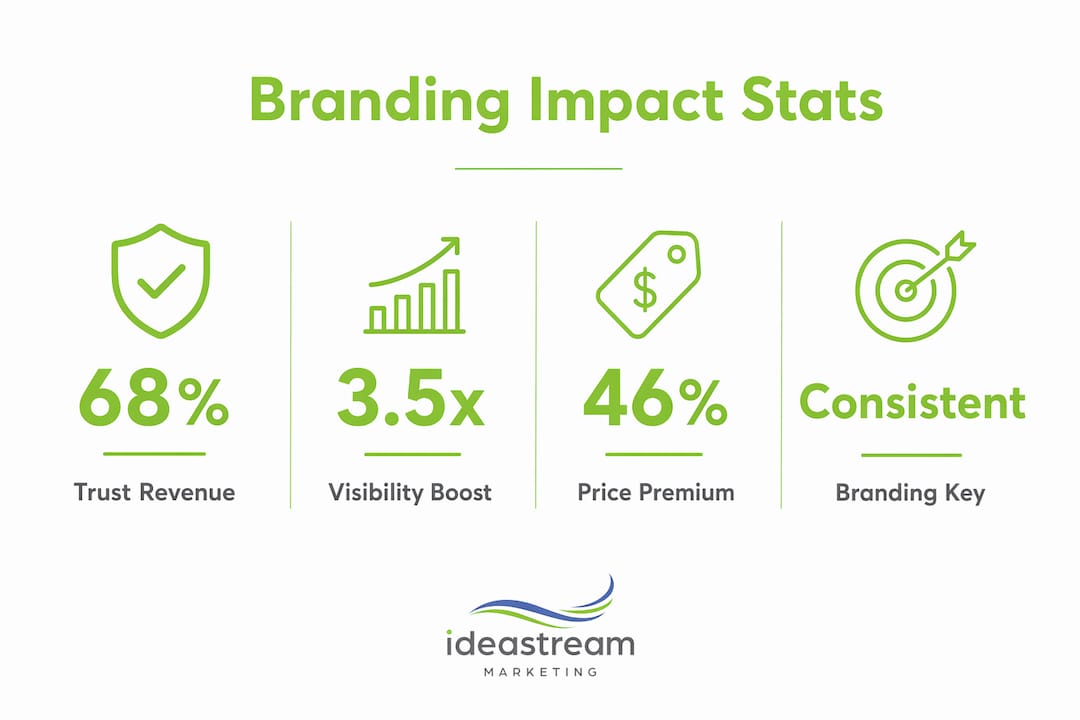
Brand trust is the single most powerful lever in a purchasing decision. 46% of customers pay more for brands they trust, and 68% say trust directly influences their willingness to pay a premium. That means your brand is not just a logo. It is a price floor.
The psychology behind this is well documented. The mere exposure effect shows that repeated brand encounters lower barriers to a first purchase over time. Customers who see your brand consistently across email, social media, your website, and physical materials develop a familiarity that feels like trust. They are not consciously analyzing your credibility. They are acting on a conditioned preference.
Brand trust also creates psychological switching costs. Customers stay loyal because a brand reflects how they see themselves, not because of contracts or pricing. A law firm client who identifies with your firm’s values and voice does not comparison shop every year. A restaurant regular who connects with your story and atmosphere does not leave for a competitor offering a $2 discount.
Consistent branding across every touchpoint reinforces this reliability. When your tone, visuals, and messaging align from your website to your invoices, customers read that consistency as professionalism. Inconsistency, on the other hand, signals instability.
Pro Tip: Audit every customer touchpoint, from your email signature to your voicemail greeting, and check whether each one reflects the same brand voice and visual identity. Gaps in consistency are trust gaps.
- Brand trust increases price tolerance and reduces price sensitivity
- Consistent visual and verbal identity signals reliability to new customers
- The mere exposure effect conditions familiarity before the first sale
- Psychological switching costs keep loyal customers from leaving for competitors
How brand recognition drives engagement and business growth
Consistently presented brands are 3.5 times more likely to have excellent visibility. That statistic matters because visibility is the precondition for every sale. Customers cannot buy from a business they do not recognize.

Recognition does more than generate awareness. It reduces the cost of every subsequent marketing effort. When customers already know your brand, paid ads perform better, email open rates climb, and referrals come naturally. Loyal customers cost less to market to and carry higher lifetime value than any new customer you acquire through paid channels. The math strongly favors investing in brand recognition early.
Brand personality and messaging deepen this effect. A business with a clear voice, a defined point of view, and messaging that speaks directly to its customers creates emotional connection. Emotional connection drives referral behavior. Customers who feel understood by a brand tell other people about it without being asked.
This dynamic is especially powerful for small and midsize businesses. Brand strategy is vital for SMEs that cannot rely on large media budgets. They build trust through quality, consistent brand interactions rather than volume advertising. Every touchpoint becomes a brand investment.
- Define your brand personality. Choose three to five words that describe how your business should feel to customers. Use those words to guide every piece of content you create.
- Create a consistent visual system. Use the same color palette, typography, and logo treatment across your website, social media, and print materials.
- Develop a brand voice guide. Document the tone, vocabulary, and communication style your business uses so every team member sounds like the same company.
- Show up on the right channels consistently. Presence on two channels done well beats presence on six channels done poorly.
- Measure recognition over time. Track branded search volume, direct website traffic, and referral rates as indicators of growing brand recognition.
Pro Tip: Ask your best customers to describe your business in their own words. The language they use is your most effective brand messaging. Build your content around their exact phrases.
How does branding differentiate your business in a crowded market?
Brand positioning is the clearest answer to the question every customer asks: why you and not someone else? Positioning clarifies what your business is, who it serves, and what it stands for. Without it, you compete on price by default. That is a race no business wins sustainably.
The most effective differentiation is not about features. Top brands outperform market indices consistently because they create perceived value that competitors cannot easily copy. A feature can be replicated in months. A brand built on trust, story, and consistent experience takes years to build and is nearly impossible to replicate.
A common and costly mistake is starting with visual design before defining strategic positioning. Business owners invest in logos and color palettes before answering the foundational questions: Who is this brand for? What problem does it solve? What does it believe? Without those answers, design decisions are arbitrary and often require expensive revisions.
Effective messaging architecture uses the language your customers already use to describe their problems. A logo is only a symbolic shortcut. The real work is building a message that resonates with how customers think and speak about their challenges.
| Differentiation approach | What it signals to customers | Durability |
|---|---|---|
| Price-based competition | Low cost, low barrier | Weak, easily undercut |
| Feature-based competition | Functional advantage | Moderate, replicable |
| Brand-based differentiation | Trust, identity, values | Strong, hard to copy |
| Community and story-based | Belonging and shared purpose | Very strong, self-reinforcing |
- Positioning answers “why you” before a customer ever asks
- Messaging built on customer language converts better than marketing jargon
- Visual identity without strategic positioning produces inconsistent results
- Brand differentiation creates defensibility that pricing cannot
Effective branding techniques every business owner can use
Strong branding starts with strategy, not design. Jumping to visual design without defining your audience and positioning leads to wasted effort and costly revisions. The sequence matters: strategy first, then identity, then execution.
The foundation is a clear brand strategy document. This covers your mission, your values, your target customer profile, and your positioning statement. It does not need to be long. It needs to be specific. Vague mission statements produce vague brands.
Brand voice is the next layer. Your voice is how your business sounds in writing and in conversation. A healthcare practice sounds different from a restaurant, which sounds different from a law firm. Defining your voice means documenting the tone, the vocabulary you use, and the vocabulary you avoid. This consistency is what makes your brand feel coherent across every channel.
Brand guidelines bring everything together. A practical brand guide covers logo usage, color codes, typography, photography style, and voice examples. It gives every team member and vendor a shared reference point. Without guidelines, your brand drifts every time a new person creates content.
Digital marketing reinforces brand experience at scale. Content marketing, social media, and branding in digital campaigns all work better when they draw from a consistent brand foundation. The content you publish, the ads you run, and the emails you send should all feel like they come from the same source.
For small businesses and startups, the priority is depth over breadth. Pick two or three channels and build a strong, consistent brand presence there before expanding. Consistency on a small stage builds more trust than scattered presence on every platform.
Key takeaways
Strong branding builds customer trust, reduces marketing costs, and creates competitive differentiation that price and features alone cannot deliver.
| Point | Details |
|---|---|
| Trust drives revenue | 68% of customers say brand trust influences their willingness to pay a premium. |
| Consistency builds visibility | Consistently presented brands are 3.5 times more likely to have excellent visibility. |
| Strategy before design | Define positioning and audience before investing in logos or visual identity. |
| Loyalty lowers costs | Loyal customers cost less to market to and generate higher lifetime value. |
| Differentiation beats price | Brand-based differentiation creates psychological switching costs that pricing cannot replicate. |
What I have learned after years of watching brands succeed and fail
The businesses I have seen struggle with branding almost always share one pattern: they treated it as a cosmetic exercise. They hired a designer, got a logo, picked some colors, and called it done. Then they wondered why nothing changed.
The brands that grow consistently do the opposite. They start with a clear point of view about who they serve and why they are the right choice. They document their voice and stick to it. They show up the same way on their website, their social media, their proposals, and their follow-up emails. That consistency compounds over time. It is not glamorous work, but it is the work that builds brand loyalty that actually holds.
The other thing I have noticed is that business owners underestimate how much their brand communicates before a single word is read. The quality of your website, the professionalism of your photography, the tone of your first email response. These signals tell customers whether you are trustworthy before they have evaluated your service. You do not get a second chance to make that first impression, and a weak brand makes every sales conversation harder than it needs to be.
My honest advice: treat branding as infrastructure, not decoration. Build it once, build it right, and let it do the heavy lifting across every channel you use.
— Dean
How Idea Stream Marketing helps businesses build brands that perform
Building a brand that earns trust and drives growth requires more than good intentions. It requires consistent execution across your website, content, advertising, and digital presence.

Idea Stream Marketing works with business owners across Long Island, New York City, and nationwide to build brand strategies that translate directly into visibility and revenue. From AI SEO services that reinforce your brand authority in search results to custom website design and content marketing, every service is built around a coherent brand foundation. If you are ready to build a brand that customers trust and competitors cannot easily copy, schedule a consultation with Idea Stream Marketing today.
FAQ
Why does branding matter more than product quality alone?
Brand trust shapes purchasing decisions before customers evaluate product quality. The Edelman Trust Barometer 2025 found that 88% of consumers say brand trust is important to them, making it a primary driver of purchase intent.
How does branding affect sales directly?
Strong branding increases price tolerance and reduces customer acquisition costs. 46% of customers are willing to pay more for brands they trust, which means a well-built brand directly improves margin.
What is the first step in building a strong brand?
Define your positioning before any visual design work. Clarifying who your brand serves, what problem it solves, and what it stands for prevents costly revisions and gives every design decision a clear purpose.
How does branding help small businesses compete?
Small businesses build trust through consistent, quality brand interactions rather than large advertising budgets. Brand strategy for SMEs focuses on depth and consistency across fewer channels rather than broad reach.
How long does it take for branding to show results?
Brand recognition builds through repeated exposure over time. The mere exposure effect shows that consistent brand encounters condition customer familiarity and lower purchase barriers, with meaningful results typically visible within six to twelve months of consistent execution.

