



October 21, 2026




TL;DR:
- Healthcare content marketing involves creating accurate educational materials to attract patients and build trust. Strict regulations like HIPAA and FTC rules shape all published content, emphasizing accuracy and compliance. Consistent, authority-built content efforts significantly increase search visibility, patient inquiries, and retention.
Content marketing for healthcare is defined as the practice of creating and distributing accurate, educational content to attract patients, build provider credibility, and grow healthcare brands. Unlike general content marketing, this discipline operates under strict regulatory frameworks including HIPAA and FTC guidelines, which shape every piece of content a healthcare organization publishes. The stakes are high: content marketing generates 3x more leads than traditional outbound marketing while costing 62% less. That efficiency advantage makes content the most cost-effective growth channel available to healthcare marketers today. Providers who commit to patient education content report 34% higher retention rates and receive nearly five times more inquiries than those who don’t.
What is content marketing for healthcare, and why does it matter?
Content marketing in healthcare is the systematic process of publishing trustworthy, clinically grounded information that guides patients through their care decisions. The industry term used by practitioners is “healthcare content marketing,” and it covers everything from blog posts and symptom guides to video testimonials and patient education portals. What separates it from standard content marketing is the obligation to accuracy. A fitness brand can publish aspirational copy. A hospital cannot.

The core purpose is threefold: educate patients, build institutional trust, and increase visibility in search. Healthcare content success depends on accuracy, empathy, and ethical presentation attributed to credible clinicians. That means every article, video, or FAQ your organization publishes should be reviewed by a qualified provider and cite primary clinical sources where appropriate. This is not optional best practice. It is the foundation of a compliant and effective content program.
Healthcare organizations that invest in digital marketing for healthcare providers consistently outperform those relying on referrals alone. The combination of search visibility and patient education creates a compounding effect: more content means more search traffic, which means more patient inquiries, which means more appointments.
How does content marketing build trust and engagement in healthcare?
Trust is the currency of healthcare. Patients do not book appointments with providers they do not trust, and they do not trust providers whose content is vague, inaccurate, or promotional in tone. Content marketing builds that trust by giving patients reliable answers before they ever walk through the door.
The mechanics of trust-building through content work on several levels:
- Accuracy and compliance. Content that follows HIPAA and FTC rules signals institutional integrity. HIPAA compliance requires that any content using Protected Health Information (PHI) for marketing purposes must have prior patient authorization. Content that respects those boundaries communicates that your organization takes patient privacy seriously.
- FAQ content reduces friction. FAQ-based content reduces administrative call volumes by 18%. Patients who find answers online do not need to call your front desk. That frees up staff and improves the patient experience simultaneously.
- Video accelerates decisions. Video patient education boosts appointment request rates by 33%. A short explainer video about a procedure gives patients the confidence to schedule rather than delay.
- Consistent publishing builds authority. Healthcare blogs raise organic traffic by 55% to 200% compared to sites without blogs. That traffic represents real patients searching for answers your organization can provide.
The engagement benefit compounds over time. A patient who reads three of your blog posts before their first appointment arrives better informed, more confident, and more likely to follow through on their care plan. That is the patient relationship content marketing builds.
Pro Tip: Assign a licensed clinician as the named author or reviewer on every educational article you publish. That byline signals authority to both patients and search engines, and it satisfies FTC expectations for credible health claims.
What are the key content types used in healthcare marketing?
Healthcare marketers use a range of formats, each suited to a different stage of the patient journey. Choosing the right format for the right moment is what separates effective content programs from scattered publishing calendars.
- Blog posts and long-form articles. These are the workhorses of healthcare SEO. A well-researched article on a specific condition or treatment can rank for years and drive consistent organic traffic. Long-form content also gives clinicians space to explain nuance, which builds credibility.
- Patient education videos. Video is the most trusted format for explaining procedures, managing expectations, and introducing care teams. Video on landing pages increases conversion by 34%, making it one of the highest-return investments in healthcare content.
- Email newsletters. Newsletters keep existing patients engaged between appointments. They work best when they deliver genuinely useful health tips rather than promotional announcements.
- Symptom checkers and interactive tools. These tools capture patients at the moment of concern and guide them toward appropriate care. They also generate significant organic traffic because they answer high-intent search queries.
- Podcasts and webinars. Long-form audio and video content builds deep authority for specialist providers. A cardiologist hosting a monthly podcast on heart health becomes the recognized expert in their market.
- Whitepapers and clinical guides. These formats serve a B2B healthcare audience: hospital administrators, payers, and referring physicians. They demonstrate institutional expertise and support partnership development.
Regulatory nuances apply across all formats. Patient testimonials require explicit HIPAA authorization and cannot serve as scientific evidence for efficacy claims under FTC rules. Testimonials require careful disclaimers to maintain compliance. A patient saying “Dr. Smith changed my life” is permissible with authorization. A testimonial claiming a treatment cured a condition is not, without competent scientific evidence backing the claim.
Pro Tip: Build a content matrix that maps each format to a specific patient journey stage: awareness, consideration, or decision. That structure prevents you from publishing content that is interesting but disconnected from patient needs.
Which healthcare marketing tactics optimize content for compliance and search visibility?
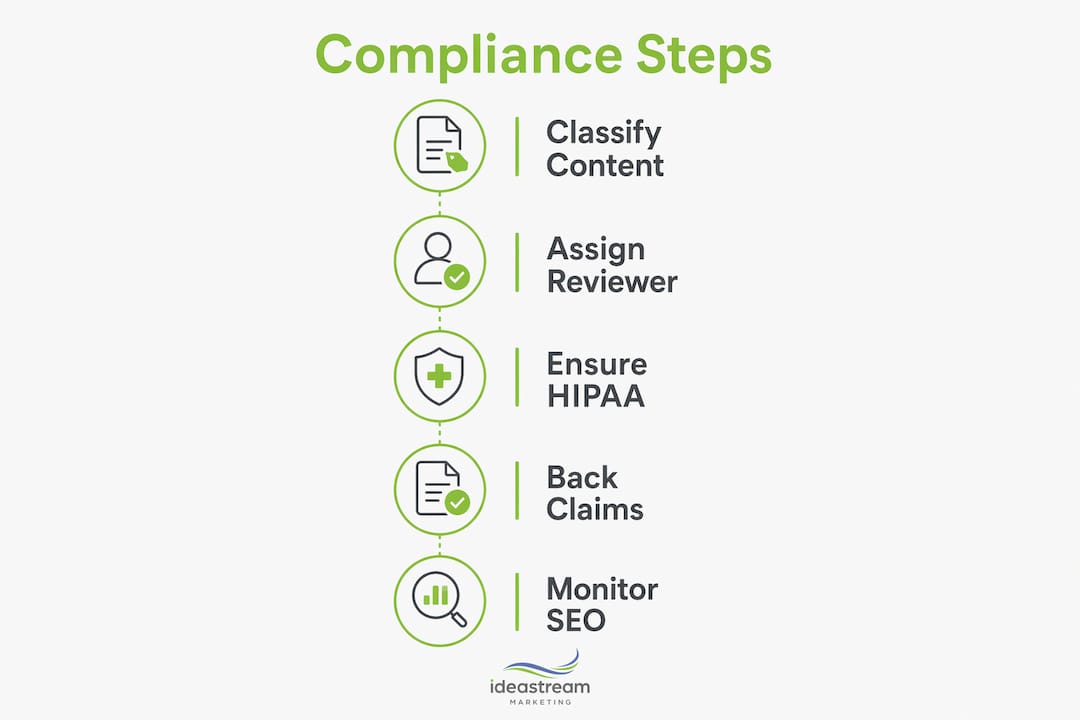
Compliance and search visibility are not competing priorities. The tactics that make content compliant also tend to make it more trustworthy, which search engines reward. The key is building compliance into your content workflow from the start rather than treating it as a final review step.
Compliance requirements every marketer must know
HIPAA governs how healthcare organizations use patient information in marketing. Marketing that uses PHI or promotes products for remuneration generally requires prior patient authorization. Treatment communications and operational messages are typically exempt, but any content that promotes a service to identified patients crosses into regulated territory.
The FTC requires that health claims be backed by “competent and reliable scientific evidence.” Anecdotal patient stories cannot substantiate medical treatment claims. That distinction matters enormously when you are writing about outcomes, success rates, or treatment effectiveness.
Standard analytics tools present a hidden compliance risk. Free-tier analytics pixels without Business Associate Agreements can violate HIPAA if they capture PHI. Marketers must map their data flows and de-identify any PHI before it reaches third-party platforms. This applies to Google Analytics configurations, Meta Pixel implementations, and any retargeting setup.
Tactics that improve both compliance and search performance
- Use structured FAQ content on every service page. 52% of health-related searches display Google AI Overviews, and FAQ-formatted content is the primary format those overviews pull from.
- Implement schema markup for medical content. FAQ schema, MedicalCondition schema, and Physician schema all improve how search engines understand and surface your content.
- Build a compliance workflow that classifies content early. Effective compliance workflows categorize content as educational, marketing to identified patients, testimonial-based, or health claim-based, then route each type through the appropriate legal and privacy review.
- Audit your analytics setup annually. Confirm that Business Associate Agreements are in place with every third-party tool that touches patient data.
Understanding how AI affects search visibility is increasingly relevant for healthcare marketers. AI-powered search surfaces authoritative, structured content, which means the same practices that satisfy compliance reviewers also satisfy the algorithms.
Pro Tip: Create a one-page content classification guide for your marketing team. When writers know upfront whether a piece is “educational” or “marketing to identified patients,” they write it correctly the first time and reduce legal review cycles.
How to apply content strategies for patient engagement and brand growth
Knowing the formats and compliance rules is necessary. Executing a content program that actually grows your brand requires a structured approach. These steps translate strategy into results.
- Map your patient journey. Identify the questions patients ask at each stage: before they know they have a condition, while they are researching options, and when they are ready to book. Build your content calendar around those questions.
- Use SEO data to prioritize topics. Keyword research tools reveal which patient questions receive the most search volume. Start with high-volume, low-competition queries where your organization can realistically rank.
- Publish consistently and build compounding returns. A single blog post delivers limited value. A library of 50 well-optimized articles creates a traffic asset that grows month over month. Consistent content publishing creates compounding returns for healthcare organizations.
- Measure what matters. Track organic traffic, time on page, appointment request conversions, and call volume changes. These metrics tell you whether your content is actually changing patient behavior.
- Blend education with brand identity. Every piece of content should reflect your organization’s values and voice. Educational content that feels generic does not build brand loyalty. Content that sounds like your providers and reflects your care philosophy does.
Reviewing healthcare marketing strategies that align content with broader growth goals helps marketers connect individual content pieces to organizational objectives. Content does not exist in isolation. It works best when it supports a coordinated digital marketing program that includes SEO, paid search, and social media.
For healthcare organizations building their first content program, the lead generation process for clinics provides a practical framework for connecting content output to measurable patient acquisition results.
Key Takeaways
Healthcare content marketing succeeds when compliance, clinical accuracy, and SEO are treated as a single integrated system rather than separate workstreams.
| Point | Details |
|---|---|
| Compliance is upstream, not a final step | Classify content type before writing to reduce legal review cycles and avoid HIPAA violations. |
| FAQ content drives dual results | FAQ-formatted content reduces call volume by 18% and captures Google AI Overview placements. |
| Video is the highest-converting format | Video on landing pages increases conversion by 34% and boosts appointment request rates by 33%. |
| Consistent publishing compounds returns | Healthcare blogs raise organic traffic by 55% to 200% through sustained, topic-focused publishing. |
| Analytics tools require compliance review | Confirm Business Associate Agreements are in place before any third-party tool touches patient data. |
What I’ve learned about compliance-first content in healthcare
After working with healthcare organizations on content and digital marketing, the pattern I see most often is this: compliance gets treated as a gate at the end of the process. A writer produces a piece, a marketer approves it, and then it sits in legal review for two weeks before coming back with significant revisions. That cycle kills momentum and frustrates everyone involved.
The organizations that produce the best healthcare content do the opposite. They classify content type before a single word is written. They know whether a piece is general education or marketing to identified patients before the brief is drafted. That upstream decision changes how the writer approaches the topic, which means the content arrives at legal review in far better shape.
The other thing I’ve noticed is that marketers underestimate how much patients have changed. People now arrive at appointments having already read three articles, watched two videos, and asked an AI assistant a follow-up question. Your content is not competing with other healthcare brands for attention. It is competing with the entire internet. That means generic, thin content does not just underperform. It actively damages trust when patients compare it to more authoritative sources.
The opportunity in 2026 is significant. AI-powered search surfaces structured, authoritative content more prominently than ever. Healthcare organizations that invest in clinician-attributed, compliance-reviewed, SEO-structured content will capture that visibility. Those that continue publishing occasional blog posts without a system behind them will not.
— Dean
Healthcare video and digital marketing services from Idea Stream Marketing
Healthcare organizations that want to grow patient engagement need content that is both compliant and compelling. That combination is harder to achieve than it sounds, and most in-house teams lack the production capacity to execute it consistently.
Idea Stream Marketing works with healthcare providers to produce professional video content and full-service digital marketing programs designed to increase search visibility, build patient trust, and drive appointment conversions. From patient education videos and branded storytelling to SEO-structured content and Google Ads management, we build content programs that meet compliance requirements and deliver measurable results. If your organization is ready to build a content program that actually grows your practice, we would be glad to talk through what that looks like for your specific goals.
FAQ
What is content marketing for healthcare in simple terms?
Healthcare content marketing is the practice of publishing accurate, educational content to attract patients, build provider trust, and grow a healthcare brand’s online visibility. It differs from general content marketing because it must comply with HIPAA and FTC regulations.
How does HIPAA affect healthcare content marketing?
HIPAA requires that any content using patient information for marketing purposes must have prior written authorization from the patient. General educational content that does not identify specific patients is typically exempt from this requirement.
What content formats work best for patient engagement?
Video and FAQ-based content deliver the strongest engagement results. Video boosts appointment request rates by 33%, while FAQ content reduces administrative call volumes by 18% and improves search visibility through Google AI Overviews.
How long does it take for healthcare content marketing to show results?
Healthcare content marketing typically produces compounding results over 6–12 months of consistent publishing. Individual blog posts can rank within weeks, but a full content library that drives sustained organic traffic takes sustained effort over multiple months.
Can patient testimonials be used in healthcare marketing?
Patient testimonials are permitted with explicit HIPAA authorization, but they cannot be used as scientific evidence for treatment efficacy claims under FTC rules. Each testimonial must include appropriate disclaimers and cannot imply guaranteed outcomes.

