



September 3, 2026


TL;DR:
- End-to-End marketing integrates all customer touchpoints into one measurable system to improve conversion rates.
- It involves aligning SEO, paid ads, content, social media, email, and analytics while maintaining messaging consistency across channels.
End-to-End marketing is defined as an integrated, full-funnel approach that coordinates every customer interaction from first awareness through post-purchase loyalty into one measurable system. The industry term for this is “full-funnel marketing,” and both phrases describe the same discipline: aligning SEO, paid advertising, content, social media, email, and analytics under a single strategy. Integrated end-to-end campaigns launch in days rather than weeks and average conversion rates of 2.9% compared to 0.5% for traditional siloed methods. That gap is not a rounding error. It reflects what happens when every channel reinforces the others instead of operating independently. Idea Stream Marketing builds exactly this kind of connected system for businesses across Long Island and nationwide.
What is end to end marketing and what does it include?
End-to-End marketing covers every touchpoint a customer encounters before, during, and after a purchase. The goal is a consistent experience at each stage, so no lead falls through the gap between channels.
The core channels in a full-funnel marketing process are:
- SEO: Drives organic discovery at the top of the funnel. Blog content, technical optimization, and schema markup bring qualified visitors to your site before they are ready to buy.
- Paid advertising: Google Ads and paid social capture demand from audiences already searching for solutions. Paid ads work best when they link to landing pages that mirror the ad’s message exactly.
- Content marketing: Educational articles, videos, and case studies build credibility at the consideration stage. Each channel promotes the others, so a blog post can feed an email sequence, a social campaign, and a retargeting audience simultaneously.
- Social media: Maintains brand visibility and nurtures warm audiences between purchase decisions. Consistent posting also generates social proof that supports conversion on other channels.
- Email marketing: Converts and retains. Automated sequences move leads from interest to decision while post-purchase emails build loyalty and referrals.
- Analytics: Google Analytics and similar platforms tie every channel together with shared data. Without unified tracking, you cannot tell which touchpoint actually closed the sale.
Messaging consistency across all six channels is what separates a true end-to-end strategy from a collection of disconnected campaigns. A prospect who sees your paid ad, reads your blog, and then receives your email should encounter the same brand voice, the same value proposition, and the same call to action at every step. That consistency builds trust faster than any single channel can alone. You can explore types of digital marketing channels in more depth to map which ones fit your business model.
How does end-to-end marketing compare to traditional approaches?

Traditional marketing runs campaigns in silos. A print ad team, a digital team, and a PR team each pursue separate goals with separate budgets and separate metrics. End-to-end marketing replaces that structure with a single, connected system.
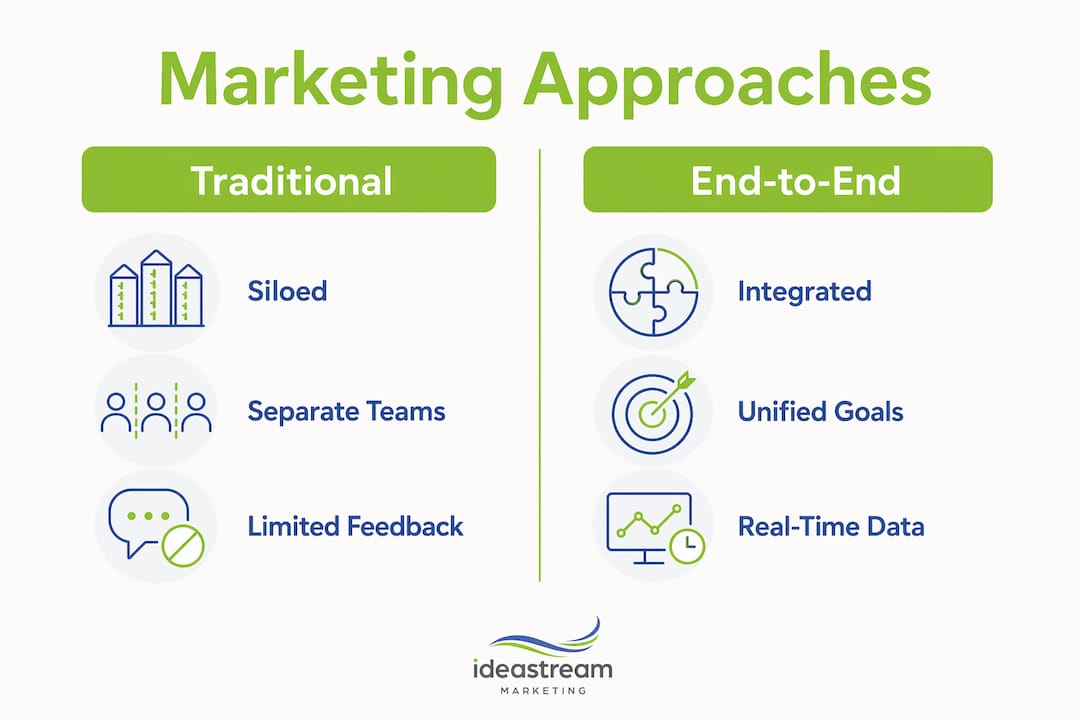
The performance difference is significant. Digital end-to-end strategies allow A/B testing in hours and PPC adjustments in real time, while traditional campaigns lock budgets into placements weeks or months in advance. Speed matters because markets shift and audiences respond differently than expected. Real-time optimization means you fix what is not working before it wastes the entire budget.
| Factor | Traditional segmented marketing | End-to-end digital marketing |
|---|---|---|
| Average conversion rate | 0.5% | 2.9% |
| Campaign launch time | Weeks to months | Days |
| ROI tracking | Difficult, delayed | Real-time, measurable |
| Budget flexibility | Fixed placements | Adjustable at any time |
| Channel coordination | Siloed teams | Unified strategy |
Businesses using end-to-end marketing lift ad revenue by 30% and increase productivity by 32% while reducing lead generation costs by up to 62%. Those numbers reflect the compounding effect of channels that share data and reinforce each other.
Traditional methods still have a role. Television, radio, and print build broad brand awareness and trust in ways that digital channels alone cannot always replicate. The most effective approach combines both, using traditional media to build recognition and digital systems to capture and convert that demand with precision.
Pro Tip: If you are running paid ads without a matching SEO and content strategy, you are paying full price for leads that a full-funnel approach would generate at a fraction of the cost. Build the organic foundation first, then use paid to accelerate.
How to implement an end-to-end marketing strategy
A seven-step framework gives you a repeatable process for building and launching a full-funnel campaign without getting stuck in planning.
- Define your goals. Set specific, measurable targets before choosing any channel. “Increase qualified leads by 40% in 90 days” is a goal. “Get more traffic” is not.
- Clarify your value proposition. State in one sentence why your customer should choose you over every alternative. Every piece of content and every ad should reflect this statement.
- Research your audience. Build detailed profiles based on real data: job titles, pain points, buying triggers, and preferred channels. Assumptions here cost money later.
- Select your channels. Choose the 3–4 channels where your audience is most active and where you can execute consistently. Spreading across every platform at once produces mediocre results everywhere.
- Develop your messaging. Write core messages for each stage of the funnel: awareness, consideration, and decision. Adapt tone and format for each channel while keeping the core proposition identical.
- Assign ownership. Every channel needs one person or team responsible for execution and results. Shared ownership produces no ownership.
- Set up reporting. Track 2–3 key metrics per channel and review them monthly or quarterly. More metrics create noise. Fewer metrics create blind spots.
The biggest mistake businesses make is trying to launch every channel at once. Starting with 3–4 content pillars and running 4–6 week test sprints prevents analysis paralysis and generates real data before you scale. Each sprint produces evidence that justifies the next decision. That is how you build a strategy that compounds over time rather than one that burns budget on assumptions.
Pro Tip: Treat your first 90 days as a learning phase, not a performance phase. Set sprint goals around data collection and channel validation, not revenue. The revenue follows once you know what actually works for your specific audience.
Understanding the foundations of digital marketing will help you make smarter channel decisions at step four.
What roles do data, automation, and AI play in full-funnel campaigns?
Data is the operating system of end-to-end marketing. Without it, you are making creative decisions based on instinct. With it, you know which ad drove the conversion, which email subject line doubled open rates, and which landing page variant produced the most qualified leads.
The practical benefits of integrating data, automation, and AI include:
- Centralized tracking: A single analytics platform, such as Google Analytics 4, connects traffic, behavior, and conversion data across all channels. You see the full customer path, not just the last click.
- AI-powered segmentation: AI tools analyze audience behavior at a scale no human team can match. They identify which segments respond to which messages and adjust delivery automatically.
- Automated sequences: Email workflows, retargeting ads, and lead scoring run without manual intervention. Automation frees your team to focus on strategy, positioning, and relationships rather than repetitive tasks.
- Real-time reporting: Automated dashboards surface performance data daily instead of waiting for monthly reports. Problems get caught and corrected faster.
The risk with automation is over-reliance. AI increases speed and relevance in campaigns but cannot replace strategic decision-making or brand trust-building. A chatbot can qualify a lead. It cannot build the relationship that closes a $50,000 contract. Keep humans in control of strategy, brand voice, and high-stakes customer interactions. Use automation to scale what is already working, not to replace the thinking that made it work in the first place.
Branding in digital campaigns explains why consistent brand voice matters even more when automation handles delivery.
Key Takeaways
End-to-end marketing outperforms siloed approaches because it connects every channel, message, and data point into one system that compounds results over time.
| Point | Details |
|---|---|
| Full-funnel integration | Connect SEO, paid ads, content, social, email, and analytics under one unified strategy. |
| Conversion advantage | End-to-end campaigns average 2.9% conversion rates versus 0.5% for traditional methods. |
| Seven-step implementation | Define goals, audience, channels, messaging, ownership, and reporting before launching. |
| Sprint-based testing | Start with 3–4 content pillars and 4–6 week sprints to validate before scaling. |
| Human-led automation | Use AI and automation to scale execution, but keep strategic decisions in human hands. |
Why most businesses get end-to-end marketing wrong
Most businesses I work with come in with the same problem: they have channels, but they do not have a system. They run Google Ads without a content strategy feeding organic traffic. They post on social media without connecting it to an email list. They track vanity metrics instead of the two or three numbers that actually predict revenue.
The uncomfortable truth is that end-to-end marketing is not complicated. It is just disciplined. The businesses that do it well are not necessarily spending more money. They are spending it in a connected way, where every dollar in one channel makes the next dollar in another channel more effective.
My strongest recommendation is to resist the urge to launch everything at once. Pick your top two channels, run a 4–6 week sprint, and measure what actually happened. Then add the next channel. That approach feels slower at the start, but it builds a system you understand and can defend with data. A big launch with no data is just expensive guessing.
The other thing I see consistently: businesses underestimate the role of brand consistency. You can have the best targeting in the world, but if your ad says one thing and your landing page says another, you lose the conversion. The message has to be identical at every step. That is not a creative preference. It is a conversion requirement.
— Dean
How Idea Stream Marketing supports your full-funnel marketing goals
Idea Stream Marketing builds the kind of connected marketing systems this article describes, combining professional video production with AI-powered digital marketing to cover every stage of the customer journey.
From branded video content and commercial production to SEO, Google Ads management, social media marketing, and AI-powered automation, Idea Stream Marketing handles the full picture. Video is one of the highest-converting assets in a full-funnel strategy, and every video we produce is built with discoverability in mind: optimized for YouTube, social platforms, and search. If you are ready to build a complete digital marketing strategy that connects your channels and produces measurable results, our team is ready to help. Contact Idea Stream Marketing to discuss your campaign goals.
FAQ
What is the definition of end-to-end marketing?
End-to-end marketing is a full-funnel strategy that integrates every customer touchpoint, from awareness through loyalty, into one coordinated and measurable system. It aligns channels, messaging, and data to create a consistent customer experience.
What does end-to-end marketing involve at a practical level?
It involves connecting SEO, paid advertising, content marketing, social media, email, and analytics so each channel supports the others. Unified brand messaging and shared data tracking are the two non-negotiable requirements.
What are the main benefits of end-to-end marketing?
End-to-end marketing produces higher conversion rates, lower lead generation costs, and faster campaign launches compared to traditional siloed methods. Businesses using this approach can reduce lead generation costs by up to 62%.
How long does it take to implement an end-to-end marketing strategy?
A basic full-funnel strategy can launch in days with digital channels. The recommended approach uses 4–6 week sprints to test and validate each channel before scaling, so meaningful results typically appear within the first 90 days.
How does video fit into an end-to-end marketing strategy?
Video supports every stage of the funnel: brand awareness at the top, product education in the middle, and testimonials or case studies at the decision stage. It is one of the most versatile assets in a full-funnel campaign.