



September 30, 2026




TL;DR:
- Web development transforms cemetery marketing by enhancing local search visibility and guiding families effectively.
- A well-structured website serves both grieving families needing quick information and pre-need visitors seeking details and education.
Web development is the primary channel that turns cemetery marketing from passive visibility into measurable, compassionate outreach. A well-built cemetery website does three things at once: it surfaces your organization in local search, guides grieving families to the right information without friction, and converts anonymous visitors into counseled prospects. Before you brief a development partner or hire one, run these three quick checks:
- Google Business Profile verification — confirm your GBP listing is claimed, verified, and shows accurate hours, photos, and categories.
- On-site schema/structured data check — use Google’s Rich Results Test to see whether your site exposes LocalBusiness, Cemetery, or Service schema.
- Mobile speed and accessibility quick test — run your homepage through Google PageSpeed Insights and check that tap targets and contrast ratios meet basic WCAG standards.
If any of these fail, schedule a discovery call with a web development partner before investing in paid advertising.
Table of Contents
- How does web development shape cemetery marketing outcomes?
- What technical SEO foundations does a cemetery site need?
- How do you turn cemetery website visitors into leads?
- Why does compassionate, accessible design matter for cemetery sites?
- What integrations and security controls should you require?
- What KPIs and deliverables should you expect from a web project?
- How do you choose the right web development and digital marketing partner?
- Key Takeaways
- A perspective worth considering
- Ideastreammarketing can build this for your organization
- Useful sources and internal resources
- FAQ
How does web development shape cemetery marketing outcomes?
A cemetery website must serve two very different visitors at the same time. The at-need visitor arrives in crisis: they need a phone number, directions, and a clear next step within seconds, usually on a phone. The pre-need visitor is researching options months or years ahead; they want pricing context, a planning guide they can download, and a gentle invitation to schedule a private consultation.
Essential pages and features every cemetery site should carry:
- Services and pricing — transparent enough to build trust, and detailed enough to answer the first question families ask
- Interment and plot availability — searchable inventory or a map-based locator where backend data supports it
- Obituaries and memorial pages — a place for families to share tributes and photos
- Contact, directions, and hours — prominent on every page, not buried in a footer
- History and community pages — heritage content that builds emotional connection and supports long-tail SEO
- Grief resources and FAQ — educational content that positions your organization as a caring guide
- Appointment scheduling — an online booking option reduces phone-tag friction for both audiences
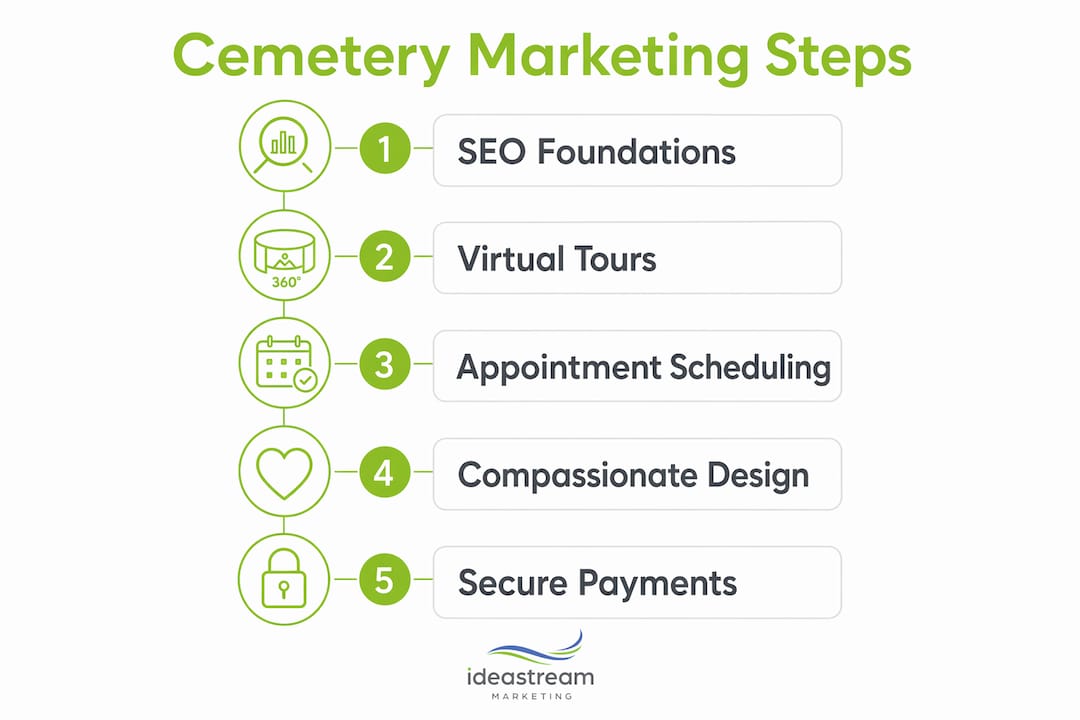
A modern, search-optimized website combined with virtual tours and CRM automation is the foundation of family outreach and interment growth. The table below maps each core feature to its primary purpose and the metric that tells you whether it’s working.
| Page / Feature | Primary Purpose | Best Measurement |
|---|---|---|
| Services and pricing | Reduce friction, build trust | Time on page, form submissions |
| Plot search / map | Convert pre-need interest | Map interactions, inquiry forms |
| Obituaries / memorials | Emotional engagement, return visits | Page views, photo uploads |
| Appointment booking | Convert at-need and pre-need | Bookings completed per month |
| Grief resources / FAQ | Organic traffic, trust | Organic sessions, downloads |
Pro Tip: Replace “Buy Now” or “Get a Quote” language with soft CTAs like “Schedule a Private Consultation” or “Download Our Planning Guide.” Families in sensitive moments respond to guidance, not sales pressure.
What technical SEO foundations does a cemetery site need?
Schema markup and a complete Google Business Profile are the two most foundational technical investments for cemetery local visibility. Structured data tells Google exactly what your organization is, where it is, and what it offers, making you eligible for rich results and local pack placement.
| Schema Type | Key Fields to Expose |
|---|---|
| LocalBusiness / Cemetery | Name, address, geo coordinates, opening hours, telephone |
| Place | Geo coordinates, map link, accessibility features |
| Service | Service name, description, price range, area served |
| Event | Memorial events, heritage tours, dates, location |
| Product / Offer | Plot or property listings, price range, availability URL |
Use a JSON-LD schema generator to build and validate your structured data before deployment. Beyond schema, your technical checklist should cover:
- Site speed — compress images, enable browser caching, and target a Largest Contentful Paint under 2.5 seconds
- Mobile responsiveness — roughly 35% of families search on phones; a non-responsive site loses them immediately
- SSL/TLS — required for trust and for Google ranking
- XML sitemap and canonical tags — prevent duplicate content and guide crawlers to priority pages
- GBP completeness — verify ownership, add service categories, upload photos, and keep hours current
Roughly 35% of consumers say they would purchase cemetery property online if given the option, which means adding secure inventory or e-commerce capability is no longer a future consideration. Plan for it in your initial build.
How do you turn cemetery website visitors into leads?
Content strategy for cemeteries splits cleanly by audience. Pre-need visitors need education and a low-pressure path to stay in touch. At-need visitors need clarity and speed. Serve both with a layered content approach:
- Planning guides and downloadable checklists (pre-need lead magnets)
- Transparent pricing pages with compassionate framing
- Short video testimonials from families (with written consent)
- Virtual tours of grounds, gardens, and memorial options
- Grief support resources and aftercare information
A simple pre-need conversion funnel looks like this:
- Visitor downloads a planning guide via a gated form
- CRM tags the contact as “pre-need interest” and triggers a nurture sequence
- Automated emails deliver educational content over 4–6 weeks
- A final email invites the contact to schedule a private visit or consultation
Cemeteries that add virtual tours and online appointment scheduling reduce friction and increase conversions for both audiences. Track downloads, form completions, email open rates, and appointment bookings to measure content performance.
Pro Tip: Before publishing a family testimonial or user-submitted memorial content, obtain written consent that specifies where the content will appear, how long it will be used, and who can request its removal. Document this in a simple one-page consent form.

Why does compassionate, accessible design matter for cemetery sites?
Cemetery websites must balance compassion with clear conversion paths rather than hard sales messaging. Design choices carry emotional weight here in ways they simply do not for most industries.
Your design checklist should include calm, respectful photography and video (drone footage of grounds works well for pre-need audiences), legible typography at body sizes of at least 16px, sufficient color contrast for WCAG AA compliance, and intuitive navigation that puts contact information one tap away. Adaptive images, a CDN, and lazy-loading keep high-quality media from slowing the page.
Operators that treat technology as an extension of hospitality, removing friction and providing transparent information, see better adoption and trust from families. Digital tools should support personal care, not replace it.
On mobile, every CTA button needs a tap target of at least 44×44 pixels. Offer alternatives to phone calls, such as a contact form or live chat, for families who cannot speak privately. ADA accessibility is both a legal consideration and a trust signal.
What integrations and security controls should you require?
SSL, visible contact verification, and reliable hosting build confidence when visitors submit personal requests. Your integration and security checklist:
- CMS — WordPress with a well-supported page builder gives non-technical staff manageable day-to-day control
- CRM integration — connect your contact forms to a CRM for pre-need segmentation and automated nurture
- GA4 and conversion events — configure goals for form submissions, downloads, and appointment bookings
- GBP linkage — connect your website URL and booking link to your verified GBP listing
- Video hosting — embed from YouTube or Vimeo rather than self-hosting to protect page speed
Security requirements for the build:
- SSL/TLS certificate installed and auto-renewing
- Daily or weekly automated backups stored off-server
- Uptime monitoring with alert thresholds
- Secure form handling with spam protection (reCAPTCHA or equivalent)
- Least-privilege admin access: staff get only the permissions their role requires
Migrating paper burial records and hand-drawn maps to a cloud-based system before enabling public plot search is critical. Public-facing features must reflect accurate backend inventory or they erode trust fast.
Pro Tip: Limit the personal information you collect on public pages to what you actually need. Document your data retention policy and who has access. This reduces privacy risk and simplifies compliance if a family requests removal of their data.
What KPIs and deliverables should you expect from a web project?
A cemetery website project that launches without configured analytics, verified schema, and a documented GBP setup is incomplete, regardless of how it looks.
Track these KPIs from day one: organic sessions for location-based queries, GBP views and click-to-call actions, form submissions, appointment bookings, planning guide downloads, and assisted conversions attributed to pre-need nurture emails.
Realistic project phases and time ranges:
- Discovery and strategy — 1–2 weeks
- Content and asset collection — 2–4 weeks (often the longest phase)
- Build and development — 3–6 weeks
- QA and accessibility review — 1–2 weeks
- Launch and post-launch monitoring — ongoing from week 1
In months 1–3, expect visibility wins: GBP impressions rising, schema-eligible pages appearing in rich results, and organic sessions climbing for local queries. Months 4–12 is when the conversion pipeline matures: pre-need leads entering CRM, nurture sequences producing consultation bookings, and measurable assisted conversions. If your site shows signs it needs a redesign, address them before investing in paid campaigns.
How do you choose the right web development and digital marketing partner?
The right partner for a cemetery website brings together local SEO expertise, schema implementation experience, respectful UX sensibility, CRM integration capability, and ideally video production skills. Specialist cemetery web developers treat searchable burial records, interactive plot maps, and GBP setup as day-one deliverables, not optional add-ons.
Hiring checklist:
- Demonstrated experience with local SEO and structured data for service-based organizations
- Portfolio examples showing sensitive, compassionate UX (not just aesthetics)
- Clear handover plan: source files, admin training, and written documentation
- CRM and analytics configuration included in scope, not billed separately
- Video production capability for virtual tours and testimonial content
Ask these questions in your first conversation:
- Can you show us a before/after example of a site you’ve built for a service organization with sensitive audiences?
- How do you handle schema implementation and GBP setup as part of the project?
- What does your handover process look like for non-technical staff?
- Who owns the source files and domain after launch?
- How do you measure success in the first 90 days?
Red flags: no clear examples of compassionate or sensitive-service work, vague answers about data ownership, pressure toward long locked-in monthly contracts with no defined deliverables, and inability to demonstrate past GBP or schema results.
Pro Tip: Request a portfolio case study that includes measurable outcomes, not just screenshots. Traffic growth, lead volume, or GBP action increases are the proof points that matter.
Key Takeaways
Web development is how cemeteries become discoverable, trusted, and capable of converting both at-need and pre-need visitors into counseled families through compassionate, technically sound digital infrastructure.
| Point | Details |
|---|---|
| Schema and GBP are foundational | Structured data and a verified Google Business Profile are the first technical investments for local visibility. |
| Serve two distinct audiences | At-need visitors need speed and clarity; pre-need visitors need education, soft CTAs, and CRM nurture. |
| Online property demand is real | Roughly 35% of consumers say they would purchase cemetery property online, making secure inventory integration worth planning now. |
| Compassionate design drives trust | Respectful imagery, accessible navigation, and soft CTAs outperform aggressive sales language for sensitive audiences. |
| Ideastreammarketing delivers the full stack | Video production, custom WordPress development, AI SEO, and local SEO combined in one agency partner for cemetery organizations. |
A perspective worth considering
Most cemetery organizations approach web development as a one-time expense rather than an ongoing marketing infrastructure investment. That framing is where the opportunity gets lost.
The cemeteries that grow pre-need pipelines are not the ones with the prettiest websites. They are the ones whose sites are technically configured to capture intent, nurture it through CRM automation, and surface the organization at the exact moment a family starts researching. A beautiful site with no schema, no GBP linkage, and no conversion tracking is essentially invisible to the families who need it most.
There is also a hospitality dimension that most web developers miss entirely. Technology in deathcare should function as hospitality: it removes friction and supports families rather than replacing personal care. That means every design decision, from CTA language to form length to page load time, should be evaluated through the lens of a grieving person on a phone at 11 PM. If the experience adds friction, it fails, regardless of how it scores on a design review.
The agencies that understand this intersection of technical rigor and human sensitivity are rare. When you find one, the results compound: better local rankings, more pre-need leads entering the pipeline, and families who arrive at a consultation already trusting your organization.
Idea Stream Marketing can build this for your organization
Idea Stream Marketing brings together custom WordPress website development, AI SEO, local SEO, schema markup, Google Business Profile optimization, and professional video production under one roof. For cemetery organizations, that combination means a site that ranks for local intent queries, earns family trust through professional video and compassionate design, and feeds a measurable pre-need pipeline through CRM integration.
Our team handles the full scope: from technical architecture and structured data through drone videography for virtual tours, content strategy, and post-launch analytics configuration. You get source files, staff training, and documented deliverables, not a locked system you cannot manage independently. View our digital marketing portfolio to see measured outcomes from past projects, then request a scoped audit to see exactly what your cemetery’s web presence needs to compete.
Useful sources and internal resources
- Google Rich Results Test — validate your schema implementation and check eligibility for rich results in Google Search.
- Google PageSpeed Insights — measure Core Web Vitals and get specific speed recommendations for mobile and desktop.
- WCAG 2.1 Quick Reference — the authoritative accessibility checklist for color contrast, tap targets, and keyboard navigation.
- Google Business Profile Help Center — official guidance on verification, categories, and managing your GBP listing.
- JSON-LD Schema Generator — generate and validate structured data snippets for LocalBusiness, Service, and Event schema types.
- GBP optimization guide — Idea Stream Marketing’s practical walkthrough for local businesses setting up and optimizing their Google Business Profile.
- Local SEO strategies — location-page and local keyword strategy guidance relevant to cemetery market areas.
- Contact Idea Stream Marketing — request a discovery call or scoped audit for your cemetery’s web presence.
FAQ
What does web development do for cemetery marketing?
Web development makes a cemetery discoverable in local search, guides families to the right information quickly, and converts visitors into pre-need or at-need leads through structured content, schema markup, and CRM-connected forms.
Which schema types should a cemetery website use?
The most useful schema types are LocalBusiness/Cemetery, Place, Service, and Event. Each should expose your address, geo coordinates, opening hours, and relevant service or pricing information to support rich results eligibility.
How important is Google Business Profile for a cemetery?
A verified and complete Google Business Profile is one of the highest-impact local visibility investments a cemetery can make. It drives map pack placement, click-to-call actions, and direction requests from families searching nearby.
Can families really buy cemetery property online?
Roughly 35% of consumers say they would purchase cemetery property online if given the option, so secure inventory integration is worth planning for in any new or redesigned cemetery site.
What should a cemetery require from a web development proposal?
Require source file ownership, schema implementation proof, GBP setup documentation, GA4 configuration with conversion events, staff training, and at least one portfolio example showing measurable outcomes from a comparable organization.