



October 21, 2026




TL;DR:
- Paid advertising for healthcare requires compliance-first creative and privacy-first measurement to avoid violations and ensure ROI. It offers targeted reach, retargeting, and measurable bookings, especially valuable for new services or local patient acquisition. Investing in video content enhances trust and effectiveness, driving better conversion and measurable outcomes.
Healthcare organizations should use paid advertising when the program is built around two non-negotiables: compliance-first creative and privacy-first measurement. Without both, you are either risking HIPAA violations or flying blind on ROI. With both in place, paid media delivers faster patient acquisition than organic search alone and gives you measurable, channel-level data on what drives booked appointments.
Two outcomes justify the investment immediately:
- Targeted reach and retargeting: Platforms like Meta and Google let you reach patients by geography, demographics, and health-related intent signals, then re-engage people who visited your site but did not convert.
- Measurable bookings when calls and CRM are connected: Most appointment conversions still happen over the phone. When call tracking and CRM data are integrated with your ad platform, you can tie spend directly to scheduled appointments.
Paid ads are especially valuable when you are launching a new service line, competing in a high-density specialty market, running local patient acquisition, or trying to close the gap between brand awareness and search volume for a condition or procedure.
Table of Contents
- Why paid advertising works for healthcare organizations
- Which channels should you use, and why does video matter?
- What compliance rules govern healthcare paid advertising?
- How do you measure ROI from healthcare paid advertising?
- How much should you budget and when will you see results?
- How do you launch a paid healthcare campaign the right way?
- Key Takeaways
- The case for a video-first paid strategy in healthcare
- Ideastreammarketing: compliant, measurable paid media and video production for healthcare
- Useful sources
- FAQ
Why paid advertising works for healthcare organizations
The benefits of healthcare paid advertising go well beyond impressions. Paid media produces concrete business outcomes when campaigns are structured around patient intent.
- Speed to visibility: Google Ads can put your practice at the top of search results within days. SEO takes months. For a new location or service, that speed matters.
- Awareness that seeds search: Patients rarely book on first exposure. A display or video ad plants the name; a search ad closes the intent. Awareness channels initiate a meaningful share of first patient touches that search later closes.
- Efficient retargeting: Someone who viewed your orthopedic surgery page but did not call is a warm lead. Retargeting keeps your practice visible while they research.
- Qualified lead generation: Paid search captures high-intent queries like “knee surgeon near me” at the exact moment a patient is ready to act.
Use-case mapping helps clarify when to prioritize paid media:
| Scenario | Best-fit channel |
|---|---|
| New specialty launch | Paid search + video |
| Seasonal campaign (flu, physicals) | Social feed ads |
| Telehealth ramp-up | YouTube + display |
| Reputation and recruitment | LinkedIn + video |
| Local patient acquisition | Google Local + Meta |
major social media platforms including Facebook, Instagram, and YouTube are among the most widely adopted paid social channels for healthcare demographic targeting and retargeting, reflecting how central these platforms have become to patient acquisition strategies.
Which channels should you use, and why does video matter?
Channel selection should follow your objective, not your comfort level.
| Channel | Primary objective | Best for |
|---|---|---|
| Paid search (Google Ads) | High-intent capture | Urgent care, specialist queries |
| Social feed (Meta) | Awareness + retargeting | Demographics, local reach |
| Video/YouTube | Trust-building, education | Complex procedures, telehealth |
| Display/CTV | Upper-funnel awareness | New service launches |
| B2B, recruitment | Referring physicians, staff hiring |
Paid search is often the first channel healthcare marketers activate because it captures high-intent traffic quickly while sidestepping many PHI-related targeting concerns.
Video is where healthcare advertisers consistently underinvest. A patient considering a procedure or choosing a provider for their family needs to trust you before they call. A 60-second physician introduction or a patient testimonial does more trust-building work than any static banner. When briefing a video production team, plan for these formats:
- Testimonial videos: Real patients describing outcomes (with proper written consent)
- Procedure explainers: Short animations or walkthroughs that reduce anxiety
- Clinic tour / hero video: Establishes environment, staff, and culture
- Physician introductions: Builds personal connection before the first appointment
Pro Tip: Produce each video asset in three lengths: 15 seconds for social feed ads, 30 seconds for pre-roll, and 60 seconds for YouTube and landing pages. Add captions to every version. One shoot, four deployable assets.
For more on healthcare content strategy and video distribution, the guidance applies directly to paid campaign creative planning.
What compliance rules govern healthcare paid advertising?
Compliance shapes every decision in healthcare paid media, from how you build audiences to what appears on your landing page. Privacy and HIPAA compliance are consistently cited as the largest barriers to effective measurement for healthcare marketers.
Compliance checklist before you run any campaign:
- Never include PHI (name, diagnosis, appointment history) in ad creative or URL parameters
- Use aggregate or consented first-party audiences, not pixel-based retargeting tied to condition pages without consent management
- Deploy a consent banner on all pages where tracking fires
- Route CRM data through HIPAA-aware connectors, not standard ad-platform integrations
- Review all ad copy for unsubstantiated clinical claims before submission
Platform-specific constraints to know:
- Meta: Prohibits targeting based on sensitive health conditions; ad review applies to healthcare claims
- Google/YouTube: Restricts certain health-related remarketing; requires certification for some pharmaceutical categories
- LinkedIn: Fewer health-targeting restrictions but still subject to your own HIPAA obligations
Building a privacy-first measurement stack/2026%20State%20of%20Healthcare-Marketing%20Report.pdf?hsLang=en) with consent management, de-identified audiences, and server-side tagging is the recommended approach for safely running upper-funnel campaigns.
Pro Tip: Bring legal, compliance, and IT into campaign design before launch, not after your first ad disapproval. Compliance is not a blocker; it is the foundation that makes measurement safe and scalable.
How do you measure ROI from healthcare paid advertising?
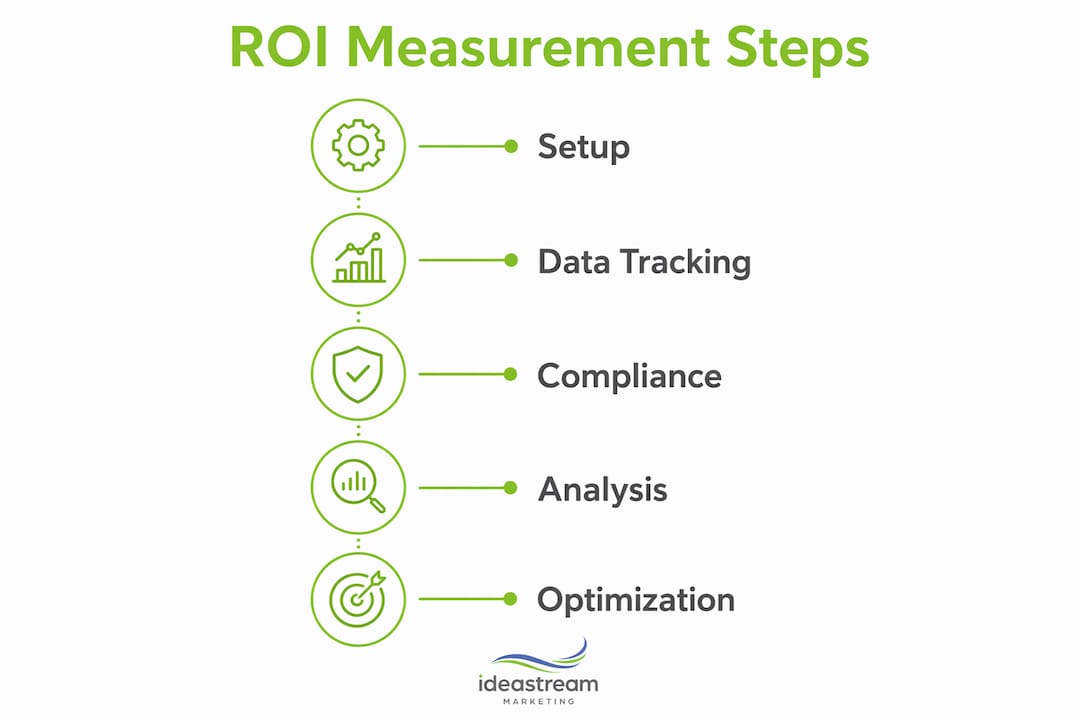
Measurement requires integrating ad data with your CRM and call tracking to attribute bookings accurately. Last-click attribution alone will mislead you.
- Call tracking with source-level attribution: Assign unique tracking numbers per channel and campaign so phone bookings map back to the ad that drove them
- CRM integration: Push lead and appointment data back into your ad platforms for conversion optimization
- Server-side tagging: Reduces data loss from browser privacy restrictions and ad blockers
- Privacy-first aggregation: Use modeled or aggregated conversion data where individual-level tracking is restricted
Google Ads is often the largest single channel by touch volume in healthcare, but last-click models can obscure the upstream awareness contributions that actually initiated the patient journey. Organizations that fix attribution often rebalance budgets, reducing search spend and increasing awareness investment, which tends to lower overall acquisition costs.
The teams to involve: marketing owns channel setup, IT owns data infrastructure, compliance reviews data flows, and the call center provides booking confirmation data. All four need to align before you scale.
How much should you budget and when will you see results?
There is no universal number, but there is a sensible structure.

| Phase | Typical monthly spend | Key KPIs |
|---|---|---|
| Test (months 1–3) | — | CPL, call volume, landing page CVR |
| Scale (months 4–6) | — | CPA, booked appointment rate |
| Ongoing optimization | Varies by market | ROAS, patient LTV, channel mix |
Timeline expectations:
- Day 0: Finalize call tracking, CRM mapping, landing pages, and compliance review
- Weeks 1–4: Campaigns in learning phase; data volume builds, avoid major changes
- Month 3: Enough conversion data to optimize bids, pause underperformers, and refine creative
- Quarter re-assessment: Rebalance channel mix based on attributed bookings, not just clicks
Patients increasingly expect online scheduling and digital convenience, so landing page readiness directly affects conversion rates. A paid campaign sending traffic to a page with no online booking option loses conversions before they happen.
Pro Tip: Set up call tracking and CRM integration before you spend a dollar on ads. Measurement infrastructure is not a phase-two task; it determines whether phase one produces any usable data.
How do you launch a paid healthcare campaign the right way?
Pre-launch checklist
- Define campaign objectives (new patient volume, service-line awareness, recruitment)
- Map target audiences by geography, demographics, and intent signals
- Write a creative brief covering formats, compliance requirements, and call-to-action language
- Confirm HIPAA-safe data handling for all tracking and CRM connections
- Set up call tracking with source-level attribution before any ads go live
- Build or audit landing pages for online scheduling, load speed, and mobile experience
- Complete compliance review of all ad copy and landing page claims
- Establish reporting cadence and KPI benchmarks
Questions to ask any agency you consider
- What healthcare clients have you run paid campaigns for, and what were the outcomes?
- How do you handle HIPAA-safe data flows between ad platforms and CRM?
- Can you show examples of video-driven ad campaigns in healthcare?
- How do you attribute phone bookings to specific campaigns?
- What is your reporting cadence and what metrics do you track beyond clicks?
Red flags: An agency unwilling to map CRM data, no call-tracking plan, generic creative with no testimonials, or no defined measurement SLA. Start your discovery call with a one-page brief covering your objectives, target patient profile, compliance requirements, and current measurement setup.
Key Takeaways
Paid advertising works for healthcare organizations when compliance and measurement are solved before launch, not after.
| Point | Details |
|---|---|
| Compliance comes first | Never run campaigns without HIPAA-safe data flows, consent management, and PHI-free creative. |
| Video builds patient trust | Testimonials, procedure explainers, and physician intros shorten the decision cycle for high-consideration services. |
| Call tracking is non-negotiable | The majority of bookings still happen by phone; without source-level call attribution, your ROI data is incomplete. |
| Fix attribution before scaling | Organizations that correct last-click bias rebalance budgets and lower acquisition costs. |
| Ideastreammarketing as your partner | Ideastreammarketing delivers integrated video production and paid media management built for measurable healthcare patient acquisition. |
The case for a video-first paid strategy in healthcare
Video is not a nice addition to a healthcare paid campaign. It is the mechanism that makes the rest of the funnel work.
Here is what most healthcare advertisers miss: they treat video as a brand exercise and static ads as the “performance” layer. The reality is the opposite. A well-produced testimonial or physician introduction running as a pre-roll ad does more conversion work than a text ad because it resolves the trust deficit before the patient ever reaches your landing page. When you pair that with proper call tracking and CRM integration, you can actually measure it.
At Idea Stream Marketing, we see this pattern consistently. Healthcare clients who invest in professional video assets, structured for multi-format reuse, get more from every dollar of paid media because the creative does the heavy lifting. The ad spend buys the audience; the video earns the appointment. Integrated video in advertising campaigns that connect production quality to measurable paid outcomes are where the real performance gains live.
The conventional wisdom says “start with search, add video later.” We would flip that. Build two or three strong video assets first, then use paid search to capture the intent those videos create. You will spend less per acquisition and build a brand that compounds over time.
Idea Stream Marketing: compliant, measurable paid media and video production for healthcare
Healthcare advertisers need more than ad management. They need creative that builds trust, measurement infrastructure that captures phone bookings, and a partner who understands the compliance stakes. Idea Stream Marketing delivers all three.
Our services for healthcare clients include professional video production (testimonials, physician intros, procedure explainers, and clinic tours), Google Ads management, social media advertising across Meta and YouTube, call-tracking and CRM integration, and performance dashboards that tie spend to booked appointments. Every campaign is built compliance-first, with HIPAA-aware data flows from day one.
Ready to build a paid media program that actually tracks to patient bookings? Contact our team to start a discovery conversation about your goals, your current measurement setup, and how professional video can multiply your ad performance.
Useful sources
The following reports and resources back the claims in this article. We recommend reviewing them directly for current platform policies and measurement frameworks.
- State of Healthcare Marketing 2026 Report (Freshpaint) — backs measurement, attribution bias, and privacy-first infrastructure claims
- The Top 7 Healthcare Marketing Challenges for 2026 (Invoca) — source for phone-booking attribution gap data
- The State of Healthcare Marketing in 2026: Key Takeaways (Invoca) — awareness channel first-touch data
- Why Paid Media Is a Must for Healthcare Organizations (HiveStrategy) — channel adoption and patient scheduling expectations
- PPC for Healthcare: Costs, Strategy & ROI Guide (CausalFunnel) — paid search prioritization and PHI-safe targeting guidance
- Meta, Google, and LinkedIn ad policy pages — consult directly for current healthcare advertising restrictions
- Consult a qualified HIPAA compliance attorney or officer before finalizing your data handling and measurement architecture
FAQ
Why should healthcare organizations use paid advertising?
Paid advertising gives healthcare organizations fast, targeted visibility for high-intent patient searches and lets you retarget warm audiences who did not convert. When call tracking and CRM data are integrated, you can tie spend directly to booked appointments.
What is the biggest compliance risk in healthcare paid advertising?
Using PHI in ad targeting or creative, or routing patient data through standard ad-platform pixels without HIPAA-safe connectors, are the most common violations. Build consent management and de-identified audiences into your setup before any campaign goes live.
How long does it take to see results from healthcare paid ads?
Initial data signals appear within the first four weeks, but meaningful optimization requires roughly three months of conversion data. Set up call tracking and CRM integration on day zero so that data is usable from the start.
Which paid channel works best for patient acquisition?
Google Ads paid search captures the highest-intent patient queries and, according to industry reporting, is often the largest single channel by touch volume for healthcare marketers. Pair it with video on YouTube or Meta for awareness and trust-building across the full patient decision journey.
Can Ideastreammarketing help with healthcare paid advertising and video production?
Yes. Ideastreammarketing provides Google Ads management, social media advertising, professional video production for healthcare clients, and call-tracking and CRM integration, all structured around HIPAA-aware data handling and measurable patient acquisition outcomes.

