






Topical authority is how much search engines trust your site to cover one subject completely, including the related questions around it. For a small or mid-sized business, it is one of the few SEO strategies where focus can beat size. You pick a narrow topic tied to what you sell, cover it more thoroughly than anyone else in your market, connect the pages with internal links, and keep the cluster fresh. This guide shows you how, step by step.
TL;DR
- Topical authority means being the most complete, helpful source on a defined subject, not ranking for one keyword at a time.
- Choose a topic from your services, your best customers and the questions they ask before they buy.
- Build one pillar page and a set of focused supporting pages, each with its own search intent, linked together with descriptive anchors.
- Publish steadily, refresh on a schedule, and track progress in Google Search Console.
- Local and service-area businesses win with real local detail, not copy-and-paste city pages.
Table of Contents
- What topical authority means for a small business
- How to choose a focused topic
- Map the pillar and the cluster
- Build it step by step
- Use video and podcasts to deepen the cluster
- Apply it to a service area without repeating yourself
- Keep the cluster current
- Measure whether it is working
- Mistakes that slow topical authority
- Our perspective
- Let us build your topic cluster
- FAQ
- Sources
What topical authority means for a small business
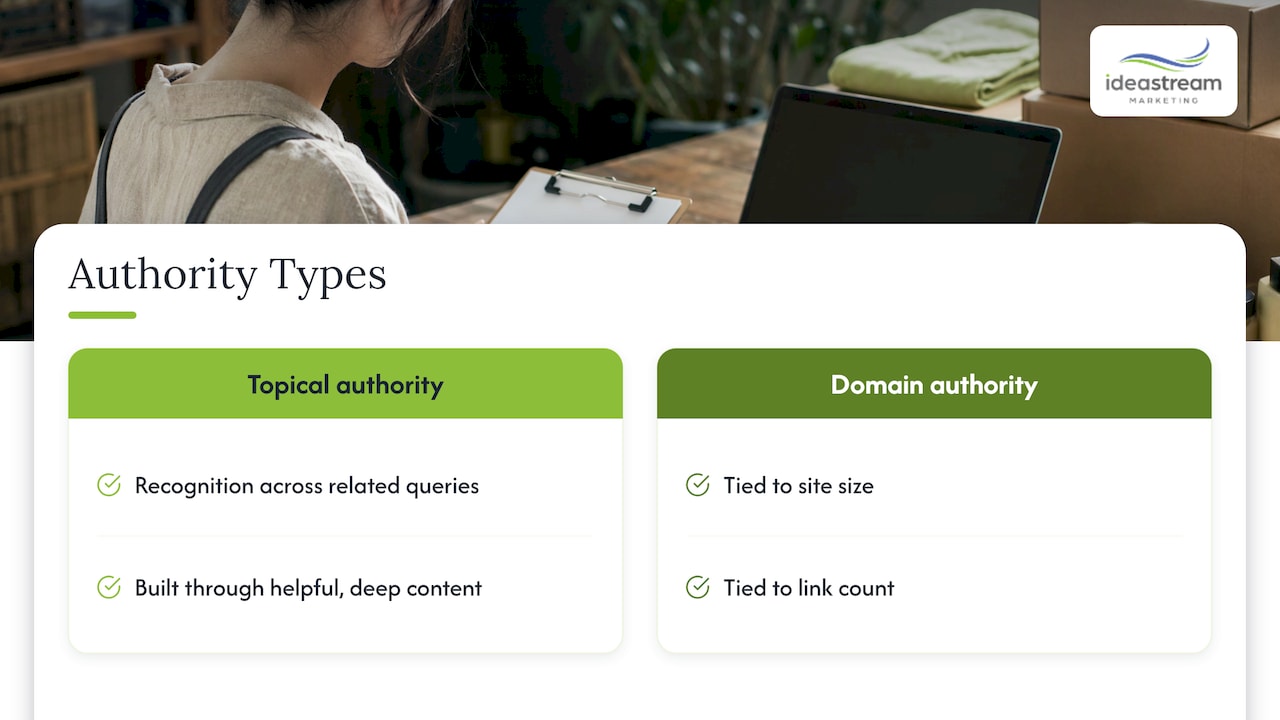
Topical authority is a search concept in which a site is recognized as a primary, expert resource on a subject across all related queries, rather than just ranking for individual keywords. It is earned through content that shows depth, relevance and helpfulness, and it is not tied to site size or link count the way domain authority is. That is good news if you run a ten-person firm.
The same sources point to a practical advantage: small businesses can outrank larger competitors by covering a niche more completely. A national brand may publish broadly. You can publish deeply about the one thing your customers hire you for.
There is also a quality angle. Google says its ranking systems are designed to prioritize helpful, reliable information created to benefit people, not content made to manipulate rankings. Thin pages and disconnected posts don’t signal expertise. A structured body of work does.
For SMBs the payoff is usually described in four ways: qualified leads, a stronger stand against bigger competitors, customer trust and better rankings for relevant keywords. Those are the outcomes we design around when we plan content for clients.
How to choose a focused topic
The most common failure starts here: a topic that is too broad (“marketing”) or too random (a different subject each month). Use three filters.
1. Start with revenue
List the services that make you the most profit and the ones you most want to sell more of. Your topic should sit directly on top of one of them. A law firm might choose “estate planning for business owners.” A Long Island contractor might choose “kitchen remodeling.” A medical practice might choose one specialty, not all of medicine.
2. Listen to the sales conversation
Write down the questions prospects ask before they sign: cost ranges, timelines, comparisons, what can go wrong, what to prepare. Each one is a potential supporting page. Your sales team, front desk and customer emails are better keyword research than any tool, because they reflect real decisions.
3. Check search intent
Search the main phrase and look at what ranks. Are the results guides, service pages, tools or videos? If every top result is a service page and you plan a blog post, you are mismatched. If results show video, plan for video. Our video SEO guide covers how to make video pages findable.
A good test: can you name 15 to 30 distinct questions inside this topic? If you can’t reach 15, the topic is probably too narrow to build a cluster. If you reach 200, split it.
Map the pillar and the cluster
A topic cluster is one pillar page giving a broad overview of the subject, plus multiple subpages on associated subtopics, all connected with internal links. The pillar should be your most complete resource on the core topic and target the broad head term. Map its H2s and H3s to the subtopics your subpages cover.
One rule keeps clusters clean: each piece of content serves a unique intent, with no overlap. Two posts competing for the same question dilute each other.
Here is an example for a hypothetical Long Island home service company focused on roof replacement.
| Page type | Example | Intent |
|---|---|---|
| Pillar | The complete guide to roof replacement | Learn the whole process |
| Spoke | How long a roof replacement takes | Specific question |
| Spoke | Asphalt shingles vs. metal roofing | Comparison |
| Spoke | What roof replacement includes in a quote | Pre-purchase |
| Spoke | Signs your roof needs replacing, not repair | Problem diagnosis |
| Spoke | Roofing and local weather conditions | Local context |
| Service page | Roof replacement near me | Ready to hire |
The service page is the money page. Every spoke should eventually point the reader toward it, and the pillar should too.
Sources describe a pillar as typically 2,000 words or more, but length is a result, not a goal. Cover the subject properly, then stop.
Build it step by step
- Publish the pillar first or alongside the first spokes. It gives the cluster a center.
- Write spokes that answer one question well. Lead with the answer, then give the detail, an example and a next step.
- Link with descriptive anchors. Say what the page is about, not “click here.”
- Add proof of firsthand experience. Case studies, original photos, screenshots, videos and specific results show that you have actually done the work.
- Review the cluster every few months. Add spokes, refresh the pillar, and prune or merge weak posts.
Internal linking that works
A workable rule: every subtopic page links up to its pillar, sideways to two or three close siblings, and down to any question or comparison page that expands on something it mentions briefly. Across a 20-page cluster that yields dozens of contextual links without turning any page into a link farm. Use natural sentences, one link per idea.
For a deeper look at how pages should support each other and your offers, see our guide to content marketing strategies for SMBs and our 2026 content marketing tips.
Publish consistently
One company-published analysis reports that domains publishing one to two relevant articles per week gained authority about 1.5 times faster than domains publishing in bursts. Treat the figure as directional, since it comes from a vendor’s own study. The practical lesson holds regardless: a steady, sustainable rhythm beats a sprint followed by silence. For most SMBs, that means one strong piece every week or two, not five in a month and nothing for a quarter.
Use video and podcasts to deepen the cluster
Written pages are the base, but a topic is easier to trust when you can see and hear the expert. A business owner who explains the topic on camera gives you three things at once: proof of experience, a second format for the same question, and raw material for social channels.
Here is how one recording session can feed a cluster:
- A podcast episode on the pillar topic, recorded in a studio with clean audio, then published with a full transcript and show notes on the pillar page.
- A short video per spoke, embedded on the matching page so visitors stay longer and see the answer demonstrated.
- Short-form clips cut from the episode for Instagram Reels, Facebook Reels, TikTok and YouTube Shorts, each pointing back to the page that covers the question in full.
- A full YouTube upload with a clear title and description that matches the page topic.
This is how we approach production at Idea Stream Marketing: every video and podcast is planned with discoverability in mind, not just a nice look. Our multi-platform content guide walks through repurposing, and our video pre-production planning guide shows how to prepare so one shoot day produces months of material.
Apply it to a service area without repeating yourself
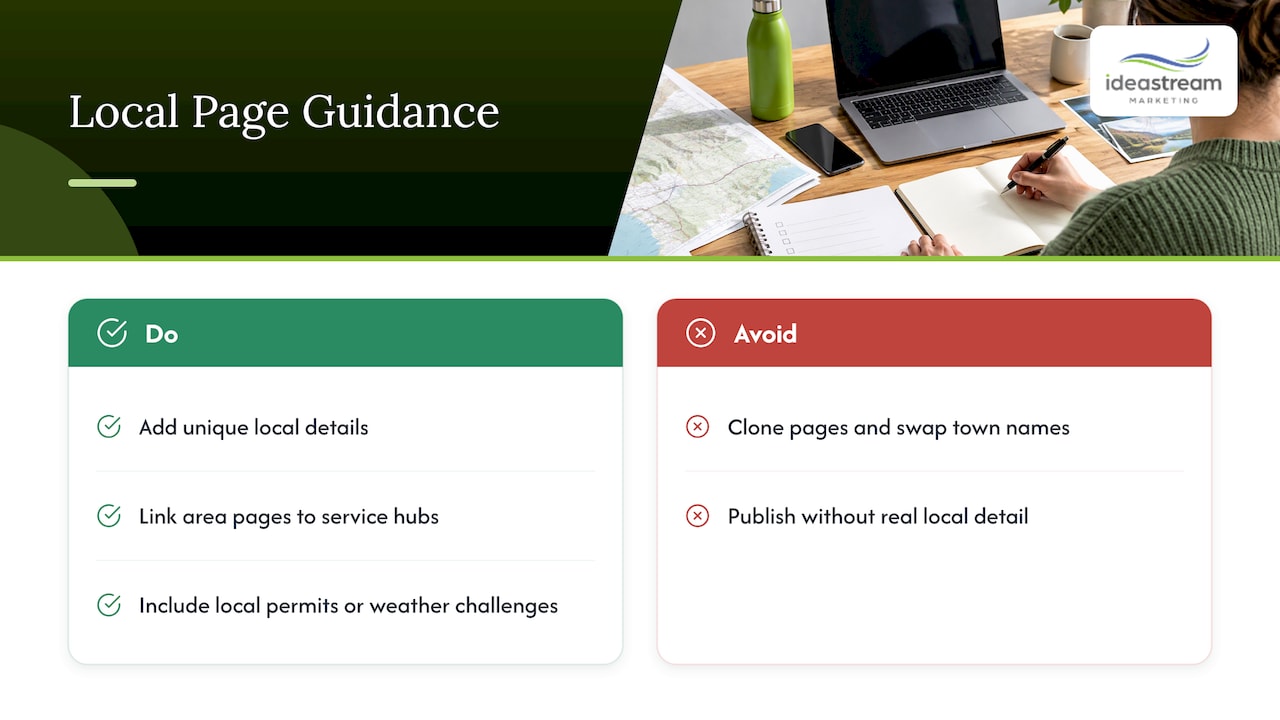
If you serve several towns, the temptation is to clone a page and swap the town name. That produces thin, templated pages. A better method: create local pages with unique local details and link area pages to the relevant service hubs. The useful local context includes things like neighborhood-specific project constraints, local permitting or site-specific weather challenges.
For a Long Island business, that might be coastal weather exposure on the South Shore, village-level permit requirements, or the types of homes and commercial buildings common in a given town. If you can’t add something real to a location page, don’t publish it yet.
Keep the structure simple: service hub at the center, area pages that each carry genuine detail, and a link from each area page back to the hub. We cover this in more depth in our guides to service area business SEO and local landing pages. If you operate in ten or more places, see our multi-location SEO approach.
Keep the cluster current
A cluster is not a project you finish. Prices change, regulations change, and search results change. Build a light maintenance routine:
- Every quarter, review the pillar for outdated facts and add links to new spokes.
- Check which spokes get impressions but few clicks, and rewrite titles and openings.
- Merge near-duplicate posts and redirect the weaker URL to the stronger one.
- Add new questions from sales calls.
The habits behind that routine mirror good customer follow-up. A customer communication plan for service businesses is a useful model: a recurring cadence beats occasional bursts of attention, whether you are updating a content cluster or staying in touch with clients.
Measure whether it is working
You don’t need a dedicated tool to start. Google Search Console is the first-party source. Open the Performance report for search results and use its advanced filtering to isolate queries on your topic. One practitioner method is to filter by a query theme and watch impressions, average position and click-through rate over a rolling 90-day window. If average position improves across a growing number of queries in that theme, the cluster is building strength.
Track these four numbers monthly:
- Impressions for your topic queries.
- Number of distinct queries your site appears for in that theme.
- Average position for those queries.
- Leads from pages in the cluster: form fills, calls, and booked consultations.
Rankings are a means. The goal is qualified inquiries, so tie the cluster to your lead tracking from the first day. Our guides to lead generation strategies for SMB growth explain how to connect content to pipeline.
Mistakes that slow topical authority
- Choosing a topic too wide. “Everything about business” has no center. Narrow until you can cover it fully.
- Publishing unrelated posts. Disconnected content doesn’t build a pattern. Every new page should have a place in the map.
- Overlapping pages. Two posts that answer the same question compete with each other.
- Weak internal links. Pages published without links to the pillar and siblings are harder for visitors and crawlers to connect.
- Templated location pages. Swapping town names adds volume, not value.
- Never updating. An outdated pillar undermines the whole cluster.
- Expecting overnight results. Authority compounds over time, so plan on months of steady work and measure on a rolling basis.
Our perspective
We see the same pattern with the businesses we work with: the ones that win in search are rarely the ones that publish the most. They are the ones that decide what they want to be known for and then show it in every format.
That is why we don’t treat video, podcasts and SEO as separate projects. A pillar page is stronger when the owner explains the topic on camera. A podcast episode becomes a dozen short clips for Reels, TikTok and Shorts. Each of those assets points back to a page built to answer one question well. Everything supports discoverability in Google, in AI-powered search and on YouTube.
Our goal is simple: build a body of work that earns trust before the first sales call, and turn that trust into leads you can measure.
Dean Spinato, CEO & Founder of Idea Stream Marketing
Let us build your topic cluster
Idea Stream Marketing is a Long Island video production company and digital marketing agency. We combine content strategy, search engine optimization, AI SEO, website development, video and podcast production under one roof, so your topic cluster is planned, filmed, written and optimized by one team.

If you want a clear plan for the topic your business should own, schedule a consultation or a studio session with us through our website. We will help you choose the topic, map the cluster and produce the content.
FAQ
How long does it take to build topical authority?
It depends on your market, your starting point and how steadily you publish. Authority builds gradually, so expect to evaluate progress over rolling 90-day windows in Search Console, not week to week. Consistency matters more than speed.
How many pages do I need in a cluster?
There is no fixed number. Start with one pillar and enough spokes to answer the real questions customers ask, often 10 to 20 for a focused service topic. Then add pages as new questions come up.
Can a new or small website build topical authority?
Yes. Topical authority is not based on website size or links, so a focused small site can compete by covering a narrow subject thoroughly and helpfully. Start with one topic tied to your best-selling service.
Do videos and podcasts help topical authority?
They help you show firsthand experience, which supports trust, and they give you a second format for the same questions. Publish them on the relevant page with a transcript, and clip them for social channels that point back to the page.
Sources
- Topical Authority: Build Trust & Dominate Search Rankings, Search Engine Land
- Topical Authority: What It Is, How Google Measures It, Ahrefs
- Creating Helpful, Reliable, People-First Content, Google Search Central
- SMBs: Establishing Yourself as the Go-To Expert Through Topical Authority, SERPrecon
- Topic clusters for SEO, Semrush
- How to Build a Topic Cluster (With an Example), ScoutRival
- How to Build Topical Authority: The Complete 2026 SEO Guide, TopicalClusters
- How to Build Topical Authority: A Practical Framework, AuthorityStack
- Topical Authority: How to Build It Systematically, Seomytics
- Topical authority for local businesses, Townsmith
- Performance report: Advanced filtering and comparison, Search Console Help

