



October 21, 2026




TL;DR:
- Professional business photography enhances brand credibility and drives marketing results through on-brand images.
- Integrating photos, videos, and AI-driven distribution maximizes return on investment by creating cohesive campaigns.
Business photography is the professional production of on-brand images that showcase your people, products, processes, and environment to build credibility and drive commercial results. The fastest path to production: hire a full-service creative partner that combines shoot production with distribution strategy in one engagement. Done right, corporate photography builds buyer trust, lifts conversion rates on landing pages and proposals, and generates a library of reusable assets across every marketing channel you run.
Table of Contents
- Why business photography matters for brand trust and growth
- Which types of business photography do you actually need?
- What to expect from production: brief through final delivery
- How photographers and agencies typically charge
- How to choose the right photographer or agency
- A ready-to-use brief and shot list for your photographer
- How to make your business photos work harder online
- Why an integrated photo, video, and AI marketing approach multiplies ROI
- Key Takeaways
- Why we treat photography as a strategic asset, not a decoration
- Ideastreammarketing: one partner for photography, video, and distribution
- Useful sources and further reading
- FAQ
Why business photography matters for brand trust and growth
Strong visuals increase perceived credibility before a single word is read. When a prospect lands on your website, opens your LinkedIn profile, or reviews your Google Business Profile, the quality of your images signals whether you are worth their time. Narrative-driven commercial photography is consistently more persuasive than generic stock imagery for converting professional buyers, and professional imagery supports higher engagement metrics that contribute to better search rankings.
“Good commercial photography should highlight the look and feel of your brand, helping visitors decide to buy from you.” — Andrew Monro, commercial photographer
The channels where photos directly influence decisions include your website homepage and About page, pitch decks and proposals, LinkedIn company and personal profiles, Google Business Profile, and paid social ads. Real images outperform stock across all of them. Consistent visual brand assets also compound over time, reinforcing recognition every time a buyer encounters your brand.
Which types of business photography do you actually need?
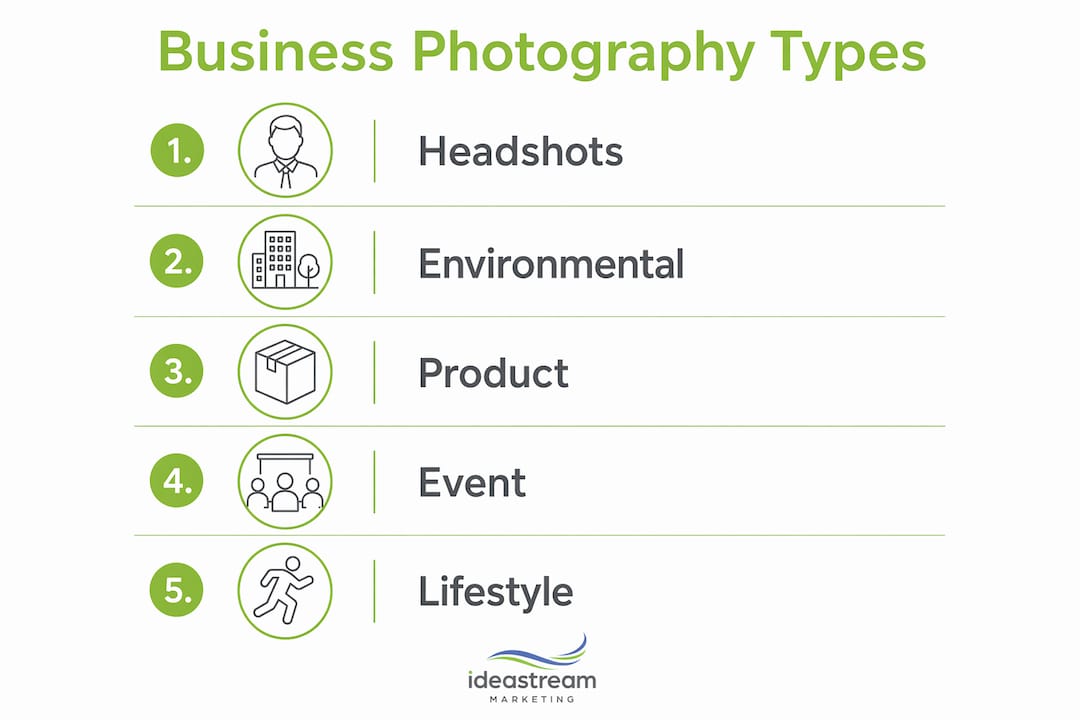
Corporate photography is broader than headshots. Here are the categories that matter most to marketing and sales teams, and the primary use case for each:
- Professional headshots: Individual portraits for team pages, LinkedIn, speaker bios, and press kits. The entry point for most businesses.
- Environmental/brand portraits: Shots of your team in context, at their desks, in the field, or in your facility. These humanize the brand and work well on About pages and culture content.
- Product photography: Essential for any company selling physical goods. Covers white-background e-commerce shots, lifestyle imagery, and detail close-ups.
- Interior and facility photography: Offices, studios, manufacturing floors, and retail spaces. Particularly persuasive for B2B buyers who need visual proof of capacity and process reliability.
- Event photography: Conferences, launches, and client gatherings. These images fuel social media and PR for weeks after the event.
- Drone/aerial photography: Facility overviews, construction progress, and location context. Adds scale and authority to industrial and real estate brands.
- Social and content packs: Ongoing batches of lifestyle and behind-the-scenes images designed for Instagram, Facebook, and email newsletters.
Pro Tip: Start with headshots and one environmental brand shoot. Those two categories cover your website, LinkedIn, and proposals, which are the highest-ROI placements for most service businesses.
What to expect from production: brief through final delivery
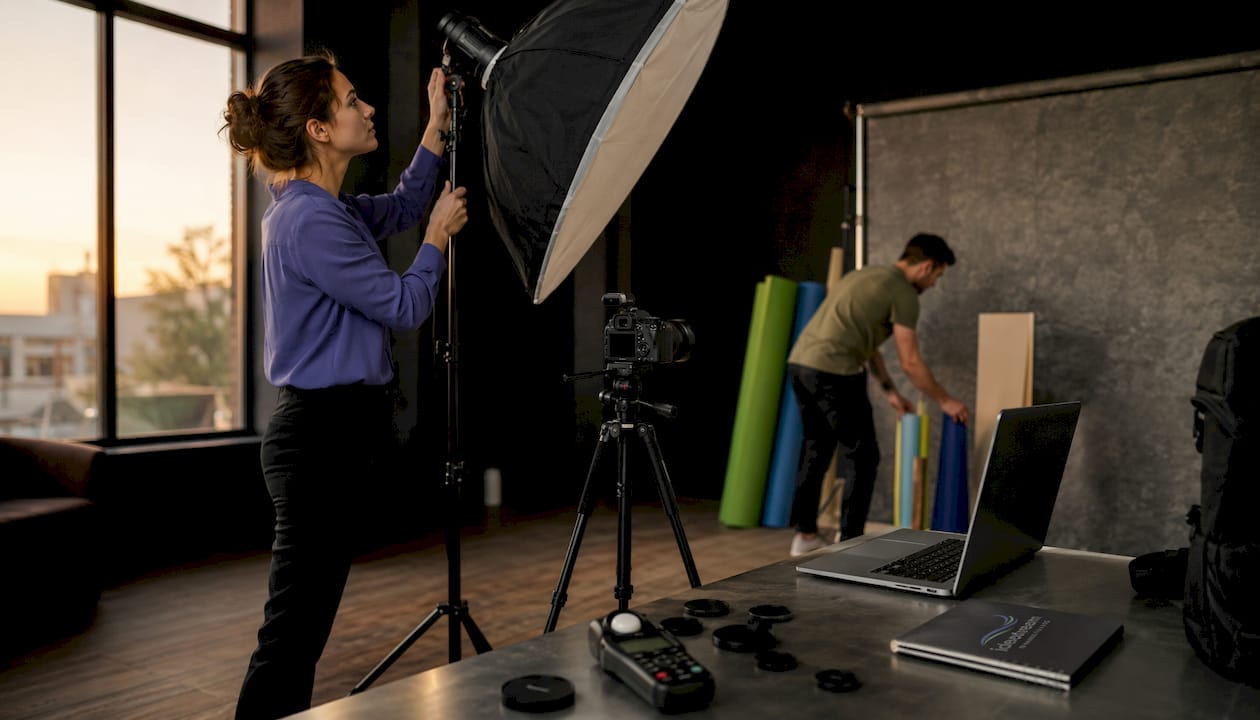
The production process runs in three phases: pre-production, shoot day, and post-production. Clear pre-production planning, including a written brief, mood boards, and a shot list, materially improves outcomes and reduces cost overruns.
| Deliverable | Format | Notes |
|---|---|---|
| High-resolution edited images | JPEG, TIFF | Web and print use |
| Web-optimized exports | JPEG, WebP | Compressed for fast loading |
| Social media crops | JPEG, PNG | Platform-specific aspect ratios |
| RAW files | Camera RAW | Usually retained by photographer unless negotiated |
| Usage license | Contract document | Specifies territory, duration, and exclusivity |
On the legal side, hiring a photographer typically purchases a usage license, not copyright ownership. Your contract should specify where you can use the images, for how long, and whether the license is exclusive. Clarify this before the shoot, not after.
Pro Tip: Ask for a model release and property release on shoot day. Collecting signatures after the fact is time-consuming and sometimes impossible.
How photographers and agencies typically charge
Pricing varies by scope, usage rights, location, crew size, and post-production volume. The five factors that move a quote the most are: number of shoot locations, crew requirements (lighting, assistants, drone operator), licensed usage (web-only vs. national advertising), turnaround speed, and the volume of edited final images.
| Project type | Typical range | Turnaround |
|---|---|---|
| Single professional headshot | $150–$400 | 3–5 business days |
| Half-day brand shoot (team + environment) | $800–$2,500 | 1–2 weeks |
| Full-day multi-location shoot | $2,500+ | 2–3 weeks |
| Event coverage (several hours) | $1,200+ | 1–2 weeks |
| Monthly content pack (ongoing) | $500+ | Weekly or bi-weekly |
Ranges above are illustrative examples based on typical U.S. market rates and will vary by market, photographer experience, and project complexity.
Treat photography as a repeatable content asset rather than a one-time expense. Building a visual library through regular refreshes or campaign-specific packs avoids recurring reshoots and supports ongoing campaigns far more efficiently.
How to choose the right photographer or agency
Match style, industry experience, and deliverables to your goals first, then vet for process and distribution support.
Decision checklist:
- Portfolio shows work in your industry or a closely adjacent one
- Images demonstrate consistent lighting, color grading, and composition across a full shoot, not just hero shots
- Photographer or agency has in-house studio access and drone capability
- Post-production workflow is documented (turnaround, rounds of revisions, file delivery method)
- Team understands how images will be used across channels (SEO, social, ads)
Interview questions to ask:
- What is your standard turnaround from shoot day to final delivery?
- What usage rights does your standard contract include, and what triggers additional licensing fees?
- How do you back up files during and after the shoot?
- Do you carry general liability insurance and, if applicable, drone operator certification?
- Can you provide references from clients in a similar industry?
Red flags: Portfolios with only hero shots and no full-shoot galleries. Contracts that are vague on usage rights. No mention of backup procedures. Quotes with no line-item breakdown.
A ready-to-use brief and shot list for your photographer
A one-page brief prevents miscommunication and keeps the shoot on schedule. Here is a template you can fill in and hand to any photographer:
- Project objective: One sentence describing the business goal (e.g., “Refresh our website and LinkedIn with on-brand team portraits and facility images that reflect our manufacturing capabilities”).
- Audience: Who will see these images and what should they feel?
- Key messages: Three to five brand words (e.g., precise, approachable, industrial-grade).
- Platforms and placements: Website homepage, About page, LinkedIn, Google Business Profile, pitch deck.
- Style references: Three to five mood board images that match the desired look.
- Must-have shots: List your non-negotiables before the shoot begins.
- Logistics: Date, location(s), point of contact, wardrobe guidance, props.
Sample shot list by priority:
- Hero team portrait (full group, well-lit, on-brand background)
- Individual headshots for each team member
- Environmental portraits (team at work, candid process shots)
- Facility or office wide shots
- Product or service detail close-ups
- Social cutaways (hands, tools, branded elements, copy-space compositions)
Mood boards and shot lists are the two tools photographers cite most often as the difference between a productive shoot day and one that runs long and delivers fewer usable images.
How to make your business photos work harder online
Image assets are marketing assets. Treating them as such means optimizing every file before it goes live.
- Filenames: Use descriptive, keyword-rich filenames (e.g.,
long-island-manufacturing-team-portrait.jpg, notIMG_4821.jpg). - Alt text: Write a concise description of what the image shows, including relevant keywords where natural.
- Compression: Export web images at the smallest file size that preserves visual quality. WebP and AVIF formats load faster than JPEG at equivalent quality.
- Structured data: Add
ImageObjectschema markup to key pages so search engines and AI platforms can index your images accurately. - Image sitemaps: Submit an image sitemap in Google Search Console to accelerate indexing.
- Responsive sizes: Serve multiple image sizes using
srcsetso mobile users are not downloading desktop-resolution files.
Visual content consistently drives higher engagement across digital channels, and proper technical optimization is what converts that engagement into measurable traffic.
Repurposing examples: A single hero team portrait can become a website banner, a LinkedIn cover image, a Google Business Profile photo, an email header, and a proposal cover. One facility shot can anchor a blog post, a Google ad, and a social post. Build an asset-naming convention from day one: [brand]-[subject]-[use]-[date].jpg keeps your library organized as it grows.
Why an integrated photo, video, and AI marketing approach multiplies ROI
Integrated production increases asset ROI by enabling cross-channel reuse and data-driven optimization from a single shoot. When photography and video are captured together under one brief, the brand story stays consistent, the style is unified, and you eliminate the cost and time of coordinating separate vendors.
A typical integrated workflow looks like this: brief development → a single shoot day that captures both stills and B-roll → editing and color grading → AI-assisted metadata and SEO optimization → distribution across web, social, and paid channels → performance review and optimization.
- Fewer re-shoots because stills and motion share the same creative direction
- Unified visual style across your website, YouTube, social ads, and sales materials
- Faster campaign launches when assets are produced and optimized in one pipeline
- Drone footage and aerial stills captured in the same session for facility and location content
Photographers who understand distribution — SEO, thumbnails, social cropping — deliver more value than those who only hand over files. Pairing that expertise with a video content strategy compounds the return on every shoot day.
Pro Tip: Brief your photographer and videographer together. A shared shot list and creative direction means your stills and motion assets look like they belong to the same campaign, because they do.
Key Takeaways
Professional business photography delivers the highest ROI when it is planned strategically, optimized for search, and produced as part of an integrated photo, video, and distribution workflow.
| Point | Details |
|---|---|
| Prioritize your first assets | Start with headshots and one environmental brand shoot to cover your website, LinkedIn, and proposals. |
| Clarify usage rights upfront | Confirm territory, duration, and exclusivity in writing before the shoot begins. |
| Optimize every image file | Use descriptive filenames, alt text, WebP format, and image schema to maximize search discoverability. |
| Plan for repurposing | One shoot day can produce assets for your website, social, ads, email, and sales materials simultaneously. |
| Choose Ideastreammarketing | Ideastreammarketing delivers integrated photography, video, drone, and AI-powered distribution in one engagement. |
Why we treat photography as a strategic asset, not a decoration
The businesses that get the most from a photography investment are the ones that treat it the way they treat any other marketing channel: with a clear brief, defined goals, and a distribution plan. What we see consistently is that companies who shoot without a plan end up with beautiful images that never get used, because no one mapped them to a specific page, campaign, or channel before the shutter clicked.
At Idea Stream Marketing, we build photography into the same brief as video and digital marketing from the start. Our in-house studio and drone capabilities mean we can capture stills, motion, and aerial content in a single production day, then optimize and distribute everything through our AI SEO and social media workflows. That is not a workflow most standalone photographers can offer, and it is the difference between a folder of files and a functioning content system.
Idea Stream Marketing: one partner for photography, video, and distribution
When you need photography that actually performs across your website, social channels, and ad campaigns, Idea Stream Marketing delivers production and distribution under one roof. Our team handles everything from the initial creative brief through shoot day, post-production, and AI-powered SEO deployment, so your images are found, not just filed.

Our core photography and marketing capabilities:
- In-house studio for headshots, product, and branded content
- Drone photography and aerial stills for facility and location shoots
- Full post-production: retouching, color grading, and social crops
- AI SEO optimization for image metadata, alt text, and schema markup
- Social media repurposing and digital marketing distribution
- Integrated video production paired with photography for unified campaigns
We serve businesses throughout Long Island, New York City, and nationwide. Contact us today to discuss your photography and marketing goals, and we will build a production plan that puts every image to work.
Useful sources and further reading
- Business Photography: Everything You Need to Know — Strategic overview of photography as brand management
- Corporate Photography: The Complete Guide for Businesses — Categories, usage rights, and channel mapping
- Why Industrial Photography Is Essential for B2B Marketing — B2B credibility and visual proof of capability
- The Visual Edge: Why Commercial Photography Is a Business Essential — SEO, engagement, and narrative-driven photography
- How to Prepare for a Photoshoot: A Practical Guide for Brands and Businesses — Pre-production planning and shot list guidance
- Why Commercial Photography Is Important for Your B2B Business — Licensing, hiring tips, and B2B use cases
- Visual Storytelling Tips: Boost Your Brand’s Impact — Narrative photography and shot-list planning
- Idea Stream Marketing Photography Services — Portfolio and integrated service capabilities
- The Power of Photography: Elevating Your Brand — Strategic benefits of photography for brand building
FAQ
What is business photography?
Business photography is any professional photography produced for a commercial purpose, including team headshots, product images, facility shots, event coverage, and branded content used across a company’s website, social media, and sales materials.
How much does a professional business photo shoot cost?
Costs vary widely by scope: a single headshot session typically runs $150–$400, while a half-day brand shoot ranges from $800–$2,500. Full-day multi-location shoots and ongoing content packs carry higher rates depending on crew, locations, and usage rights.
What usage rights do I get when I hire a photographer?
Hiring a photographer typically grants a usage license, not copyright ownership. Your contract should specify the permitted platforms, geographic territory, duration of use, and whether the license is exclusive. Always clarify this before the shoot.
How do professional photos improve SEO and website performance?
Professional imagery increases dwell time and engagement metrics that support search rankings. Optimizing image filenames, alt text, compression, and schema markup further improves discoverability across Google and AI-powered search platforms.
Can Ideastreammarketing handle both photography and video in one shoot?
Yes. Ideastreammarketing produces photography, video, and drone content in a single integrated production day, then optimizes and distributes all assets through AI SEO and social media workflows, serving businesses on Long Island, in New York City, and nationwide.

