



September 23, 2026


AI search visibility measures how often your brand gets mentioned or cited inside answers from ChatGPT, Perplexity, Google AI Overviews, Gemini, and Claude. It is not a ranking position. It is a measurable rate: mentions, citations, share of voice, and sentiment tracked across engines. Start by running a four-instrument baseline this week: platform reports, analytics, verified server logs, and a scheduled prompt panel.
TL;DR:
- Citation rates above 30% indicate strong AI visibility, while below 10% suggest most prompts overlook your brand altogether.
- Weekly prompt panels of 40 to 100 queries per persona track trends accurately, with consistent scheduling essential for reliable data.
- Proper crawlability, schema updates, and adding answer blocks near the top of pages are primary technical fixes to improve AI citations.
- Different AI engines rely on varied sources and update frequencies, so dedicated per-platform reporting reveals actionable divergences.
- Building AI-friendly content like schema-rich pages, transcripts, and podcast episodes enhances long-term AI recognition and citation.
Table of Contents
- What Does AI Search Visibility Actually Measure?
- The Four-Instrument Measurement Framework
- How Do You Build a Prompt Panel That Gives Reliable Numbers?
- Why Do ChatGPT, Perplexity, and Google AI Overviews Behave So Differently?
- What Should Be On Your AI Visibility Audit Checklist?
- How Idea Stream Marketing Builds AI Visibility Programs
- Why Marketing Leaders Should Stop Measuring Clicks Alone
- Get an AI Visibility Audit Built Around Your Actual Numbers
- Sources
- FAQ
What Does AI Search Visibility Actually Measure?
AI search visibility is a composite score, not a single number. It blends several distinct metrics that each answer a different question about how AI engines treat your brand.
- Mention rate: how often your brand name appears in AI responses to relevant prompts, cited or not.
- Citation rate: how often an AI answer links to or names your specific page as a source.
- Share of voice: your mention count relative to competitors mentioned in the same prompt set.
- Sentiment: whether the AI frames your brand positively, neutrally, or critically.
- Prominence: where you land in the answer, first-mentioned versus buried in a list of five.
This is why AI visibility is not a Google ranking with a new name. A page can rank first organically and still get skipped entirely in an AI Overview that pulls from a different source. Engines behave differently enough that per-engine breakdown is not optional. For interpreting citation rate specifically, a rough benchmark holds: above 30% counts as strong visibility, 10% to 30% means you’re present but inconsistent, and below 10% means most prompts never surface you at all.
The Four-Instrument Measurement Framework
Every AI visibility event breaks into four stages: a crawler visits your site, an engine retrieves your content, it decides whether to cite you, and (sometimes) a human clicks through. Each stage needs its own instrument. Blending signals from one instrument into another is how teams end up with numbers nobody trusts.
| Instrument | What it measures | What it can’t tell you |
|---|---|---|
| Platform reports (Google Search Console, Bing Webmaster Tools) | Impressions and citations logged by the platform itself | Competitor context or sentiment |
| Analytics / referral traffic | Actual clicks from AI answer pages to your site | Whether you were mentioned without a click |
| Verified server logs | Whether AI crawlers (GPTBot, PerplexityBot, ClaudeBot) actually reached the page | Whether the crawl led to a citation |
| Scheduled prompt panel | Real-time mention and citation rate across a fixed query set | Ground truth for every possible user prompt |
Microsoft’s Bing dashboard now adds intent labels and citation share data, which fills a gap platform reports used to leave blank. When two instruments disagree, that’s not noise to ignore. If server logs show GPTBot crawling a page weekly but your prompt panel shows zero citations for that topic, the content is reachable but not answer-worthy. That’s a content problem, not a technical one, and the two instruments together just told you which fix to run first.
How Do You Build a Prompt Panel That Gives Reliable Numbers?
A prompt panel is a fixed, repeated set of questions you run against AI engines on a schedule, logging whether your brand shows up. Run it inconsistently and every number becomes noise. Run it the same way every week and you get a trend line you can actually act on.
- Cover four prompt types. Branded (“Is Idea Stream Marketing good for video production?”), category (“best video production company Long Island”), comparison (“agency X vs agency Y”), and problem-based (“how to grow a podcast audience”).
- Anchor each prompt to a persona. Write a 50 to 80 word persona blob describing a realistic buyer (a healthcare marketing director, a law firm partner) and prepend it to the prompt so the AI response matches how a real prospect would ask.
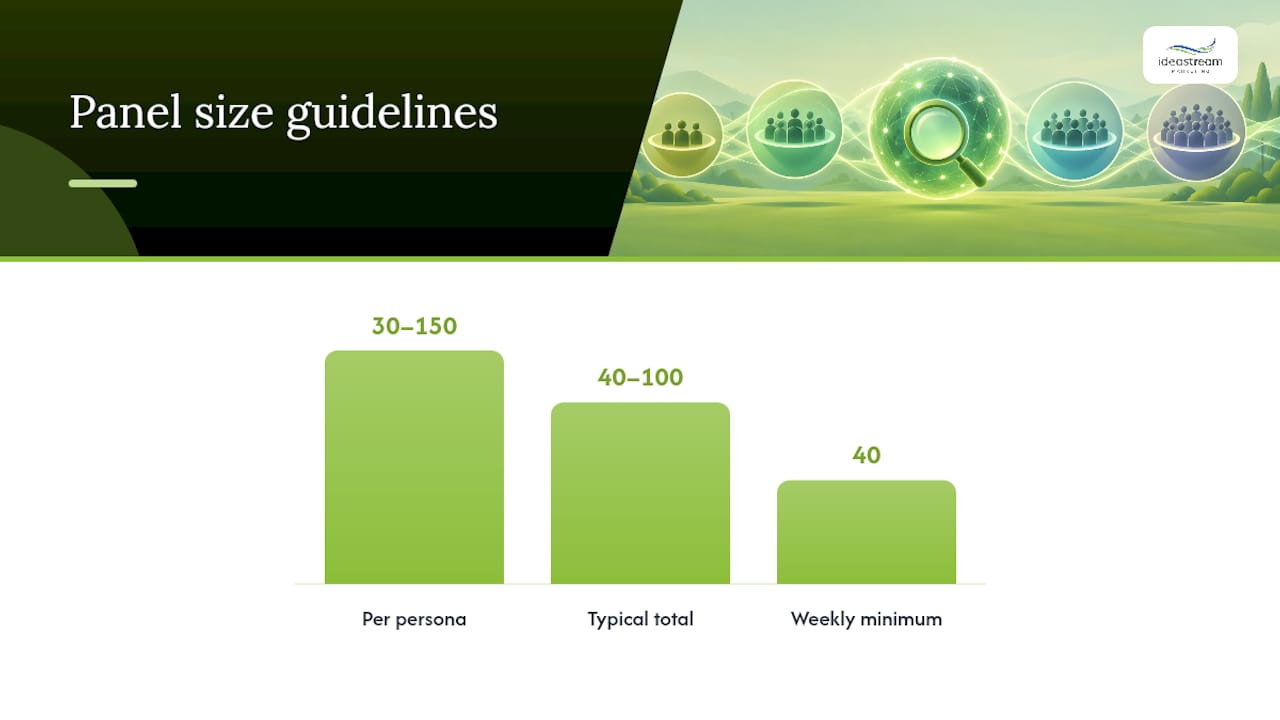
- Size the panel correctly. Run 30 to 150 prompts per persona, with most teams settling on 40 to 100 total prompts as the practical range for weekly tracking.
- Set a weekly cadence at minimum. Monthly checks miss the shifts that matter; a weekly 40-prompt panel typically runs $30 to $50 a month in API costs.
- Log four fields per response. Brand mention (yes/no), cited URL (if any), sentiment, and the full raw text of the answer.
Raw text retention matters more than it sounds. Six months from now, when a client asks why visibility dropped in March, the raw response is the only record that shows exactly what the AI said and why.
Pro Tip: Don’t rebuild your prompt list every quarter to chase trends. A stable panel run consistently for 12 weeks is worth more than a clever panel run once.
Why Do ChatGPT, Perplexity, and Google AI Overviews Behave So Differently?
Treating “AI search” as one channel is the fastest way to misread your own data. Each engine pulls from different sources and weights freshness differently.
- Perplexity leans heavily on live web retrieval, so freshly published or recently updated content surfaces faster than in engines relying on a static index.
- Google AI Overviews and AI Mode pull largely from Google’s existing organic index, so traditional ranking signals still influence citation odds.
- ChatGPT mixes its training data with live Bing retrieval for certain queries, which means an outdated brand fact can persist even after you’ve fixed it on your site.
- Gemini and Claude each weight authoritative, structured sources differently, which is part of why surface rate needs per-platform reporting rather than a single blended score.
The remediation differs by engine, too. A crawlability fix moves the needle on Perplexity fast. A depth and authority problem on Google AI Overviews needs content work, not a technical patch. Watch Perplexity’s referrer data in analytics, the Bing AI dashboard for citation share, and the generative AI report inside Search Console. Reporting a single “AI visibility score” across all four engines hides exactly the divergence you need to act on.
What Should Be On Your AI Visibility Audit Checklist?
Run this as a 30 to 90 day sequence, not a one-time cleanup.
- Check crawlability first. Server-side log analysis for known AI agents (GPTBot, PerplexityBot, ClaudeBot) is the single most reliable early signal that your key pages are even reachable.
- Fix technical hygiene. Add or update an llms.txt file, resolve canonicalization conflicts, and make sure schema and FAQ markup are valid.
- Rewrite for extraction. Add self-contained 40 to 60 word answer blocks near the top of key pages; this pattern is directly tied to higher lift rates into AI-generated answers.
- Refresh dated content and cite real data. Freshness signals matter more to some engines than others, so update timestamps and figures rather than just republishing.
- Earn third-party citations. Third-party citations rank as the highest-impact lever for AI inclusion, ahead of on-page tweaks alone. Press placements, roundup articles, and podcast guest appearances all count.
The two-week rule: A single bad week in your prompt panel is not a crisis. Most teams overreact to short-term swings, so wait for a sustained two-week trend or a 20% move before changing strategy.
How Idea Stream Marketing Builds AI Visibility Programs
The agency’s AI visibility workflow follows the same four-stage logic covered above: baseline audit, prompt panel, content and PR, and then remeasurement. The difference is what feeds the content stage. Instead of publishing text alone, the studio produces assets built for citation from the start:
- Concise, schema-rich landing pages with answer blocks near the top.
- Video content with full transcripts, which gives AI crawlers extractable text tied to a real, watchable asset.
- Podcast episodes that double as source material AI engines can cite by topic.
- Ongoing AI SEO services that treat schema, freshness, and crawlability as recurring maintenance, not a one-time fix.
Why Marketing Leaders Should Stop Measuring Clicks Alone
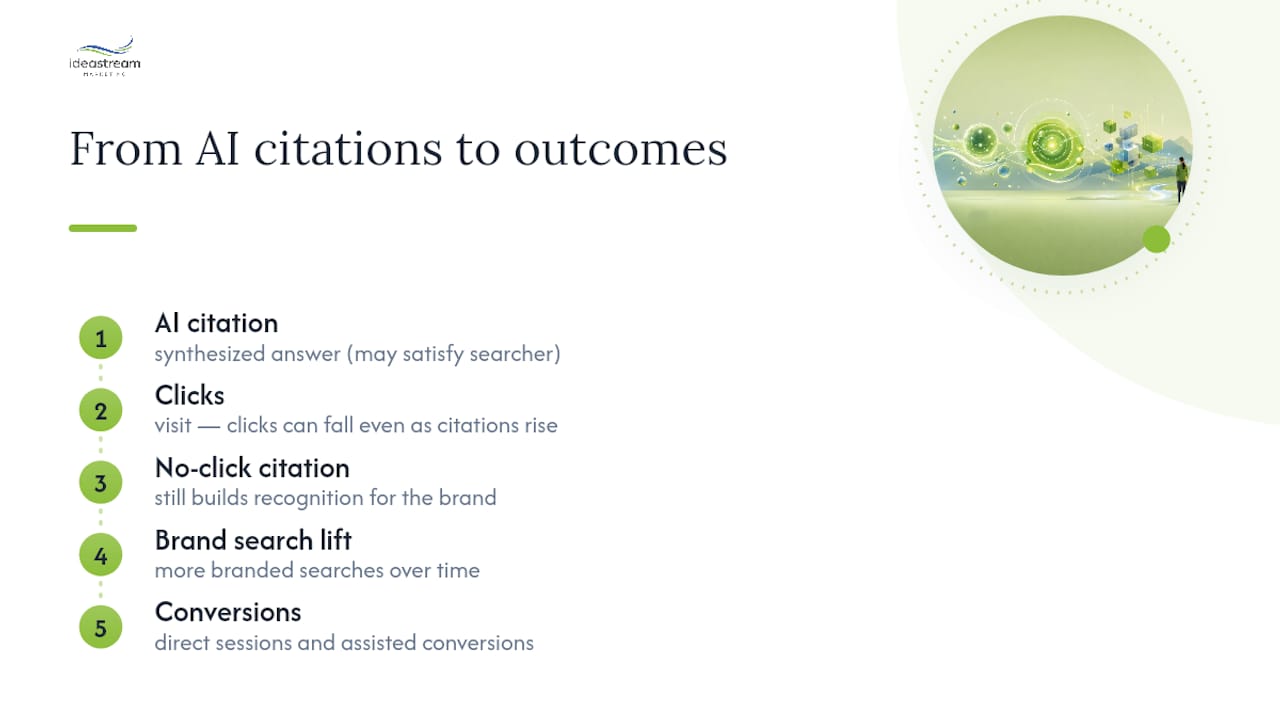
Clicks from AI answers will often fall even as citations rise, because a synthesized answer can satisfy the searcher without a visit. That’s not a failure signal. Reorient KPIs toward brand search lift, direct sessions, and assisted conversions, and budget for measurement the same way you budget for media spend. The brand that gets cited without the click is still building the recognition that drives the next direct visit.
Get an AI Visibility Audit Built Around Your Actual Numbers
Most agencies still sell SEO reporting built for a search engine that hasn’t been the whole game since AI Overviews and ChatGPT started answering questions directly. Idea Stream Marketing runs the measurement stack this article describes, then pairs it with the kind of content that actually earns citations: video with transcripts, podcast episodes, and schema-rich pages built to be lifted into an AI answer, not just ranked on a results page.
If your brand has no idea what its citation rate looks like on ChatGPT or Perplexity right now, that’s the starting point. Idea Stream Marketing’s AI SEO company services include baseline audits, prompt panel setup, and the technical fixes (llms.txt, schema, crawlability) covered in this article. Schedule a consultation through the Idea Stream Marketing team and get a real number attached to where your brand stands today, before you spend another quarter guessing.
Sources
For deeper methodology, Ankur AI’s measurement guide covers the four-instrument stack in detail. Citare’s framework walks through persona-anchored prompt panels. Semrush’s optimization guide covers structuring content for AI lift.
- How to Actually Measure AI Search Visibility (Ankur AI)
- How to Measure AI Search Visibility: A Complete Framework · Citare
- AI Search Visibility: What It Is and How to Measure It – RankScope
- AI Search Visibility: What It Is and How to Measure It in 2026 – Appearly
- How to Optimize Content for AI Search Engines 2026 Guide — Semrush
FAQ
What Is a Good AI Search Visibility Score?
A citation rate above 30% is considered strong, 10% to 30% means you’re occasionally present, and below 10% means most relevant prompts never surface your brand. These benchmarks vary by industry and query volume, so treat them as a starting reference, not a fixed target.
How Often Should I Run a Prompt Panel?
Weekly is the recommended minimum cadence, since monthly checks miss short-term shifts tied to content updates or algorithm changes. A 40-prompt weekly panel typically costs $30 to $50 a month in API fees, making it accessible even for small teams.
Does AI Search Visibility Replace Traditional SEO?
No. Traditional search engine optimization still determines whether Google indexes and ranks your content, and several AI engines pull directly from that index. AI visibility measurement adds a second, parallel layer on top of ranking work rather than replacing it.
How Much Does Idea Stream Marketing Charge for an AI Visibility Audit?
Pricing depends on the scope of the audit and ongoing measurement work involved, and current rates are available directly through Idea Stream Marketing’s team. Reach out for a consultation to get a quote based on your current site and existing content library.
What’s the Fastest Fix for Low AI Citation Rates?
Check server logs first to confirm AI crawlers like GPTBot and PerplexityBot can actually reach your key pages, since crawlability issues block everything downstream. If crawling looks clean, add 40 to 60 word extractable answer blocks near the top of your most important pages next.