



October 10, 2026



Podcast SEO means optimizing the text, metadata, and web assets around your audio so search engines and directories can find, understand, and rank your episodes. The single highest-leverage move is publishing a dedicated episode page with a full in-page transcript and clear metadata for every episode. Do this consistently and you’ll see steadier gains in Google visibility and directory search placement within a few publishing cycles.
TL;DR:
- Keep show titles under 100 characters, place the main keyword early, and put the clearest topic and audience in the description’s first 150 characters.
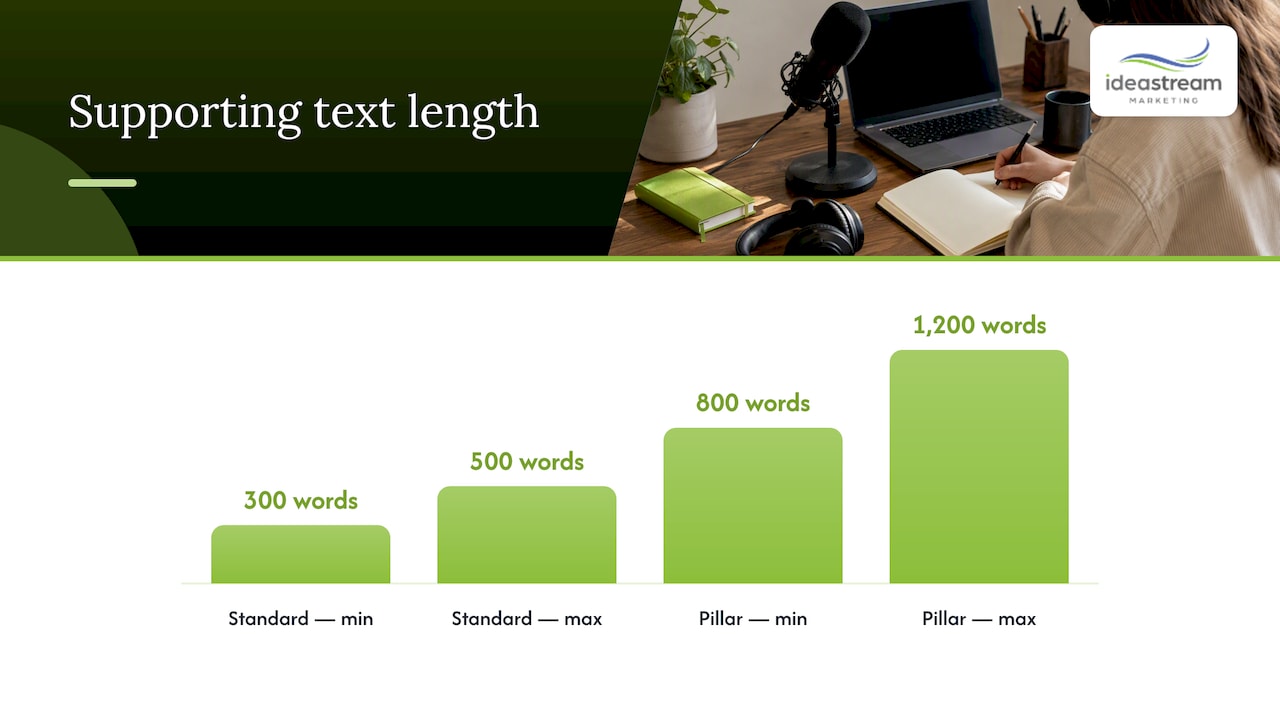
- Publish each transcript visibly on its episode page, with unique metadata and timestamps that identify speakers; add 300 to 500 supporting words for standard episodes.
- Use 800 to 1,200 supporting words for cornerstone episodes, while shorter conversational or timely episodes can use concise notes to publish faster.
- Validate RSS tags before submission and test PodcastEpisode structured data, which can enable playable audio cards; directory changes may take time to appear.
- Put the strongest insight within the first 90 seconds, then track completion, saves, follows, and episode page traffic monthly to identify where listeners leave.
Table of Contents
- How to optimize your show-level metadata
- Build SEO-friendly episode pages and publish transcripts
- RSS, ID3 tags and PodcastEpisode structured data
- Practical templates for episode titles and show notes
- Directory submission and directory-specific optimization tips
- Episode topic discovery: finding ideas people actually search for
- Which metrics matter and how to improve engagement signals
- Production to publish: the workflow that ties it together
- Leveraging backlinks for podcast episodes to boost SEO authority
- Promoting podcasts through social media and content marketing
- Guest SEO: promoting your guests’ keywords and networks
- Why podcast SEO is non-negotiable in the age of AI search
- How we help with podcast production, transcripts, and repurposing
- FAQ
- Sources
How to optimize your show-level metadata
Your show title, subtitle, description, and cover art set the foundation directories use to categorize and rank your entire feed. Search crawlers cannot listen to your audio, so these text fields carry the full weight of how algorithms understand what your show is about, according to Shopify’s podcast SEO guide.
Start with your show title. Place your primary keyword within the first portion of the title, and keep the total length under 100 characters so it displays cleanly across Apple Podcasts, Spotify, and search results, a limit Shopify recommends for display purposes. Your subtitle and the opening of your description do similar work: because descriptions often get truncated, the first 150 characters need to carry your most important keywords and your clearest value proposition.
A few more fundamentals shape how directories and search engines evaluate your show:
- Write show descriptions between 150 and 400 words, front-loading the topic and audience in the first sentence.
- Use cover art that meets each directory’s size requirements and add descriptive alt text when you display it on your own site.
- Select your two Apple Podcasts categories deliberately, choosing the ones your target listeners actually browse rather than the broadest options available.
- Avoid stuffing your description with keyword lists. Directories can flag that behavior as spam and suppress your show’s ranking, a risk outlined in Podcasting Authority’s SEO strategy guide.
Treat show-level metadata as a living asset. Revisit it every few months as your positioning sharpens, and keep the language natural so it reads well to a human browsing a directory, not just to an algorithm parsing a feed.
Build SEO-friendly episode pages and publish transcripts
A dedicated web page for each episode is what turns your podcast into content Google can actually index. Your RSS feed gets your audio into directories, but it does little for search visibility on its own. An owned episode page, hosted on your website with a unique title tag, meta description, and full transcript, gives search engines something substantial to crawl, and it gives AI systems something citable, according to AllAble’s podcast SEO research.
Build each page with the following elements:
- A unique page title and meta description that include your target keyword phrase and differ from every other episode’s title tag.
- Descriptive H2 subheadings that break the page into scannable sections, such as the topic summary, guest bio, and key takeaways.
- The full transcript published directly in the page body, not hidden behind a download link or a collapsed toggle, since crawlers weigh visible, indexable text far more heavily.
- Timestamps paired with speaker labels throughout the transcript, so both readers and search engines can navigate to specific moments.
- Natural keyword placement in the opening paragraph, a subheading, and the closing summary, rather than repeated mechanically throughout.
Clean up your transcript before publishing. Automated transcription tools get you most of the way there, but a human pass to fix misheard names, add punctuation, and correct technical terms makes the page far more usable and far more trustworthy to a reader deciding whether to keep scrolling.
Page length should match the episode’s purpose. Standard episodes do well with 300 to 500 words of supporting text beyond the transcript, while pillar or cornerstone episodes, the ones meant to rank for a core topic long-term, benefit from 800 to 1,200 words, a range AllAble recommends for depth and topical coverage.
Pro Tip: Write your episode page’s opening paragraph last, after the transcript is finalized. You’ll naturally pull in the strongest quotes and the clearest framing of what the episode delivers.
RSS, ID3 tags and PodcastEpisode structured data
Three technical layers determine whether directories and search engines can actually parse your show correctly: your RSS feed, your audio file’s embedded metadata, and the structured data on your episode pages.
Your RSS feed needs accurate values in every core tag: show and episode title, subtitle, description, the enclosure URL pointing to your audio file, artwork, and the explicit content flag. Errors here are a common reason episodes fail to appear in a directory search even after submission.
ID3 tags embedded in the audio file itself (title, artist, album, and artwork) serve as a secondary verification signal for platforms and media players, reinforcing what your RSS feed already states.
On your episode pages, PodcastEpisode schema in JSON-LD format tells Google explicitly what kind of content it’s looking at. Structured data that follows Google’s own documentation can unlock playable audio cards and richer search result appearances, a real visibility advantage over a plain text listing. Include these fields:
- Episode name, description, and datePublished.
- An associatedMedia or audio object pointing to the enclosure file, with duration specified.
- The full transcript text, when your template supports it, since Google treats it as part of the page’s indexable content.
Validate your work with Google’s Rich Results Test before publishing, and run your RSS feed through a validator to catch malformed tags before they cause indexing problems.
Practical templates for episode titles and show notes
A reusable title formula saves time and keeps your metadata consistent across every episode. The most effective pattern combines a keyword phrase, a concrete benefit, and, when relevant, a guest name: “How to Price Your Services Without Losing Clients, with [Guest Name].” Keep titles under roughly 70 characters so they don’t truncate in directory listings or search results.
A few formula variations worth rotating:
- Keyword + outcome: “Cold Email Deliverability: Why Most Campaigns Land in Spam”
- Keyword + guest: “Scaling a Service Business Past $1 Million, with [Guest Name]”
- Question format: “What Actually Moves the Needle in Local SEO?”
Show notes deserve the same structure every time, which makes them faster to write and easier for readers to scan. Open with a three-sentence hook that states the episode’s core problem and promise. Follow with three to five bullet takeaways. Add a timestamped chapter list so listeners and search engines alike can jump to relevant segments. Close with a resources section linking anything mentioned, plus a clear call to action.
Reserve long-form show notes, the 300-plus word version with full context and links, for pillar episodes and anything tied to a specific keyword you’re targeting seriously. Shorter, punchier summaries work fine for conversational or timely episodes where depth matters less than speed to publish.
Throughout all of this, favor natural-language variants of your target phrase over repeating the exact keyword. A show about financial planning might use “retirement planning,” “saving for retirement,” and “retirement income strategy” across a single page rather than the same three words every time.
Directory submission and directory-specific optimization tips
Getting listed is only the starting point. Each major platform treats your metadata a little differently, and directories re-crawl your feed on their own schedule, not instantly, so changes take time to propagate.
Follow this sequence when launching or updating a show:
- Submit your RSS feed to Apple Podcasts, Spotify, and Google/YouTube Music through each platform’s official submission portal.
- Confirm your show appears correctly in each directory’s search results within a few days, checking title display, artwork rendering, and category placement.
- Re-submit or ping your feed after any major metadata change, since some platforms cache older versions until prompted to refresh.
- Monitor for parsing errors using a feed validator, catching issues before they suppress your visibility.
Each directory weighs signals differently. Apple leans heavily on title and category matching, Spotify’s discovery surfaces respond to engagement data like completion rate, and Google/YouTube Music indexes your show notes text much like a webpage. That means your directory optimization and your website’s episode pages need to work together, not separately. A feed with perfect metadata but no corresponding web presence still misses the search traffic that comes from Google indexing your transcript and show notes directly.
Episode topic discovery: finding ideas people actually search for
Strong episode topics start with demand validation, not guesswork. Before you record, check whether real people are searching for the angle you’re considering.
A few reliable ways to validate topic demand:
- Use Google Trends to see whether interest in a topic is rising, flat, or seasonal before committing a full episode to it.
- Search directly inside Apple Podcasts and Spotify to see what similar shows are already covering and where gaps exist.
- Try a keyword planning tool to estimate search volume and find related phrases worth building an episode around, an approach detailed in Baby Love Growth’s keyword discovery guide.
- Frame at least one episode segment as a direct question, since question-based framing aligns well with how AI search tools surface and cite answers.
Pick two or three target phrases per episode, then map each one deliberately: one in the title, one in the subtitle or opening line of the description, and one woven naturally into the transcript or show notes. Build your editorial calendar around a mix of evergreen pillar topics, the ones built to rank for a year or more, and timely episodes that capture short-term search interest tied to news or seasonal questions in your industry.
Which metrics matter and how to improve engagement signals
Platforms reward shows that keep listeners engaged, and that behavior data feeds directly into how prominently your episodes surface in search and recommendation feeds. Track completion rate, saves, follows, total listens, and, separately, your episode page’s web traffic and any backlinks pointing to it.
Front-loading your most valuable content within the first 90 seconds measurably improves listener retention, a tactic AllAble ties directly to platform ranking algorithms that weight completion rate.
A few tactics that move these numbers:
- Open with the episode’s core insight or promise instead of a long preamble.
- Add chapter markers so listeners can navigate and return to specific segments.
- End episodes with a specific, single call to action rather than several competing ones.
- Repurpose strong segments into short clips for Instagram Reels, TikTok, YouTube Shorts, and Facebook Reels to drive new listeners back to the full episode.
Review your analytics monthly. If completion rates drop at a predictable point, that’s a signal to adjust episode length or pacing. If certain titles consistently outperform others, let that pattern guide your title formula going forward.
Production to publish: the workflow that ties it together
A reliable podcast SEO result comes from a repeatable production workflow, not a one-time optimization push. The sequence that consistently works for small teams:
- Plan the episode around a validated topic and two to three target keyword phrases.
- Record with clean audio, since a noisy recording creates transcription errors that compound into metadata problems later.
- Edit for pacing and trim dead air, then front-load the strongest content.
- Add timestamps and chapter markers during editing, not after.
- Transcribe the episode, then have a human review pass for accuracy.
- Publish the episode page with the full transcript, unique metadata, and PodcastEpisode schema.
- Promote through social clips, email, and relevant backlink outreach.
This is where production quality and search strategy meet. Our podcast production work pairs clean studio recording with the transcript and schema implementation this workflow requires, so an episode’s audio quality and its search visibility get built at the same time instead of as separate afterthoughts.
Small teams often split these roles across two or three people: one owns booking and planning, one owns recording and editing, and one owns publishing and metadata. If you’re a solo creator, batching each step, recording three episodes in one sitting, then dedicating a separate block to transcription and publishing, keeps quality consistent.
Pro Tip: Build a simple publishing template (a document with every metadata field listed) so no episode goes live missing a title tag, meta description, or schema markup.
Leveraging backlinks for podcast episodes to boost SEO authority
Backlinks work for podcast episode pages the same way they work for any other web page: a link from a relevant, credible site signals to Google that your content is worth ranking higher. The difference with podcasts is that most creators never build an episode page capable of earning a link in the first place, so a transcript-rich, well-structured page is the prerequisite, not the backlink strategy itself.
A few reliable ways to earn links to episode pages:
- Share quotable guest insights with your guest’s own site or team, since guests frequently link back to episodes they appeared on.
- Pitch a relevant stat or quote from the episode to a journalist or industry blogger covering the same topic.
- Reference past episodes from new episode pages, building a network of internal links that reinforces topical relevance across your site.
- Submit standout episodes to industry roundups or newsletters that cover podcasts in your niche.
A single link from a respected site in your industry does more for an episode page’s ranking than a handful of low-quality directory listings. Prioritize outreach to sites and people genuinely connected to the episode’s topic, since that relevance is part of what makes the link valuable in the first place. Treat backlink building as an ongoing habit tied to every pillar episode you publish, not a one-time campaign disconnected from your regular production schedule.
Promoting podcasts through social media and content marketing
Discoverability compounds when your episode content lives in more than one place. A single recording session can generate a full episode, a handful of short clips, a written article, and several social posts, each one a separate opportunity for someone to discover your show.
Repurposing is the most efficient path here. Pull the strongest 30 to 60 second moments from each episode and cut them into vertical clips for Instagram Reels, TikTok, and YouTube Shorts, then share longer excerpts as Facebook Reels or native video posts. Each clip should work as a standalone piece of value, not just a teaser, so viewers who never find the full episode still get something useful.
Beyond clips, a few content marketing moves extend an episode’s reach:
- Turn key takeaways into a short blog post or newsletter segment that links back to the full episode page.
- Quote a guest directly in a social post and tag them, since guests sharing posts with their own audience extends reach organically.
- Post the episode’s chapter list or biggest insight as a standalone graphic, giving people a reason to engage even on a quick scroll.
Consistency matters more than volume here. A show that reliably publishes clips and posts around every episode builds a recognizable presence, while sporadic promotion rarely builds the engagement signals that platforms and search algorithms reward over time.
Guest SEO: promoting your guests’ keywords and networks
Every guest on your show brings their own audience, their own search visibility, and their own set of keywords worth incorporating into your episode metadata. Treating guest SEO as part of your standard workflow extends your reach well beyond your existing listener base.
Start by researching what your guest is known for searching-wise: their book title, their company name, their signature framework or methodology. Incorporate those specific terms naturally into your episode title, description, and transcript, since people searching for your guest by name or topic may discover your episode as a result.
A few guest-focused tactics worth building into your checklist:
- Include the guest’s full name and company in the episode title or subtitle when it fits naturally.
- Link to the guest’s website, book, or primary project from the episode page, which also signals relevance to search engines.
- Ask guests to share the episode with their own audience, since that sharing often generates both traffic and backlinks.
- Reference any unique terminology or framework the guest uses, since those specific phrases may have low competition and high relevance for search.
This approach benefits both sides. Your episode page gains topical authority tied to a recognizable name, and your guest gains another piece of searchable content tied to their own brand. Over time, a show that consistently optimizes for its guests builds a reputation that makes high-profile guests easier to book, since appearing on your show becomes a visible, search-friendly asset for them too.
Why podcast SEO is non-negotiable in the age of AI search
AI search systems and direct audio indexing have changed what “discoverable” means for a podcast. A system that can summarize or cite your content needs text to work with, and a transcript published on an indexable episode page is what makes that possible. A show with great audio but no transcript is, to most of these systems, invisible.
The priority order hasn’t flipped, but it has clarified. Transcripts and episode pages come first, because without indexable text nothing else matters. Structured data comes second, turning a readable page into something a search engine can present as a rich result. Engagement tactics, chapters, front-loaded value, social clips, come third, compounding the reach of content that’s already indexable.
One trade-off worth naming honestly: a title optimized purely for keywords sometimes sacrifices the personality that makes a show memorable. The better approach blends both, keeping a consistent, brand-forward show name while letting episode titles carry the keyword weight.
How we help with podcast production, transcripts, and repurposing
Strong podcast SEO depends on clean audio, accurate transcripts, and metadata implemented correctly on every episode, and that’s exactly where our podcast production work fits. We record and edit your episodes, build out episode pages with transcripts and structured data, and cut each episode into clips for Instagram Reels, TikTok, YouTube Shorts, and Facebook Reels so one recording session fuels weeks of content.
If you’d rather hand off the technical side and focus on the conversations, schedule a consultation with our team to talk through a podcast production plan built around visibility from day one.
FAQ
How much does a podcast with 10,000 listeners make?
Podcast earnings vary widely based on niche, ad rates, and sponsorship deals rather than following a fixed formula tied to listener count. Monetization through sponsorships, affiliate links, or listener support tends to matter more than raw audience size at this stage, so a show’s engagement and niche relevance often predict revenue better than download numbers alone.
How do I learn SEO as a beginner?
Start with the fundamentals: how search engines crawl and index text, how metadata like titles and descriptions work, and how to structure content for readability. Google’s own structured data documentation is a solid, free starting point for understanding how search engines interpret your content technically.
How much does a podcast with 50,000 listeners make?
As with smaller shows, revenue at this audience size depends on sponsorship rates, ad placements, and how engaged the audience actually is, rather than on download count alone. A show with a specific, high-value audience niche often commands better sponsorship terms than a larger but more general audience.
How do you make money with SEO?
Businesses and creators generate revenue through SEO by ranking content that drives traffic toward products, services, or sponsorship opportunities, converting that visibility into leads or sales. For a podcast specifically, strong SEO on episode pages drives the kind of steady, compounding traffic that makes a show more attractive to sponsors over time.
Sources
- Podcast SEO (Shopify)
- Podcast SEO (AllAble)
- Podcast SEO strategies (Podcasting Authority)
- Structured data markup that Google Search supports (Google Developers)