



October 10, 2026



Generative engine optimization, or GEO, is the practice of shaping content so AI answer engines like Google’s AI Overviews, ChatGPT, and Perplexity cite your site in their generated responses. The single most important action to take today is adding concise, citable fact blocks with real sources and statistics to your highest-value pages, then watching AI-feature impressions and high-intent clicks as your first measure of progress.
TL;DR:
- Benchmark testing found that citation focused methods, including sources, statistics, and quotations, increased page visibility in generative answers by roughly 30 to 40%.
- Keep crawlability and indexability intact; citation selection favors topical match, recency, and explicit facts such as prices or timestamps over formatting alone.
- Prioritize conversion focused pages and cornerstone guides, adding a sourced 40 to 60 word answer beneath the relevant heading with a hard fact.
- Measure changes through Search Console AI feature impressions and clicks, then compare matched rewritten pages against untouched pages before judging traffic or conversions.
Table of Contents
- What GEO Is and Why It Matters Now
- How GEO Differs From Traditional SEO
- Evidence-Based GEO Strategies: A Prioritized Checklist
- How to Implement GEO: A Practical Workflow
- How to Measure GEO Performance
- Practitioner View: How We Apply GEO in Production
- Integrating GEO With Video Content Optimization
- GEO’s Impact on Social Media and YouTube SEO
- Combining GEO With AI-Powered Production Tools
- GEO in Multimedia Marketing Campaigns
- Future Trends in GEO and AI Search
- Local SEO Considerations Within GEO
- Perspective: Strategic Implications for Content Production
- How We Help You Execute a GEO Program
- FAQ
- Sources
What GEO Is and Why It Matters Now
Generative engines do not just rank pages, they read across dozens of sources, synthesize an answer, and choose a handful of sites to cite as evidence. When your page becomes one of those citations, you get visibility inside the answer itself, not just a blue link beneath it. That shift changes how people find and trust a business, because a cited source carries implicit credibility that a standard search result does not.
The upside is measurable. Research from GEO: Generative Engine Optimization (arXiv / Princeton) found that applying citation-focused methods, adding sources, statistics, and quotations, increased a page’s visibility in generative engine responses by roughly 30 to 40% on benchmark tests. That is a meaningful swing for any content team already producing articles, videos, or podcasts.
Being cited consistently tends to improve several outcomes at once:
- Referral traffic quality improves, since readers arrive already primed by the AI’s summary of your content.
- Time on site often rises because visitors land expecting depth, not a quick skim.
- Lead probability increases when the cited passage includes a clear, factual answer that builds trust before the click.
GEO is not a replacement for search visibility. It is an added layer on top of it, and businesses that ignore it are leaving a growing share of discovery to competitors willing to format their expertise for machine synthesis.
How GEO Differs From Traditional SEO
Traditional SEO optimizes for a ranked list of links. GEO optimizes for selection: being one of the few sources an AI model decides to quote or paraphrase inside a single generated answer. That distinction changes where marketers should spend their effort.
- Citation preference beats ranking position. An AI engine does not need ten good answers, it needs one or two trustworthy ones, so topical match, recency, and explicit facts like pricing or timestamps carry outsized weight according to What Gets Cited: Competitive GEO in AI Answer Engines (ACM).
- Foundational SEO is still the entry ticket. Indexability, crawlability, and core quality signals remain non-negotiable, because Google’s own guidance confirms AI Overviews draw from the same indexed content and ranking systems as classic Search.
- Formatting alone will not move the needle. The ACM research found formatting changes had negligible effect on citation odds compared with completeness and factual specificity, so a bulleted list dressed up to look authoritative accomplishes little without real facts underneath it.
The practical takeaway: keep doing the SEO work that gets you indexed and ranked, then layer GEO-specific tactics, unique statistics, direct quotes, and complete factual answers, on top of your strongest pages first.
Evidence-Based GEO Strategies: A Prioritized Checklist
Not every GEO tactic carries equal weight. Research gives us a reasonably clear hierarchy of what to fix first.
Content-level priorities, based on combined findings from GEO-bench testing:
- Add citations to credible external sources near your key claims, since GEO: Generative Engine Optimization (arXiv / Princeton) found this among the strongest single-method levers.
- Insert concrete statistics instead of vague qualifiers, because generative engines favor specific, verifiable numbers over general claims.
- Include short quoted facts or expert statements that an AI model can lift cleanly into a synthesized answer.
- Build explicit timestamp, price, or spec blocks, since the ACM study identified price mentions and recent timestamps as unanimous drivers of citation across multiple large language models.
Structural signals matter too, though they support rather than replace factual content: schema markup that matches your visible text, clear H2 headings that frame a fact block as its own answerable unit, and canonical versions of your most authoritative pages so engines do not split credit across duplicates.
Content tactics worth building into your production workflow include short 40 to 60 word passages that answer one question completely, dedicated FAQ blocks, and transcript-derived fact highlights pulled directly from video or podcast recordings, which already contain quotable, timestamped material.
Combining methods outperforms any single tactic.
Pro Tip: Write one 40 to 60 word “citation-ready” passage per key page, built around a single hard fact, a source link, and a timestamp where relevant, then place it right under the H2 it answers.
How to Implement GEO: A Practical Workflow
Turning the checklist into a repeatable process takes structured audit and execution phases, not a one-time content sprint.
- Map queries to intent. List the questions your audience actually asks AI tools, then group them by topic cluster rather than by old keyword lists.
- Identify retrieval-ready pages. Flag pages that already rank reasonably well or cover a topic in depth, since these have the best retrieval potential for a generative engine to pull from.
- Inventory existing factual assets. Pull together video transcripts, podcast transcripts, case data, and statistics already sitting in your content library but not yet formatted for citation.
- Prioritize rewrites. Start with pages closest to conversion, service pages and cornerstone guides, before touching lower-traffic content.
- Add citations, statistics, and structured data. Insert schema, short citable passages, and sourced facts directly into the page body, not buried in footnotes.
- Publish and track. Push updates in batches so you can compare before-and-after performance cleanly.
Assign a content lead to own the rewrite queue and a technical SEO team member to handle schema and canonical cleanup. A realistic pilot runs in three phases: 30 days for the audit and first batch of rewrites, 60 days to expand across your top 20 pages, and 90 days to review results and plan the next cycle. Our own 40 to 60 word passage playbook walks through the exact passage structure we use in client rewrites.
Pro Tip: Timebox each GEO pilot page edit to under 30 minutes by building a reusable fact-block template your writers can fill in rather than draft from scratch.
How to Measure GEO Performance
Measuring GEO well means combining direct AI-feature data with proxy signals, since not every platform exposes citation data the same way.
Direct measures worth tracking:
- AI feature impressions and clicks, which Google Search Console now reports alongside standard Search performance.
- Citation share where a platform exposes it, letting you see how often your domain appears in generated answers for target queries.
Proxy measures fill the gaps:
- Query-level traffic lift on pages you have rewritten for GEO, compared against a baseline period.
- Conversion lift and time on page for visitors arriving from AI-feature clicks versus standard organic clicks.
- Engagement with the specific passages you built as citation-ready fact blocks.
The strongest test design is a controlled rewrite: pick matched pairs of similar pages, rewrite one with GEO tactics and leave the other untouched, then log retrieval context and compare pre and post performance. Our weekly AI search visibility baseline gives teams a simple way to run this check consistently instead of guessing at progress.
Practitioner View: How We Apply GEO in Production
We treat every video and podcast recording as a source of citation-ready content, not just a finished asset. Our editing workflow pulls transcripts immediately after a shoot and tags the strongest factual statements, a statistic, a named result, a direct quote, for reuse as schema-ready passages on the site.
A few practices any in-house team can replicate:
- Transcribe every video or podcast episode and extract one or two quotable, fact-dense lines per segment.
- Match those lines to the page or blog post that already covers the same topic, then insert them as short, sourced passages.
- Add schema markup to the page the same day the content is published, not weeks later.
- Treat each recording session as raw material for multiple GEO-ready assets rather than a single output.
This pairing of production and technical SEO work is why our AI SEO services are built around the same content our studio already produces.
Integrating GEO With Video Content Optimization
Video already contains the raw material GEO rewards: specific claims, named results, and spoken quotes that a transcript turns into text an AI model can retrieve and cite. The gap most teams miss is that a video sitting on a page without a transcript or structured summary gives a generative engine nothing to pull from.
Closing that gap starts with a full transcript published alongside the video, broken into short sections that mirror the page’s headings. Each section should carry one clear, quotable statement, since the ACM research on citation drivers found completeness and explicit facts outperform generic descriptions when models choose what to cite. Adding VideoObject schema with accurate duration, upload date, and description further aligns the page with the same signals Google’s AI features already rely on for classic Search.
Our video content checklist for marketing pros walks through the transcript and schema steps we apply to every corporate video, testimonial, and training video we produce, so the footage works as hard for search as it does for the viewer watching it.
GEO’s Impact on Social Media and YouTube SEO
YouTube functions as its own retrieval source for several AI platforms, which means a well-optimized video description, chapter list, and transcript can earn citations the same way a blog post does. Short-form platforms, Instagram Reels, Facebook Reels, TikTok videos, and YouTube Shorts, play a different role: they extend reach and drive brand recall, but their captions and on-screen text still benefit from the same factual, specific language that performs well in GEO.
Repurposing a single podcast episode into several short clips multiplies your chances of being discovered across platforms. A clip built around one concrete statistic or a direct quote from the episode tends to perform better on social feeds and doubles as a citable fragment if it is also published as text on your site. Consistent captions and video titles across YouTube, Instagram, and TikTok reinforce the same topical signals that help an AI engine recognize your business as an authority on the subject.
Treat each podcast recording as a content system: one long-form episode, several short-form clips, and a transcript-derived set of fact blocks for the website, all pointing back to the same core expertise.
Combining GEO With AI-Powered Production Tools
AI-powered tools now handle much of the heavy lifting in video and podcast production, from automated transcription to upscaling footage to broadcast quality. The best practice is to let these tools speed up production while a human editor still decides which facts and quotes get surfaced as citation-ready text, since AI-generated summaries can miss the specific detail that actually earns a citation.
For video upscaling, character consistency, and multi-language dubbing needs, tools like Take4K offer practical guides for AI-enhanced video workflows that pair well with a GEO-focused production pipeline. For broader content optimization audits across a site, resources like Baby Love Growth’s AI content guide walk through scalable workflows for applying these same principles beyond video.
The pattern that works best: use AI tools to cut production time on editing, captioning, and transcription, then apply human judgment to select the statistics, quotes, and facts worth turning into a citable passage. Speed without factual precision will not earn an AI citation, no matter how polished the final cut looks.
GEO in Multimedia Marketing Campaigns
A campaign that pairs video, podcast, and written content tends to generate more citation opportunities than any single format alone, simply because it produces more distinct factual fragments an AI engine can retrieve. A testimonial video, for example, yields a transcript quote, a statistic about the result achieved, and a short written case summary, three separate citable assets from one shoot.
The strongest campaigns treat the podcast episode as the hub: the full episode goes to YouTube and audio platforms, short clips go to Instagram Reels, Facebook Reels, TikTok, and YouTube Shorts, and the transcript feeds a blog post with fact blocks pulled directly from the conversation. Each piece reinforces the same core claim in a different format, which gives a generative engine multiple paths to the same expertise.
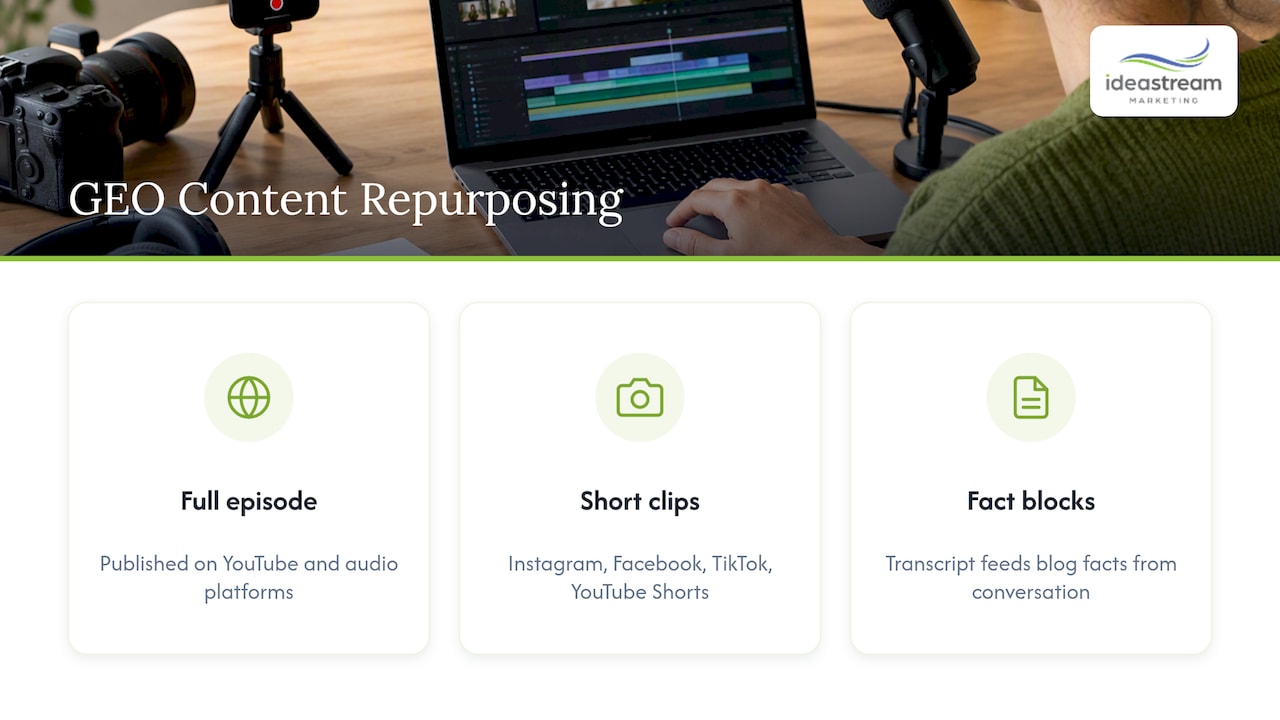
This structure also protects against platform risk. If one channel’s algorithm shifts, the underlying factual content still lives on owned pages formatted for GEO, which keeps the citation opportunity intact regardless of where the original clip performs best.
Future Trends in GEO and AI Search
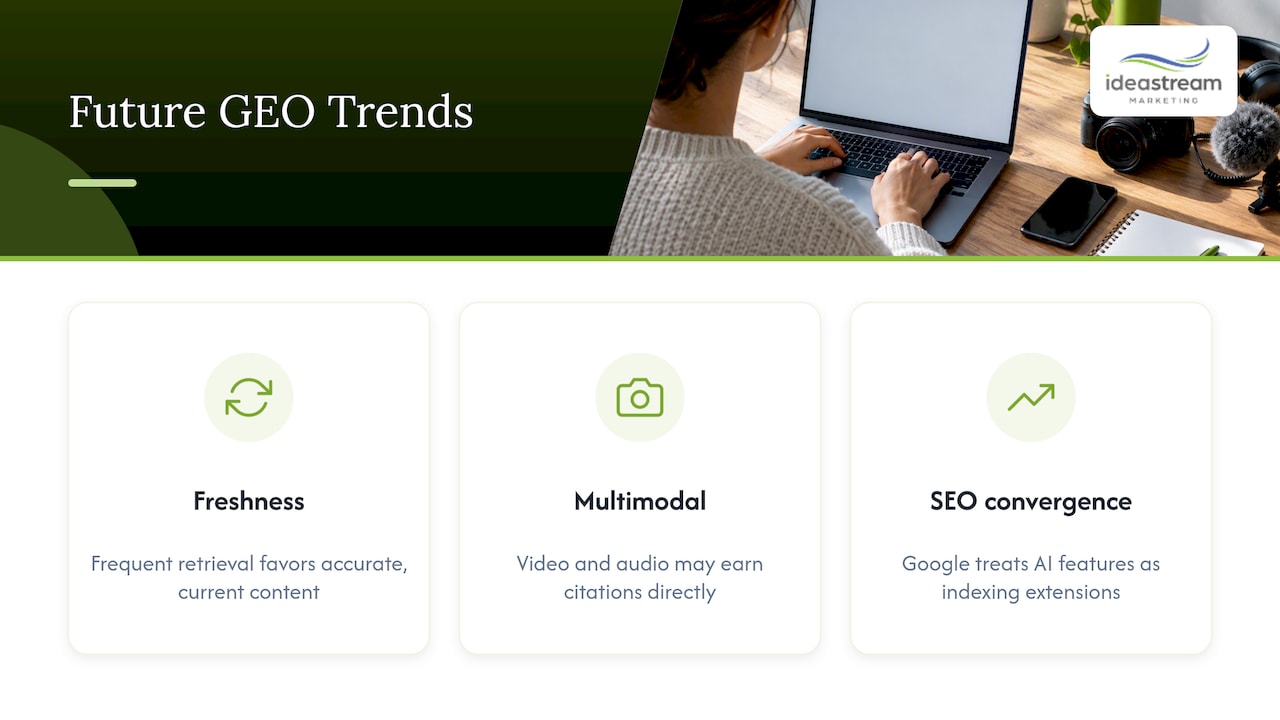
Generative engines are moving toward more frequent retrieval updates, which means content that stays accurate and current will likely hold citation advantages longer than static pages. Expect AI platforms to lean further into explicit facts, pricing, specifications, and dates, as a filtering mechanism, following the pattern the ACM research already documented.
Multimodal retrieval is also expanding. As AI systems get better at pulling directly from video and audio rather than relying solely on transcripts, well-produced video with clear spoken facts may start carrying citation weight on its own, not just through its text companion. Agencies that already produce clean, factually dense video and podcast content will be positioned to adapt quickly, since the underlying asset quality does not need to change, only the technical wrapper around it.
Marketers should expect GEO to keep converging with core SEO rather than splitting into a separate discipline, since Google’s own guidance already treats AI features as an extension of the same indexing and ranking systems. The practical implication: build for clarity, accuracy, and citability now, and most future algorithm shifts will refine rather than reverse that approach.
Local SEO Considerations Within GEO
Local businesses face a specific version of the citation problem: generative engines answering location-based queries still need explicit, verifiable facts, service areas, hours, named neighborhoods, and specific service details, to choose a local source over a generic one. A Google Business Profile with accurate categories and complete service descriptions feeds the same retrieval systems that power AI Overviews, so the fundamentals have not changed even as the output format has.
Local service pages benefit from the same 40 to 60 word fact-block structure as any other GEO content, but with specific neighborhood and service-area language built in rather than generic city names. A page that states exactly which towns or counties it serves, paired with a concrete detail like typical project turnaround or a named service, gives an AI engine a complete, citable answer instead of a vague regional claim.
Video testimonials and location-tagged content add another layer of local specificity that text alone often lacks, since a client speaking on camera about a specific project naturally produces the kind of concrete, quotable detail that both local searchers and generative engines respond to.
Perspective: Strategic Implications for Content Production
The real shift GEO forces is away from single-query keyword content and toward assets built to influence many related queries at once. Structured material, video, transcripts, and fact blocks together, serves human readers and AI retrieval equally well, which is why production and technical SEO can no longer operate as separate functions. Agencies that already combine both are simply better positioned to execute this well.
— Dean Spinato, CEO & Founder of Idea Stream Marketing
How We Help You Execute a GEO Program
Running a GEO pilot well means pairing content production with technical execution, and that combination is the core of what we do. We build the video, podcast, and written assets that generate citable facts, then handle the schema, structured data, and AI SEO work that gets those facts in front of generative engines.

A typical engagement draws on:
- AI SEO services to audit existing pages and implement schema and citation-ready rewrites.
- Podcast production to create the recordings that feed both social clips and transcript-based fact blocks.
- Video production for testimonials, training content, and branded storytelling that doubles as GEO material.
If you want a structured audit and a 90-day pilot built around your own content library, schedule a consultation with our team and we will map out where your strongest citation opportunities already exist.
FAQ
What is generative engine optimization in simple terms?
Generative engine optimization is the practice of formatting and sourcing content so AI tools like AI Overviews, ChatGPT, and Perplexity choose to cite it when generating an answer. It builds on standard SEO but adds a focus on explicit facts, citations, and statistics that research shows drive citation selection, as documented by Princeton and arXiv researchers.
Does GEO replace traditional SEO?
No, GEO builds on traditional SEO rather than replacing it. Google’s own guidance confirms AI features rely on the same indexing and quality signals as classic Search, so crawlability and core SEO fundamentals remain the foundation.
Which GEO tactics have the strongest research support?
Adding citations, concrete statistics, and short quoted facts together produced visibility gains of roughly 30 to 40% in benchmark testing from GEO: Generative Engine Optimization (arXiv / Princeton). Separate research on citation drivers found topic match, recency, and explicit price or timestamp details were consistent factors across multiple AI models, according to ACM’s GEO study.
Can video and podcast content help with GEO?
Yes, video and podcast transcripts provide ready-made, quotable, and timestamped material that converts easily into the short factual passages generative engines favor. Repurposing a single episode into transcripts, blog fact blocks, and short clips for Instagram Reels, TikTok, or YouTube Shorts multiplies the citation opportunities from one recording session.
How do I measure whether GEO is working?
Track AI feature impressions and clicks in Google Search Console, since Google reports these metrics alongside standard Search data. Pair that with proxy measures like query-level traffic lift and conversion lift on pages you have specifically rewritten with citations and fact blocks.
Sources
- GEO: Generative Engine Optimization (arXiv / Princeton)
- What Gets Cited: Competitive GEO in AI Answer Engines (ACM)
- AI features and your website | Google Search Central