



October 16, 2026



Citations go to pages that clear three gates at once: they’re indexed and snippet-eligible, they carry a tightly written 40 to 60 word answer passage a model can lift cleanly, and they show clear author and organization signals through schema. Miss any one gate and the other two don’t matter. This week, prioritize technical eligibility, answer-first formatting, and schema plus multimedia, then track results through the Generative AI report in Search Console.
TL;DR:
- Pages must be technically eligible with proper crawlability, rendering, schema markup, and no snippet restrictions to be considered for AI Overviews.
- Structuring answer passages as clear, answer-first sections answering specific sub-questions in 40 to 60 words significantly increases citation chances.
- Implementing FAQPage, HowTo, Organization, and Person schema, along with full transcripts and descriptive media alt text, boosts extraction and citation likelihood.
- Citation rates are best tracked via the Generative AI report in Search Console, with consistent updates every 30 to 60 days and ongoing schema validation.
- Focusing on depth and comprehensive answers in fewer pages, rather than thin content spread across multiple pages, improves authority signals for AI citation.
Table of Contents
- What AI Overviews Optimization Actually Means
- Technical Checklist to Make Pages AI Overview Eligible
- How Do You Write Passages AI Overviews Can Cite?
- Which Schema and Media Formats Help Citation Odds?
- How Do You Measure AI Overview Citation Impact?
- Setting Up Editorial Guardrails That Actually Hold
- Different Optimization Approaches For AI-Generated Content
- Ethical Considerations And Bias Mitigation
- Performance Optimization Across Different AI Platforms
- Fitting AI Overview Work Into Your Existing SEO Program
- Agency Perspective: What Actually Moves the Needle
- How Idea Stream Marketing Builds AIO-Ready Content
- Sources
- FAQ
What AI Overviews Optimization Actually Means
AI Overviews are Google’s generative summaries that sit above traditional blue links, synthesizing an answer from multiple sources instead of pointing to just one. Ai overviews optimization is the practice of structuring a page so that summary layer can find it, trust it, and lift a passage from it cleanly. That’s a different job than classic ranking, and treating it as the same skill set is where most SEO teams lose ground.
Google doesn’t answer a query with one document. It uses query fan-out, breaking a single search into several related sub-queries, then pulling supporting passages from different pages to assemble one synthesized response. Ranking number one for the head term guarantees nothing here. A page can sit on page two of traditional results and still get cited, because it answered one sub-question in the fan-out better than anyone else.
This changes what “visibility” means in practice:
- Ranking measures where a page lands in the traditional ten blue links for a single query.
- Citation measures whether a passage from that page gets pulled into the synthesized answer, often for a sub-question the searcher never typed.
- A page can rank poorly and still be cited, or rank well and get skipped entirely if its content isn’t structured for extraction.
The click math has shifted too. Pew Research found users click links less often when an AI summary appears on the results page. That sounds like bad news until you look at the other half of the finding: when users do click through from an AI Overview, that traffic tends to show higher engagement quality. Fewer visitors, but visitors who are further along and more likely to convert. That trade favors sites built for citation over sites built purely for click volume.
Technical Checklist to Make Pages AI Overview Eligible
Nothing downstream matters if the page can’t be crawled, indexed, and shown with a snippet. Google has confirmed there are no additional technical requirements beyond standard Search eligibility for a page to appear in AI Overviews, which means your existing indexability audit is your starting checklist, not a separate project.
Work through these in order:
- Confirm crawlability in robots.txt. Check that priority pages aren’t blocked, and that any disallow rules written for a different purpose haven’t accidentally caught the URLs you want cited.
- Verify server-side or fully rendered content. If your answer passages only appear after client-side JavaScript executes, don’t assume the crawler renders them the way a browser does. Test with the URL Inspection tool in Search Console and check the rendered HTML tab specifically.
- Audit snippet controls. A
nosnippetmeta tag or a restrictivemax-snippetvalue blocks Google from showing any preview text, which removes the page from AI Overview consideration entirely. Search these tags site-wide; they often get added years ago for reasons nobody remembers. - Add Organization and Person schema. Entity resolution depends on the model being able to confidently tie a passage to a known, credible source. Minimal Organization and Person markup on your about and author pages does real work here.
- Run a live test on five priority URLs. Pull each through URL Inspection, confirm indexing status, check the rendered content, and confirm no snippet restriction is active.
Assign ownership before you start: technical SEO owns robots.txt and rendering, content owns the schema fields tied to authorship, and whoever runs the CMS should own the snippet-control audit, since that’s often a legacy setting nobody assigned.
Pro Tip: Run the URL Inspection tool’s “view crawled page” render before you touch content strategy. If your answer paragraph isn’t in that rendered HTML, no amount of rewriting will get it cited, because the model never sees it.
How Do You Write Passages AI Overviews Can Cite?
Structure each section to answer one sub-question completely in the first paragraph, then build supporting depth underneath it. That single formatting habit does more for citation odds than almost anything else on this list.
Start by mapping the fan-out. Before you write a word, list every sub-question a searcher plausibly has around your topic. For “ai overviews optimization,” that list includes “what triggers an AI Overview,” “how is it different from featured snippets,” “how do you measure it,” and half a dozen more. Each sub-question becomes its own H2 or H3, phrased as a real question the way a person would type it.
Then apply the answer-first rule to every one of those headings:
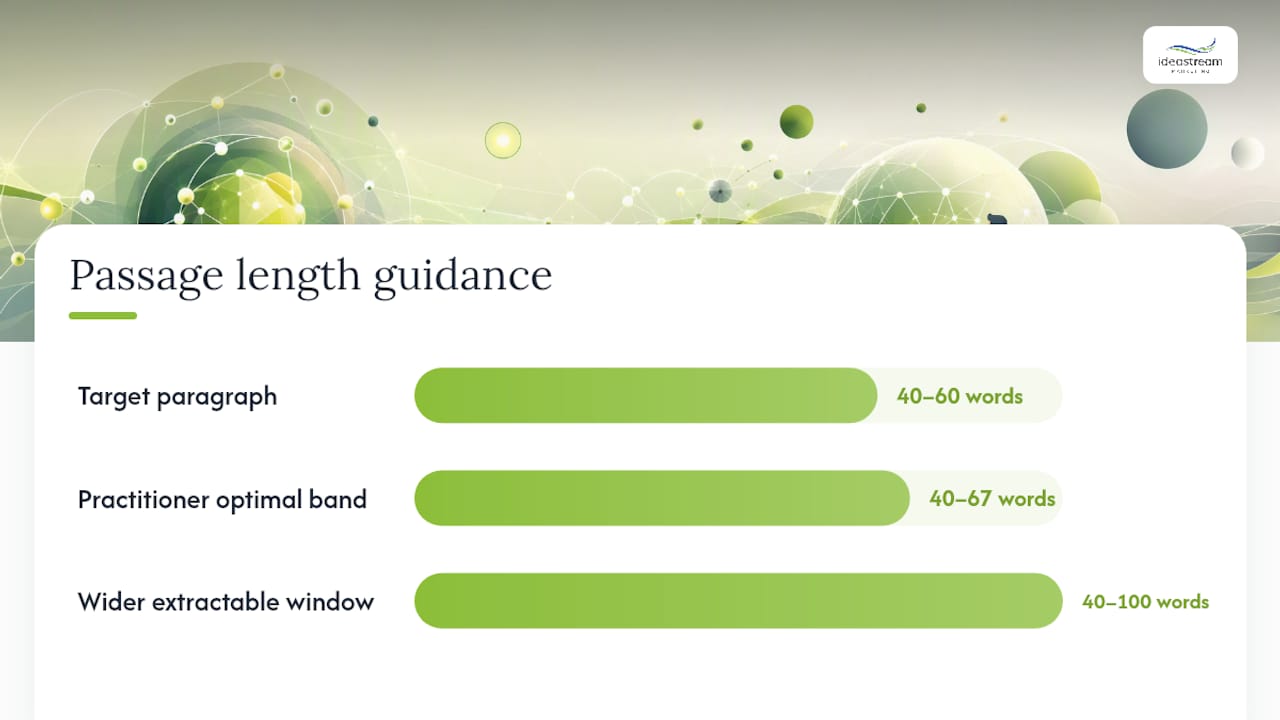
- Open with a 40 to 60 word paragraph that states the direct answer plainly, with no throat-clearing setup.
- Follow that paragraph with evidence, an example, or a caveat that adds real depth.
- Keep sentences short enough to read cleanly on mobile, since most traffic to your site is already arriving on a phone and cramped paragraphs lose readers before they finish the thought.
The 40 to 60 word target isn’t arbitrary. Practitioner testing summarized by SearchScore puts the optimal extractable passage in a 40 to 67 word band, with successful extractions happening across a wider 40 to 100 word window when the passage is fully self-contained. The tighter you write, the less editing the model has to do to lift your sentence whole.
A useful test: could this paragraph be read aloud, on its own, as a complete answer to the heading above it? If it needs the paragraph before it to make sense, rewrite it. That’s the same discipline HubSpot’s guidance points to when it recommends treating every H2 and its opening paragraph as a standalone citation unit rather than a stepping stone in a longer argument.
One decision trips up more teams than any writing rule: whether to go deep on one URL or split a topic across several thinner pages. Depth wins more often than not. A single comprehensive page that answers eight related sub-questions under eight clear H2s gives the fan-out process eight separate chances to cite you from one URL. Splitting those same eight questions across eight thin pages usually means seven of them never accumulate enough authority signal to clear the E-E-A-T gate in the first place. Consolidate unless a sub-topic genuinely deserves its own search intent and its own page.
Which Schema and Media Formats Help Citation Odds?
Structured data and multimodal content both raise your odds of selection, and the two work together rather than as separate checkboxes. Practitioner data from SearchScore reports multimodal integration correlating with a 156% higher selection rate compared with text-only pages, which makes this one of the highest-leverage sections on this list.
Prioritize these schema types on priority pages:
- Article schema with clear
datePublishedanddateModifiedfields, since freshness signals feed directly into the ranking pipeline. - FAQPage schema wrapped around genuine question-and-answer content, not artificially split sentences. This gives the model a pre-packaged extractable unit.
- HowTo schema for process content, structured in the actual sequential steps a reader follows.
- Organization and Person schema, tying every article to a named author and a verifiable entity. This is the same entity-resolution signal that determines whether the model attributes a passage to you or to a similarly named competitor.
FAQPage and HowTo schema help extraction because they hand the model a format it already expects: a question paired with a bounded answer. Keep those schema-wrapped answers in the same 40 to 60 word range you use in body copy; padding them out defeats the purpose.
On multimedia, add full transcripts to embedded video, write descriptive alt text that states what’s actually in the image rather than a generic label, and caption video content so the same information exists in text form for the crawler. For structuring video content that supports both viewer engagement and text-based extraction, treat the transcript as required output, not an afterthought.
For comparison data, use native HTML tables instead of images of tables or PDF embeds. A model can parse and re-render an HTML table’s rows and columns; it can’t reliably extract text trapped inside a graphic. Our own schema implementation guidance walks through the JSON-LD patterns that pair cleanly with this kind of structured content.
How Do You Measure AI Overview Citation Impact?
Track citations as a distinct metric from rankings, using the Generative AI report inside Search Console as your primary source and Google Analytics events to confirm what happens after a citation click occurs. Treating citation tracking as an extension of your existing rank-tracking dashboard, rather than a separate discipline, is the fastest way to miss what’s actually working.
Build the measurement habit around three moves:
- Establish a tracked query basket. Pick 20 to 30 queries tied to your priority pages, including the fan-out sub-questions you’re targeting, and log a baseline for both traditional visibility and AI Overview appearance before you make any changes.
- Run structural experiments with a control. Rewrite the answer-first passage on half your priority pages and leave the other half untouched for a defined period, then compare citation rates between the two groups rather than judging the whole site at once.
- Test schema additions in isolation. Add FAQPage or HowTo schema to one batch of pages without touching the prose, so you can attribute any citation lift specifically to the markup rather than to simultaneous content changes.
Layer in freshness testing too. Practitioner tracking from PromptAlpha suggests pages updated within the last 30 days often see a measurable citation boost over stale pages covering the same topic, which argues for building update cadence into the experiment calendar rather than treating it as a one-time fix.
Pro Tip: Export your Generative AI report data monthly and keep it in the same dashboard as your rank tracking. Citation rates move differently than rankings do, sometimes climbing while rankings stay flat, and you’ll miss that divergence if the two live in separate tools.
For teams running fan-out query mapping at scale, a dedicated AI search automation service can help centralize the sub-question tracking that manual spreadsheets struggle to maintain past a few dozen queries.
Setting Up Editorial Guardrails That Actually Hold
Citation gains erode fast without a maintenance rhythm and clear ownership, so treat this as an operating process rather than a one-time project. A 30 to 60 day refresh cadence on your highest-priority pages keeps freshness signals current, and certain triggers should force an immediate update outside that schedule: a competitor overtakes you in citations for a tracked query, the underlying facts in your answer passage change, or Search Console shows a sudden drop in AI Overview appearances for pages that previously performed well.
Build the workflow around three roles:
- A content owner who maps sub-questions, writes the answer-first passages, and keeps the refresh calendar current.
- A schema owner who applies and validates structured data, since malformed JSON-LD silently breaks entity resolution.
- A QA reviewer who checks that new pages meet a real search intent rather than existing purely to insert a keyword phrase.
That last guardrail matters more than it sounds. The temptation to spin up dozens of near-duplicate pages targeting slight keyword variations is exactly the kind of scaled, low-value content pattern that fails the E-E-A-T gate before it ever reaches passage ranking. Depth on fewer pages beats volume on thin ones every time in this pipeline.
Different Optimization Approaches For AI-Generated Content
Prompt engineering and generation-parameter tuning matter more when AI tools assist your content production, not just when Google’s model decides what to cite. Teams using large language models to draft first passes need a different toolkit than teams writing everything by hand.
Temperature settings control how deterministic or exploratory a model’s output is. Lower temperature values produce tighter, more predictable phrasing, which tends to suit the compact, factual answer passages this whole citation game rewards. Higher temperature settings introduce more variation and creative phrasing, useful for brainstorming angles but often too loose for the 40 to 60 word extractable unit you’re trying to hit.
Prompt structure matters just as much as the parameter dial. A prompt that explicitly requests a direct answer in a fixed word count, followed by supporting evidence, produces drafts far closer to the answer-first format than an open-ended request for “an article about X.” Build your prompts around the same structure you want the final page to have: question, direct answer, evidence.
None of this replaces human editing. AI-assisted drafts still need a pass for accuracy, for genuine expertise the model can’t fabricate, and for the specific examples that separate a credible page from a generic one. Treat generation tools as a way to produce a faster first draft of an answer-first structure, not a way to skip the editorial judgment that determines whether that structure holds up to fact-checking.
Ethical Considerations And Bias Mitigation
Content optimized purely to satisfy an extraction algorithm carries a real risk of drifting away from accuracy in favor of quotability, and that trade-off deserves honest attention. A sentence engineered to sound confidently definitive scores well with passage re-rankers. It also misleads readers if the underlying claim is actually uncertain or contested.
Bias shows up in a few specific ways worth watching. Overly confident phrasing can flatten a nuanced topic into a false absolute, which is bad practice even before you consider AI citation. Sourcing that leans only on a narrow set of easily quotable studies, while ignoring genuinely relevant contradicting research, produces a distorted picture even when every individual sentence is technically accurate. And content produced at high volume through AI assistance, without proportional editorial review, tends to accumulate small factual drifts that compound across dozens of pages before anyone notices.
The fix isn’t complicated, but it does require discipline: keep a named, credentialed human in the review loop for any claim that touches health, finance, legal standing, or safety, regardless of how the draft was produced. A page that earns a citation by being honestly hedged where the evidence is thin will hold up better over time than one that earns it by overstating certainty.
Performance Optimization Across Different AI Platforms
Google’s AI Overviews, Bing’s Copilot integration, and standalone assistants like ChatGPT and Perplexity don’t all weigh the same signals, even though the underlying optimization habits overlap heavily. Treating “AI search optimization” as one undifferentiated target means missing platform-specific behavior that actually moves citation rates.
Google’s pipeline, as covered above, leans hard on its existing index, its E-E-A-T filtering stage, and passage-level re-ranking tied to Knowledge Graph entity recognition. Bing’s generative results draw more directly on its own index and put comparable weight on structured data, but its crawler and indexing quirks differ enough from Googlebot that a page eligible for one isn’t automatically eligible for the other. Standalone assistants that don’t maintain their own real-time index, depending on the platform and query, sometimes rely on retrieval from a smaller or differently weighted source set, which can make authoritative, well-linked pages punch above their traditional ranking weight.
The practical response isn’t building separate content for each platform. It’s making sure the fundamentals, clean indexability, answer-first passages, strong schema, and clear entity signals, are solid enough to clear whichever gate a given platform uses. A page engineered only for Google’s specific pipeline quirks, at the expense of general clarity and structure, is a fragile investment if that platform changes its ranking approach. Build for extractability and trust as universal properties, then layer platform-specific technical checks, like confirming Bingbot access separately from Googlebot, on top of that foundation.
Fitting AI Overview Work Into Your Existing SEO Program
AI Overview optimization isn’t a parallel workstream competing for budget against traditional SEO. It’s an extension of the same technical and content foundation, applied with a sharper focus on passage-level extractability. Teams that treat it as a separate initiative usually end up duplicating work that their existing SEO process already covers.
Your technical SEO audit already checks indexability, crawl budget, and rendering; the AI Overview checklist just adds snippet-control verification and schema completeness to that same audit. Your keyword research process already identifies search intent; fan-out mapping is simply a deeper layer of that same research, breaking a head term into the sub-questions a generative model will actually query against. Your content calendar already schedules updates; the 30- to 60-day freshness cadence for priority pages is a tighter version of the refresh discipline good content teams already practice.
The place these two efforts genuinely diverge is measurement. Traditional SEO reporting centers on rank position and organic click volume. AI Overview tracking needs the Generative AI report in Search Console running alongside that traditional dashboard, because a page can lose click share to an AI summary while gaining citation-driven brand visibility that a rank tracker alone won’t show. Report both numbers side by side, and stop treating a ranking dip in isolation as a loss if citation appearances are climbing in the same period. AI’s broader shift in digital marketing workflows makes this integration the expectation going forward, not an optional add-on to the SEO plan you already run.
Agency Perspective: What Actually Moves the Needle
Most teams over-invest in schema and under-invest in the actual sentence quality of their first paragraph. We’ve watched pages with immaculate JSON-LD markup get skipped in favor of a plainer competitor page, simply because that competitor answered the question in one clean sentence instead of three hedged ones. Schema earns you consideration. The sentence earns you the citation.
The most common pitfall isn’t technical at all. It’s writing the answer-first paragraph after the SEO team has already decided what keyword it needs to contain, which produces stiff, unnatural phrasing that reads like it was built for a machine rather than for a person who happens to be reading it via a machine. The best-performing pages we’ve reviewed write the honest answer first, then check it against structure second.
Teams typically know something is working within a few reporting cycles, once the Generative AI report starts showing appearances for queries that never generated impressions on rank trackers before.
— Dean
How Idea Stream Marketing Builds AIO-Ready Content
Idea Stream Marketing is the alternative to piecing this work together across three disconnected vendors: one for technical SEO, one for video, one for schema. We run all three under a single roadmap built specifically around passage-level extractability and entity signals, so your answer-first content, your video transcripts, and your Organization schema all reinforce the same citation goal instead of competing for separate budgets.
Our process starts with a technical and content audit against the checklist above, moves into a fan-out mapping session that identifies the sub-questions your priority pages should own, then into production, where our media team builds the video content and transcripts that feed both viewer engagement and extractable text, alongside the AI SEO work that ties schema, structure, and measurement together. We close the loop with a reporting cadence built around the Generative AI report, not just traditional rank tracking. If you want a clear read on where your priority pages currently stand against this checklist, get in touch with our team and we’ll walk you through what an audit would surface.
Sources
Google narrows a pool of candidate pages down to a handful of citations through a multi-stage pipeline, not a single ranking score. Understanding each stage tells you exactly where your content can fail, and where you can fix it.
Reverse-engineering work from Ziptie maps the process into distinct phases:
- AI Features and Your Website | Google Search Central
- How AI Overviews choose their sources | SearchScore
- Pew Research: click behavior with AI summaries (2025)
That E-E-A-T gate is the part most teams underestimate. A page can have great writing and solid backlinks, and still never reach the passage-ranking stage if its authority signals are thin or its author identity is unclear. Fix the trust signals first. A brilliantly written passage on a page with no clear author, no organization schema, and no topical history behind it often never gets read by the second stage at all.
“Extractable” has a concrete meaning here: a sentence or two that answers a specific question completely, without requiring the reader to have seen the preceding paragraph. If a passage depends on “as mentioned above” or a pronoun with an unclear antecedent, it fails extraction even if the information itself is accurate.
FAQ
What Is AI Overviews Optimization?
It’s the practice of structuring a page so Google’s AI Overviews can index it, verify its trust signals, and lift a self-contained passage from it as a cited answer.
How Long Should An Extractable Answer Passage Be?
Aim for 40 to 60 words per passage, since practitioner testing shows that band gets cited most reliably, with successful extraction possible up to about 100 words if the passage stands alone.
Does Ranking Number One Guarantee An AI Overview Citation?
No. Citations come from passage-level selection across a fan-out of sub-queries, so a page can rank lower in traditional results and still get cited for answering one specific sub-question well.
Which Schema Types Matter Most For AI Overviews?
Article, FAQPage, HowTo, Organization, and Person schema all help, with Organization and Person markup playing an outsized role in entity resolution and attribution accuracy.
How Do I Track AI Overview Citations?
Use the Generative AI report in Search Console as your primary source, paired with Google Analytics events to measure engagement from the citation clicks you do receive.
How Often Should Priority Pages Be Updated?
A 30 to 60 day refresh cadence works for most priority pages, with immediate updates triggered whenever underlying facts change or a tracked query loses citation visibility.

