





If a drone flight serves your business in any way, the person flying it needs an FAA Remote Pilot Certificate under Part 107. To earn it, you must be at least 16, read, speak, write and understand English, be fit to fly safely, and pass the FAA’s Unmanned Aircraft General (UAG) knowledge test. For a Long Island or New York business weighing aerial video for listings, job sites, events or brand films, that is the bar every commercial flight has to clear.
TL;DR
- Any drone flight that is not purely recreational is a Part 107 operation, and the person at the controls needs a remote pilot certificate (or direct supervision by someone who holds one).
- Eligibility: age 16 or older, English proficiency, no condition that interferes with safe flying, and a passing score on the UAG test.
- The test has 60 questions, a two-hour limit and a 70% pass mark, with a fee of about $175 per attempt.
- The certificate itself does not expire, but you must show recurrent knowledge every 24 months.
- Each drone must be registered, and flights in controlled airspace need authorization, usually through LAANC.
Table of Contents
- Who needs a Part 107 certificate
- Part 107 eligibility requirements
- What the knowledge test covers
- How to get your Part 107 certificate, step by step
- Keeping the certificate current
- Operating rules every commercial flight must follow
- What certification costs you in practice
- Aerial footage that works for your marketing
- Where the rules are heading
- FAQ
- Sources
Who needs a Part 107 certificate
Part 107 is the FAA’s Small UAS Rule. It covers commercial and government uses of drones weighing less than 55 pounds. According to the FAA’s Aeronautical Information Manual, anyone flying a civil small drone in the national airspace for a purpose other than recreation or pleasure must hold a remote pilot certificate with a small UAS rating.
In plain terms, “commercial” is broader than being paid per flight. Photographing your own office building for your website, filming a job site for social media, capturing a restaurant patio for an ad, or shooting a property for a listing are all business uses. If the footage supports your marketing, treat the flight as a Part 107 flight.
There is one useful exception to the “must hold it yourself” idea. Under 14 CFR 107.12, someone without a certificate may touch the controls only while under the direct supervision of a certificated remote pilot in command who can immediately take control. That is supervision, not a loophole: the certificate holder remains responsible for the flight.
Part 107 eligibility requirements
The FAA’s Become a Certificated Remote Pilot page lists the basics, and 14 CFR 107.61 is the underlying rule:
- Be at least 16 years old.
- Read, speak, write and understand English. The rule allows for possible medical limitations, such as a hearing condition.
- Be in a physical and mental condition to fly safely. The rule refers to any known condition that would interfere with safe operation.
- Pass the initial aeronautical knowledge exam, the UAG.
Pilots who already hold a Part 61 pilot certificate and meet the flight-review requirements can complete the FAA’s specified online training instead of sitting for the test. Most business owners and marketing teams will take the test route.
What the knowledge test covers
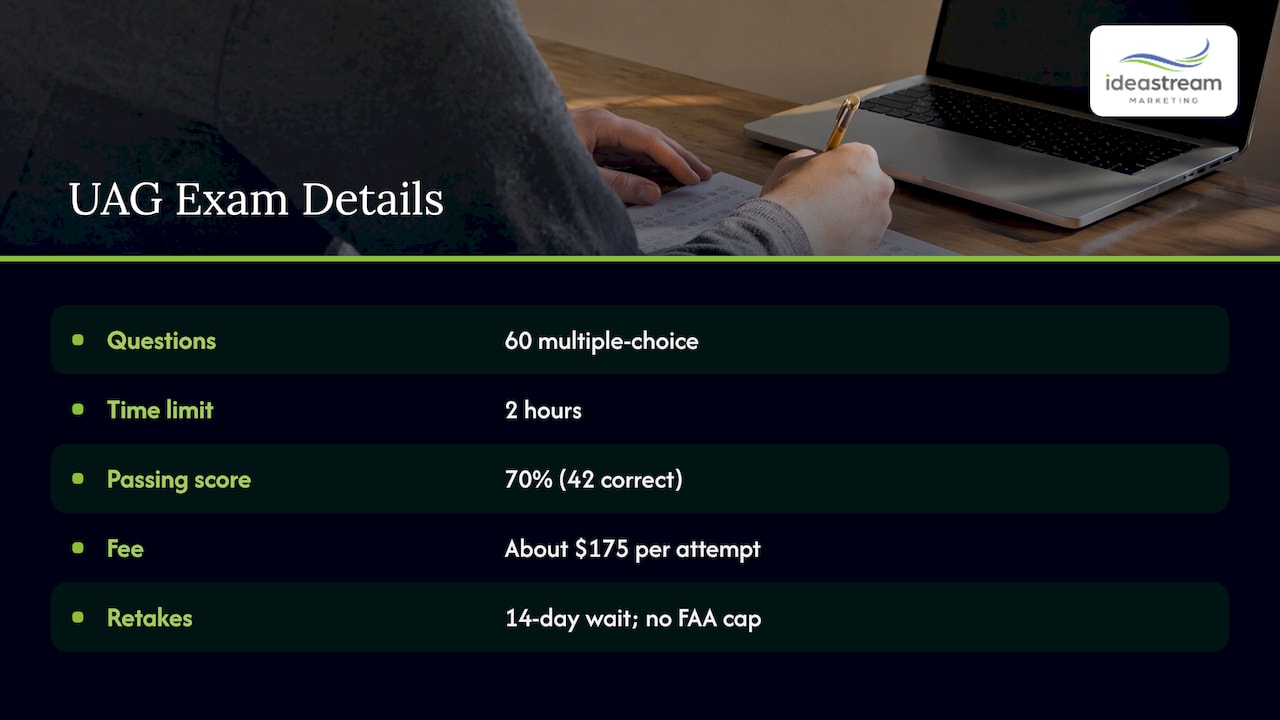
The UAG is a 60-question multiple-choice exam with a two-hour limit. You need 70%, which is 42 correct answers. The University of Maryland Extension’s 2026 guide puts the fee at about $175 per attempt and says you can retake after 14 days if you miss, with no FAA cap on attempts.
The topics come from 14 CFR 107.73: regulations, airspace classification, weather sources and effects, drone loading and performance, emergency procedures, crew resource management, radio communication, the effects of drugs and alcohol, aeronautical decision-making, airport operations, preflight inspection and maintenance, and night operations.
What changed on the test
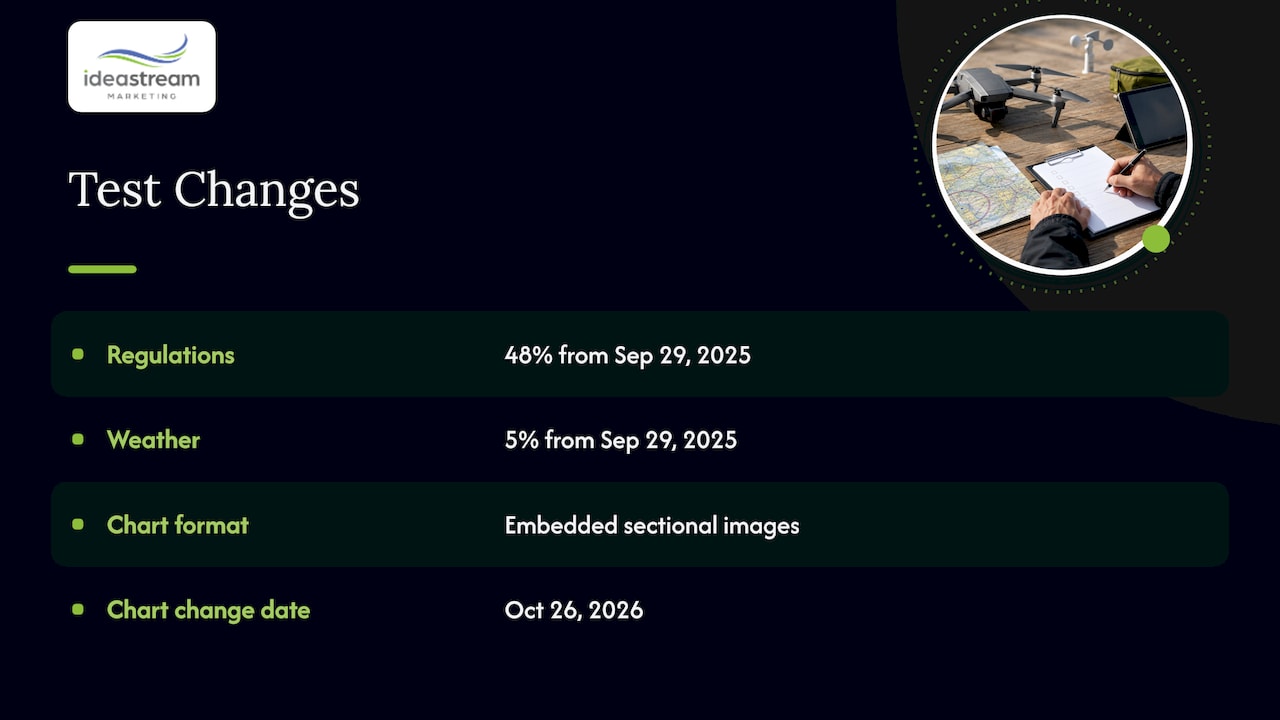
The test has been shifting. According to The Drone Girl’s August 2026 report, the FAA’s August 2025 advisory, effective September 29, 2025, raised the weight of regulations to 48% of the exam and cut weather to 5%. The same report says that from October 26, 2026, the exam includes embedded sectional-chart images instead of relying only on a printed supplement. If you are studying from older material, check that it reflects the newer emphasis on regulations and chart reading.
How to get your Part 107 certificate, step by step
The sequence below follows the University of Maryland Extension guide and the FAA’s process.
- Create an FAA Tracking Number (FTN). Register at IACRA, the FAA’s online certification system. The number follows you through testing and application. Typos in your legal name are the most common snag, so match your government ID exactly.
- Schedule the UAG test at an approved testing center. The guide names PSI centers, with a fee of about $175. Book early if you want a weekday slot near the New York metro area.
- Study the test areas. Spend the most time on regulations, airspace and reading sectional charts. These are what the test now weights most heavily, and they are also what keeps real flights legal.
- Take the test. Bring valid photo ID. Expect 60 questions in up to two hours, with 70% required.
- Apply in IACRA. After you pass, complete FAA Form 8710-13 online.
- Clear the TSA security background check. Per the guide, a temporary certificate typically arrives by email within one to three weeks.
- Receive the permanent card. The plastic certificate arrives by mail, generally within six to eight weeks.
A realistic timeline is a few weeks of study, then roughly one to two months until you can fly commercially with a temporary certificate in hand, depending on the background check.
Keeping the certificate current
The certificate does not expire, but your privileges do lapse if you let your knowledge go stale. Under 14 CFR 107.65, you may not act as remote pilot in command unless, within the previous 24 calendar months, you passed the initial knowledge test, completed recurrent training covering the 107.73 topics, or (for qualifying Part 61 holders) completed the 107.74 training.
The FAA offers free online recurrent courses through its FAASTeam site. Its announcement of the recurrent courses lists a course for pilots who are not Part 61 certificated, so most business pilots can use that one. Put the 24-month date in a shared calendar. A lapsed pilot cannot legally fly a commercial job.
Operating rules every commercial flight must follow
Passing the test is the entry ticket. These day-to-day rules, summarized on the FAA’s Part 107 page, apply to every job:
| Rule | Part 107 limit |
|---|---|
| Maximum altitude | 400 feet above ground level (higher if within 400 feet of a structure) |
| Maximum speed | 100 mph (87 knots) |
| Visibility | At least 3 miles from the control station |
| Time of day | Daylight, or twilight with anti-collision lighting |
| Line of sight | Keep the drone within sight; use a visual observer for first-person-view flying |
| Other aircraft | Always avoid manned aircraft |
| Moving aircraft | No operating from a moving aircraft |
Airspace authorization
Flights in Class B, C, D and E airspace need air traffic control authorization. The FAA says most of these are handled through LAANC, an app-based system that often returns authorizations within seconds. This matters on Long Island, where airports and their surrounding controlled airspace touch a lot of the commercial and waterfront areas businesses like to film. Check the airspace for every location before you promise a client or your own team a shot.
Operations over people, night flying and waivers
Since April 21, 2021, Part 107 pilots can fly at night, over people and over moving vehicles without a waiver, provided they meet the conditions of the Operations Over People rule. Other restricted activities, such as flying beyond visual line of sight, still require a waiver under § 107.205. Build waiver lead time into any project that needs it.
Registration
Every drone flown under Part 107 must be registered. The FAA says registration is done on its DroneZone site and costs $5, and the registration number must be placed on the aircraft.
What certification costs you in practice
The exam fee is the smallest part. A business that flies its own drone should plan for:
- the test fee of about $175, plus a second fee if a retake is needed;
- study time for the pilot, often several evenings of focused work;
- the $5 registration per aircraft;
- a drone suited to the footage you need, plus spare batteries and storage;
- a 24-month recurrent training habit;
- the time to check airspace and authorizations before every shoot.
Then comes the real cost: the footage still has to be planned, shot, edited and published in a way that moves your marketing forward. A certificate lets someone fly. It does not tell you which shots sell a medical practice, a restaurant or a contractor’s work.
Aerial footage that works for your marketing
If your goal is aerial video rather than a new credential for your team, we can take that on. Our drone videography service covers aerial footage as part of full video production, from concept and scripting to filming, editing, color grading and delivery. We build each video to support search visibility, YouTube and social performance, so the footage keeps working after the shoot. Our Long Island video production team can plan aerial shots alongside interviews, testimonials and product video, and our guide to drone video marketing, costs and FAA rules goes deeper on planning a shoot.

Ready to talk about aerial video, a podcast studio session or short-form reels for your business? Schedule a consultation with us through Idea Stream Marketing.
Where the rules are heading
The FAA’s Part 108 proposal, which would address flights beyond visual line of sight, was published as a proposed rule in 2024, and a final rule was expected during 2026, according to the reporting in The Drone Girl’s August 2026 article. Until a final rule takes effect, Part 107 remains the framework for small commercial drone flights. Check the FAA’s Part 107 page for the current status before planning anything long-range.
Our perspective
We treat aerial footage like any other piece of content: it has to earn its place. A drone shot of a building is only useful if it answers a question your customer has, whether that is where you are, how big the job site is or what the venue feels like from above.
That is why we plan drone work as part of a full production, with the same attention to scripting, editing and color grading as an interview or a commercial. The clips can then be cut into Instagram Reels, Facebook Reels, TikTok videos and YouTube Shorts, and placed on your site and your Google Business Profile, so one shoot feeds many channels.
For businesses on Long Island and across New York, we think the smartest approach is to decide what you need the footage to do first, and then choose how to get it.
Dean Spinato, CEO & Founder of Idea Stream Marketing
FAQ
Do I need Part 107 to fly a drone for my business?
Yes, if the flight is for any purpose other than recreation. Business marketing footage, real estate photos and job-site documentation all count. The person at the controls needs a remote pilot certificate with a small UAS rating, or must be directly supervised by someone who holds one.
How long does it take to get a Part 107 certificate?
Study time varies by person. After passing the test, the University of Maryland Extension guide describes a temporary certificate by email in about one to three weeks and the permanent card by mail within six to eight weeks.
Does the Part 107 certificate expire?
The certificate has no expiration date, but you can only use its privileges if you have passed the knowledge test or completed recurrent training within the previous 24 calendar months. The FAA provides free online recurrent courses for this purpose.
Can I fly anywhere with a Part 107 certificate?
No. You still need authorization to fly in Class B, C, D and E airspace, usually through LAANC, and you must follow the operating limits on altitude, speed, visibility and line of sight. Some operations need a waiver.
Sources
- FAA Aeronautical Information Manual, Chapter 11, Section 5
- FAA: Small Unmanned Aircraft Systems (UAS) Regulations (Part 107)
- eCFR: 14 CFR Part 107 Subpart B, Operating Rules
- eCFR: 14 CFR 107.61, Eligibility
- FAA: Become a Certificated Remote Pilot
- eCFR: 14 CFR Part 107 Subpart C, Remote Pilot Certification
- University of Maryland Extension: Guide for FAA Part 107 Certification and Drone Registration
- The Drone Girl: The Part 107 test is changing
- FAA: Recurrent Training Courses for Drone Pilots
- FAA: Certificated Remote Pilots including Commercial Operators

