






A YouTube Shorts strategy that works for a business has one job: introduce you to new people in a few seconds and lead them to something deeper, such as a full video, a playlist or a consultation request. Views alone do not do that. The plan below covers the pieces that matter: who the Shorts are for, what they say, how to make them findable in YouTube and Google, how often to post and which numbers to watch.
It is written for owners and marketing managers at Long Island and New York businesses, from law firms and medical practices to contractors, restaurants and B2B companies, who want Shorts to produce inquiries rather than vanity metrics.
TL;DR
- Treat Shorts as the front door to your long-form video and website. Each one should point to a related longer video, playlist or channel page.
- Pick three to five content pillars from your real customer questions, then make short versions of the answers.
- Win the first two seconds, add captions, and put your keyword in the title and the first line of the description.
- Post at a pace you can hold for months. Consistency beats bursts.
- Measure retention, shares and inquiries that mention a video, not raw views.
Table of Contents
- What Shorts are for in a business channel
- Step 1: Define your audience and the action you want
- Step 2: Choose three to five content pillars
- Step 3: Research what works, then do it in your voice
- Step 4: Write a hook and a story that fits 30 seconds
- Step 5: Optimize Shorts for search
- Step 6: Set a posting rhythm you can keep
- Step 7: Measure what leads to business
- Step 8: Reuse Shorts and long-form video across platforms
- Where we can take the work off your hands
- Our perspective
- FAQ
- Sources
What Shorts are for in a business channel
Shorts are vertical videos that viewers swipe through in a feed. YouTube’s official creator guide recommends filming in 9:16 vertical, capturing attention in the first few seconds, posting regularly, linking Shorts to longer videos or live streams, replying to comments and tracking results in YouTube Analytics. Those are the basics, and none of them is a strategy yet.
The strategy starts with the role Shorts play next to your other content. VidIQ’s guidance for brands frames it well: Shorts introduce you to new audiences with a quick answer or insight, while long-form video gives depth and builds trust. Make each Short a doorway to a related long video, playlist or channel page.
The scale of the feed explains why this matters. Metricool’s study of 799,718 videos from 71,177 accounts found that 61% of measured organic views came from the Shorts feed when comparing February 2025 with February 2026. Average views per Short rose 127% to 5,320.59, but average view duration fell 67% to about 16 seconds and engagement dropped from 4.94% to 1.85%. More people are seeing Shorts and each one is held for less time. Your strategy has to earn attention fast and then move people somewhere with more room to persuade.
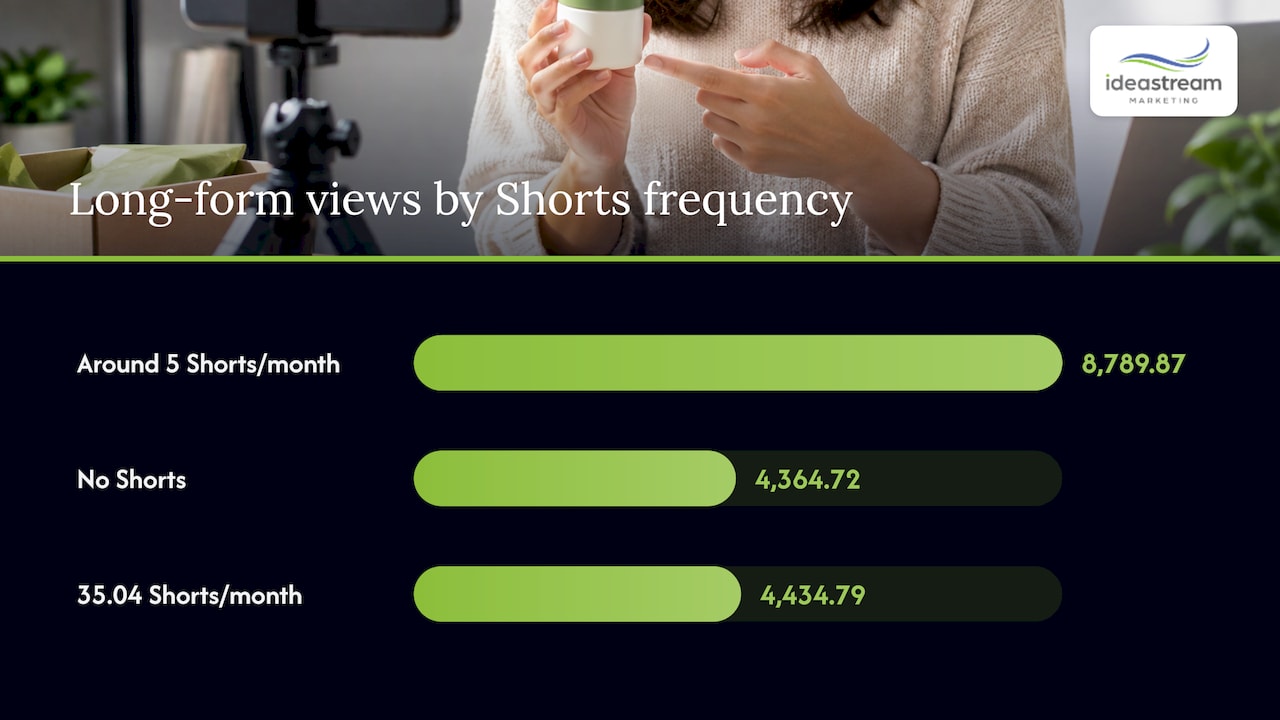
The same study pattern shows Shorts and long-form working together. A February 2025 to February 2026 analysis found channels posting around five Shorts a month averaged 8,789.87 views per long-form video, against 4,364.72 for channels with no Shorts. Channels posting 35.04 Shorts a month averaged 4,434.79. A modest, steady Shorts habit beside strong long-form content did better than flooding the feed.
Step 1: Define your audience and the action you want
Before you film, write down two things: who you want to reach and what you want them to do after watching. HubSpot’s business YouTube guide advises defining both first, using analytics from your other channels or your sales data. It also suggests building a library that covers the whole funnel: awareness audiences respond to thought leadership, while people close to buying respond to proof of results.
For a local or regional business, that translates into concrete choices:
- A law firm might aim Shorts at people asking basic questions about a legal situation, with the action being a visit to a practice-area page.
- A medical practice might answer common patient questions in 30 seconds, with the action being a call to schedule.
- A contractor or home service company might show a before-and-after job, with the action being a quote request.
- A restaurant or event venue might show the room, the food and the staff, with the action being a reservation or inquiry.
- A B2B firm might compress a client lesson into one tip, with the action being a longer case study.
The risk to avoid is the wrong-audience problem. VidIQ’s Tyler Bizarro calls topic alignment the single most important factor in preventing it: the people a Short attracts must be the people your long-form content serves. A funny Short that has nothing to do with your services can collect views from viewers who will never hire you.
Step 2: Choose three to five content pillars
Pillars are the recurring topics your channel owns. One practitioner guide suggests defining three to five pillars before producing Shorts and being able to describe your niche in five words or fewer. That is a useful test. “Estate planning answers for Long Island families” passes. “Business and life tips” does not.
Good pillars come from places you already have:
- The questions prospects ask on the phone or in the first meeting.
- Objections that slow down a sale.
- Jobs, cases or projects that show your process (with permission and within your industry’s privacy rules).
- Myths in your field that you correct every week.
- People: your team, your owner, your spokesperson.
HubSpot notes that a trustworthy spokesperson who appears across a series of Shorts, speaks plainly and is willing to use humor can make even a professional business feel modern and accessible. Appearing in a series matters more than a one-off. Pick someone who is comfortable on camera and let viewers get to know them.
Our guide to scripting marketing videos helps turn pillars into tight scripts, and our video pre-production guide covers the planning that makes batch filming possible.
Step 3: Research what works, then do it in your voice
Competitor and niche research does not need special software. A simple loop is enough:
- List 10 to 20 accounts in your niche and adjacent ones, including businesses in other cities that serve the same kind of customer.
- Review their top Shorts from the last 30 to 90 days.
- Flag outliers, roughly 2x an account’s median views, and tag each by hook, format and topic.
- Test the repeating patterns in your own voice for two to four weeks.
- Repeat the research monthly, because formats fade.
Competitor structure is only half of it. A content strategy team at RunWave AI argues that a plan built on only competitor analysis or only buyer research either sounds like everyone else or talks to nobody. Pair what is working in the feed with what your own customers actually ask.
To keep keywords honest, type your topic into YouTube’s search bar, note the autocomplete suggestions and filter the results to Short videos to see who already covers the question. Google Trends helps check whether interest is rising.
Step 4: Write a hook and a story that fits 30 seconds
Attention is the scarce resource. Hootsuite’s guide says the opening three seconds matter more than the last thirty: if the retention graph falls off early, revisit the hook. It also notes the algorithm favors Shorts that are watched all the way through or replayed.
A workable structure for a business Short:
- Seconds 0 to 2: the hook. State the question or the surprising result. “Your contractor quote is missing this line item” works better than “Hi, I’m Mike from…”
- Seconds 2 to 20: the payoff. One idea, shown rather than told. Cut anything that does not serve it.
- Final seconds: the next step. A spoken line pointing to a related video, or a loop that returns to the opening line.
Captions are not optional. VidIQ points out that most Shorts are watched on mute, so burned-in or uploaded captions carry the message. Looping the ending into the opening can also lift watch time per impression.
Google’s own marketing team describes the mindset of a Shorts viewer: people in the feed are ready to tap, swipe and click, so brands need formats that invite action as well as tell a story. For a service business, the action can be as simple as “the full walkthrough is linked below.”
Trim aggressively. A community tip from creators is to check the retention graph and, if viewers drop off at 30 seconds in a 59-second Short, edit it to that length. Our guide to social media video editing walks through the cutting process, and our Reels production strategy applies to Shorts because the format is the same.
Step 5: Optimize Shorts for search
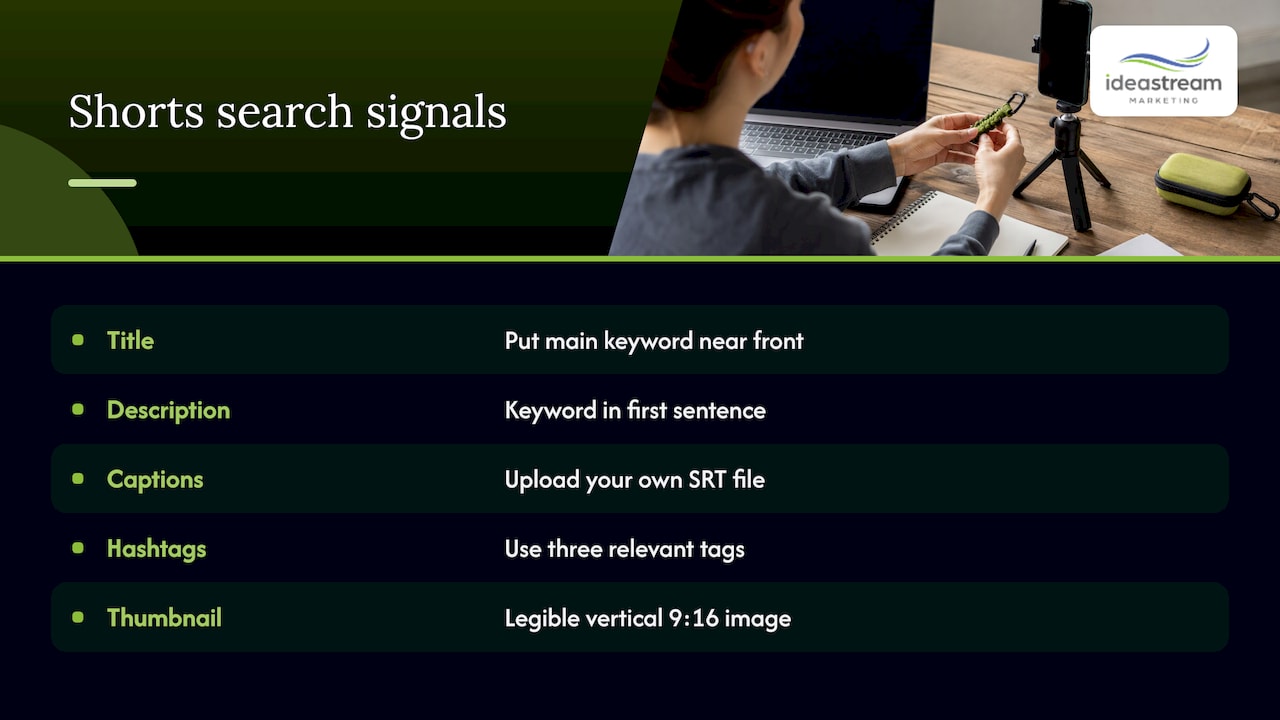
Most Shorts views come from the feed, but search still brings in viewers who are looking for an answer. VidIQ’s 2026 SEO guide says Shorts use the same metadata signals as long-form videos: title, description, hashtags and captions. Here is how to use each.
Title. Write it in the words a customer would type, with the main keyword near the front. YouTube’s own guidance for Shorts allows titles up to 100 characters. Keep it accurate; the title should match what the video delivers.
Description. Put the main keyword in the first sentence, and write a unique one or two sentences rather than pasting the same text on every upload. Descriptions are indexed by Google, so Shorts can appear in Google Search results.
Captions. YouTube indexes closed captions. Auto-generated captions can mishear jargon, brand names and hyphenated terms, so uploading your own SRT file gives exact keyword coverage. For a medical or legal business with technical vocabulary, this step is worth the few extra minutes.
Hashtags. Use a few. Current guidance is to keep to three relevant tags, and YouTube itself treats tags as not important, so titles, descriptions and thumbnails matter more for discovery. Avoid generic tags such as #viral and avoid recycling the same three on everything. Adding #Shorts is not required.
Thumbnail. A vertical 9:16 image that is legible on a phone screen helps in channel and search views.
There is evidence that searchers sometimes prefer quick answers. One creator’s case study reported a 30-second how-to Short that earned more than 100,000 views, with 85% of them coming from YouTube search, beating longer videos on the same topic. Treat that as one example rather than a rule, but it shows why a question-and-answer Short deserves a searchable title.
Search optimization for AI assistants and Google AI Overviews follows the same logic: clear titles, descriptions and transcripts that state the answer plainly. Our AI SEO services page explains how video fits into that picture.
Step 6: Set a posting rhythm you can keep
How often should you post? The data points in a consistent direction: steady and sustainable.
| Source | What it found |
|---|---|
| Metricool 2026 YouTube study | Individual Shorts performed best at 2 to 4 uploads a week (5,872.34 average views per post); monthly totals kept rising at higher frequencies |
| Buffer’s January 2026 frequency guide | 1 to 3 Shorts a week suits most accounts; regular posting produced 5x more engagement |
| YouTube Help | Plan around frequency, consistency and volume, and weigh production cost against return before locking in a schedule |
Metricool also notes that YouTube says frequency is not a ranking factor for any single Short. The practical takeaway: choose two to four Shorts a week, and keep that going. A practitioner guide makes the same point with a concrete comparison, three Shorts a week for 12 straight weeks beating daily posting for three weeks followed by a month of silence.
For brand channels, VidIQ suggests a starting ratio of two or three Shorts to each long-form video, with the Shorts orbiting the same topic as the weekly long video. That ratio ties your Shorts back to the content that builds trust.
Timing. Buffer’s 2026 analysis found Friday at 4 p.m. was the best single time to post Shorts, with evenings strong and Tuesday weakest. Treat that as a starting hypothesis and compare it with your own Studio data, since your customers’ habits may differ.
A simple monthly production routine
- Plan 12 to 13 Shorts for the month before filming.
- Film in one or two batch sessions per week, or one longer session if schedules are tight.
- Edit, caption and write metadata in a single pass.
- Schedule uploads so the cadence holds on busy weeks.
Batching is where a professional studio saves the most time. One filming day can yield a month of material.
Step 7: Measure what leads to business
Open YouTube Studio and use the Shorts filter in analytics. According to YouTube Help, it shows views, comments, remixes, likes, subscribers, how many times a Short was shown in the feed, and the share of times viewers watched versus swiped away. A traffic report shows where viewers found your Shorts, including YouTube search terms, suggested videos, playlists and external sites.
An important rule change affects how you read views. Beginning March 31, 2025, Shorts views count each time a Short starts to play or replays, with no minimum watch time. A view is therefore a weak proof of interest on its own.
Track these instead:
- Swipe-away rate and retention. Does the opening hold viewers? If retention at three seconds is poor, the hook is the problem.
- Shares per view. The clearest signal that a Short was useful to a specific person.
- Search terms. Compare the YouTube search terms in the Reach report with your titles.
- Inquiries that mention a video. Ask every new lead where they saw you, and log the answer.
Then run a half-hour monthly review. Sort the month’s Shorts by retention rather than views, compare the top three with the bottom three on format, opening, length and where the payoff lands, and change one thing the next month. One change at a time keeps results attributable.
Our lead generation strategies guide shows how to connect those inquiries to your sales process.
Step 8: Reuse Shorts and long-form video across platforms
The 9:16 format that works on Shorts is the same as Instagram Reels, Facebook Reels and TikTok. HubSpot notes the identical aspect ratio means a Short can run on both YouTube and TikTok. One production day can therefore feed several channels.
Podcasts and longer interviews are especially productive sources. A 30-minute recording usually holds several self-contained answers. Cut each into a vertical clip with captions, publish it as a Short, and link back to the full episode. Our guide to video content repurposing lays out the workflow, and our overview of YouTube marketing for small businesses shows how Shorts fit into a wider channel plan.
Remember that a Short seen on a platform other than YouTube will not carry your YouTube metadata. Adjust captions and calls to action for each destination.
Where we can take the work off your hands
If you are planning this alongside running a business, the production load is usually the sticking point: scripting, filming, editing, captioning, writing metadata and tracking results every week. Idea Stream Marketing is a video production and digital marketing agency in Kings Park, Long Island, and we produce professional video, business podcasts, and social media reels, including short-form video and repurposed podcast clips. Every video and strategy we develop is built for visibility in Google, AI search, YouTube and social platforms.
If you want a Shorts plan built from your pillars, filmed in batches and edited for YouTube Shorts, Instagram Reels, Facebook Reels and TikTok, schedule a consultation or studio session with our team.

For a look at the production side first, see our Long Island video production page.
Our perspective
Most businesses we talk to treat Shorts as a separate chore: one more platform, one more posting schedule. We see it differently. A Short is the shortest version of something your business already knows how to explain, and it works best when it is planned together with your long-form video, your podcast and your website.
That is why we start with the full picture. Record the long conversation once, with good audio and good lighting, then cut it into vertical clips with captions, titles and descriptions written for search. One production day then feeds YouTube Shorts, Reels, TikTok and your own site, and every piece points toward the same next step.
Our approach combines creative production with measurable technical marketing, so you know which Shorts get people to stay, share and call. The goal is not more views. It is more of the right people finding you when they are looking for what you do.
Dean Spinato, CEO & Founder of Idea Stream Marketing
FAQ
How long should a YouTube Short be?
Keep it as long as the idea needs and no longer. Check the retention graph in YouTube Studio: if most viewers leave at 30 seconds, trim the Short to that point. Shorter, tighter videos make it easier for people to watch to the end or replay, which the algorithm favors.
How often should a business post YouTube Shorts?
Two to four per week is a strong target, based on Metricool’s 2026 study, and Buffer suggests one to three for most accounts. YouTube says frequency is not a ranking factor for any single Short, so the right number is the one you can keep up for months without quality slipping.
Do hashtags and keywords matter for Shorts SEO?
Keywords matter more than hashtags. Put the main keyword near the start of the title and in the first sentence of the description, add accurate captions, and use up to three relevant hashtags. YouTube describes tags as not important, so do not spend much time on them.
Can I repurpose podcast episodes into Shorts?
Yes. Pull out self-contained answers from a recorded episode, crop them to vertical 9:16, add captions, and link to the full episode in the description or spoken call to action. The same clips can go to Instagram Reels, Facebook Reels and TikTok.
How do I know if Shorts are bringing in leads?
Watch retention, shares and search terms in YouTube Studio, then ask every new inquiry where they found you and record any mention of a video. Views alone prove little, since a view now counts when a Short simply starts to play.
Sources
- Your guide to getting started with YouTube Shorts
- YouTube Shorts for Brands
- YouTube Shorts Algorithm Explained, Metricool 2026 study
- YouTube Views Are Rising, But Watch Time And Ad Revenue Are Falling
- Creating a YouTube Channel for Your Business
- How to Research What Content Works in Your Niche
- How to Build a YouTube Shorts Strategy That Drives Results
- How to Build a Content Strategy for Short-Form Video
- YouTube Shorts: Everything you need to know
- Make YouTube part of your marketing strategy, Think with Google
- YouTube SEO in 2026
- YouTube Shorts SEO Checklist (2026)
- Buffer: Best Time to Post on Social Media
- Buffer: How Often to Post on Social Media
- Upload schedule tips for Shorts, YouTube Help
- Content tab analytics tips for Shorts, YouTube Help

