



August 4, 2026




TL;DR:
- Small and medium-sized businesses often struggle with social media engagement due to lacking a clear strategy. Establishing goals aligned with business objectives, defining a specific target audience, and focusing on 2-3 platforms optimize effort and results. Developing content pillars, batching creation, and tracking analytics enable consistent, valuable posts that foster long-term growth and community trust.
Many small and medium-sized businesses pour real time and energy into social media, yet the results often feel flat. You’re posting, you’re staying active, but the engagement just isn’t there. The problem usually isn’t effort. It’s structure. Without a clear strategy connecting your content to your business goals, even the most consistent posting schedule can feel like shouting into a crowd. This guide walks you through a practical, step-by-step process to build a content creation system that actually moves the needle, from clarifying your goals to measuring what’s working.
Table of Contents
- Assessing your social media goals and audience
- Building your content strategy: pillars, calendar, and batching
- Crafting quality posts: best practices, frequency, and platform differences
- Scheduling, analytics, and continuous improvement
- Common myths and hard-earned truths about social media content creation
- Next steps: level up your content creation with expert support
- Frequently asked questions
Key Takeaways
| Point | Details |
|---|---|
| Quality over quantity | Posting fewer, high-value posts yields greater engagement than excessive daily posting. |
| Content pillars matter | Structuring content around clear themes makes planning and execution easier for SMBs. |
| Leverage scheduling tools | Using scheduling and analytics platforms saves time and ensures consistent posting. |
| Measure and iterate | Regularly track analytics and adjust strategy to optimize results. |
| Focus on top platforms | Choose 2-3 key social platforms where your audience is active to maximize impact. |
Assessing your social media goals and audience
Before you write a single caption or film a single reel, you need to know why you’re posting and who you’re posting for. This sounds obvious, but it’s the step most SMBs skip. They jump straight to creating content without a clear purpose, and then wonder why it doesn’t produce results.
Start by aligning your content goals with your broader business objectives. Are you trying to build brand awareness in your local market? Generate leads for a specific service? Drive online sales? Or maybe you want to build a loyal community around your brand. Each of these goals requires a different content approach. Brand awareness content focuses on reach and visibility. Lead generation content includes clear calls to action and value offers. Community-building content prioritizes conversation and responses.
Once your goals are clear, define your target audience with real specificity. Go beyond basic demographics like age and location. Think about their interests, daily frustrations, and the questions they’re typing into search engines. The content marketing strategies that actually work are built on a deep understanding of what your audience needs, not just what you want to say.
A key part of the methodology for small business content success involves setting goals aligned with business objectives, defining your target audience, choosing platforms strategically, and building a consistent content calendar. Trying to be everywhere at once dilutes your effort. Instead, identify 2 to 3 platforms where your audience is genuinely active and concentrate your energy there.
Here’s a quick comparison of platform audiences to help you decide where to focus:
| Platform | Primary audience | Best content type | Top use case |
|---|---|---|---|
| 18 to 34 age group | Reels, carousels, stories | Brand awareness, products | |
| Professionals 25 to 55 | Articles, text posts, video | B2B lead generation | |
| 25 to 55 age group | Video, events, groups | Community, local reach | |
| TikTok | Under 30, growing 30+ | Short-form video | Brand discovery, virality |
| X (Twitter) | News-oriented, 18 to 49 | Text, threads, news | Thought leadership |
You can also reference industry benchmarks to see how similar businesses in your sector perform across platforms, which makes platform decisions data-driven rather than guesswork.
The platforms you choose should also inform the tone and format of your content. LinkedIn favors professional, insight-driven posts. Instagram rewards visual creativity and authenticity. TikTok thrives on personality and entertainment. Understanding these differences upfront saves you from recycling the same post everywhere and expecting the same outcome.
Pro Tip: Schedule short interviews with five to ten of your best existing customers. Ask them which platforms they use daily, what content they find useful, and what problems your business helped them solve. This direct input is often more valuable than any analytics tool and helps you build an audience persona grounded in reality.
Pair your social media strategies with a documented audience profile. Write it down. Pin it somewhere visible. Every piece of content you create should pass a simple test: does this serve the person on that profile?
Building your content strategy: pillars, calendar, and batching
With your goals and audience defined, the next step is to build the framework that holds everything together. That framework has three parts: content pillars, a content calendar, and a batching workflow.

Content pillars are the three to five core themes your content will consistently revolve around. They give your posting a sense of direction and make it easier to generate ideas without starting from scratch every time. According to content pillar examples, the most effective pillars for social media include educational content, inspirational stories, promotional offers, community-building posts, and behind-the-scenes glimpses of your business. Each pillar serves a different purpose in your overall strategy.
Here’s how each content pillar type works in practice:
| Content pillar | Purpose | Example for an SMB |
|---|---|---|
| Educational | Build authority and trust | “5 things to ask before hiring a contractor” |
| Inspirational | Create emotional connection | Customer success story or transformation |
| Promotional | Drive conversions | Limited-time offer, new service announcement |
| Community-building | Encourage conversation | Polls, questions, local event highlights |
| Behind the scenes | Build authenticity | Team spotlight, day-in-the-life video |
Once your pillars are set, build a monthly content calendar. Assign each day of the week a pillar type so you’re never guessing what to post. For example, Mondays might be educational, Wednesdays behind the scenes, and Fridays promotional. This structure is one of the key methodology steps recommended for small business content strategy because it eliminates decision fatigue and creates reliable consistency.
A well-organized calendar prevents last-minute content panic.
Batching is the third piece of the puzzle, and it’s a game-changer for busy business owners. Instead of creating content every day, you set aside one or two days per month to produce everything at once. You film multiple videos in a single session, write captions in bulk, and design graphics in one sitting. This approach to multi-platform reach dramatically reduces the mental overhead of content creation.
Here’s a simple batching workflow to follow:
- Confirm your content calendar for the upcoming month, noting which pillars and platforms each post targets.
- Write all captions and scripts in a single document before any recording or designing begins.
- Record all video content in one or two focused sessions, grouping similar formats together.
- Design all graphics and static images using templates to speed up production.
- Schedule all posts using a social media scheduling tool at least one week in advance.
- Review the scheduled content as a batch to check for consistency in tone and branding.
Pro Tip: Use AI tools to repurpose your pillar content across platforms. A long-form LinkedIn article can become five Instagram captions, a short TikTok script, and a series of X posts. Explore interactive content ideas to keep repurposed content fresh and engaging rather than repetitive.
Crafting quality posts: best practices, frequency, and platform differences
Strategy and structure set the stage. But the actual post, the visual, the caption, the call to action, is what your audience experiences. Quality in social media content doesn’t mean expensive production. It means relevance, clarity, and value.
Every post should meet a basic quality standard before it goes live. The visual should be clean and on-brand. The message should be easy to understand in under five seconds. And there should always be a reason for someone to stop scrolling, whether that’s a useful tip, a relatable moment, or a compelling question. Good growth tips consistently point back to value as the core driver of engagement.
Here’s a breakdown of the most effective post formats for SMBs:
- Short-form video (Reels, TikTok, Shorts): Highest reach potential across most platforms. Works best for tutorials, quick tips, behind-the-scenes moments, and personality-driven content.
- Carousel posts (Instagram, LinkedIn): Great for educational content, step-by-step guides, and before-and-after stories. Users swipe through, which increases time spent with your content.
- Long-form written posts (LinkedIn): Builds thought leadership and trust. Best for sharing professional insights, lessons learned, and client case studies.
- Static image posts: Still effective for promotions, quotes, and announcements when paired with strong copy.
- Stories and ephemeral content: Ideal for polls, Q&As, and real-time updates that encourage direct interaction.
When it comes to frequency, the data is clear. Average inbound engagements per post grew by 17% to 14 in 2024, which signals that audiences are responding more to well-crafted content rather than volume. And a few well-timed posts per week can drive higher engagement than daily posting. Oversaturation actually trains your audience to ignore you.
A practical guide to posting frequency recommendations suggests 3 to 5 posts per week on Instagram, LinkedIn, and Facebook, and more frequent posting on TikTok and X where daily content is the norm. Build your schedule around what you can sustain with quality, not maximum volume.
The Instagram engagement guide reinforces this point: timing, format, and consistency beat frequency every time. Test your posts at different times of day and track which slots generate the most impressions and saves. Over time, patterns emerge that are specific to your audience.
Pro Tip: Your best-performing post type on one platform may completely flop on another. Treat each platform like a separate audience with different expectations. Dedicate 30 days to testing different formats and posting times on each platform before drawing conclusions. Check your video content strategies to see how short-form video can be adapted for multiple channels without starting from scratch.
Scheduling, analytics, and continuous improvement
Creating content is only half the work. The other half is knowing what’s working and using that information to get better over time. This is where scheduling tools and analytics become essential parts of your process.
Tools like Hootsuite and Buffer allow you to schedule posts across multiple platforms from a single dashboard, using them for analytics and benchmarking against industry averages so you always know how your performance compares. Scheduling in advance also means your content goes out consistently even during your busiest weeks, which protects the continuity that algorithms reward.
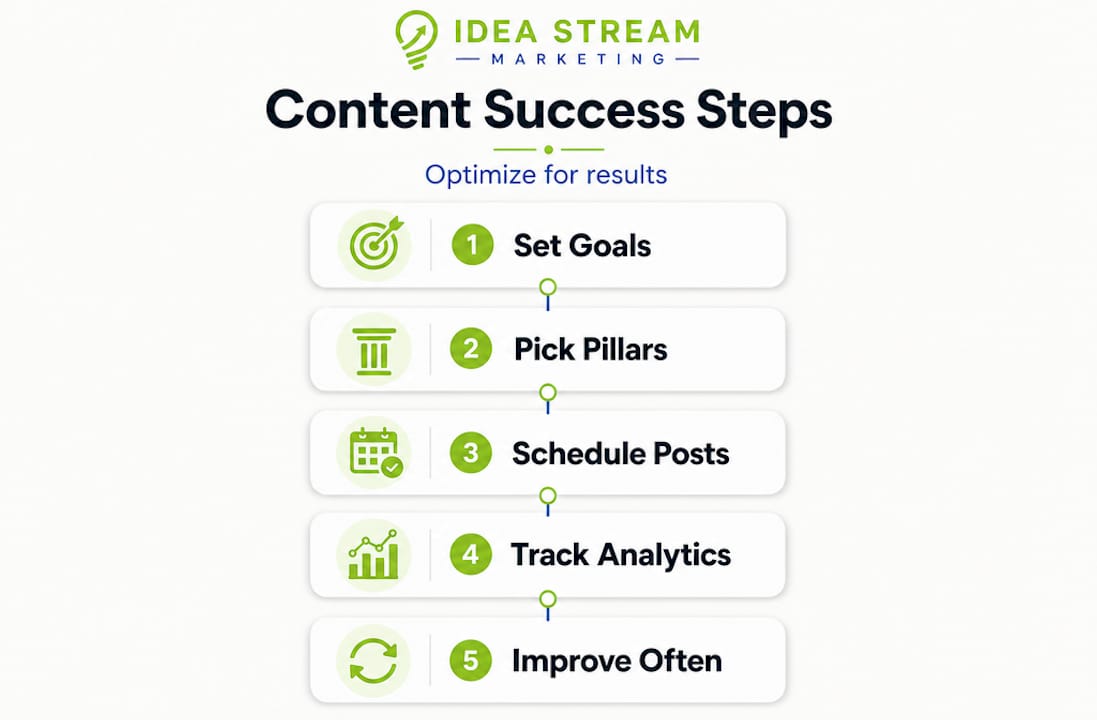
For content strategy tips grounded in 2025 research, original research and collaborative content consistently outperform generic posts, especially in saturated markets.
Here’s a simple process for analyzing and iterating your content strategy:
- Schedule your content one to two weeks in advance using a scheduling tool.
- After two to four weeks, pull performance data for each post, looking at engagement rate, reach, saves, and link clicks.
- Identify your top three and bottom three performing posts and look for patterns in format, topic, and timing.
- Adjust your content calendar for the following month based on what you find, doubling down on what worked and replacing what didn’t.
- Repeat the review cycle monthly so your strategy evolves with your audience.
Key metrics to track for a clear picture of content performance:
- Engagement rate: Likes, comments, shares, and saves divided by reach. This is the clearest signal of content relevance.
- Reach: How many unique accounts saw your post. Growing reach indicates your content is being shared or surfaced to new audiences.
- Conversion: Click-throughs to your website, form submissions, or direct messages generated by a specific post. This connects content to business outcomes.
- Follower growth rate: A steady, consistent growth in followers over time confirms your content is attracting new people.
Our social media management services are built around this kind of data-driven iteration. Tracking performance monthly transforms your content strategy from guesswork into a system that genuinely improves with time.
Pro Tip: In saturated markets, collaborative content such as interviews with local experts, partner features, or co-created posts with complementary businesses can significantly boost both reach and credibility. Original research, even simple surveys shared with your audience, positions your brand as a trusted source and sets your content apart from generic industry posts.
Common myths and hard-earned truths about social media content creation
Here’s something we see regularly: business owners get frustrated with social media because they’ve been told that more posting equals more growth. They burn out trying to post every day, the quality drops, and engagement actually falls. Then they conclude social media doesn’t work. It does work. The strategy just needs to be recalibrated.
The biggest myth in social media content is that daily posting is the price of entry. It isn’t. In saturated markets, over-posting dilutes engagement and can actually signal low quality to platform algorithms. Collaborative content like interviews and original research consistently outperforms generic daily posts. Less, done better, wins.
Success comes from steady, relevant content, not a rush to fill timelines.
The second myth is that you need to be everywhere. Spreading yourself across six platforms with mediocre content on each is far less effective than owning two platforms with excellent, consistent content. Your audience doesn’t reward presence. They reward value.
What actually builds long-term engagement for SMBs comes down to a handful of habits:
- Consistent branding across every post: Same colors, fonts, tone, and voice. This builds recognition and trust over time.
- Genuinely useful insights: Content that answers real questions your audience is asking establishes your business as the go-to authority in your space.
- Authentic collaboration: Partnering with other local businesses or industry voices amplifies your reach and brings credibility that self-promotion alone can’t create.
- Patient, steady pacing: Social media growth for SMBs is a long game. Businesses that build strong audiences do so over months and years, not overnight campaigns.
Connecting your marketing strategies to this longer view protects you from chasing short-term trends at the expense of lasting community relationships. Your audience will tell you, through their engagement, exactly what they want from you. The key is to listen consistently and adjust with intention.
Next steps: level up your content creation with expert support
Building a content strategy that consistently drives results takes time, skill, and the right tools. If you’ve worked through these steps and want to accelerate your growth further, professional support can make a significant difference.
At Idea Stream Marketing, we work with SMBs across the country to build content systems that align with their goals and actually convert. From AI SEO services that boost your search visibility to data-driven web design that turns social traffic into leads, we provide end-to-end solutions designed for growth. Whether you need a custom content strategy session or full-service social media management, we’re ready to be the partner that helps your business connect with more of the right people. Schedule a consultation with our team today to find out where your content can go.
Frequently asked questions
How many social media posts should my business publish each week?
Most SMBs see strong engagement with 3-5 posts per week on major platforms like Instagram, LinkedIn, and Facebook, but consistency and quality are more important than quantity.
What types of content perform best for small businesses?
Content pillars like educational, inspirational, promotional, community-building, and behind-the-scenes themes consistently drive the strongest engagement for SMBs across industries.
Should I focus on every social media platform?
It’s best to focus on 2-3 platforms where your target audience is most active and repurpose your content across them using AI tools to maximize efficiency and impact.
What analytics should I track to measure social media content success?
Key metrics include engagement rate, reach, and conversion. Use tools like Hootsuite or Buffer for scheduling, analytics, and benchmarking your performance against industry averages for continuous improvement.