


September 16, 2026



TL;DR:
- Successful paid ads in 2026 require proper audience, assets, and tracking setup before launching.
- Choosing the right platform depends on your target audience, goals, and available creative formats.
- Continuous testing, agile optimization, and accurate measurement are key to maximizing ad ROI.
Paid advertising has never been more competitive, or more capable of delivering real results when done right. Many businesses are watching their ad budgets disappear with little to show for it, not because paid ads don’t work, but because platforms, formats, and buyer behavior have shifted dramatically. In 2026, winning campaigns require more than just a credit card and a boosted post. This guide walks you through everything: how to prepare before you spend a dollar, which platforms deserve your budget, how to build campaigns that convert, and how to measure what actually matters. Whether you’re running your first campaign or looking to fix a struggling account, these strategies will help you get more from every dollar you invest.
Table of Contents
- Setting up for success: What you need before launching paid ads
- Choosing the right paid platforms in 2026
- Creating compelling campaigns: Strategy, creative, and optimization
- Tracking, measuring, and maximizing your ad ROI
- Avoiding common mistakes and troubleshooting paid ad campaigns
- Why paid ad success in 2026 will belong to agile marketers
- Ready to accelerate your paid advertising results?
- Frequently asked questions
Key Takeaways
| Point | Details |
|---|---|
| Prep before launch | Set clear goals, audiences, and tracking before spending on ads. |
| Pick the right platforms | Match your campaign goals and audience with the best 2026 ad platforms. |
| Creative wins campaigns | Strong visuals and ongoing testing boost paid ad performance significantly. |
| Track and refine | Measure the right metrics, review often, and adjust campaigns quickly for maximum ROI. |
| Avoid costly mistakes | Watch for common errors and act fast to troubleshoot underperforming ad campaigns. |
Setting up for success: What you need before launching paid ads
Every failed ad campaign shares a common thread: it launched before the basics were in place. Before you spend anything, take stock of what you actually have ready.
Start with your audience. Clear business goals and a well-defined target customer are the foundation of any effective paid campaign. Go beyond basic demographics. Think about your customer’s daily challenges, what they search for, what motivates them to buy, and where they spend time online.
Next, audit your assets. A strong campaign needs:
- Compelling visuals (images, short videos, graphics)
- Clear, benefit-focused ad copy
- Landing pages that match your ad’s promise
- Offers that give your audience a reason to act now
You also need your tracking in order. Without proper conversion tracking, you’re flying blind. Set up your pixels, configure Google Tag Manager, and make sure your analytics platform records every meaningful action: form fills, purchases, calls, and downloads. Explore online advertising essentials to understand what a complete setup looks like.
Finally, build a realistic budget. Research what your industry’s average cost-per-click looks like and plan around that. Use digital marketing strategies 2026 resources to benchmark your planning against current market conditions.
| Setup Area | Ready State | Common Gap |
|---|---|---|
| Audience definition | Personas with psychographics | Only age/gender info |
| Creative assets | Video + static images ready | No visuals prepared |
| Tracking | Pixels + UTMs active | No conversion events set |
| Budget | Based on CPC research | Arbitrary number |
| Landing page | Dedicated, message-matched | Sends to homepage |
Pro Tip: Never launch a paid campaign without at least one conversion event confirmed in your analytics. If you can’t measure it, you can’t improve it.
Choosing the right paid platforms in 2026
With your assets and goals ready, the next challenge is picking the right channels for investment. Not every platform will work for every business, and spreading budget too thin is one of the fastest ways to see poor results.
Here’s how the major platforms stack up for 2026:
| Platform | Best For | Avg. CPC | Unique Strength |
|---|---|---|---|
| Google Ads | High-intent buyers, search demand | $2–$6 | Captures active searchers |
| Meta (Facebook/Instagram) | Brand awareness, retargeting, B2C | $0.50–$2 | Deep audience targeting |
| B2B, professional services | $5–$12 | Job title and industry targeting | |
| TikTok | Young audiences, product discovery | $0.50–$1.50 | High engagement, low entry cost |
| YouTube | Video storytelling, broad reach | $0.10–$0.30 (CPV) | Video-first, massive scale |
As the value of social media ads continues to grow, platforms like Meta and TikTok have introduced more sophisticated targeting tools that rival Google’s intent-based approach. Meanwhile, Google Ads trends 2026 show AI-powered bidding and Performance Max campaigns reshaping how budgets are allocated automatically.

Video is no longer optional. Platforms reward video content with lower costs and higher reach. Review your video marketing strategies 2026 options early so creative production doesn’t hold up your launch.
When selecting platforms, ask yourself:
- Where does my target customer spend the most time online?
- Is my goal brand awareness, leads, or direct sales?
- What creative formats do I have available right now?
- What’s my minimum viable budget per platform?
For most small and mid-size businesses, starting with two platforms and mastering them beats dabbling across five.
Creating compelling campaigns: Strategy, creative, and optimization
Once you’ve chosen your platforms, it’s time to develop ads and campaign structures built for maximum impact. Great targeting with weak creative still fails. And great creative sent to the wrong audience wastes your budget just as fast.
Here’s how to build campaigns that actually perform:
- Define your audience segments first. Create separate ad sets for cold audiences (no prior contact), warm audiences (website visitors, email lists), and past buyers.
- Write copy that leads with the benefit. Your headline should answer “what’s in it for me?” within the first five words.
- Build a clear offer. Free consultations, limited-time discounts, and downloadable resources consistently outperform vague “learn more” messages.
- Test at least three creative variations. Different images, headlines, or video lengths reveal what your audience actually responds to.
- Set up your A/B tests properly. Change one variable at a time so you know what drove the result.
As ad creative optimization shows in competitive 2026 markets, businesses that continuously test and refine creatives consistently outperform those running static campaigns for months.
Brands that run structured creative testing see up to 30% higher conversion rates compared to those using a single ad variation, according to HubSpot marketing statistics.
Pro Tip: Your best-performing organic social posts are a goldmine. Repurpose those into your first paid creatives before building anything new. They’ve already proven they resonate.
Don’t overlook targeted social media ads as a starting point for businesses newer to paid channels. A retargeting campaign alone can deliver strong returns because you’re reaching people who already know your brand.
Tracking, measuring, and maximizing your ad ROI
Building good campaigns is only half the battle. Now let’s make sure you’re learning from every ad dollar spent.
Effective tracking and attribution are not optional extras; they are what separate profitable campaigns from expensive experiments. In 2026, multi-touch attribution models have become more accessible and more important, especially as buyers interact with your brand across multiple channels before converting.
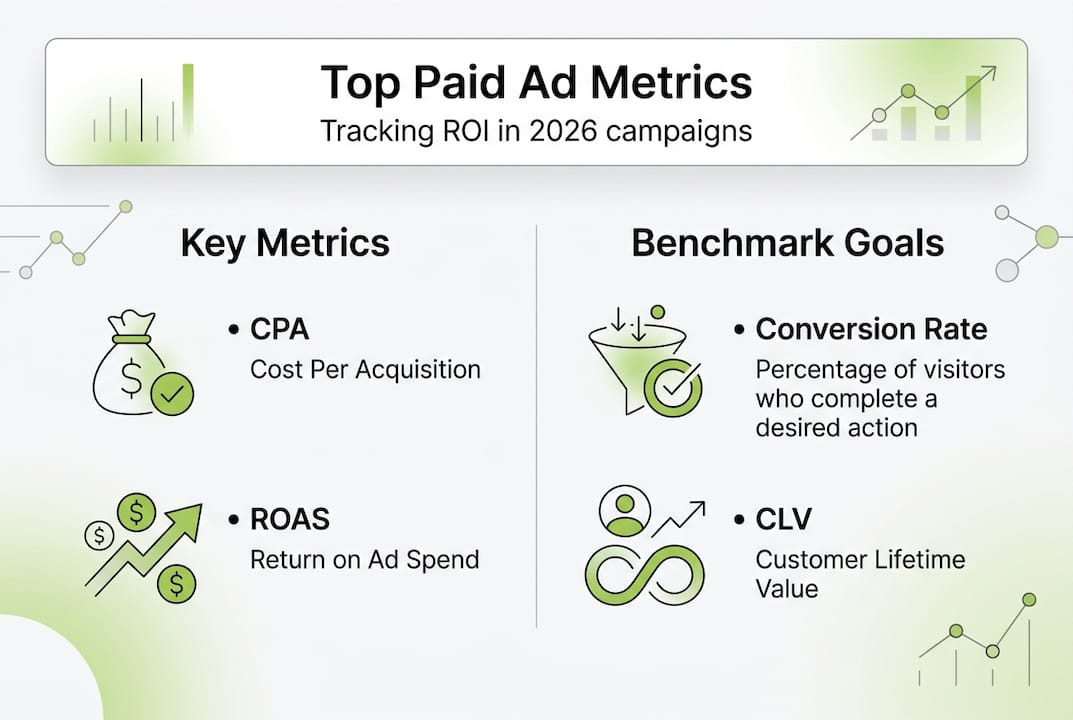
The KPIs that matter most:
| Metric | What It Tells You | Target Benchmark |
|---|---|---|
| CPA (Cost Per Acquisition) | What you pay for each new customer | Varies by industry |
| ROAS (Return on Ad Spend) | Revenue earned per dollar spent | 3x or higher |
| Conversion Rate | % of clicks that become leads or buyers | 2–5% average |
| CLV (Customer Lifetime Value) | Long-term value of an acquired customer | Should exceed CPA |
For tracking ROI on paid ads, always use UTM parameters on every link. This tells you exactly which campaign, ad set, and creative drove each conversion.
Common tracking mistakes to avoid:
- Missing or misfired pixels that skip conversion data
- UTM parameters that are inconsistent or missing altogether
- Relying on impressions and clicks as success metrics
- Ignoring view-through conversions on video campaigns
- Using last-click attribution when buyers touch multiple channels
Pro Tip: Block 30 minutes every week to review campaign performance. Pause anything spending without converting for more than seven days. Speed matters in paid advertising.
Avoiding common mistakes and troubleshooting paid ad campaigns
Even with careful planning, issues arise. Here’s how to spot and fix them before they drain your budget.
Small targeting and creative errors can waste significant budget before you notice the damage. The most frequent culprits are:
- Targeting audiences that are too broad or too narrow
- Writing ad copy that describes features instead of benefits
- Choosing automated bidding strategies before the platform has enough data
- Running the same creative for weeks without testing new variations
- Ignoring negative keyword lists on search campaigns
If a campaign is underperforming, work through this quick checklist:
- Verify your conversion tracking is firing correctly.
- Check your audience size. Too small limits delivery; too large hurts relevance.
- Review your ad frequency. High frequency often signals ad fatigue.
- Compare your landing page bounce rate to your ad click-through rate.
- Confirm your bid strategy matches your campaign’s current data volume.
Ad fatigue is real and often overlooked. When users see the same ad repeatedly, they stop responding. Watch for drops in click-through rate over time as a clear warning sign. The future of social media marketing includes more dynamic creative options that rotate automatically to fight fatigue.
For deeper diagnosis, review common paid advertising mistakes and compare against your own account structure.
Pro Tip: Use each platform’s built-in diagnostic tools monthly. Google’s Recommendations tab and Meta’s Delivery Insights flag issues before they become expensive problems.
Know when to get help. If you’ve audited your campaigns and still can’t identify why performance is declining, that’s a signal to bring in an expert rather than continue guessing.
Why paid ad success in 2026 will belong to agile marketers
Most guides end with a checklist and send you off. But there’s a harder truth worth sharing.
The businesses seeing the strongest paid advertising returns in 2026 are not the ones with the biggest budgets. They’re the ones moving fastest. Algorithm updates, new ad formats, and shifting audience behaviors mean that last quarter’s winning strategy can become next quarter’s wasted spend. Rigid campaign structures and static creative sets simply can’t keep up.
What we’ve seen consistently is this: marketers who test three creative directions per campaign instead of one find their winners faster and at a lower cost. That’s not just theory. It reflects how platforms reward active optimization with better delivery and lower costs.
Automation is a powerful tool, but it works best when humans guide it with smart inputs. Don’t hand your account fully over to a platform’s AI and walk away. Stay in the loop. Experiment with formats your competitors aren’t using yet. Treat every campaign as a learning opportunity, not just a spend event. Explore agile digital marketing approaches that build this kind of adaptive thinking into your regular workflow.
Ready to accelerate your paid advertising results?
If this guide gave you a clearer picture of where to focus, you’re already ahead of most businesses starting campaigns this year. Knowing what to do and having the bandwidth to execute it are two different things.
At Idea Stream Marketing, we work with growth-focused businesses across the U.S. to plan, build, and manage paid campaigns that deliver measurable returns. From strategy and creative to tracking and optimization, our team handles full-service digital marketing built around your specific goals. We also integrate AI-driven marketing strategies to help your campaigns stay ahead as platforms evolve. Reach out today for a free campaign review and let’s find where your budget can work harder.
Frequently asked questions
What is the best budget for paid ads in 2026?
Most small businesses find traction by starting with $1,000 to $3,000 per month, then scaling based on what the data shows. Budget needs should align with your business goals and the average platform costs in your industry before you commit.
How do I choose between Google Ads and social media ads?
Choose Google Ads when your customers are actively searching for what you offer. Social media works better for building awareness and retargeting. Platform selection should always reflect where your audience spends time and what action you want them to take.
What metrics matter most for paid ad campaigns in 2026?
Focus on cost per acquisition (CPA), return on ad spend (ROAS), conversion rate, and customer lifetime value (CLV). Effective tracking and correct attribution help you understand which of those numbers you can actually improve.
How often should I refresh my ad creatives?
Plan to update creatives every four to six weeks, or sooner if you see a drop in click-through rates. Creative refresh cycles keep audiences engaged and prevent the performance decline that comes with repetitive exposure.
What’s a quick sign my ads aren’t working?
A sharp rise in cost per acquisition or a conversion rate drop that lasts more than a week is a clear warning. Sudden metric shifts almost always point to targeting issues, creative fatigue, or a tracking problem that needs immediate attention.