


September 30, 2026



TL;DR:
- Paid advertising is best used as an amplifier within a broader marketing system.
- Success depends on quality signals, accurate tracking, and strategic integration with organic efforts.
- Automation and AI are transforming paid strategies, requiring focus on creative, data, and goal alignment.
Paid advertising is one of the most misunderstood tools in digital marketing. Many business owners assume that launching a campaign means instant leads and a full pipeline. The reality is more nuanced. Without the right strategy, data, and channel mix, even a well-funded ad campaign can produce underwhelming results. This guide breaks down exactly what paid advertising is, how it works mechanically, where it wins, and where it falls short. More importantly, it shows you how to use it as part of a broader growth system rather than a standalone shortcut to revenue.
Table of Contents
- Defining paid advertising: Core concepts and role
- How paid advertising works: Auction dynamics, formats, and real costs
- Strengths and challenges: When and why paid advertising wins (or loses)
- Modern strategies: Automation, AI, and making paid ads work in 2026
- A fresh perspective: Why paid advertising is only half the growth story
- Get expert support for your paid advertising strategy
- Frequently asked questions
Key Takeaways
| Point | Details |
|---|---|
| Paid ads capture demand | Paid advertising works best for targeting ready buyers, not creating interest from scratch. |
| Quality beats budget | Better creative and targeting often outperform simply spending more per click. |
| Integrate with organic | Blending paid ads with SEO and content delivers more sustainable, scalable business growth. |
| Automation needs data | AI-driven campaigns only succeed when you provide clear goals, conversion data, and creative variety. |
Defining paid advertising: Core concepts and role
Paid advertising refers to any form of digital promotion where a business pays for placement in front of a target audience. Unlike organic marketing, which earns visibility over time through content, SEO, and reputation, paid ads put your message in a specific location immediately in exchange for money. That distinction sounds simple, but the strategic implications are significant.
The primary formats you will encounter include:
- Search ads: Text-based ads that appear on Google or Bing when users search specific keywords
- Display ads: Visual banner ads served across websites in Google’s Display Network or other programmatic (automated buying and selling of ad space) networks
- Social ads: Sponsored posts on Facebook, Instagram, LinkedIn, TikTok, and similar platforms
- Video ads: Pre-roll or mid-roll video ads on YouTube and streaming platforms
- Shopping ads: Product listings shown at the top of search results, common in ecommerce
- Sponsored content: Native ads that blend into editorial environments, such as sponsored LinkedIn articles or newsletter placements
Each format serves a different purpose and reaches users at different stages of their decision-making process. Search ads intercept someone already looking for a solution. Display and social ads interrupt users who may not be actively searching but fit a target audience profile. Understanding which format matches your goal is the first decision that determines whether a campaign will work.
Where do paid ads actually appear? Search engines like Google and Microsoft Bing show ads at the top and bottom of search result pages. Social platforms place ads inside user feeds, stories, and sidebars. YouTube serves video ads before or during content. Programmatic networks place display ads across millions of websites in real time based on audience data.
Paid advertising fits into a broader growth model alongside owned media (your website, email list, content) and earned media (press, organic social, reviews). The critical insight is that paid excels at demand capture but struggles to create new demand on its own. If no one knows they need your product, showing them an ad rarely changes that. This is why paid advertising works best when it is layered with brand building and organic efforts that warm the market first.
Exploring paid advertising strategies in depth helps clarify how to align each format with business objectives. And if you want a broader view of how paid fits into a full channel plan, reviewing digital marketing strategies gives useful context for prioritization.
Pro Tip: Treat paid advertising as an amplifier, not a foundation. It works best when your brand, website, and organic presence are already providing clear signals of credibility and value to the people you are targeting.
How paid advertising works: Auction dynamics, formats, and real costs
Most digital ad platforms operate through an auction system. Every time a user loads a page or types a search query, an automated auction determines which ad to show and in what position. Understanding how these auctions work directly affects how efficiently you spend your budget.
In Google’s search auction, three primary factors determine your ad’s position and cost:
- Your bid: The maximum amount you are willing to pay per click (CPC, or cost per click)
- Quality Score: A rating Google assigns based on how relevant your ad and landing page are to the search query
- Expected impact: The anticipated effect of your ad extensions (additional links, call-outs, sitelinks) on performance
The key point is that auction dynamics reward quality over bid alone. A well-structured ad with a highly relevant landing page can outrank a competitor bidding more money. This means better creative and tighter keyword targeting often outperform larger budgets.
Quality Score is Google’s way of telling you whether your ad actually deserves the traffic you are paying for. A low Quality Score means you are overpaying for underperforming placement. Improving it reduces your cost per click and improves your position simultaneously.
Here is how a search ad is actually delivered in practice:
- A user types a query into Google
- Google identifies all eligible ads based on keyword targeting
- An instantaneous auction evaluates each advertiser’s bid and Quality Score
- The winning ad is displayed in the appropriate position
- The advertiser is charged only when the user clicks (pay-per-click model)
- Conversion tracking records whether that click resulted in a lead, sale, or other goal action
The actual costs vary considerably by industry, competition, and campaign type. Here is a general cost comparison across common scenarios:
| Platform / Campaign Type | Avg. Cost Per Click | Best For |
|---|---|---|
| Google Search (competitive) | $3 to $15+ | High-intent buyers, service businesses |
| Google Search (low competition) | $0.50 to $3 | Niche products, local markets |
| Facebook/Meta Social | $0.50 to $2 | Brand awareness, retargeting |
| LinkedIn Sponsored Content | $5 to $12+ | B2B lead generation |
| Google Display Network | $0.10 to $0.50 | Retargeting, brand visibility |
Two major pitfalls trip up many advertisers. First, using broad match keywords (which show ads for loosely related searches) without negative keywords (terms you exclude) results in wasted spend on irrelevant traffic. Second, last-click attribution (giving full credit to the final touchpoint before conversion) often misrepresents which channels actually drove the decision, leading to poor budget allocation.
AI-driven automation, including Google’s Performance Max campaigns, now handles much of the ad serving process. While this improves efficiency in some cases, it can cause problems, such as Performance Max cannibalizing your branded keyword traffic, meaning your paid campaigns compete against your own organic search results.
Strengths and challenges: When and why paid advertising wins (or loses)
Understanding the mechanics leads naturally to examining the contexts in which paid advertising excels or faces headwinds, and what this means for your marketing mix.
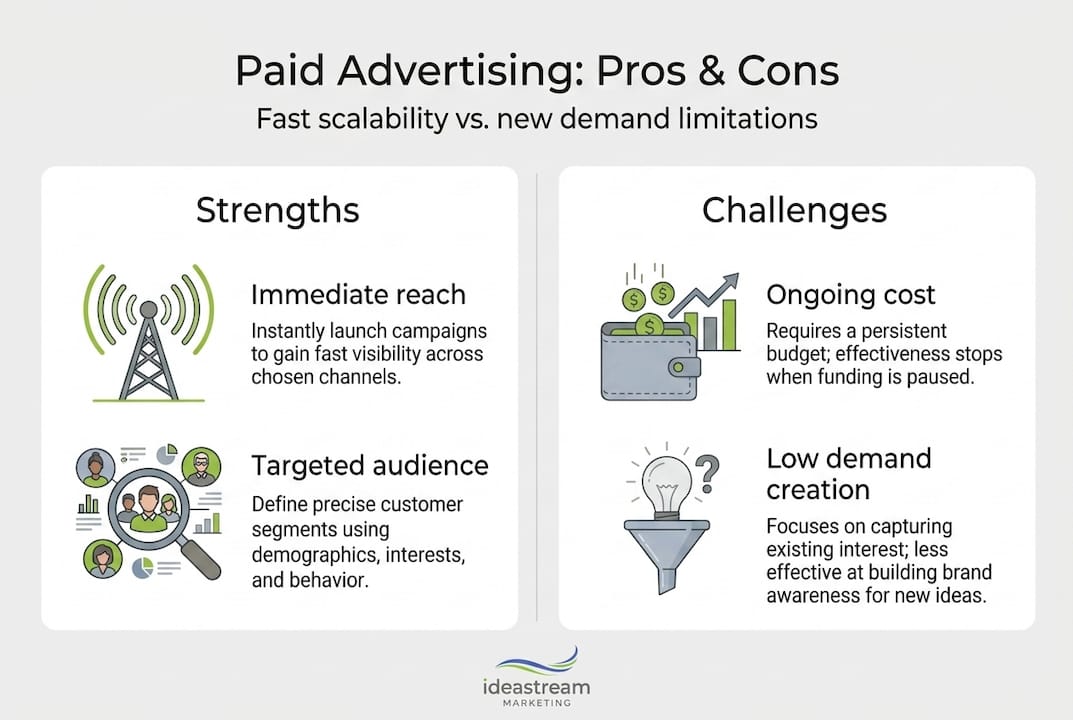
The single greatest strength of paid advertising is speed. You can launch a campaign today and have your message in front of thousands of targeted users by tomorrow. For new product launches, time-sensitive promotions, or entering a competitive market where organic ranking takes months, that immediacy is genuinely valuable.

But speed comes with conditions. Paid advertising excels at fast scalability but struggles to create new demand. If your target audience does not yet recognize they have a problem your product solves, search ads will find very few people looking. In those situations, content marketing, social education, and brand building need to run alongside paid campaigns to bring new audiences into the awareness stage first.
Here is a practical comparison of paid, organic, and hybrid approaches:
| Approach | Time to Results | Cost Model | Best Use Case |
|---|---|---|---|
| Paid only | Immediate | Ongoing spend | Promotions, demand capture |
| Organic only | 3 to 12 months | Content investment | Brand building, long-term SEO |
| Hybrid (paid + organic) | Short-term + long-term | Balanced | Scalable, sustainable growth |
The hybrid model consistently outperforms either channel in isolation, especially for businesses with longer sales cycles.
Key challenges that paid advertisers face in 2026:
- Rising cost per click (CPC): Increased competition in nearly every industry pushes up auction prices, squeezing margins for businesses without strong conversion rates
- Creative fatigue: Audiences see the same ad repeatedly and stop responding, requiring ongoing creative refresh cycles
- Cannibalization from new campaign types: Automated campaign formats like Performance Max can absorb budget that was previously delivering strong results from manual campaigns
- Attribution confusion: Multi-touch attribution models are still imperfect, making it hard to know which campaign truly influenced a conversion
- Audience saturation: On social platforms especially, re-targeting the same small audience repeatedly drives up frequency and drives down engagement
The strongest paid advertising strategies are built around audience-first targeting and transactional intent keywords. Rather than bidding on broad category terms, focus on what someone types when they are ready to act. Combining this approach with AI-driven marketing growth tools allows you to adjust targeting, budget allocation, and creative in near real time based on performance signals.
Modern strategies: Automation, AI, and making paid ads work in 2026
Recognizing strengths and challenges sets the stage for taking action. Here is how to put advanced, future-ready paid advertising into practice.
The biggest shift in paid advertising over the past two years is the rise of AI-driven automation. Google’s automated bidding, responsive ads, and Performance Max campaigns now make many of the micro-decisions that advertisers used to control manually. This is not inherently bad, but it changes your role significantly.
Your job is no longer to micromanage every bid. Your job is to feed automation quality inputs, including creative variety, strong landing pages, and accurate conversion data, so the system can optimize toward your actual business goals. A campaign fed with vague conversion signals (like page views) will optimize for the wrong outcomes. Feed it purchase completions or qualified lead form submissions, and the algorithm has something meaningful to work with.
Google’s AI Overviews, which now appear at the top of many search results, are also changing click behavior on informational queries. If a user gets their answer directly from an AI-generated summary, they may never click an ad or an organic result. This makes it more important than ever to focus paid budgets on transactional and high-intent keywords where users still need to take action.
Here is a step-by-step framework for building a future-ready paid advertising strategy:
- Define clear conversion goals: Know exactly what action counts as success, whether it is a phone call, form submission, or purchase
- Build high-quality landing pages: Your ad’s destination must match the promise of the ad and load quickly on mobile
- Diversify creative assets: Provide multiple headlines, images, and video options so the algorithm can test combinations
- Set up proper conversion tracking: Use Google Tag Manager and verify that all goal actions are being recorded accurately
- Conduct regular account audits: Review search term reports, negative keyword lists, and audience exclusions at least monthly
- Integrate paid with SEO and content: Use your highest-performing organic content to inform ad copy and landing page messaging
Understanding how AI transforms digital marketing is now a practical requirement for anyone managing ad campaigns, not just a trend to watch. Platforms that leverage AI-enhanced marketing workflows can streamline the testing, optimization, and reporting processes that used to consume hours of manual work.
Pro Tip: Before increasing your ad budget, audit your conversion tracking. If the system is not recording goals accurately, automation will optimize for the wrong behavior and budget increases will only amplify the problem, not fix it.
A fresh perspective: Why paid advertising is only half the growth story
Here is something most paid advertising articles will not tell you directly: over-reliance on paid ads is one of the most common reasons otherwise solid businesses plateau.
We have seen businesses spending significant budgets on Google Ads month after month, chasing last-click return on ad spend (ROAS) as their primary performance metric. The problem is that attribution biases favor last-click, meaning the channel that gets credit for a conversion is often not the channel that actually drove the decision. This leads to doubling down on paid while neglecting the brand and content investments that made those paid conversions possible in the first place.
Smart experimentation matters too. Testing different ad variations reveals audience affinities and contextual signals, not absolute winners. A test that shows one headline outperforms another still does not explain why. Without that understanding, you are optimizing on a surface level while missing the strategic insight below.
The marketers achieving the strongest long-term results treat paid advertising as one tool in a connected system. They use it to capture demand their brand and content have already created. They reinvest paid learnings back into organic strategy. And they regularly audit their channel mix to find where growth is actually coming from, using smart marketing strategies that account for the full customer journey.
Paid advertising is powerful. But it is not a substitute for building something worth advertising.
Get expert support for your paid advertising strategy
Paid advertising in 2026 requires more than a budget and a basic campaign setup. It demands strategic alignment across channels, data-driven decision-making, and the ability to adapt quickly to platform changes driven by AI.
At Idea Stream Marketing, we build integrated paid advertising strategies that connect your campaigns to your broader digital marketing services framework, including SEO, content, and automation. Our team understands the full picture of how paid fits into AI for marketing growth and scalable lead generation. Whether you are starting your first campaign or restructuring an underperforming account, we are here to help you move forward with clarity and confidence.
Frequently asked questions
How does paid advertising differ from organic marketing?
Paid advertising places your message directly in front of targeted audiences at a cost, while organic marketing attracts traffic naturally through content and SEO. Organic builds long-term visibility while paid excels at speed and demand capture for audiences already searching.
What is the biggest mistake businesses make with paid ads?
Many businesses rely on high bids rather than improving ad quality and landing page relevance. Since auction dynamics reward quality over the highest bid, poor Quality Scores mean you overpay for underperforming placements.
Are all paid advertising channels equally effective?
No. Effectiveness depends on your audience, competition level, and how well your campaign is structured. Testing yields contextual insights rather than universal winners, so channel performance varies significantly by business type and goal.
How should I adapt paid ad strategies to AI updates?
Focus on feeding automation quality creative assets, accurate conversion data, and well-structured landing pages. Quality inputs over micromanaging bidding is the right posture, and monitoring how AI Overviews affect click behavior on key queries is now an essential part of campaign management.
Recommended
- Paid Advertising Guide: Proven Strategies for 2026 Growth | Web Design & Marketing Agency
- What scalable growth means in digital marketing success | Idea Stream Marketing
- What is digital marketing? Strategies for scalable growth | Web Design & Marketing Agency
- Why choose a full-service agency for strategic growth | Idea Stream Marketing