



September 25, 2026




TL;DR:
- A strong script is essential for engaging viewers and driving meaningful results.
- Define clear objectives and know your audience before scripting.
- Use proven structural frameworks like PAS-CTA, Hook-Value-CTA, or story arc for different video types.
You spend time, money, and energy producing a marketing video, and it falls flat. Viewers drop off in the first ten seconds, your message gets lost, and the results don’t justify the investment. This is one of the most common frustrations for marketing managers and business owners, and the root cause is almost always the same: a weak or missing script. A strong script is the foundation of every effective marketing video. It shapes your message, controls pacing, and drives the viewer toward a clear action. This guide walks you through a proven, step-by-step process for scripting marketing videos that actually connect with your audience and deliver measurable results.
Table of Contents
- Define your objectives and know your audience
- Choose the right video script structure
- Drafting your script: audio and visuals in sync
- AI tools and human review: blending speed with brand voice
- Polishing and testing your script for engagement
- Why most marketing video scripts miss the mark — and how to fix it
- Need help scripting or producing marketing videos?
- Frequently asked questions
Key Takeaways
| Point | Details |
|---|---|
| Start with clear goals | Identify the business objective and audience before drafting any script. |
| Pick the right structure | Choose a proven script format to focus messaging and drive action. |
| Align audio and visuals | Use a two-column layout so your script’s words and images work together. |
| Leverage AI, refine humanly | Let AI speed up drafting but always review scripts for brand authenticity. |
| Iterate and test for engagement | Read scripts aloud, get feedback, and tweak for maximum viewer retention. |
Define your objectives and know your audience
Start by rooting your video scripting in your business objectives and audience understanding.
Before you write a single word, you need to know exactly what you want your video to accomplish. That sounds obvious, but many businesses skip this step and jump straight into filming. The result is a video that looks polished but says nothing meaningful to anyone specific.
Start by asking: what is this video supposed to do? Your answer will shape every creative decision that follows. Common video goals include:
- Building brand awareness with new audiences
- Generating leads by explaining a product or service
- Educating existing customers on how to use what they bought
- Driving conversions at the bottom of the sales funnel
- Retaining customers by reinforcing trust and value
Once you know your goal, identify your audience. Who are they? What problems are they trying to solve? What language do they use when they talk about those problems? A video targeting a first-time buyer needs a completely different tone and message than one aimed at a returning customer ready to upgrade.
You also need to match your script to the right stage of the marketing funnel. Awareness-stage videos should educate and spark curiosity without pushing too hard. Consideration-stage videos should compare, demonstrate, or build trust. Conversion-stage videos need urgency and a clear call to action. Skipping this alignment is one of the main reasons videos underperform.
Video marketing strategy works best when it connects scripting and production to measurable objectives, and effective video marketing strategies consistently show that businesses with clear video KPIs report higher content effectiveness. As one resource on video marketing strategy notes, connecting scripting to a repeatable workflow for planning and scaling content is what separates one-off videos from a real content system.
Pro Tip: Before writing your script, write one sentence that completes this prompt: “After watching this video, my viewer will [specific action or belief].” If you can’t complete it clearly, your objective needs more work.
Choose the right video script structure
With objectives in hand, select a script structure that aligns with your goals and message.
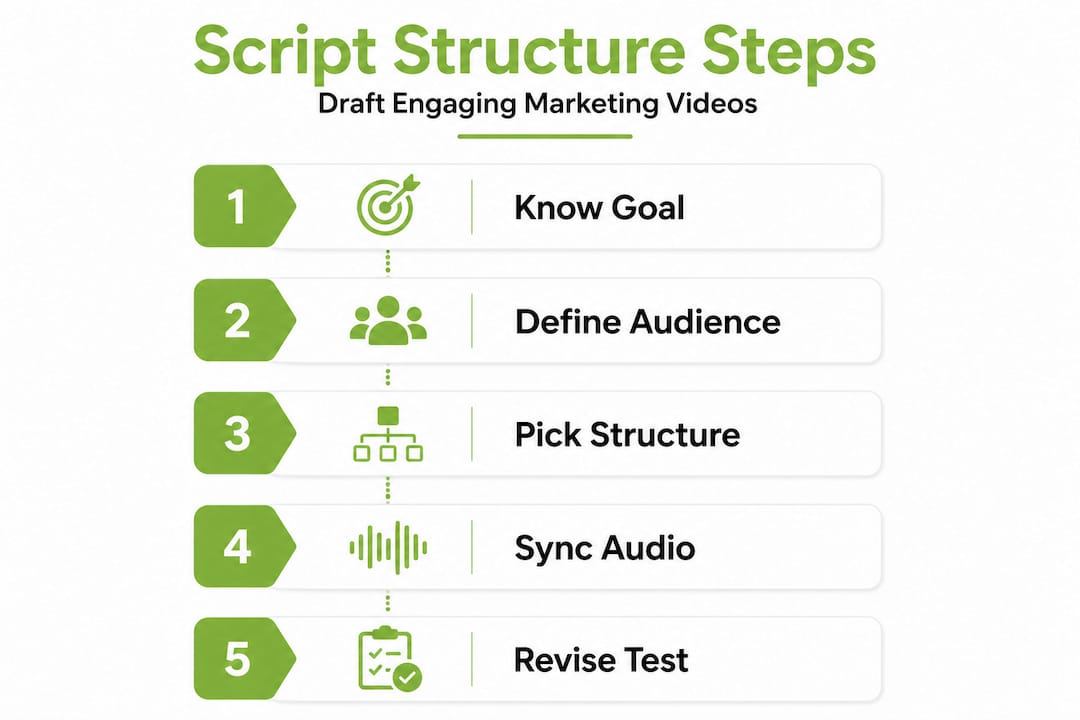
Not all scripts are built the same. The structure you choose depends on your video type, your audience’s awareness level, and where the video lives. Three proven frameworks cover most marketing video scenarios:
-
PAS-CTA (Problem, Agitate, Solve, Call to Action): This is the go-to structure for ad-style videos. You open by naming a problem your audience recognizes, intensify the pain point to create emotional resonance, then present your solution. You close with a direct call to action. It’s focused, fast, and effective.
-
Hook, Value, CTA: This format works well for social media and educational content. You open with a strong hook (a surprising fact, a bold claim, or a relatable scenario), deliver concentrated value in the middle, and close with a simple next step. It’s especially effective for short-form platforms like Instagram Reels or YouTube Shorts.
-
Simple Story Arc: This is the narrative approach. You introduce a character (often a customer persona), show them facing a challenge, walk through the journey, and arrive at a resolution. It’s ideal for brand videos, testimonials, and longer explainer content.
Here’s a quick comparison to help you choose:
| Structure | Best for | Length | Tone |
|---|---|---|---|
| PAS-CTA | Paid ads, landing page videos | 15 to 90 seconds | Direct, urgent |
| Hook, Value, CTA | Social media, YouTube | 30 to 120 seconds | Engaging, educational |
| Simple Story Arc | Brand videos, testimonials | 60 to 300 seconds | Warm, narrative |
For ad-style videos specifically, PAS-CTA and problem-agitate-solve approaches are among the most recommended script mechanics for turning viewers into leads. You can explore more video content marketing approaches to see how structure plays into broader content strategy, and look at examples of engaging video scripts that put these frameworks into practice.
Pro Tip: For very short social videos under 30 seconds, skip the full script and use a tight outline of three to five talking points instead. Word-for-word scripts can make delivery feel stiff and unnatural in short-form formats.
Drafting your script: audio and visuals in sync
Once you’ve selected your structure, bring your script together with audio and visuals planned side by side.
One of the most practical tools in video scripting is the two-column script format. The left column contains everything that will be heard: narration, dialogue, sound effects, and music cues. The right column describes everything that will be seen: on-screen text, B-roll footage, graphics, and transitions. This format keeps your production team aligned and prevents the common problem of audio and visuals telling two different stories.

Here’s a simplified example for a brand introduction video:
| Audio | Visuals |
|---|---|
| “Running a business is hard enough without worrying about your marketing.” | Wide shot of busy office environment |
| “At [Brand Name], we handle the strategy so you can focus on growth.” | Logo animation, team working at desks |
| “From video to SEO to paid ads, we build systems that scale.” | Quick cuts of service results, graphs trending up |
| “Ready to grow? Let’s talk.” | CTA card with website URL and phone number |
Two-column scripts help production teams align what’s said with what appears on screen, which reduces editing time and keeps the final video focused. The same guidance warns that skipping scripting leads to over-editing, videos that run too long, and audiences that disengage early.
Common drafting mistakes to avoid:
- Info overload: Trying to say everything in one video. Pick one message per video.
- Neglecting visuals: Writing audio-only and leaving visuals as an afterthought. Plan both together.
- Over-scripting delivery: Writing in a formal, stiff tone that sounds unnatural when spoken aloud.
- Burying the hook: Starting with your company name or backstory instead of the viewer’s problem.
“Most video marketing needs a script; outlining keeps communication logical and pacing tight.”
Once your draft is complete, do a table read. Read the script out loud from start to finish, timing yourself. If something sounds awkward or takes too long to say, rewrite it. Your ear will catch problems your eyes miss. This step takes ten minutes and saves hours of reshooting. You can also explore video storytelling in marketing to understand how narrative structure shapes viewer experience at a deeper level.
AI tools and human review: blending speed with brand voice
With a script draft in hand, enhance your workflow further by integrating AI where it adds value but never compromising quality.
AI scripting tools have changed how fast marketing teams can produce first drafts. If you’re managing a content calendar with multiple videos per month, AI can cut your drafting time significantly. Here are some tools worth considering:
- ChatGPT or Claude: Useful for generating full script drafts from a brief prompt. Works well for PAS-CTA and Hook/Value/CTA formats.
- Descript: Combines AI transcription with script editing, making it easy to revise recorded content.
- HeyGen or Synthesia: AI video platforms that can turn scripts into video with AI avatars, useful for explainer content at scale.
- Otter.ai: Transcribes existing video or audio content so you can repurpose it into new scripts.
- Jasper: A marketing-focused AI writing tool that can generate scripts aligned to brand tone guidelines.
The benefits are real. AI speeds up the scripting-to-video workflow, helps maintain consistency across longer content series, and makes it easier to repurpose a single script into multiple formats, such as a long-form YouTube video, a short social clip, and a landing page video.
That said, AI scripts still need human review for brand voice, clarity, and alignment to messaging goals. AI doesn’t know your specific customer relationships, your brand’s tone nuances, or the subtle language your audience responds to. It also tends to produce generic phrasing that sounds fine on the surface but lacks the specificity that makes a message stick.
You can see how AI content creation tools fit into a broader marketing automation strategy to scale content production without sacrificing quality.
Pro Tip: Use AI to generate a first draft, then have a team member who knows your brand voice review it line by line. The goal is to use AI for speed, not to replace the judgment that makes your messaging authentic.
Polishing and testing your script for engagement
After drafting, the review and test cycle ensures your script truly connects. Here’s how to refine until it resonates.
A script isn’t finished when the first draft is done. The best marketing scripts go through at least two or three rounds of revision before they’re camera-ready. Here’s a practical process:
- Read it aloud: Time the script and listen for anything that sounds unnatural. If you stumble on a phrase, rewrite it. Aim for a conversational rhythm, not a formal presentation.
- Get outside feedback: Share the script with someone outside your marketing team, ideally someone who represents your target audience. Ask them what the video is about and what they would do next. If they can’t answer clearly, the message needs work.
- Test a rough cut: Record a simple test version and measure viewer retention. Most video platforms show you exactly where viewers drop off. If you’re losing people in the first five seconds, your hook needs revision.
- Refine the call to action: Test different versions of your CTA. “Learn more” performs differently than “Get your free quote” or “Watch the full demo.” Small word changes can shift click-through rates meaningfully.
- Iterate based on data: Don’t treat your first published version as final. Review performance data after two to four weeks and make adjustments to the next version.
For short-form content specifically, word-for-word scripts can hurt delivery by making the speaker sound rehearsed rather than natural. Talking points preserve conversational pacing and often perform better on platforms where authenticity matters.
Avoiding common marketing mistakes during the revision process is just as important as getting the draft right the first time.
Pro Tip: Shorten your intro by at least 20 percent during the revision phase. Most scripts open with too much context before getting to the point. Viewers decide whether to keep watching within the first three seconds.
Why most marketing video scripts miss the mark — and how to fix it
Here’s an uncomfortable truth: most marketing video scripts don’t fail because of bad production or the wrong platform. They fail because the people writing them are afraid to be specific.
Generic scripts feel safe. Saying “we help businesses grow” or “our team is passionate about results” sounds professional, but it says nothing. It doesn’t tell the viewer what problem you solve, who you solve it for, or why they should care. Vague messaging is a symptom of trying to appeal to everyone, and it ends up connecting with no one.
The real barrier isn’t a lack of technology or the right template. It’s a fear of clarity. Being specific means excluding some viewers, and that feels risky. But specificity is exactly what makes a message land. A script that says “we help dental practices fill their schedule without relying on referrals” will outperform a generic “we grow your business” message every time, because it speaks directly to a real, recognized problem.
Another habit that holds scripts back is writing for the brand instead of the viewer. Every sentence in your script should answer the viewer’s unspoken question: “What does this mean for me?” If a line is about your company’s history, awards, or team size and it doesn’t connect directly to the viewer’s benefit, cut it.
Getting feedback from non-marketers is one of the most underused tools in script development. When someone outside your industry can explain your video’s message back to you in plain language, you know the script is working. If they’re confused or bored, the script isn’t ready.
Finally, great scripting is a skill built through repetition, not inspiration. The first script you write will be weaker than the tenth. Review what you can learn from common scripting errors, study what worked in past videos, and treat every script as a learning opportunity. The businesses that consistently produce effective video content aren’t more creative. They’re more committed to the process of iteration.
Need help scripting or producing marketing videos?
If you’ve worked through this guide and feel ready to take your video content to the next level, we’re here to support that next step.
At Idea Stream Marketing, we combine strategic scripting with full-service video marketing and videography services to help businesses produce content that performs. Whether you need help developing a script framework, integrating video in advertising campaigns, or building a complete content system, our team brings both the creative and technical expertise to make it happen. Our digital marketing approach connects every video to a broader strategy designed for measurable growth. Reach out to our team and let’s build something worth watching.
Frequently asked questions
What’s the simplest script structure for marketing videos?
The PAS-CTA method (Problem, Agitate, Solve, Call to Action) is an easy-to-use structure that works for most ad-style videos and gives you a clear, repeatable framework.
Should I write every word or use talking points?
For short-form videos, talking points outperform word-for-word scripts because they preserve natural delivery and pacing. For longer or higher-stakes content, a full script is the better choice.
How does a two-column script format improve video production?
Two-column scripts keep audio and visuals aligned from the start, which reduces miscommunication between writers and production teams and leads to tighter, more focused videos.
Can AI help me script marketing videos faster?
Yes, AI can draft scripts quickly and consistently, but human review remains essential for maintaining brand voice, clarity, and accurate alignment to your messaging goals.
What’s the biggest mistake to avoid when scripting marketing videos?
Skipping the script entirely is the most damaging mistake, as it typically results in rambling delivery, videos that run too long, and audiences that disengage before reaching your call to action.
Recommended
- Video Marketing 101 Engaging Your Audience Like Never Before
- 6 effective video marketing strategies that work in 2026 | Idea Stream Marketing
- Unlocking Marketing Potential Video Storytelling
- Long Island Visual Poetry: Narratives with Photography
- Why Cinematic Videos Transform Your Marketing Results | QuickAdVideo Blog