



October 16, 2026

Drone videography is the practice of capturing aerial video footage using remotely piloted aircraft, then editing that footage into polished deliverables for clients or creative projects. It can absolutely be profitable, provided you pair the right certification, a focused niche, and tiered service packages. Three actions you can take today: (1) register for the FAA Part 107 knowledge exam at IACRA, (2) research entry-level prosumer drones in the DJI Mini or Air series, and (3) bookmark a structured course like Drone Pilot Ground School or UAV Coach to start your study plan this week.
Key Takeaways
Drone videography is profitable when you combine Part 107 certification, commercial insurance, niche-focused packages, and value-based pricing that moves beyond selling raw footage.
| Point | Details | ||||||||||
|---|---|---|---|---|---|---|---|---|---|---|---|
| Part 107 is non-negotiable | Pass the 60-question exam (70% minimum, $175 fee) and register your drone for $5 at FAADroneZone. | ||||||||||
Table of Contents
- Is drone videography profitable? Revenue models and how to set rates
- Where drone videography is used: top sectors and typical deliverables
- What gear do you actually need to start shooting professional aerial video?
- Flight technique, cinematic shot types, and camera settings to master
- How to legally fly for pay: Part 107, registration, Remote ID, and waivers
- Preflight checklist, flight planning, airspace tools, and safety best practices
- Editing workflow: ingest, rough cut, color grading, codecs, and delivery formats
- How to launch a drone videography business and win clients
- Where to learn: courses, practice drills, and resources to accelerate your skills
- What new drone pilots consistently get wrong
- Idea Stream Marketing brings certified drone production and marketing strategy together
- Authoritative links and recommended reading
- Sources
- FAQ
Is drone videography profitable? Revenue models and how to set rates
The short answer is yes, but the pilots who actually build sustainable income treat it as a service business, not a gig. Raw footage is a commodity. Business-focused deliverables are not.
Primary revenue models break into four categories. Project-based work covers one-off shoots for real estate listings, events, or marketing campaigns. Retainer agreements lock in recurring visits for construction progress monitoring or property management. Subscription or monitoring contracts deliver scheduled data products to agriculture or infrastructure clients. Data products, including orthomosaic maps, 3D models, and thermal reports, command the highest per-deliverable rates because they require specialized sensors and processing software.
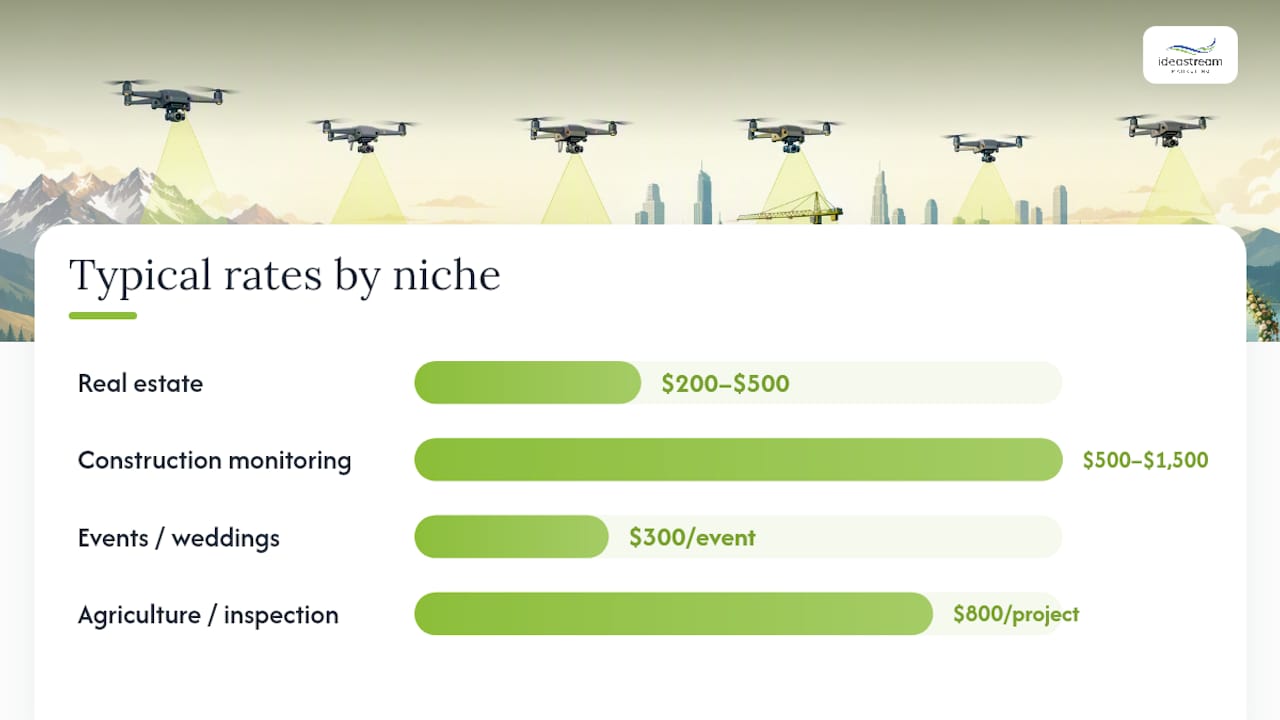
According to DroneNestle, sample niche rates for common commercial work look like this:
| Niche | Typical Rate | Deliverable |
|---|---|---|
| Real estate | $200–$500 per listing | Edited video tour + stills |
| Construction monitoring | $500–$1,500 per visit | Progress report + orthomosaic |
| Events / weddings | $300 per event | Edited highlight reel |
| Agriculture / inspection | $800 per project | Thermal or multi-spectral data |
Pro Tip: Calculate your cost of doing business (CODB) first: drone depreciation, insurance premiums, software subscriptions, travel, and exam renewal fees. Then price packages above that floor. Hourly billing exposes you to scope creep; project or value-based pricing protects your margin and signals professionalism to clients.
The market has shifted decisively toward data-driven services. Pilots who add technical sensors like LiDAR, thermal cameras, or multi-spectral rigs command higher rates and recurring contracts that pure cinematic operators rarely see.
Where drone videography is used: top sectors and typical deliverables
Choosing the right niche early saves months of unfocused marketing. These six sectors generate the most consistent commercial demand.
- Real estate. Listing agents and developers order aerial video tours, exterior walkthroughs, and neighborhood context shots. Deliverables are typically a 60–90 second edited video in H.264 or H.265, plus a set of high-resolution stills. Work is project-based and volume-driven, so building relationships with a handful of active agents creates reliable weekly bookings.
- Construction and development. General contractors and project owners need scheduled progress documentation, orthomosaic maps, and volumetric measurements. This niche provides recurring revenue because a single project can run 12–24 months. Deliverables often include processed point clouds or 3D models alongside standard video.
- Events and weddings. Ceremony overviews, venue reveals, and crowd aerials are standard requests. Deliverables are edited highlight reels, usually 2–5 minutes, delivered as H.264 MP4 for web and social. Work is seasonal and one-off, but referrals compound quickly in tight local markets.
- Infrastructure inspection. Power lines, cell towers, bridges, and pipelines require visual inspection footage and, increasingly, thermal imagery. Clients are utilities and engineering firms. Rates are high because the work requires precision flying in challenging environments, and repeat contracts are common.
- Precision agriculture. Farmers and agronomists use multi-spectral and thermal drone data to assess crop health, irrigation efficiency, and pest pressure. Deliverables are processed NDVI maps and field reports. High-margin niches like precision agriculture and infrastructure inspection generate repeatable data products that justify premium pricing.
- Media, film, and branded content. Production companies, advertising agencies, and brands commission cinematic aerial sequences for commercials, documentaries, and social campaigns. Deliverables are RAW or LOG footage files plus graded exports. This niche is competitive but pays well when you can demonstrate a strong portfolio reel. Drone footage integrated into a broader brand video strategy consistently outperforms ground-only production in viewer engagement.
What gear do you actually need to start shooting professional aerial video?
Equipment decisions matter more at the beginning than most new pilots expect. Buying the wrong drone for your niche costs time and money you cannot recover.
| Class | Best For | Pros | Cons | Typical Price Band |
|---|---|---|---|---|
| Entry-level (DJI Mini 4 Pro) | Learning, real estate | Under 250g, minimal registration in some jurisdictions, 4K/60fps | Smaller sensor, limited wind resistance | $760 |
| Prosumer (DJI Air 3, Mavic 3 Pro) | Client work, events, real estate | 1-inch or multi-lens sensor, longer flight time | Heavier, higher cost | $1,100 |
| Specialized (FPV, thermal, LiDAR) | Inspection, agriculture, cinematic | Unique capabilities, premium rates | High cost, steep learning curve, sensor-specific software | $3,000 |
Beyond the drone itself, these accessories materially improve footage quality and operational reliability:
- ND filters (ND8, ND16, ND64, ND128): control shutter speed for cinematic motion blur
- Spare batteries (minimum 3 per shoot): most prosumer drones fly 25–35 minutes per charge
- Charging hub: charge multiple batteries simultaneously between flights
- High-speed microSD (V30 or faster, 128GB minimum): avoid dropped frames in 4K/60fps
- Polarizing filter: reduces glare on water and glass surfaces
- Prop guards: protect rotors during close-quarters or indoor shots
- Hard-shell carry case: protects gear in transit and looks professional on client sites
- Commercial liability insurance: clients routinely require a $1M certificate of insurance (COI)
Pro Tip: The 180-degree shutter rule is the single most impactful camera setting for cinematic footage. Set your shutter speed to double your frame rate (e.g., 1/50s at 24fps, 1/120s at 60fps), then use ND filters to achieve correct exposure at that shutter speed. Without this, your footage will look sharp but unnaturally stiff, like security camera video rather than film.
Flight technique, cinematic shot types, and camera settings to master
Cinematic aerial footage is not about flying fast. It is about controlled, intentional movement that tells a visual story. These shot types form the foundation of professional drone videography work.
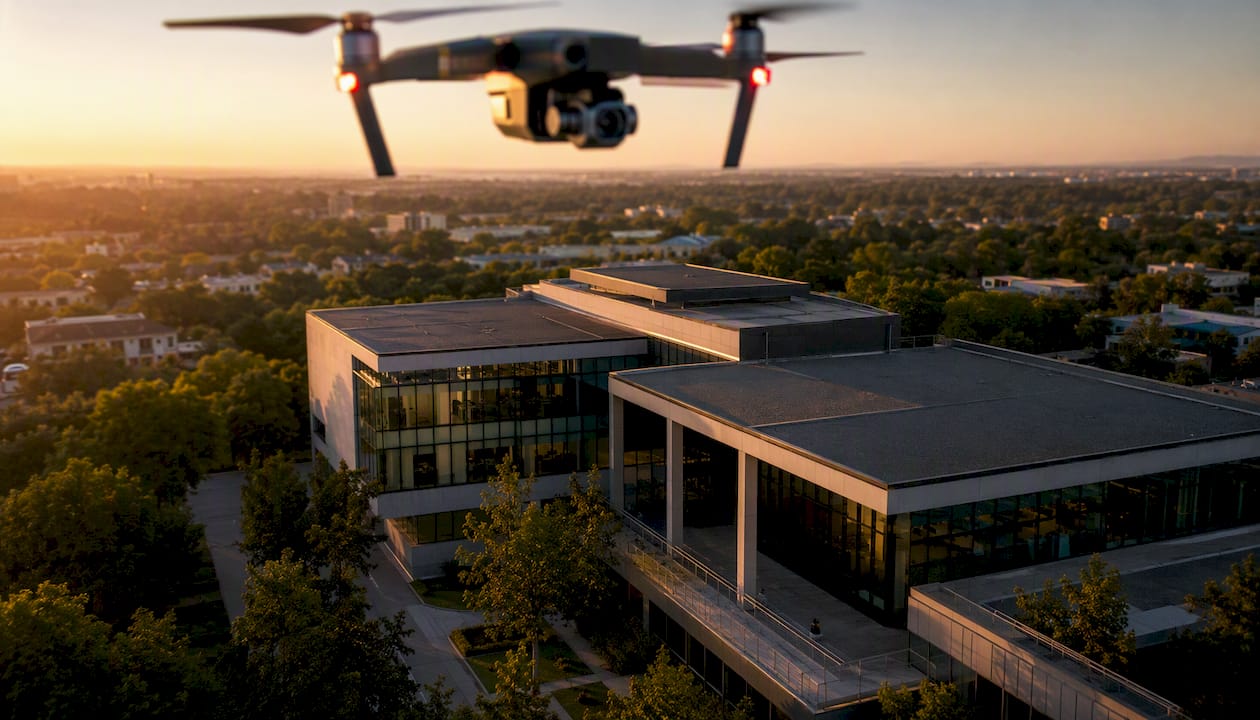
Reveal shot
The drone rises or moves forward while a subject comes into frame from behind an obstacle, a treeline, or a building. Reveals are the most-used establishing shot in real estate and event work because they create instant visual drama.
Orbit (point of interest)
The drone circles a fixed subject while the camera stays locked on it. Orbits work best at a consistent altitude and speed. Vary the radius to create different emotional intensities: tight orbits feel urgent, wide orbits feel grand.
Tracking shot
The drone follows a moving subject, a car, a person, a boat, at a consistent distance and angle. This requires smooth throttle control and anticipating the subject’s path. FPV rigs excel here, but a standard prosumer drone on a well-planned route delivers clean results.
Top-down (God’s-eye view)
Camera points straight down while the drone moves laterally. This perspective is striking for mapping, agriculture, and abstract creative shots. It also works well as a transition cut between scenes.
Push-in
The drone flies slowly toward a stationary subject while maintaining altitude. Simple and effective for product reveals, architectural features, or portrait-style subject shots.
Parallax
The drone moves laterally while the camera stays locked on a foreground subject, creating depth as the background shifts. This is one of the more technically demanding shots but produces footage that looks unmistakably cinematic.
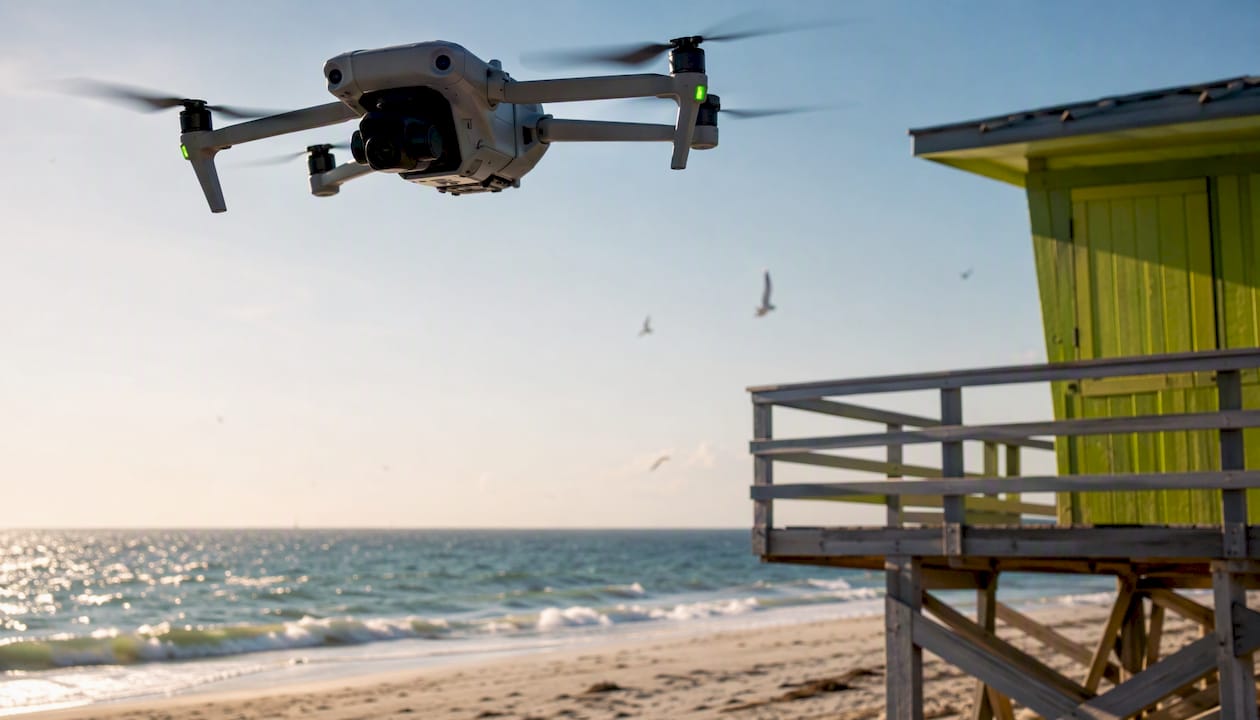
Camera settings cheat sheet:
| Setting | Recommended Value | Why |
|---|---|---|
| Frame rate | 24fps (cinematic), 60fps (slow-mo) | 24fps matches film look; 60fps gives 2.5x slow-motion at 24fps playback |
| Shutter speed | 2x frame rate (1/50s at 24fps) | Produces natural motion blur per the 180-degree rule |
| ISO | As low as possible (100–400) | Minimizes noise in the sky and shadow areas |
| White balance | Manual (Kelvin) | Prevents auto-WB shifts mid-shot |
| Color profile | D-Log or D-Log M | Preserves dynamic range for grading |
| ND filter | Match to shutter target | ND16 in bright sun at 24fps; ND8 in overcast |
Practice drills that build real skill:
- Days 1–30: Master basic maneuvers in an open field. Practice straight-line push-ins, smooth orbits at three different radii, and controlled ascents. Fly the same path repeatedly until the movement is muscle memory.
- Days 31–60: Add shot sequencing. Plan and execute a 5-shot sequence (establishing reveal, orbit, tracking, top-down, push-in) on a single subject. Edit the sequence and review the cuts.
- Days 61–90: Shoot a real-world mini-project (a local business, a friend’s property) and deliver a 60-second edited reel. This forces you to manage battery swaps, lighting changes, and client-ready output under realistic conditions.
Battery management belongs in every practice session. Check firmware updates for both the drone and controller before every shoot, and inspect props for nicks or stress cracks that could cause vibration artifacts in footage.
How to legally fly for pay: Part 107, registration, Remote ID, and waivers
You need a Remote Pilot Certificate under FAA Part 107 to charge for drone work in most commercial contexts. Flying for compensation without it is a federal violation, not a technicality.
Here is the step-by-step path to certification:
- Step 1 — Study. The Part 107 knowledge exam covers 60 multiple-choice questions across 120 minutes, with a minimum passing score of 70%. Topics include airspace classification, weather, aeronautical charts, and emergency procedures. The exam fee is typically $175.
- Step 2 — Create an FAA Tracking Number (FTN). Register at IACRA (iacra.faa.gov) to get your FTN before scheduling the exam. You will need it at the testing center.
- Step 3 — Schedule and pass the UAG exam. Book through an FAA-approved testing center (PSI or CATS). Bring your FTN and a government-issued ID.
- Step 4 — Complete FAA Form 8710-13 via IACRA. After passing, submit your application online. A Transportation Security Administration (TSA) security vetting follows automatically.
- Step 5 — Register your drone. Register at FAADroneZone. Registration costs $5 and is valid for 3 years. Any drone 0.55 pounds or heavier requires registration before commercial flight.
- Step 6 — Recurrent training every 24 months. Part 107 privileges lapse without current recurrent training. Complete the free FAA WINGS recurrent training or an approved course to stay current.
Part 107 operational rules for small UAS under 55 pounds include: keep the drone within visual line-of-sight, operate during daylight or civil twilight with anti-collision lighting, stay at or below 400 feet AGL unless within 400 feet of a structure, and limit airspeed to 100 mph. Night flight, operations over people, and flight over moving vehicles are permitted without a waiver if you meet the Operations Over People rule conditions.
Remote ID is now a standard requirement. Your drone must broadcast identification and location data in real time. Drones that cannot broadcast natively require a Remote ID module. The only exception is operating within an FAA-Recognized Identification Area (FRIA).
Common operations that still require a waiver include beyond visual line-of-sight (BVLOS) flight, operations above 400 feet in uncontrolled airspace, and certain flights over restricted areas. Apply for waivers through FAADroneZone well in advance of any planned operation.
Pro Tip: Carry printed proof of your current recurrent training and your COI to every commercial shoot. Showing up with both documents speeds contract approvals on construction sites and corporate campuses, where site managers routinely ask for them before allowing any flight.
Preflight checklist, flight planning, airspace tools, and safety best practices
A thorough preflight routine is what separates professional operators from hobbyists. Run this checklist before every commercial flight:
- Firmware: confirm drone, controller, and gimbal firmware are current
- Battery health: check charge level (minimum 90% for a full shoot), cycle count, and swelling
- Payload security: verify camera, gimbal, and any sensor attachments are locked and calibrated
- Weather brief: check wind speed (stay below your drone’s rated wind resistance), precipitation, and visibility
- NOTAM and TFR check: review Notices to Air Missions and Temporary Flight Restrictions for your location and time window
- Airspace authorization: confirm you have LAANC approval or a manual authorization for controlled airspace
- Site hazards: identify power lines, trees, RF interference sources, and bystander zones before takeoff
- Emergency plan: know your return-to-home altitude, battery abort threshold, and nearest safe landing zone
For airspace and weather planning, these tools are standard in professional workflows. B4UFLY (FAA’s official app) gives a quick go/no-go status for your location. Aloft (formerly Kittyhawk) provides LAANC authorization, airspace maps, and flight logging in one platform. UAV Forecast delivers wind, visibility, and Kp index data formatted specifically for drone pilots. ForeFlight is preferred by pilots who also hold manned aircraft certificates and need integrated aeronautical chart overlays.
On-site communication matters as much as airspace compliance. Brief your ground crew and any bystanders before each flight. Get written client approval for the flight area, and document it. Keep your COI accessible and know your insurer’s incident reporting process before you ever need it. Weather conditions deserve particular attention: even drones rated for 25 mph winds perform better and produce smoother footage below 15 mph. Overcast skies often produce better footage than harsh midday sun, so do not cancel a shoot just because it is cloudy.
Editing workflow: ingest, rough cut, color grading, codecs, and delivery formats
Post-production is where aerial footage becomes a deliverable clients will pay for. A disciplined workflow saves hours and prevents the nightmare of losing a shoot to a corrupted card.
- Ingest and backup. Copy all footage to your primary drive, then immediately duplicate to a backup drive. Never edit from the original card. Use a tool like ShotPut Pro or simply a manual copy-verify process. Label folders by date, client, and location.
- Review and selects. Watch every clip at 1.5x speed and mark selects. Delete obvious rejects (bad exposure, prop in frame, shaky start/end) to reduce timeline clutter before you cut.
- Rough cut. Assemble selects in your NLE (DaVinci Resolve, Adobe Premiere Pro, or Final Cut Pro X) in a logical story order. For a real estate video, that typically means: exterior reveal, neighborhood context, front approach, interior (if applicable), aerial outro. For events, it follows the event timeline.
- Color grading. If you shot in D-Log or D-Log M, apply a LUT first to normalize exposure, then grade for the client’s brand tone. DaVinci Resolve’s Color page is the industry standard for this step. Match color temperature across clips shot in changing light.
- Audio and music. License music through Artlist, Musicbed, or Epidemic Sound. Sync music cuts to visual transitions. Keep music at roughly 20–25% of the video’s emotional weight; it should support the footage, not compete with it.
- Export and deliver. For web and social, H.264 at 10–20 Mbps in a 16:9 or 9:16 aspect ratio covers most platforms. For broadcast or agency delivery, ProRes 422 or DNxHR is standard. Archive original LOG files and project files for at least 12 months.
Codec and format quick reference:
- Web / social: H.264, MP4 container, 1080p or 4K, 10–20 Mbps
- Broadcast / agency: ProRes 422 HQ or DNxHR, MOV or MXF container
- Client archive: Original LOG files + DaVinci project file
- Vertical social (Reels, TikTok, Shorts): H.264, 9:16, 1080×1920, 30fps
Pro Tip: Your demo reel should run 45–60 seconds and open with your single best shot in the first three seconds. Export it as H.264 at 20 Mbps for Vimeo hosting and as a separate 9:16 vertical cut for Instagram. A video content checklist helps you confirm every deliverable meets platform specs before you send the final file.
How to launch a drone videography business and win clients
Getting certified and skilled is half the work. Packaging your services and finding paying clients is the other half.
Three sample service packages give clients a clear decision framework and protect you from scope creep:
- Basic Package ($250–$500): Up to 60 minutes of flight time, one location, edited 60-second video, 5 still images, delivered within 5 business days. Ideal for real estate listings and small business social content.
- Standard Package ($600–$1,200): Up to 3 hours on-site, two locations, edited 2–3 minute video, 15 stills, one revision round, delivered within 7 business days. Covers events, mid-range real estate, and branded content.
- Premium Package ($1,500–$3,500+): Full-day shoot, multiple locations, 4K LOG files, color-graded master edit, vertical social cuts, unlimited revisions within scope, 10-day delivery. Suited for construction monitoring, commercial campaigns, and agency clients.
Contract checklist before any paid shoot:
- Proof of Part 107 certification and current recurrent training
- Commercial liability COI (minimum $1M per occurrence, as clients often require)
- Site permission documentation and any required airspace authorizations
- Usage and licensing rights (who owns the footage, where it can be used, for how long)
- Cancellation and weather clause (reschedule policy, deposit terms)
- Deliverable specifications and revision limits in writing
Marketing channels that actually work for new drone operators:
- Build a Vimeo portfolio with three to five niche-specific reels, not a single generic show-reel.
- Reach out directly to real estate agents, general contractors, and event planners in your area with a one-page capability sheet and a link to your reel.
- List your services on your own website with location-specific pages (e.g., “drone video services in [city]”) to capture local search traffic.
- Use LinkedIn to connect with marketing managers at construction firms, hospitality groups, and regional brands.
- Partner with ground-based photographers and videographers who do not fly. They refer overflow work; you return the favor with ground-level referrals.
- Offer a discounted first shoot to a local business in exchange for a testimonial and permission to use the footage in your portfolio.
Understanding why video drives real business growth helps you speak your clients’ language. When you frame aerial footage as a lead-generation and trust-building asset rather than a visual novelty, you close more contracts and justify higher rates.
Where to learn: courses, practice drills, and resources to accelerate your skills
Structured training shortens the path from curious beginner to confident commercial operator. These resources cover the full range from Part 107 prep to advanced cinematic technique.
- Drone Pilot Ground School: One of the most thorough Part 107 prep courses available, with video lessons, practice tests, and a pass guarantee. Their videography guide also covers camera settings, shot sequencing, and editing workflows in practical detail. Best for pilots who want a single structured program that covers both certification and technique.
- UAV Coach: Offers a well-organized Part 107 course alongside step-by-step aerial videography tutorials that emphasize shot ordering, establishing shots, and editing sequences. Their approach of building from strong establishing shots through reveals and cutaways mirrors how professional editors actually think about aerial footage.
- Drone U: Covers Part 107 licensing in depth, including exam format specifics (60 questions, 120 minutes, 70% passing score, $175 fee) and recurrent training requirements. Drone U also publishes business-focused content on pricing and niche selection that goes beyond pure certification prep.
- YouTube playlists: Channels like Potato Jet, Billy Kyle, and DJI’s official channel publish free technique tutorials covering specific shot types, ND filter selection, and color grading workflows. Use these to supplement structured courses, not replace them. Search for “[your drone model] cinematic settings” to find model-specific guidance.
- FAA free resources: The FAA’s UAS page and FAADroneZone provide official regulatory guidance, airspace authorization tools, and recurrent training modules at no cost. Bookmark the Part 107 regulations page as your compliance reference.
30/60/90 practice plan:
- Month 1: Complete your Part 107 study program (2 hours per day), pass the exam, register your drone, and fly at least 10 hours in open, uncontrolled airspace. Focus on smooth basic maneuvers.
- Month 2: Execute the 5-shot sequence drill weekly. Shoot and edit one mini-project per week. Study color grading fundamentals in DaVinci Resolve using free YouTube tutorials.
- Month 3: Shoot a full portfolio project for a local business or property. Deliver a complete package (edited video, stills, vertical cut). Apply for your first paid client using your new reel.
Certified instructors from programs like Drone Pilot Ground School and UAV Coach provide structured feedback that self-teaching rarely replicates. Look for courses that include practice exams with explanations, not just question banks, and that cover both the regulatory and creative sides of the work.
What new drone pilots consistently get wrong
Most pilots who struggle to build a drone business make the same four mistakes, and none of them are about flying skill.
under-pricing is the most common. New operators see competitors charging $150 for a real estate shoot and match that rate to win work. The problem is that $150 does not cover insurance, equipment depreciation, editing time, and travel. Calculate your CODB before you quote a single job. If your floor is $300, charge $300.
Skipping insurance is the second. A $1M commercial liability policy costs roughly $500–$1,500 per year depending on your coverage and flight volume. That is a small fraction of a single commercial contract. Clients at construction sites, corporate campuses, and events will ask for your COI before you ever take off. Showing up without one ends the relationship immediately.
Weak client communication kills repeat business. Clients do not always know what they want from aerial footage. Pilots who ask the right questions before the shoot (What is this video for? Where will it be published? What feeling should it create?) deliver better work and get called back. Pilots who just show up and fly get replaced.
A thin or generic portfolio is the fourth. A reel that shows a little of everything (a wedding, a beach, a construction site, a car) tells no story about your specialty. Niche-specific reels convert better. A real estate agent wants to see real estate aerials, not your best FPV run.
On the question of DIY versus hiring a professional: if you are a business owner who needs aerial footage for a one-time campaign, hiring a certified operator with a proven portfolio is almost always faster and less expensive than buying equipment, getting certified, and building the skill yourself. The break-even point only tips toward DIY if you need aerial content on a weekly or monthly basis. For most businesses, professional video production that integrates drone footage into a broader content strategy delivers far more return than a drone purchase.
Idea Stream Marketing brings certified drone production and marketing strategy together
Certified drone footage is only as valuable as the strategy behind it. Idea Stream Marketing combines FAA-compliant drone cinematography with full-service video production and digital marketing so every aerial shot is built to perform, not just impress. We handle concept development, scripting, drone filming, professional editing, color grading, and platform-optimized delivery for businesses across Long Island, New York City, and nationwide.
When you work with us, you are not buying raw footage. You are getting a production and distribution plan that supports SEO, social media performance, and long-term brand growth. Before hiring any drone video provider, ask these questions: Are they Part 107 certified with current recurrent training? Do they carry a $1M COI? Can they show niche-specific portfolio work? Do they deliver footage optimized for your platforms, not just a generic MP4? Idea Stream Marketing answers yes to all of them. Contact us to get a quote and see how aerial production fits into your next campaign.
Authoritative links and recommended reading
These primary sources and training programs are the most reliable references for certification, technique, and business development in drone videography.
- FAA Commercial Operators page: The official starting point for Part 107 privileges, waivers, and operational rules for certificated remote pilots.
- FAA Part 107 regulations summary: Core operational rules for small UAS under 55 pounds, including visual line-of-sight, altitude limits, and links to FAADroneZone.
- Become a Certificated Remote Pilot (FAA): Step-by-step FAA guidance on the IACRA process, exam requirements, drone registration ($5 for 3 years), and recurrent training.
- Drone U Part 107 License Guide: Detailed breakdown of exam format, fee, passing score, and recurrent training cadence from a leading drone education provider.
- Drone Pilot Ground School Videography Guide: Practical coverage of camera settings, shot sequencing, and editing workflows alongside Part 107 prep.
- UAV Coach Aerial Videography Guide: Step-by-step shot-order and sequencing advice from one of the most widely used drone training platforms.
- DroneNestle: How to Sell Drone Videography: Practical go-to-market advice on licensing, insurance, tiered pricing, and sample rate ranges by niche.
- Drone Brands: Is a Drone Business Profitable?: Analysis of high-margin niches and the shift toward data-driven drone services in 2026.
Sources
- Certificated Remote Pilots including Commercial Operators
- Small unmanned aircraft systems (UAS) regulations: Part 107
- Become a Certificated Remote Pilot | Federal Aviation Administration
- How to Sell Drone Videography: Market Your Aerial Services 2026 – DroneNestle
- Is a Drone Business Profitable? The 2026 Truth Revealed – Drone Brands
- How to Get Your Part 107 License in 2026 (Step-by-Step)
FAQ
What is drone videography?
Drone videography is the capture and editing of aerial video footage using remotely piloted aircraft, typically for commercial clients in real estate, construction, events, inspection, or media production.
Can drones be used for videography professionally?
Yes. With a Part 107 Remote Pilot Certificate, commercial liability insurance, and a client-ready portfolio, drone operators work professionally across dozens of industries, from real estate to infrastructure inspection.
How much do drone videographers charge?
Rates vary by niche and deliverable: real estate shoots typically run $200–$500 per listing, while construction monitoring visits range from $500–$1,500 depending on the data products included.
How much can you make as a drone videographer?
Income depends on niche, volume, and pricing model. Pilots focused on high-margin work like precision agriculture, thermal inspection, or construction monitoring, and who use tiered value-based packages, build the most consistent revenue.
Do I need FAA certification to charge for drone video?
Yes. Flying for compensation without a Part 107 Remote Pilot Certificate is a federal violation.

