



October 16, 2026
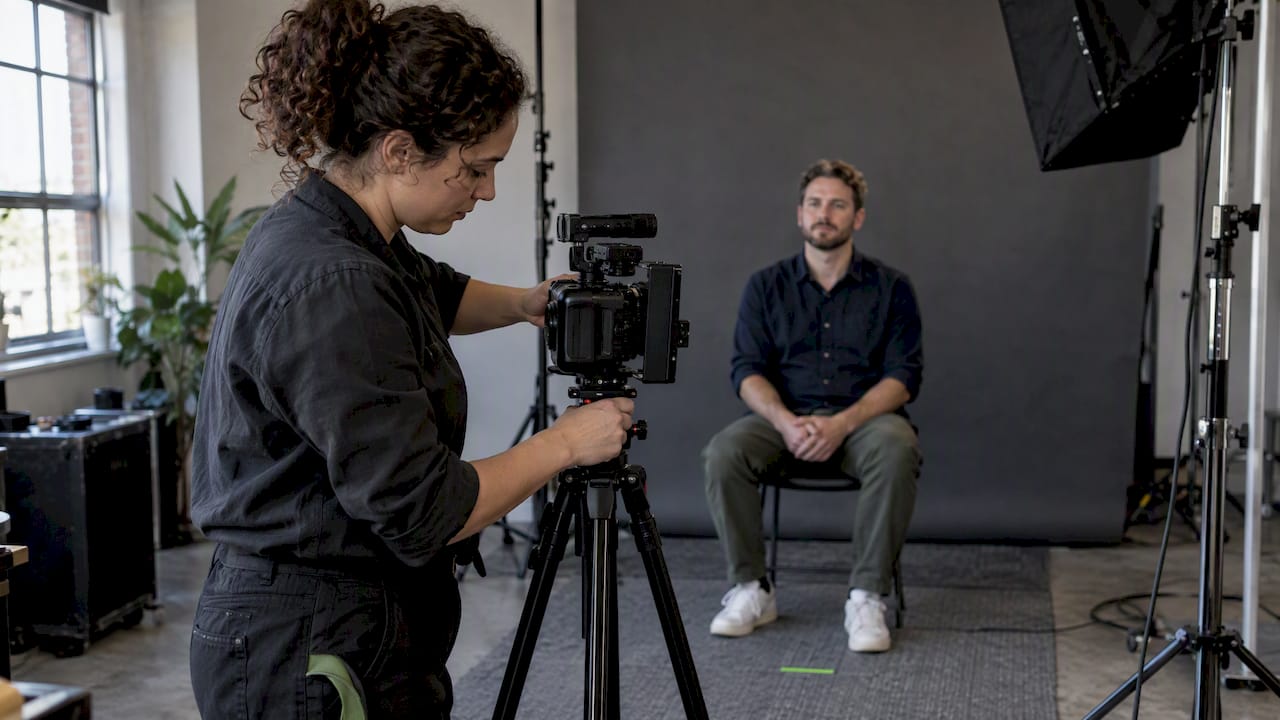

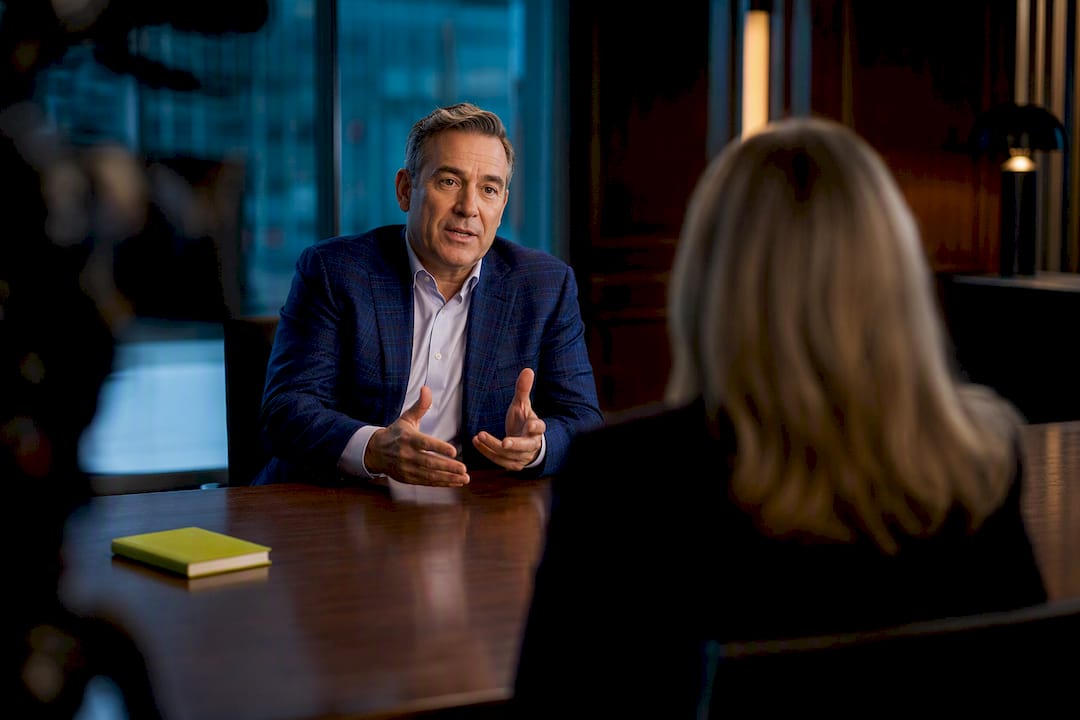

The corporate video types that consistently deliver results are brand/about films, explainer videos, product demos, promotional/social shorts, testimonials, training and onboarding videos, recruitment films, and event recaps. Pick among them by naming your primary business goal first, whether that’s awareness, consideration, conversion, hiring, or internal enablement, then match the format to that goal. Each type carries its own runtime, distribution channel, and budget range, which we break down next.
TL;DR:
- Explainer videos and product demos are most effective for converting leads and should focus on clear calls to action and highlighting key workflows.
- Brand films and event recaps require higher budgets, longer timelines, and benefit from repurposing footage into multiple social and short-form assets.
- Prioritize long-form educational content like webinars or brand films for 2026, pairing them with short social cuts to maximize impact and reach.
- Production costs commonly start around $1,000 for simple videos and can exceed $50,000 for comprehensive live-action projects, with timelines from 1 to over 12 weeks.
- Confirm your video’s purpose, target audience, and repurposing plan early to ensure the content aligns with your goals and feeds ongoing marketing efforts.
Table of Contents
- Corporate Video Types Explained: What Each One Does Best
- How Do You Choose the Right Corporate Video Type?
- What Do Corporate Videos Cost and How Long Do They Take?
- How Idea Stream Marketing Produces Corporate Video
- Which Video Types Deserve Priority in 2026?
- Ready to Turn These Video Types Into a Real Campaign?
- Sources
- FAQ
Corporate Video Types Explained: What Each One Does Best
Every corporate video type solves a different business problem, and confusing them is the fastest way to waste a production budget. Here’s how the eight main types break down, along with the practical details you need before briefing a producer.
- Brand/about films. These tell your company’s origin story and values, usually running 1 to 3+ minutes. They belong on your homepage and in investor presentations, shot as narrative live action. Cost sits medium to high because they demand real storytelling craft. Pro Tip: Plan your shoot day to capture extra footage you can repurpose into three or four shorter social cuts, following practical tactics for turning video assets into a distribution plan. (Maximizing Your Content Strategy | Creator Guard)
- Explainer videos. Built to clarify what your product or service actually does, these run 30 to 120 seconds using animation or screencast. Cost is low to medium, and B2B marketers lean on them heavily because they translate complex ideas into decisions, with usage rates cited at 45 to 73 percent across major B2B reports. Prioritize a tight script and a single clear call to action over flashy animation.
- Product demos. These show your product in actual use, running about one to three minutes through screen capture blended with real product footage. Track demo-to-trial conversion as your KPI, and highlight the two or three workflows prospects care about most rather than every feature you’ve built.
- Promotional and social shorts. Built for awareness and engagement, these run 6 to 60 seconds on TikTok, LinkedIn, and YouTube Shorts. Sixty-nine percent of video marketers created social video in 2026, making it the single most common format in the industry. Design every cut for silent autoplay with captions baked in, since most viewers scroll with the sound off.
- Testimonial and case study videos. These provide social proof during the consideration stage, typically 60 to 180 seconds combining interview footage with supporting B-roll. Testimonial content drives outsized engagement compared to standard product videos, but only when you capture specific outcomes and real numbers instead of vague praise.
- Training and onboarding videos. Built for internal enablement, these work best as modular segments rather than one long file, using talking-head, screencast, or interactive formats. Completion rate is your KPI. Add captions and export LMS-friendly files, since even small teams can produce effective onboarding content cheaply this way.
- Recruitment and employer brand videos. These support hiring and retention, running 1 to 3 minutes through day-in-the-life footage or employee interviews. Authentic voice beats polish here. Concrete benefits and real employee stories outperform scripted corporate messaging every time.
- Event recap and launch videos. These amplify the energy of a live event after the fact, running 1 to 4 minutes with fast, high-energy edits. Pull individual clips from the raw footage for social teasers, since a single event shoot can fuel weeks of secondary content.
Live action remains the most commonly produced style overall, followed by animation and screen-recorded formats, so most of these types default to real footage unless the content is inherently technical or abstract.
How Do You Choose the Right Corporate Video Type?
Start with the goal, not the format. A three-step framework keeps the decision simple:
- Define one primary goal and its KPI. Awareness, lead conversion, onboarding speed, and hiring quality each point to a different video type, and trying to serve two goals in one video usually serves neither well.
- Match format to goal and audience. A cold prospect needs an explainer or a promotional short; a warm lead close to deciding needs a testimonial or product demo.
- Choose your production style and repurposing plan before filming. Decide up front whether footage gets cut into training modules, social teasers, or both, because that decision changes how you shoot.
Before signing with a producer, ask about audience demographics, the distribution plan, deliverable formats (including captions and raw masters), the repurposing plan, revision terms, usage rights, and a realistic timeline. A video content checklist helps keep these questions organized before a kickoff call.
Pro Tip: If a vendor can’t describe how they’ll repurpose your footage into two or three additional assets, that’s a red flag. So is a scope of work with no captioning or SEO plan attached.
What Do Corporate Videos Cost and How Long Do They Take?
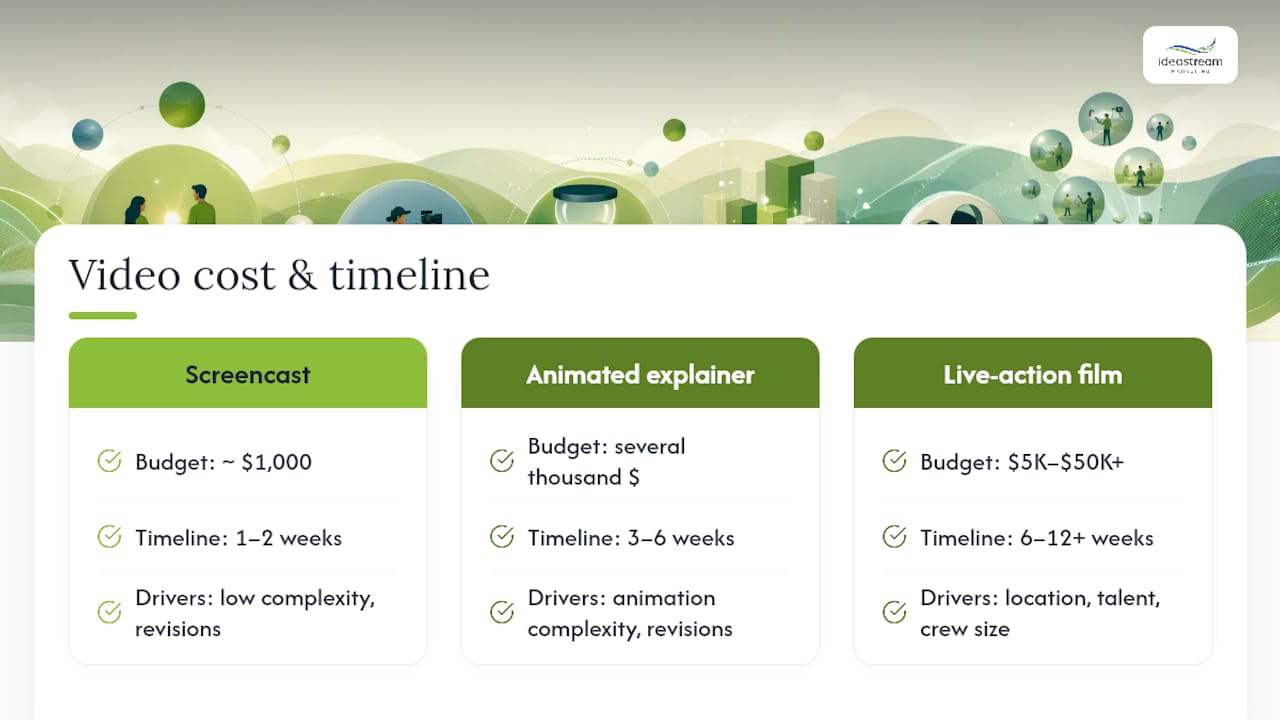
Budget and timeline scale directly with production complexity. A basic screencast or talking-head video often starts near a thousand dollars and can ship in 1 to 2 weeks. An animated explainer typically runs several thousand dollars with a 3 to 6 week turnaround, while a polished live-action brand film ranges from $5,000 to $50,000 or more, taking 6 to 12+ weeks from concept through final delivery. Event coverage varies widely depending on scope and crew size. The biggest cost drivers are animation complexity, location and talent fees, the number of interviewees, music licensing, and how many rounds of revisions you’ve built into the contract.
How Idea Stream Marketing Produces Corporate Video
Idea Stream Marketing handles the full production cycle: concept development, scripting, filming, drone cinematography, editing, motion graphics, captioning, and final delivery across formats. Every video gets built with video SEO in mind from the first script draft, not bolted on afterward, so client videos rank on YouTube and Google while feeding a repurposing plan that turns one shoot into weeks of usable content.
Which Video Types Deserve Priority in 2026?
Educational, product, social, and webinar formats are pulling the most investment and impact right now, and that’s not a coincidence. These four formats do double duty, educating prospects while directly supporting pipeline. If you’re prioritizing, pair one reusable long-form asset per campaign, a brand film or webinar, with a steady stream of short-form social cuts pulled from it.
— Dean
Ready to Turn These Video Types Into a Real Campaign?
Reading about eight corporate video types is one thing. Actually defining your goal, matching it to the right format, and building a repurposing plan that stretches one shoot across months of content takes a production partner who’s done it before.
Idea Stream Marketing works through the same framework covered above on every project: we start by pinning down your primary goal and KPI, then map the deliverables, caption files, and repurposing plan before a camera rolls. Whether you need a promotional or social video campaign or a training video library built for your LMS, our in-house studio handles scripting through final delivery with discoverability built in from day one. Reach out for a project quote and we’ll help you figure out exactly which video type fits your budget and timeline.
Sources
- State of Video in 2026: Video Marketing Statistics & Insights from Wistia (hosted on HubSpot blog)
- B2B video marketing statistics for 2026: A comprehensive analysis
FAQ
What Are the Main Types of Corporate Videos?
The main types are brand/about films, explainer videos, product demos, promotional and social shorts, testimonials, training and onboarding videos, recruitment videos, and event recaps, each tied to a distinct business goal.
Which Corporate Video Type Generates the Most Leads?
Explainer videos and product demos consistently drive strong returns for B2B marketers, while webinars remain a top lead-generation format with a lower cost-per-lead than many paid channels.
How Much Does a Corporate Video Cost?
Costs range from around $1,000 for a basic screencast to $50,000 or more for a polished live-action brand film, depending on complexity, talent, and location.
Should I Choose Live Action, Animation, or a Screencast?
Choose live action for brand storytelling and testimonials, animation for abstract or technical explainer content, and screencast for software demos and training modules where budget and speed matter most.
How Long Does Corporate Video Production Take?
Simple projects like screencasts can ship in 1 to 2 weeks, while a full brand film with location shoots and multiple revision rounds typically takes 6 to 12 weeks or longer.

