



October 16, 2026
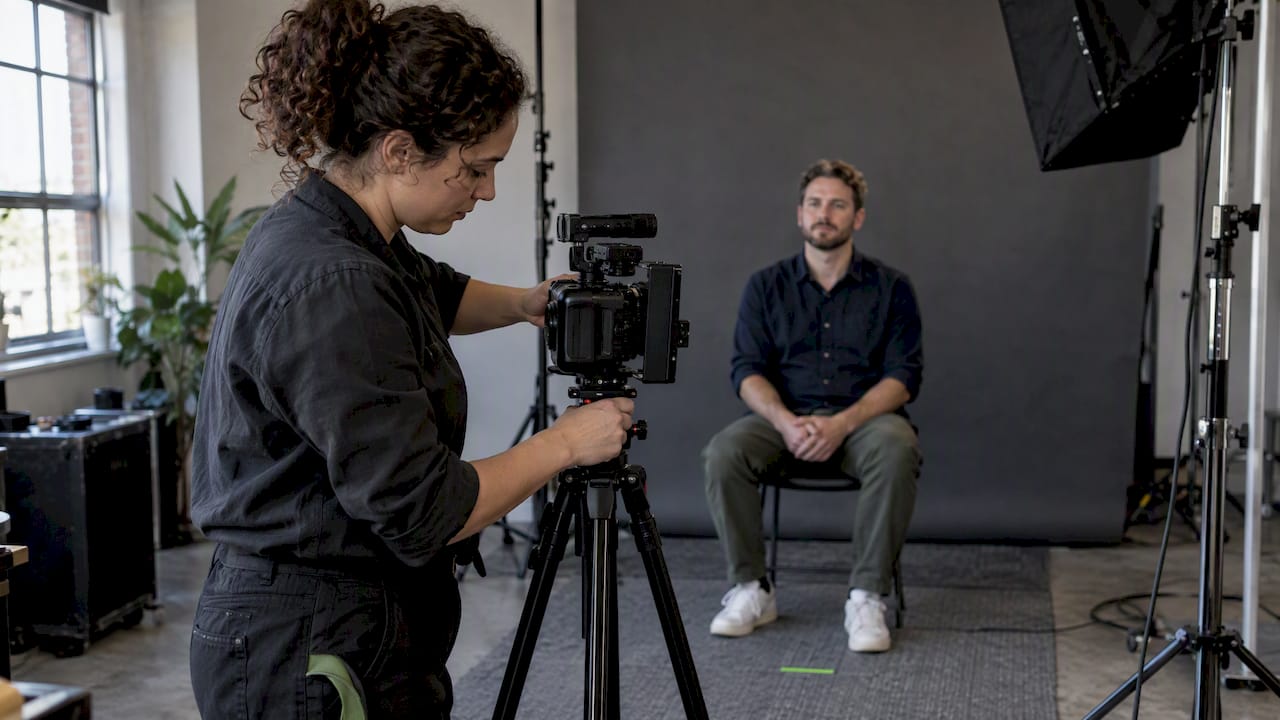
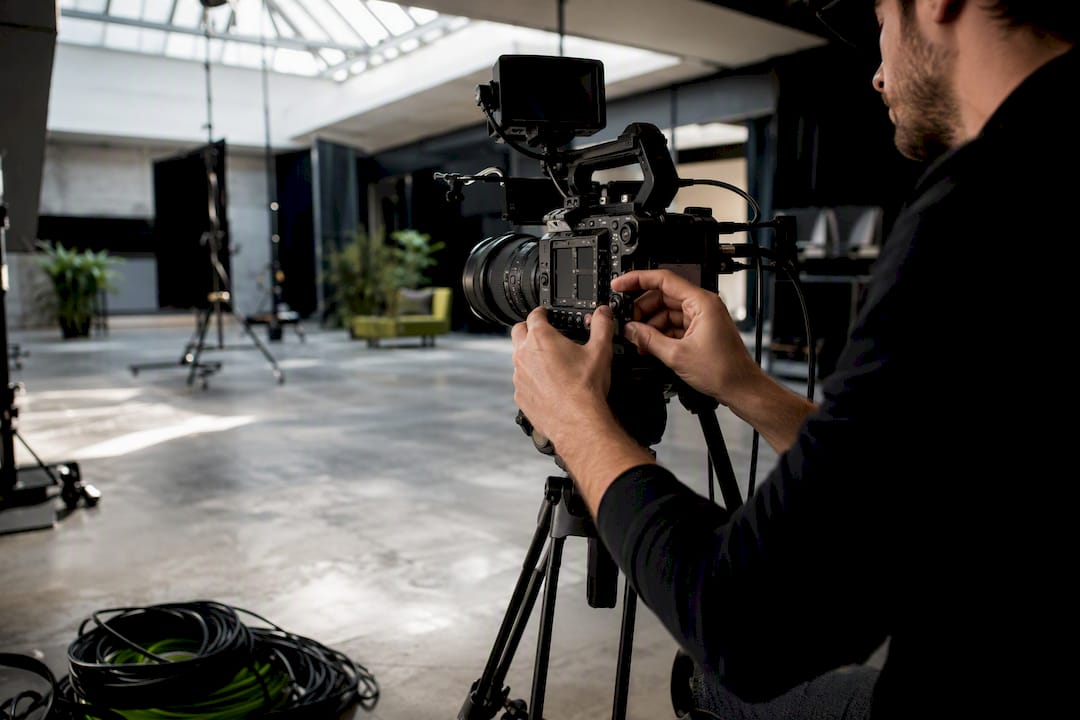
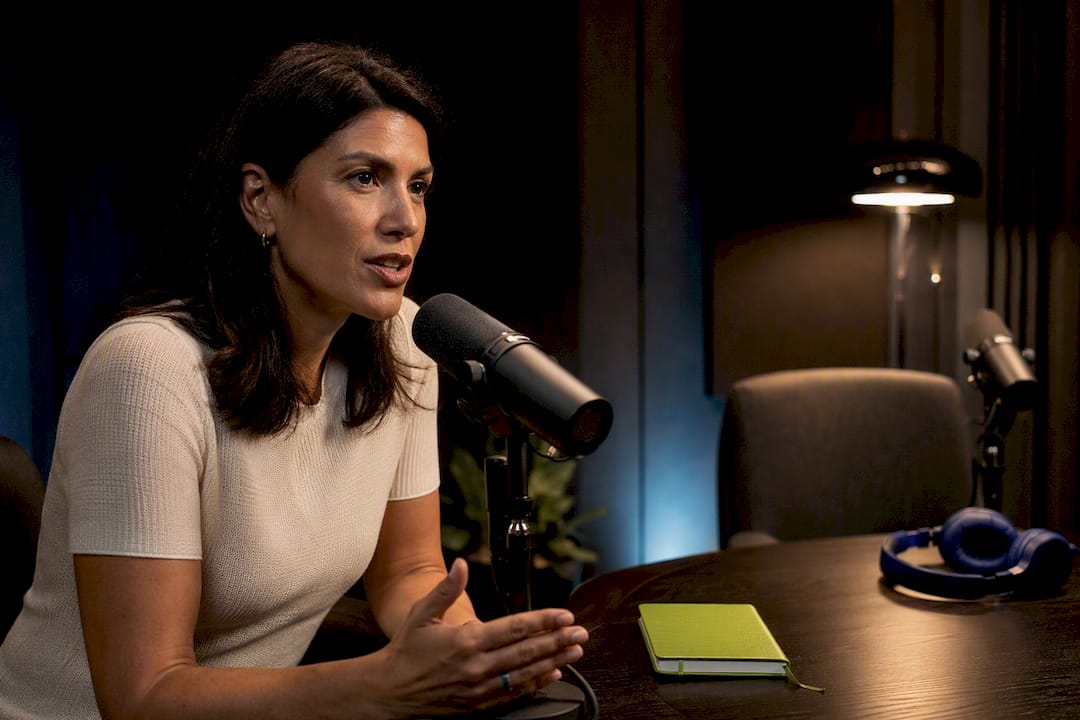

The best corporate interview videos come from objective-driven questions, pristine audio, and an edit-first shooting plan built around a clear repurposing outline. Every question should trace back to a marketing goal, every session should produce both short social cuts and a full-length master, and every shoot should assume the footage will get sliced a dozen different ways before it ever reaches a viewer. This is the production discipline our team at Idea Stream Marketing applies on every shoot, and it’s the standard the rest of this guide walks through.
TL;DR:
- Questions must be directly aligned with marketing goals to ensure footage is useful across multiple formats and platforms.
- Interviewers should limit their talk time to stay under 30 percent to elicit more authentic and valuable answers from subjects.
- Proper lighting, audio, and shooting at 4K with a shallow depth of field create a polished look without needing expensive gear.
- Prioritizing the brief, question design, and talk-time discipline upfront produces more usable footage than focusing primarily on camera equipment.
- Build a comprehensive asset map and repurposing plan before shooting to maximize ROI with full-length videos, social clips, and quote cards.
Table of Contents
- What Are Corporate Interview Videos and When Should You Use Them?
- Pre-production Checklist: Brief, Questions, and Releases
- How Do You Direct an Interview to Get Authentic Answers?
- Camera, Lighting, and Audio Setup for a Cinematic Look
- Making the Most of a Time-Limited Interview
- Editing, Pacing, and Video SEO for Interview Footage
- Distribution and Repurposing: One Interview, Many Assets
- Why This Approach Comes From Real Production Experience
- The Editorial Take: What Most Guides Get Wrong About Interview Videos
- Ready to Produce Your Own Corporate Interview Video?
- Sources
- FAQ
What Are Corporate Interview Videos and When Should You Use Them?
Corporate interview videos are on-camera conversations with employees, executives, or customers that a business turns into marketing assets, whether that’s a customer testimonial, a brand story piece, a thought-leadership clip, or a recruitment video. The format you choose should map directly to the business goal, because the objective shapes everything downstream, from the questions you ask to how you shoot and cut the footage; for specialized tips on messaging to public-sector audiences, see general advice for gov marketing.
Match the interview type to what you’re actually trying to accomplish:
- Testimonials build proof and typically run 60 to 90 seconds for social, with a 3 to 5 minute version for the website.
- Brand story videos build trust and usually need 3 to 10 minutes of narrative arc, cut down into 15 to 30 second teasers.
- Thought leadership extends reach and works best as short, quotable clips under a minute paired with a longer podcast-style cut.
- Recruitment videos support hiring and perform well as a mix of 15 to 60 second vertical clips and a 2 to 3 minute full piece.
Naming the outcome before you write a single question is what separates footage that gets used from footage that sits on a hard drive.
Pre-production Checklist: Brief, Questions, and Releases
A one-page brief is the single highest-leverage document in the whole production. Tie every planned question to a specific marketing KPI, whether that’s website conversions, applicant volume, or social engagement, so nobody wastes camera time on questions that sound interesting but don’t serve the goal.
Question design should mix three types: scripted lines for exact phrasing you need verbatim, narrative prompts that invite storytelling, and behavioral examples that force specifics. Scenario-based prompts, like asking what someone would do in their first 30, 60, or 90 days in a role, reveal thinking and reduce rehearsed answers far better than generic “tell me about yourself” openers.
Before the shoot day, lock down:
- A prioritized question list marked must-have versus nice-to-have.
- A timed run sheet mapping questions to minutes.
- A shot list and B-roll plan.
- Signed consent and release forms.
- A transcript plan so captions and metadata aren’t an afterthought.
Our video content checklist for marketing pros covers this exact workflow in more detail if you want a reusable template.
Pro Tip: Build your run sheet backward from your tightest must-have shot. If the exec cancels early, you’ll have already captured the soundbite you can’t afford to lose.
How Do You Direct an Interview to Get Authentic Answers?
The interviewer’s job is to disappear. Ask behavioral questions and push for specifics, “what exactly did you do?” rather than “how did that go?”, and avoid leading questions that hand the subject an answer to agree with. Leading questions produce stiff, canned soundbites that feel scripted on camera even when they weren’t.
Watch your own talk time. Interviewers in recorded sessions often speak 55 to 70 percent of the total airtime, which crowds out the subject and weakens the material you actually need. Aim for the interviewer to stay at or under the recommended threshold of total talk time. That single adjustment produces cleaner, more usable answers because the subject fills the space instead of reacting to your commentary.
A few techniques that consistently help:
- Run a 60 to 90 second warm-up before rolling. Ask something unrelated to the topic to burn off nervous energy.
- Use structured follow-ups rather than improvised tangents. Consistent question rubrics convert interviews into reliable, usable data instead of a pile of loosely related quotes.
- Let silence sit. Nervous interviewers jump in to fill gaps; subjects often say their best line right after a pause.
- Repeat the question back in your subject’s own words if they trail off, so you can re-ask cleanly without leading.
Interviewers who talk too much also tend to drift into anecdotal storytelling instead of steering the subject toward a clear, editable answer. A stopwatch on your phone is a low-tech fix that works.
Camera, Lighting, and Audio Setup for a Cinematic Look
You don’t need a feature-film budget to get a cinematic interview. You need the right priorities, in the right order: audio first, lighting second, camera third.
For camera and lens choices, shoot at 24 or 30 frames per second in at least 4K, even if the final delivery is 1080p, since it gives you cropping room for vertical social cuts. A lens choice that produces shallow depth of field separates your subject from the background and reads as polished rather than corporate-flat.
Lighting has two reliable paths. A simple two-light interview kit, one key light softened through a diffusion panel and one fill to control shadow density, covers most conference rooms and offices. A 3-point cinematic alternative adds a background or rim light to separate the subject from the wall behind them, which matters more than people expect in shallow, uninteresting office spaces.
Audio is where corporate videos are won or lost:
- A lavalier mic clipped close to the collarbone, backed up by a shotgun mic on a boom or stand.
- An inline recorder capturing a redundant audio file separate from the camera.
- Active monitoring through headphones during the actual take, not just a sound check beforehand.
Pro Tip: If you can only upgrade one piece of gear, upgrade audio. Viewers forgive a mediocre wide shot far more readily than they forgive audio that hisses, echoes, or clips.
Keep consistent headroom, a natural eye line just off-lens, and matching white balance across cameras if you’re shooting multi-camera setups. Continuity mistakes are the fastest way to make a polished interview look amateur in the edit.
Making the Most of a Time-Limited Interview
Executives rarely give you more than 30 to 60 minutes, so structure the block around capturing your most valuable material first, not last.
- First 10 minutes: camera checks, mic levels, and the 60 to 90 second warm-up conversation.
- Next 15 to 20 minutes: must-have questions tied directly to your marketing KPI, captured as clean, isolated takes.
- Following 15 to 20 minutes: nice-to-have questions and any behavioral follow-ups that add color.
- Final 5 to 10 minutes: safety shots, silent B-roll of the subject at their desk or workspace, and a beauty pass of the room.
If the schedule slips, and it usually does, cut from the bottom of that list up, never from the top. Staying calm and sticking to the priority order is what keeps a shortened session from becoming a wasted one.
Editing, Pacing, and Video SEO for Interview Footage
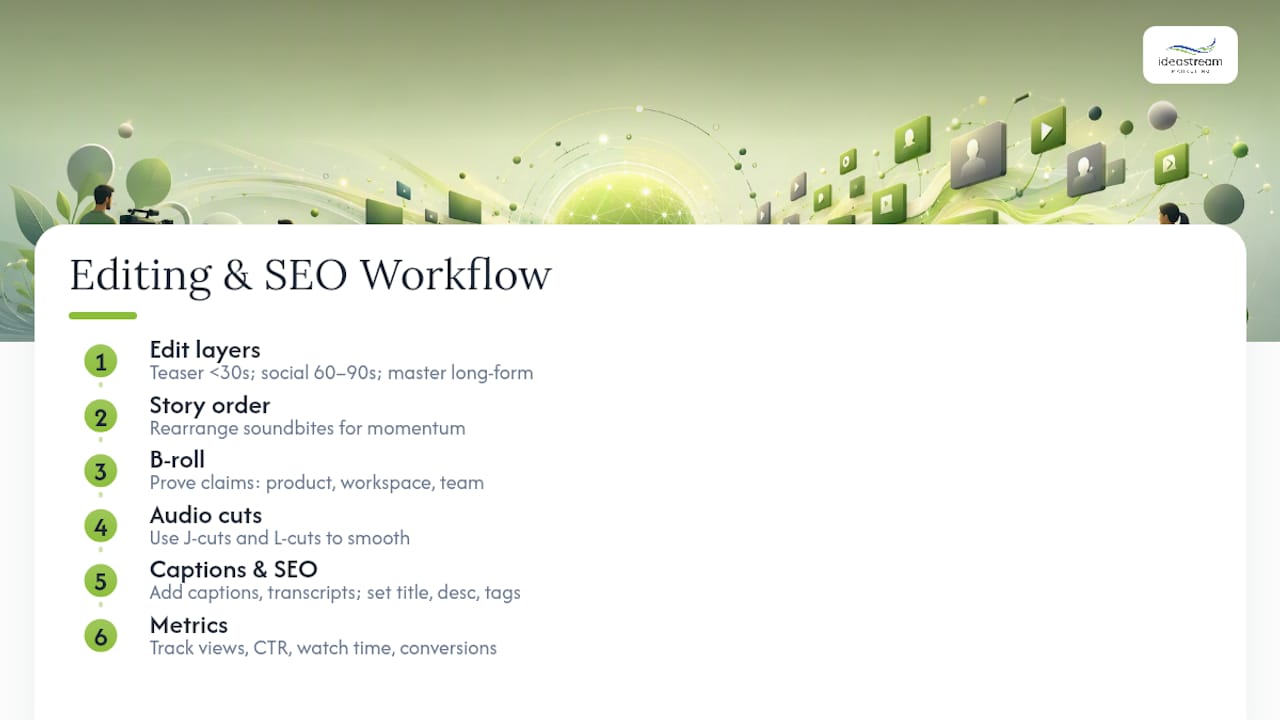
Structure your edit in layers: a teaser under 30 seconds, a handful of short social clips between 60 and 90 seconds, and a long-form master that assembles the strongest soundbites into a narrative arc. Build the story from the answers, not the question order; the best edits rearrange soundbites to create momentum the actual conversation didn’t have.
Use B-roll to prove claims rather than just decorate them, showing the product, the workspace, or the team you’re describing. J-cuts and L-cuts, where audio from one clip leads into or lingers under the next visual, keep pacing smooth and hide edit points.
Captions and full transcripts are non-negotiable at this point. Captioned, transcribed video improves both accessibility and search discoverability across YouTube, LinkedIn, and Google. Populate your title, description, tags, and chapter markers before you publish, and choose a thumbnail with a clear facial expression, since it consistently outperforms a static logo card.
Track a small set of metrics after launch: views, click-through rate, average watch time, and downstream conversions. If watch time drops sharply in the first 15 seconds, your teaser cut needs work before you touch anything else.
Distribution and Repurposing: One Interview, Many Assets
A single well-shot interview should generate far more than one video. Build your asset map before the shoot so nobody scrambles afterward:
- Full-length master for the website and YouTube.
- One to three minute cuts for LinkedIn, framed around a single theme each.
- 15 to 60 second vertical clips for Instagram Reels, Facebook Reels, TikTok, and YouTube Shorts.
- Audiograms and quote cards pulled straight from the transcript for feed posts.
The workflow runs transcript first, then highlight selection, then short edits, then captions, then a distribution schedule spread across a week or two rather than dumped all at once. Test different thumbnails and calls-to-action on your top clips, and put UTM-tracked links in bios and descriptions so you can see which platform actually drives conversions instead of guessing. This same repurposing logic applies directly to podcast production, where a single recorded episode can be sliced into weeks of short-form clips across every platform your audience actually uses.
Why This Approach Comes From Real Production Experience
Idea Stream Marketing pairs hands-on video production with AI-driven SEO, which means every interview we shoot is built to perform in search and social from day one, not just look good in a sizzle reel. Our team has applied this exact workflow across recruitment videos that fill open roles faster and brand story videos that build long-term trust with prospective customers.
A typical production package includes a discovery call, a written brief, a half-day or full-day shoot, and a deliverable set built for reuse: a full master, three to five short social cuts, a transcript, and SEO-ready metadata. That standardized list keeps approvals fast and avoids the scope creep that stalls so many corporate video projects before they ever launch.
The Editorial Take: What Most Guides Get Wrong About Interview Videos
Most advice on corporate interview videos focuses obsessively on gear, which lens, which light kit, which mic, and almost never on what happens after the camera stops rolling. That’s backward. The research on interview quality points somewhere else entirely: talk-time discipline and question structure predict usable footage far more reliably than any piece of equipment does.

The conventional wisdom also treats the shoot as the finish line. In practice, the shoot is the raw material stage. If you walk in without a repurposing plan already mapped out, you’ll capture 45 minutes of decent footage and turn it into one video, when the same session could have produced a master, five social clips, and a quote-card series with almost no extra shoot time.
Prioritize the brief and the question design first. Prioritize talk-time discipline second. Treat gear as the third concern, not the first. Businesses that flip that order end up with beautiful footage nobody edits into anything useful, because nobody planned what to do with it. The camera settings matter less than most people think. The plan for the footage matters more than almost anyone accounts for.
— Dean
Ready to Produce Your Own Corporate Interview Video?
Idea Stream Marketing is the practical alternative to piecing together a freelance crew, a separate editor, and a third vendor for captions and metadata. We handle concept development, filming, editing, and SEO-ready deliverables under one roof, which means your interview video is built to rank and convert from the first planning call, not patched together after the fact. When you book a session, expect a discovery call to define your objective, a scheduled shoot day built around a timed run sheet, and a delivery package that includes your full master, short social cuts, and transcript.
If you want a head start before your shoot, ask our team for a production checklist when you schedule a consultation or reach out through our contact page to talk through your project timeline and goals.
Sources
- Interviewing biases (Cornell HR)
- 25 interview questions to ask when hiring a VP of Marketing (JRG Partners)
- Strategic interview prompts that actually expose marketing leadership (DemandLoops)
- The interviewer who talks too much (HR Job Interviews)
FAQ
What Are the 5 C’s of a Good Interview Question?
There’s no single agreed-upon framework, but strong corporate interview questions are generally clear, concise, contextual, candid-inviting, and connected to a specific marketing goal.
What Is the 30-60-90 Rule for Interview Questions?
It’s a prompting technique that asks a subject what they would do in their first 30, 60, or 90 days in a role or situation, which surfaces genuine thinking rather than rehearsed talking points.
What Is the 80/20 Rule in Interviewing?
The subject should account for roughly 80 percent of the talk time while the interviewer stays near 20 to 30 percent, since interviewers who dominate the conversation weaken the usable material they walk away with.
What Is the Biggest Red Flag in a Corporate Interview Shoot?
A subject giving vague, generic answers without specifics is the clearest warning sign, and it usually means the interviewer asked leading or overly broad questions instead of behavioral, detail-forcing ones.
How Long Should a Corporate Interview Video Be?
It depends on the platform: aim for 15 to 60 seconds for vertical social clips, 60 to 90 seconds for LinkedIn or testimonial cuts, and 3 to 10 minutes for a full-length brand story or website master.

