



October 5, 2026



Agency-managed podcast distribution combines professional studio production with technical RSS and platform management plus video-first repurposing to make each episode a measurable lead-generation asset. This approach covers everything from recording through submission to Apple Podcasts and YouTube, plus editing full episodes into social clips. We recommend this model for businesses that need reliability, polished video packaging, and results they can actually track.
TL;DR:
- Agencies handle technical complexities like RSS feed validation, artwork compliance, and platform-specific submission processes to ensure episodes go live smoothly.
- Video-first distribution boosts credibility and reach, with over half of U.S. listeners aged 12 and up consuming video podcasts, making professional production essential.
- The full workflow from preproduction to social repurposing typically takes several stages, with emphasis on quick turnaround times and reliable validation.
- Contract negotiations should clarify ownership of files, inclusion of social clips, and guaranteed publishing timelines to avoid delays or disputes.
- Using an agency adds value through integrated SEO, schema markup, and optimized metadata, increasing discoverability on search engines and discovery platforms.
Table of Contents
- What’s Included in a Professional Distribution Package
- Why Businesses Hire Agencies for Distribution
- The Technical Rules Agencies Handle Behind the Scenes
- How Agencies Move an Episode From Recording to Publishing
- How to Choose an Agency and What to Put in the Contract
- Our Approach to Studio Production and AI-Driven Discoverability
- Ready to Put Your Podcast in Front of More Buyers
- FAQ
- Sources
What’s Included in a Professional Distribution Package
A proper agency package starts well before recording. Preproduction planning sets episode briefs, guest questions, and a content calendar so every session has a clear purpose. From there, the work moves into capture, either in a studio with multi-camera video or through managed remote recording when guests join from elsewhere.
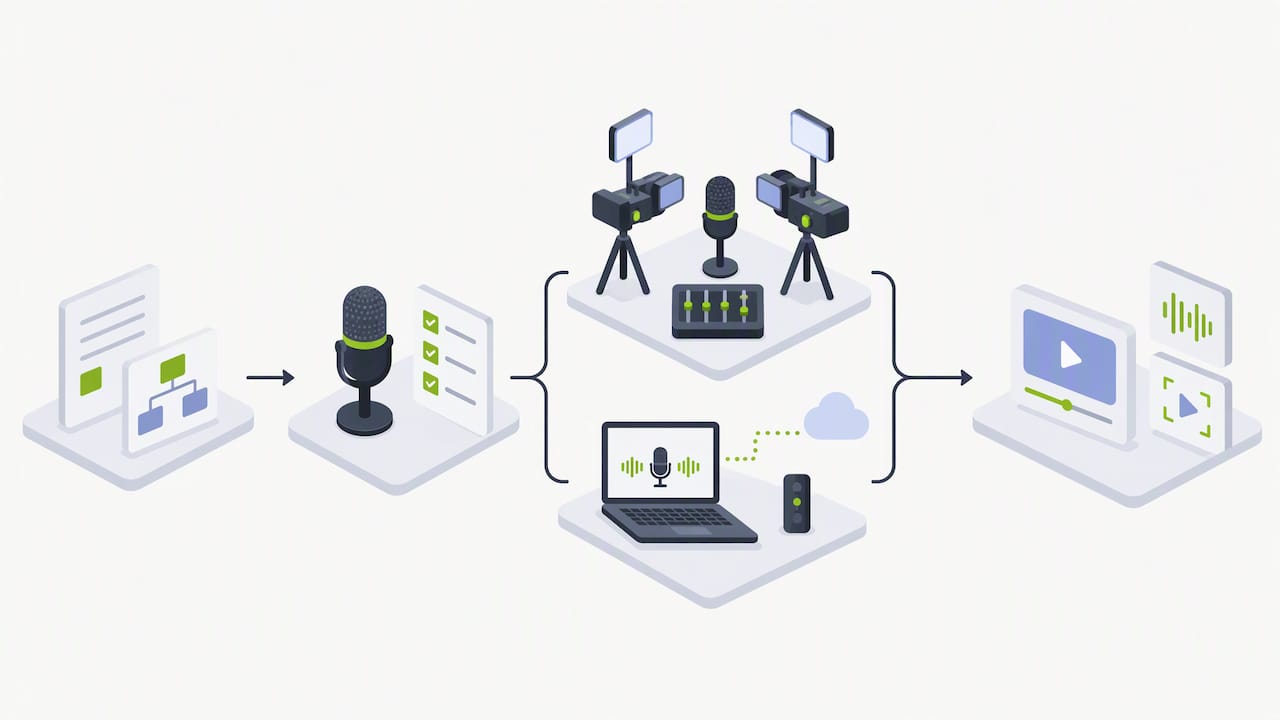
Postproduction is where most of the value gets built: audio mixing, full video editing, captions, and transcripts all come standard. Then comes the technical layer that most business owners never see: RSS feed management, metadata and artwork formatting, and submission to platforms including Apple Podcasts Connect validation and YouTube’s RSS ingestion system.
A complete package typically includes:
- Preproduction briefs and guest coordination
- Studio or managed remote recording with video capture
- Audio mixing, video editing, captions, and transcripts
- RSS feed setup, artwork, metadata, and platform submissions
- Short-form clips, audiograms, and social scheduling
Pro Tip: Ask any agency you’re evaluating whether video capture is included by default, not as an add-on. It’s the foundation for every clip you’ll want later.
Why Businesses Hire Agencies for Distribution
The commercial case for agency-managed distribution comes down to reach, trust, and speed. Publishing both audio and video versions puts your show in front of listeners on Spotify and Apple while also reaching viewers who prefer YouTube, which now functions as one of the largest podcast discovery surfaces available.
Production quality matters more than most founders expect. A polished, well-lit video episode signals credibility the same way a clean website or a sharp commercial does, and that trust often carries directly into conversion.
Video podcast consumption is widespread among U.S. listeners aged 12 and up, according to Edison Research, which makes video-first packaging a practical requirement rather than a nice-to-have.
Key benefits of agency-managed distribution include:
- Wider reach across audio and video-first platforms simultaneously
- Higher perceived credibility from professional production value
- More touchpoints per episode through repurposed clips
- Fewer submission errors and faster time-to-publish
The Technical Rules Agencies Handle Behind the Scenes
Getting a podcast live on major platforms involves more technical plumbing than most business owners realize. Apple requires a properly formatted RSS 2.0 feed, including correct enclosure tags for file URL, length, and type, along with artwork that meets Apple’s size and format specs. The feed also has to be validated inside Apple Podcasts Connect before the show can go live.
YouTube works differently. Submitting an RSS feed to YouTube triggers automatic video uploads for each episode, but those uploads still need thumbnail optimization, correct video packaging, and compliance with YouTube’s content policies to perform well.
Common technical checkpoints agencies manage:
- Confirm the server supports HTTP HEAD and byte-range requests, which prevents playback and seeking failures
- Verify each episode has a stable, unique GUID so analytics stay accurate across edits and re-uploads
- Check artwork dimensions and file format against platform specs before submission
- Run the feed through a validator and review any Apple Podcasts Connect warnings before publishing
- Confirm region and content restrictions won’t block the episode after it goes live
Pro Tip: A malformed GUID is one of the most common reasons an episode shows up as duplicated or loses its listener history. It’s a small detail with outsized consequences.
How Agencies Move an Episode From Recording to Publishing
A repeatable production pipeline is what separates a reliable podcast partner from one that causes delays. The stages generally break down like this:
- Preproduction: build the editorial calendar, coordinate guests, and plan which moments will become standalone clips
- Recording: capture in-studio or via managed remote sessions, shooting extra footage specifically for repurposing
- Postproduction: edit audio and video, master sound levels, add captions and transcripts, and write SEO-friendly titles and descriptions
- Validation and submission: run RSS checks, clear Apple Podcasts Connect validation, confirm YouTube ingestion or manual upload, and set the publishing schedule
- Repurposing: cut short clips for Instagram Reels, Facebook Reels, TikTok, and YouTube Shorts, design custom thumbnails, schedule the social rollout, and track performance
This workflow keeps delivery formats consistent: mp3 for audio feeds and mp4 with chapter markers and captions for video, which speeds up editing and reduces turnaround time on every future episode.
A few things worth confirming with any partner:
- Whether raw footage is kept for future repurposing needs
- How quickly clips are delivered after the full episode drops
- Whether social scheduling is handled in-house or passed to another vendor
How to Choose an Agency and What to Put in the Contract
Not every “podcast agency” offers the same scope, so the selection process matters. Look for demonstrable video-first experience, real examples of successful platform submissions, a clear repurposing process, and some form of analytics reporting.
Pricing models vary. Some agencies charge per episode, bundling production and a set number of social assets into one fee; others work on retainer, which tends to fit businesses publishing weekly or biweekly. Either way, the quote should spell out exactly what’s included.
Before signing anything, confirm:
- Who owns the master recordings and final files
- Which delivery formats and how many revision rounds are included
- Who owns the hosting account and RSS feed if you ever switch vendors
- What turnaround time is guaranteed for publishing after recording
- Ask for sample deliverables from a comparable business client
- Ask how the agency handles a failed Apple or YouTube validation
- Ask for a written turnaround time from recording to live publish
Pro Tip: If an agency can’t explain what happens when a feed validation fails, that’s a sign they haven’t managed enough real submissions to anticipate the common failure points.
Our Approach to Studio Production and AI-Driven Discoverability
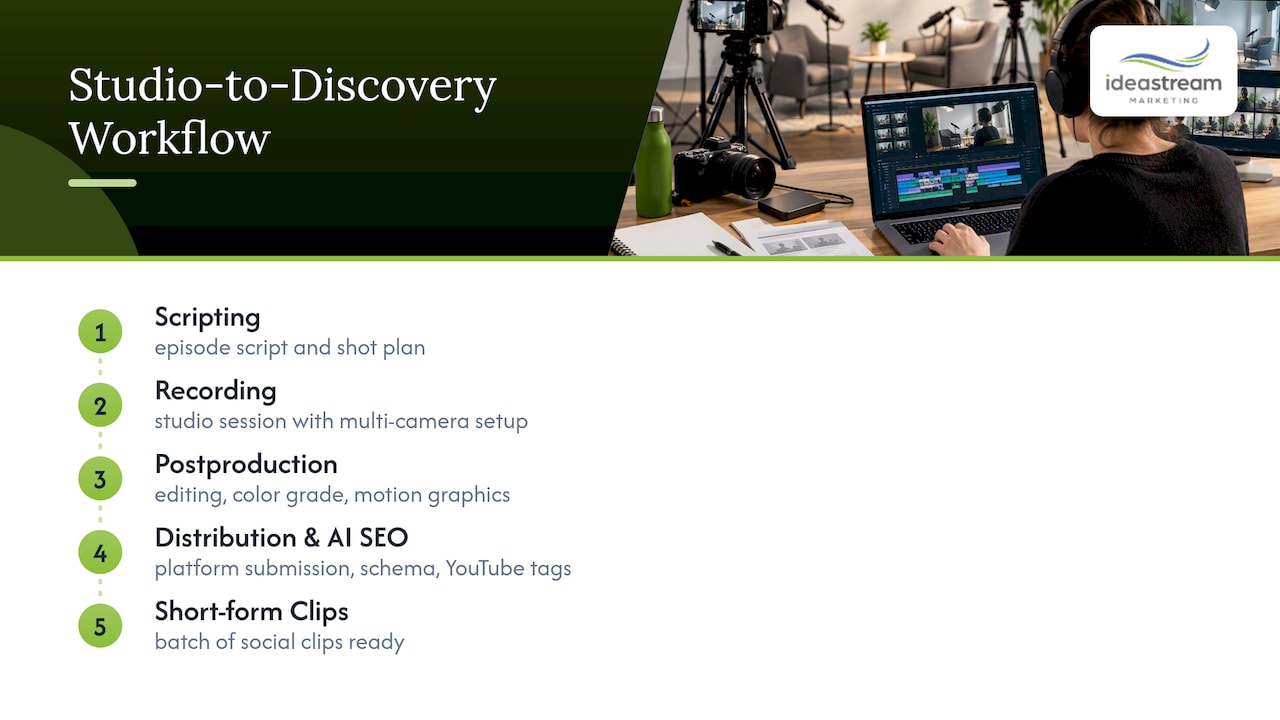
We handle scripting, multi-camera filming, professional editing, color grading, and motion graphics for podcasts we produce. We treat each episode as a content asset, not just an audio file.
Distribution is only half the job; partnering with services like PTT Music’s podcast distribution platform ensures your show also benefits from extended reach and music licensing options. We also build AI SEO, schema markup, and YouTube optimization into every episode’s metadata and landing page, which helps episodes surface in both traditional search and newer AI-powered discovery tools. A typical workflow starts with a recording session in our studio, moves through full postproduction and platform submission, and ends with a batch of short-form clips ready for social. You can see the full scope of this on our podcast production services page.
— Dean Spinato, CEO & Founder of Idea Stream Marketing
Ready to Put Your Podcast in Front of More Buyers
We built our podcast production process for business owners who want a show that actually generates leads, not just downloads. We handle recording and editing, manage platform submission and validation steps, and turn each episode into clips for Instagram Reels, TikTok, and YouTube Shorts.
What that looks like in practice:
- Studio-quality recording with multi-camera video capture
- Full RSS setup, platform submissions, and metadata optimization
- Short-form clips and thumbnails ready for social scheduling
- AI SEO and schema built into every episode landing page
If you’re ready to see what a full production and distribution plan looks like for your business, explore our podcast production services or reach out to schedule a consultation.
FAQ
What does agency-managed podcast distribution actually include?
It covers the full production cycle: recording, editing, RSS feed setup, platform submissions to places like Apple Podcasts and YouTube, and repurposing episodes into short clips for social media. A quality package also includes metadata and artwork optimization so episodes are easier to discover.
How long does it take to get a podcast live on Apple Podcasts and YouTube?
Timelines depend on how quickly the RSS feed passes Apple’s validation checks and whether YouTube’s ingestion runs without errors. A clean, properly formatted feed with correct artwork and tags typically moves through validation much faster than one with formatting issues.
Is agency-managed distribution better than self-publishing?
Self-publishing works for hobbyists, but agency management reduces technical errors, adds professional video production, and builds repurposing into the process from day one. For a business using a podcast to generate leads, the added production value and consistent publishing schedule tend to outweigh the lower cost of doing it alone.
What makes video-first podcast distribution worth the investment?
Video podcasts reach a wider audience and support clip-based repurposing across TikTok, Instagram Reels, and YouTube Shorts. Edison Research reports that over half of U.S. listeners age 12 and up have consumed a video podcast, which supports treating video as a default rather than an afterthought.
What should I ask a podcast agency before signing a contract?
Ask who owns the master files and RSS feed, what happens if a platform validation fails, and how many social clips are included per episode. You should also get a clear turnaround time in writing from recording day to the episode going live.
Sources
- Podcast RSS feed requirements – Apple Podcasts for Creators
- Publish podcasts to YouTube from an RSS feed
- The Podcast Consumer 2025 – Edison Research