






A business podcast gives your company a regular, focused way to build trust with the people you want as customers, show your expertise in your own words, and create content that works across search, video and social media. Done well, one conversation becomes a full episode, a video, a transcript page and a month of short clips. Below we cover the benefits that research supports, how each one works in practice, and what it takes to get them.
TL;DR
- Podcast audiences in the U.S. are at record highs, and video podcasts are now part of the mix, so a show can reach buyers on audio, YouTube and social platforms.
- In an Adobe survey of U.S. business owners who launched a podcast, 71% said it built deeper audience trust and 61% said it strengthened brand authority.
- Transcripts, episode pages and backlinks give a podcast real SEO value, and clips extend its reach on Reels, TikTok and YouTube Shorts.
- The shows that pay off have a clear audience, a repeatable production process and a plan to repurpose every episode.
Table of Contents
- Why a business podcast makes sense right now
- The main benefits of a business podcast
- Our perspective
- What separates podcasts that deliver from podcasts that fade
- How to repurpose each episode
- Who benefits most
- Turn your expertise into a show with Idea Stream Marketing
- FAQ
- Sources
Why a business podcast makes sense right now
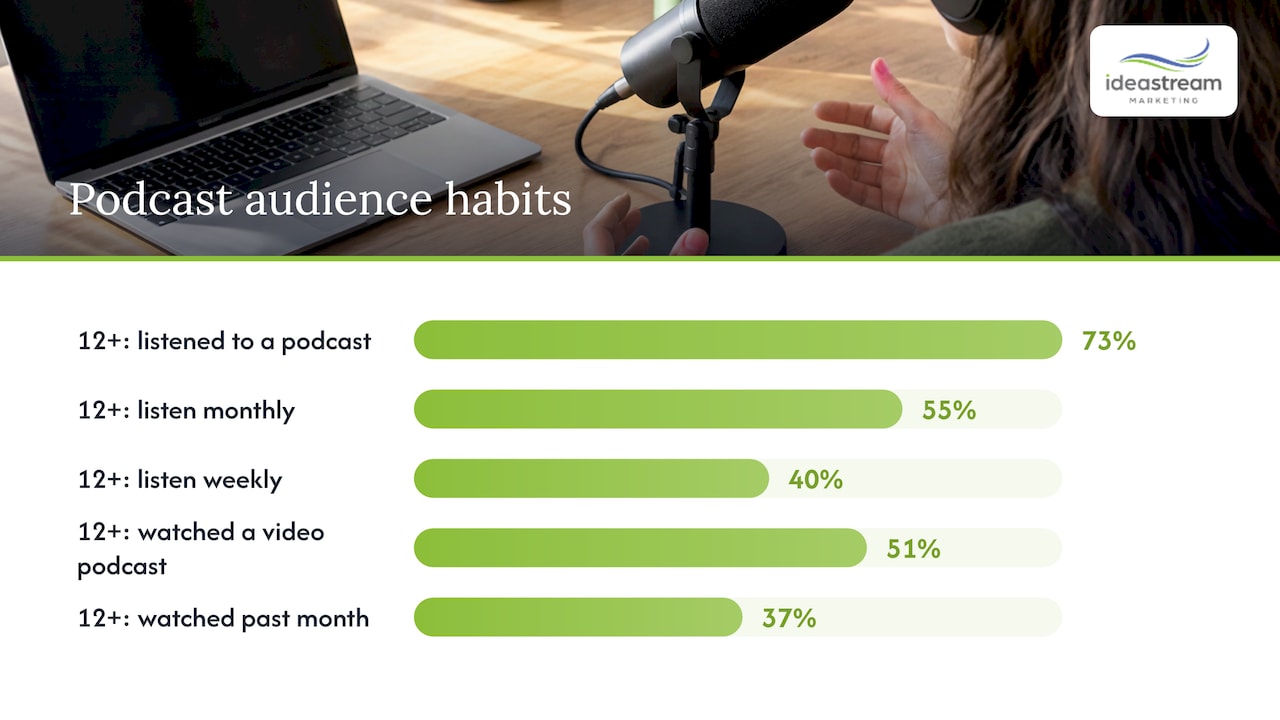
Listening habits have changed in your favor. Edison Research’s 2025 report found that 73% of Americans 12 and older have listened to a podcast, 55% listen monthly and 40% listen weekly, all record highs as of July 2025. The same research, summarized in Edison’s full report, estimates 158 million monthly consumers, up from 46 million in 2015.
Video matters too. According to Radio Ink’s coverage of the same study, 51% of Americans 12 and older have watched a video podcast, and 37% did so in the past month. That is good news for a business that records on camera, because the same session can feed an audio feed, a YouTube channel and social clips.
And the audience is paying attention. Podnews editor James Cridland told UNSW BusinessThink that up to 92% of podcasts are heard on headphones, which creates a focused, one-to-one listening experience. A listener who gives you 30 minutes of attention is a very different prospect from someone who scrolled past a banner ad.
The main benefits of a business podcast
Trust and credibility
Trust is the benefit business owners name most often. In Adobe’s survey of 903 U.S. business owners, 71% of those who launched a podcast said it built deeper audience trust, and trust was also the top reason owners gave for starting one. A study cited by Wistia found that 63% of people view the hosts of podcasts they listen to as trustworthy, and 80% trust those hosts’ recommendations.
Why does this happen? Long-form conversation is hard to fake. When a law firm partner explains how a probate case actually moves, or a contractor walks through what drives a remodel’s cost, listeners hear how you think. That builds confidence before a sales call ever happens.
Authority and expertise
In the same Adobe survey, 61% of owners who launched a podcast said it strengthened their brand authority. A podcast gives you a repeatable format for answering the questions customers ask most. Over a season, those answers add up to a body of work that positions you as the specialist in your market.
It also sharpens you. Preparing talking points and fielding a guest’s questions tends to improve how you explain your services in proposals, interviews and pitches.
Brand awareness
Nielsen brand lift benchmarks, reported by Radio Ink, show podcast campaigns producing on average a 10-point lift in brand awareness, an 8-point lift in information-seeking and a 6-point lift in purchase intent. Those figures describe podcast advertising, but they point to the same thing: the format moves people from unfamiliar to familiar to ready to buy.
An owned show works on that same principle over time. Each episode is another appearance in your audience’s day, in your voice, under your brand.
Relationships with clients, partners and referral sources
Guest episodes are one of the most underrated benefits. Inviting a client, a vendor, a local official or a referral partner onto the show gives you a reason to start a conversation, gives them exposure, and gives you a piece of content they will happily share with their own network. In Adobe’s survey, 54% of owners cited connecting with clients or partners as a reason to podcast.
A 2020 Linköping University thesis on B2B podcasting listed building relationships among five reasons companies podcast, alongside cost and time efficiency, active listening, branding and employer branding. That last one is worth noting: a show lets prospective hires hear your culture and your people.
Leads and sales
Podcasts influence buying behavior. Edison’s 2025 data, as reported by Radio Ink, shows 44% of weekly podcast listeners purchased a product after hearing a sponsorship or ad. The IAB’s creator economy guide cites a cross-channel attention study in which podcasts earned the highest attentive seconds per thousand impressions, at an attention CPM of $2.80 against $4.30 for all media on average.
For a service business, the lead path is usually indirect and very effective: a prospect hears several episodes, visits your website, and contacts you already knowing how you work. Give every episode a clear next step, such as a consultation link, a guide download or a booking page, so that interest has somewhere to go.
Search visibility
A podcast can strengthen your SEO in a few specific ways:
- Backlinks. Search Engine Land describes podcasts as a natural link-building tool, since guests and hosts tend to link to the episodes they appear on. It also reports a case where adding podcasts to a marketing strategy coincided with a 45% boost in qualified lead conversions and a 36.08% rise in revenue from organic search.
- Transcripts. In a This American Life case study, transcripts were associated with a 6.68% increase in search traffic and a 3.89% increase in inbound links.
- Authority links. A PodSEO analysis of 655,000 editorial podcast placements found high-authority sites link to podcast websites 69.2% of the time.
One caution on expectations: Google wound down playable podcasts in search results in 2023, so the search value comes from the pages you publish around each episode, not from the audio appearing in results. That is why we build episode pages with transcripts, summaries and schema. Our guide to podcast SEO covers the details.
A content engine for every channel
This is the benefit that changes the economics. A single recording session can produce:
- The full audio episode for Apple Podcasts, Spotify and other directories
- The full video episode for YouTube
- Short vertical clips for Instagram Reels, Facebook Reels, TikTok and YouTube Shorts
- A transcript and written recap for your website and blog
- Quote graphics and email newsletter content
- Audiograms and teasers for LinkedIn
Instead of thinking up new content every week, you record real conversations and let editing do the multiplying. We go further into where each format performs best in our piece on podcast distribution platforms.
Our perspective
We see the same pattern with business owners on Long Island and across New York. They are experts at what they do, and their best selling happens in conversation, on a job site, in a consultation, over coffee. A podcast captures that conversation and lets it work for you around the clock.
The mistake we see most often is treating a podcast as a standalone audio project. A show that lives only in a podcast app is easy to overlook. A show planned with video, short-form clips, transcripts and search in mind becomes a library that supports your website, your social channels and your sales team at the same time.
That is why we handle the whole chain: recording in a professional setting, editing, video, clips for Reels, TikTok and Shorts, episode pages and optimization for Google and AI search. When one team plans all of it from the start, every episode does more work for your brand.
Dean Spinato, CEO & Founder of Idea Stream Marketing
What separates podcasts that deliver from podcasts that fade
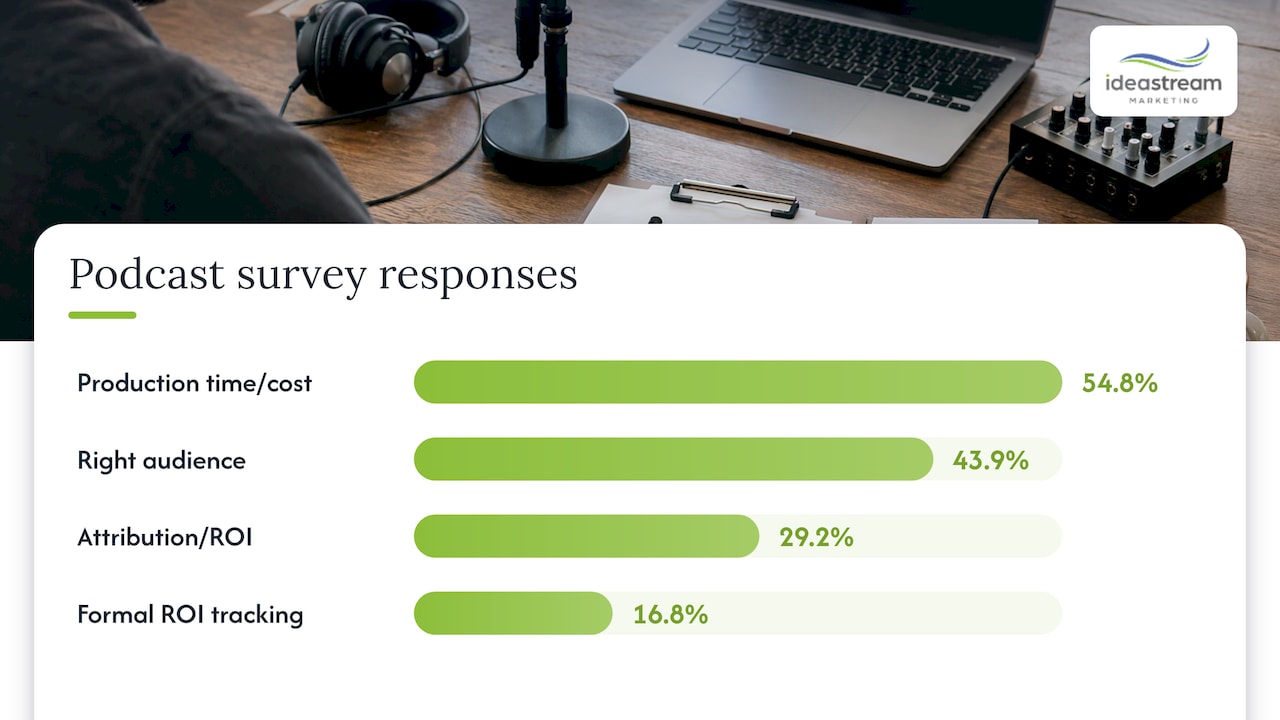
The benefits above are real, but they come from consistency and planning. A July 2026 PPC Land survey of podcast marketers shows where teams need to put their effort: 54.8% named production time and cost as a major concern, 43.9% named reaching the right audience, and 29.2% named measuring attribution and ROI. Only 16.8% track formal ROI. Each of those is a planning question you can answer before episode one.
Choose one audience and one promise
The Linköping thesis noted that reaching the right people matters more than reaching the masses. A Long Island estate-planning attorney does not need a million downloads. She needs a few hundred local families and referral partners who trust her. Write one sentence that names who the show is for and what they will get, and test every episode idea against it.
Make production repeatable
Production time is the most common stumbling block, so remove it from your plate. Set a recording schedule, batch several episodes per session, and hand editing, audio cleanup, video and clip creation to a team. Our podcast production services are built for exactly that, and our page on podcast video editing explains the post-production side.
Decide how you will measure it
Measurement is far easier when you decide it up front. Pick a small set of numbers: episode plays and watch time, website visits from episode pages, form fills or calls that mention the show, and the number of sales conversations where a prospect already heard an episode. Add a simple question to your intake form: “How did you hear about us?”
Promote every episode
Publishing is not promotion. Plan the clips, the email, the LinkedIn post and the guest’s share kit before you record. Our podcast marketing strategy page lays out how we approach audience growth.
How to repurpose each episode
Repurposing is where a business podcast pays back its production time. Here is a workflow you can follow for every episode:
- Record on camera. Capture video as well as audio, with clean sound and good framing. A professional podcast studio session makes this simple.
- Publish the full episode. Send audio to your podcast directories and the full video to YouTube with a clear title and description.
- Pull three to five clips. Look for a single complete idea of 30 to 60 seconds: a surprising answer, a practical tip, a short story. Reframe them vertically and add captions.
- Post clips on every short-form platform. Instagram Reels, Facebook Reels, TikTok and YouTube Shorts all accept vertical video, and each lets you point viewers to the full episode.
- Build the episode page. Publish an edited transcript, a summary, key takeaways, guest bio and schema markup on your site.
- Write the written asset. Turn the strongest topic into a blog post or a LinkedIn article, and quote the best line in an email to your list.
- Review and repeat. Check which clips drew the most views and watch time, and use that to choose your next topics.
A transcript is worth the effort. A Lower Street study of 200 B2B podcasts, cited by VOCAP, found that shows publishing edited transcripts had 47% more organic traffic and 3.2x more qualified leads than shows with only short show notes.
Who benefits most
The format suits a wide range of businesses, particularly those where trust drives the buying decision:
- Law firms and professional services: explain how processes work and answer the questions clients ask in a first meeting.
- Medical and healthcare practices: put approachable faces and plain-language explanations in front of patients.
- Contractors and home services: show your process, your crew and your standards.
- Real estate and hospitality: share local knowledge, market updates and behind-the-scenes stories.
- B2B companies and consultants: demonstrate expertise to long-cycle buyers and nurture them between meetings. Our guide on starting a business podcast walks through planning for this audience.
For a broader look at why timing matters, see why businesses should start podcasting now.
Turn your expertise into a show with Idea Stream Marketing
We are a Long Island video production company and digital marketing agency, and we produce business podcasts from first concept to final distribution. That includes recording, video editing, short-form clips for Instagram Reels, Facebook Reels, TikTok and YouTube Shorts, episode pages built for search, and the marketing around them. We work with business owners, executives and professionals on Long Island and throughout New York.
If you are ready to talk about a show for your company, schedule a consultation or studio session with our team. You can also read more about our podcast production approach first.
FAQ
What are the main benefits of a podcast for a business?
The best-supported benefits are deeper audience trust, stronger brand authority, more awareness and better relationships with clients and partners. In Adobe’s survey of U.S. business owners who launched a podcast, 71% reported deeper trust and 61% reported stronger authority. A podcast also feeds your SEO and social channels through transcripts, episode pages and clips.
Can a business podcast generate leads?
Yes, usually by building familiarity before a prospect contacts you. Listeners hear how you think, visit your site and arrive warmer than a cold inquiry. Add a clear call to action to every episode and track how new customers heard about you so you can connect the show to results.
Does a podcast help SEO?
It can. Episode pages with full transcripts give search engines more relevant content to index, and guests and partners often link to their episodes, which earns backlinks. Google no longer shows playable podcasts in search results, so the value comes from the pages you publish around each episode.
How do I turn podcast episodes into social media content?
Record on video, then edit three to five short vertical clips from each episode, each built around one complete idea. Add captions and post them as Instagram Reels, Facebook Reels, TikTok videos and YouTube Shorts, linking back to the full episode. A professional editing team can handle this for every episode so you stay consistent.
Do I need a video podcast or is audio enough?
Audio reaches commuters and people who listen while they work, but video opens up YouTube and short-form social platforms. Edison’s 2025 data shows 51% of Americans 12 and older have watched a video podcast. Recording both gives you the widest reach from the same session.
Sources
- The value of branded podcasts for businesses (Adobe Express)
- Podcasting as a Digital Marketing Tool (Linköping University thesis)
- How businesses can leverage podcasting for brand-building (UNSW BusinessThink)
- The Podcast Consumer 2025 (Edison Research)
- Podcast Listening Hits New Highs As Video Changes The Game (Podcast News Daily)
- Edison: Video Podcasts, Gen Z Fuel Record Audio Growth (Radio Ink)
- Nielsen: Podcast Ads Boost Brand Metrics Across Verticals (Radio Ink)
- 7 Great Reasons to Start a Podcast for Your Business (Wistia)
- Podcasting in the Creator Economy guide (IAB)
- How to use podcasts for natural link building (Search Engine Land)
- How Adding Transcripts Boosts Podcast SEO and Engagement (3Play Media)
- We Analyzed 655,000 Podcast Placements (PodSEO)
- Google winds down feature that put playable podcasts in search results (TechCrunch)
- Podcast adoption hits 44.9% but skepticism blocks the rest (PPC Land)
- Transcribe Podcast for SEO: 2026 Guide (VOCAP)

