



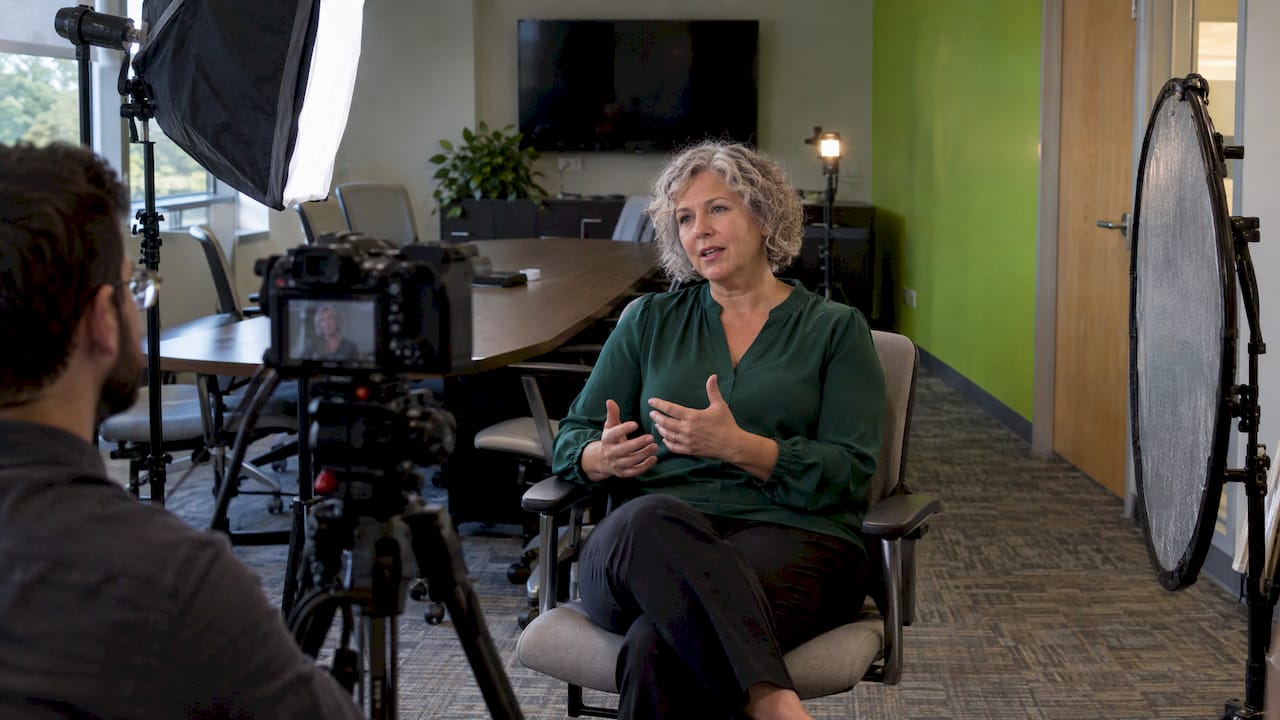


Good interview lighting comes down to four choices: where the key light sits, how much fill you add, how you separate the subject from the background, and how consistent the result is from one shoot to the next. Get those right and your CEO, attorney, physician or founder looks credible and approachable. Get them wrong and the best answer in the world looks flat, harsh or amateur. Here is the setup we build on for corporate interviews, with a diagram you can sketch, numbers to start from and fixes for the problems that show up on real shoots. If you would rather have a crew handle it, our Long Island video production team lights and films business interviews for companies across Long Island and New York.
TL;DR
- Start with three-point lighting: a soft key about 45 degrees to one side of the camera and slightly above eye level, a dimmer fill on the other side, and a back light behind the subject.
- For corporate video, keep the contrast low (around 2:1), the background evenly lit and every light on the same color temperature.
- Draw a floor plan before you shoot. It shows where the camera, subject and each light go, and it keeps the look consistent across several interviews.
- Two guests, glasses, small offices and windows each need a small adjustment, covered below.
- Repeatable beats fancy: a setup your team can rebuild the same way every time protects your brand look.
Table of Contents
- Why lighting decides how an interview reads
- The classic three-point setup
- An interview lighting diagram you can sketch in five minutes
- Set up the room before you place the lights
- Settings for a polished corporate look
- Adapting the setup to real situations
- Lights and tools to look for
- Mistakes that make interviews look amateur
- Lighting is one part of a good interview
- Let us light and film your interview
- FAQ
- Sources
Why lighting decides how an interview reads
Viewers forgive a lot of things, but they judge a speaker in the first seconds, and light is a large part of that judgment. Lighting tells them whether the person is trustworthy, serious, relaxed or tired. It also tells them whether your company pays attention to detail.
For a business owner, the stakes are practical. An interview video lives on your website, in sales emails, on YouTube and in short clips on social media. A well-lit interview can be cut into a testimonial, a leadership message, a podcast episode and several Reels. A badly lit one gets reshot or never published. Because the footage gets reused, it pays to light it properly once.
The classic three-point setup
Three-point lighting is the starting framework for almost every interview. It uses three lights, each with one job.
Key light: shapes the face
The key is your main light and the brightest source on the subject. Georgetown University’s video production guide places it first, at 45 degrees to the right or left of the camera and slightly angled down. Place it slightly above eye level, so shadows fall under the nose and chin instead of across the eyes. A softbox, a lantern or an LED panel with diffusion gives the softest, most flattering wrap around the face.
Where it goes wrong: putting the light too high or straight in front. Videomaker notes that overly top-down or flat front-on light creates harsh shadows or a flat image.
Fill light: softens the shadows
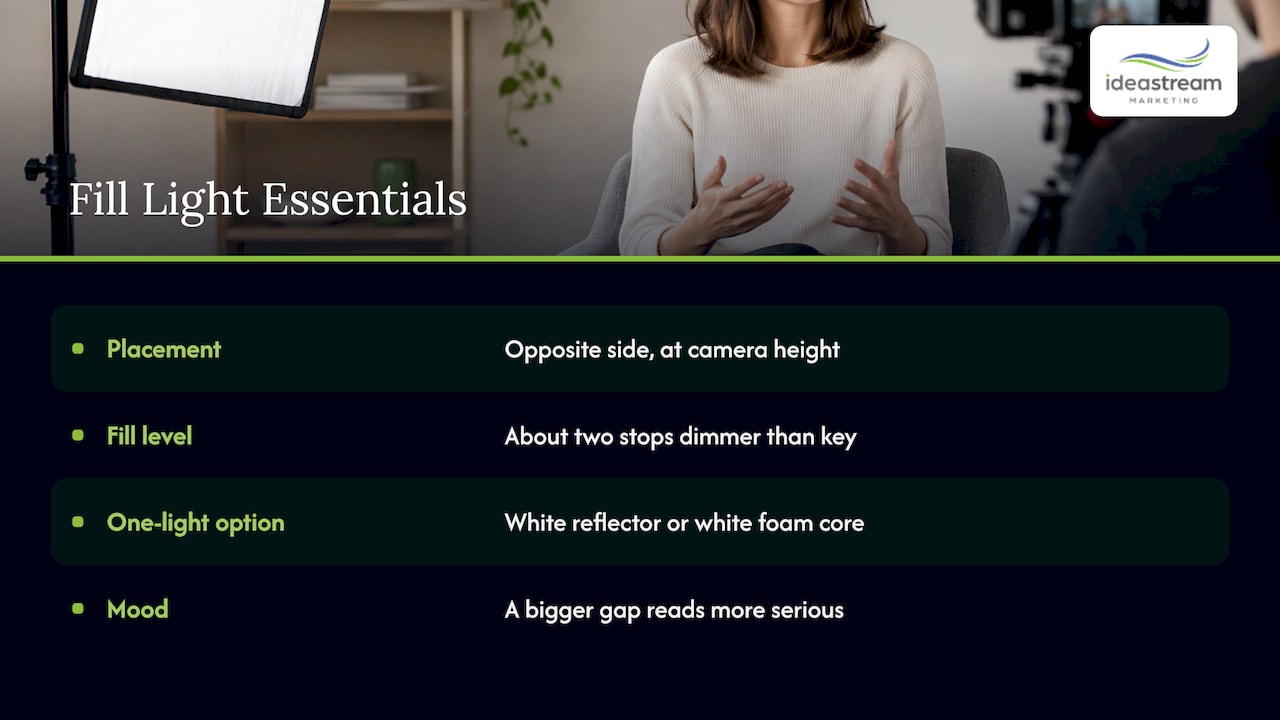
The fill goes on the opposite side of the camera and lightens the shadows the key creates. Videomaker describes the fill as about two stops dimmer than the key, placed at camera height. A stop is one step of brightness: each stop up or down doubles or halves the light. If you only have one light, a white reflector or a sheet of white foam core on the shadow side does the same job. MACCAM suggests a white bounce card or 4×4 foam core as the simplest fill, with the shadow side about one to two stops darker than the key side.
The fill sets the mood. AbelCine’s staging tutorial explains that a bigger gap between the bright and dark sides of the face reads more serious, a smaller gap reads more approachable, and lighting both sides perfectly evenly can make the subject look like a product.
Back light: separates the subject from the background
The back light sits behind the subject, off to one side and above, aimed at the shoulders and hair. It creates a thin edge of light that lifts the person off the background. Georgetown’s guide places it behind the subject and off to one side for exactly this separation. Keep it controlled with barn doors or a flag so it does not spill into the lens and cause flare.
An interview lighting diagram you can sketch in five minutes
A lighting diagram is a top-down floor plan: you look at the room as if from the ceiling. You do not need software. Use a sheet of paper and follow this order.
- Draw the room and mark the walls, windows and doors.
- Place the subject’s chair. Pull it away from the back wall.
- Draw the camera directly facing the chair, on the subject’s eye line.
- Draw the key at roughly 45 degrees to one side of the camera, angled toward the subject.
- Draw the fill on the opposite side, closer to the camera axis and dimmer.
- Draw the back light behind the subject, on the side opposite the key if possible.
- Add a background light or a lamp on the wall behind the subject.
The text version looks like this, with the camera at the bottom and the wall at the top:
        [wall + background light]

   [back light]
                    (subject)

   [fill]      [camera]      [key]
The diagram does more than guide the setup day. Videomaker’s multiple-talent guide recommends drawing the plan for every camera position, because it shows whether the light seems to come from the same place in every shot. Lamps do not move around a room between angles. Viewers sense when that happens even if they cannot say why.
Set up the room before you place the lights
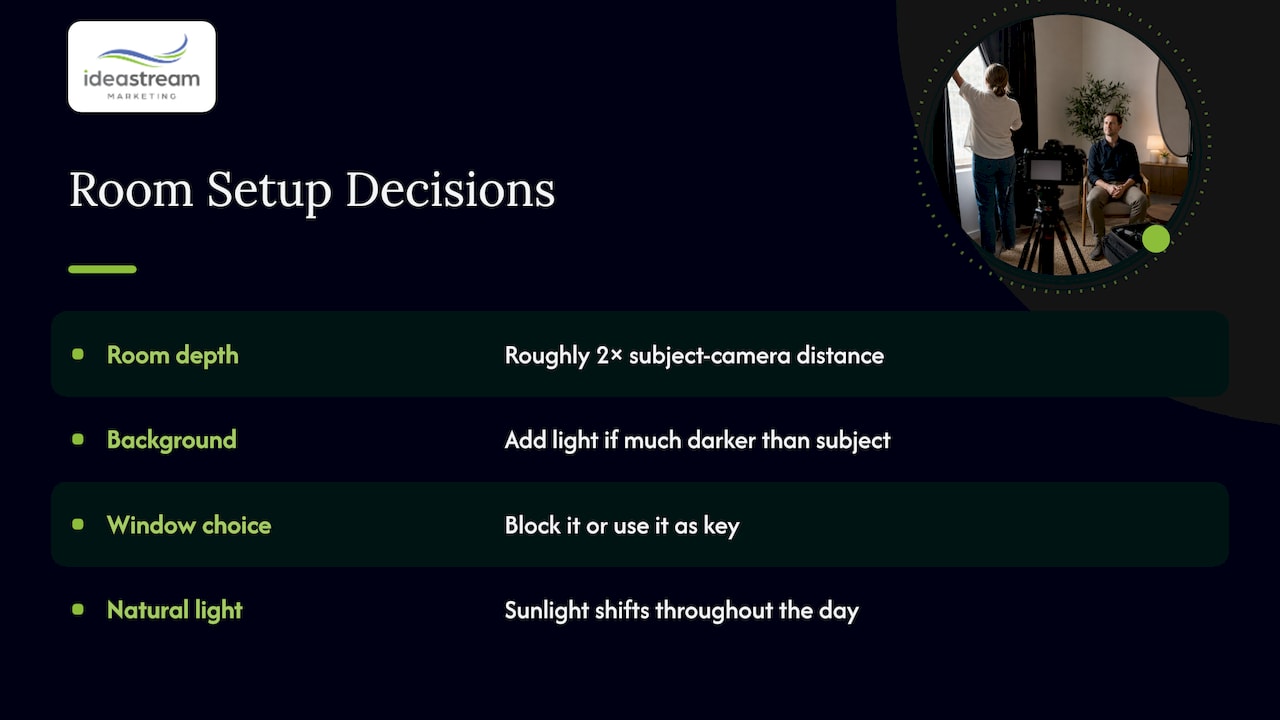
Lighting starts with space. AbelCine’s guide advises leaving roughly twice as much room behind the subject as the distance between subject and camera. That depth lets you use a longer lens, which flatters faces, and it keeps the subject’s shadow off the wall behind them. It also gives you room for the back light and a background light.
The same guide calls the background your best chance to add to the story. A bookshelf, a workshop, a product line or a clean office with some depth says something about the speaker. If the background is much darker than the lit subject, add a light to it.
Windows deserve a decision. The same tutorial warns against relying on natural light, because sunlight shifts throughout the day. A 10 a.m. interview and a 2 p.m. interview in the same conference room can look like two different companies. Either block the window and control everything with your own lights, or put the window to work as the key and add a reflector, then shoot fast.
On Long Island, that usually means offices with big south-facing windows, medical suites with overhead fluorescents and restaurants with warm lighting. Each needs a quick check before you commit to a position.
Settings for a polished corporate look
Corporate interviews call for a cleaner, more even style than a documentary or a dramatic profile. Ikan’s interview lighting guide recommends the following for formal interviews.
| Setting | Corporate starting point |
|---|---|
| Key position | About 45 degrees to the side, slightly above eye level, angled down 15 to 30 degrees |
| Fill strength | Higher for a flatter, cleaner look (80 to 90% of the key); 50 to 75% for a general interview |
| Contrast ratio | Close to 2:1 |
| Background | Even and undistracting |
| Color temperature | 4500K to 5600K for a crisp look |
Color temperature, measured in Kelvin (K), describes how warm or cool a light looks. Lower numbers are orange and warm, higher numbers are blue and cool. The rule that matters most: set every light to the same value. MACCAM suggests a 5600K key in daylight environments and 3200K in tungsten rooms. Mixing a warm lamp with a cool panel gives you skin that shifts color from one side of the face to the other.
A contrast ratio of 2:1 means the lit side of the face is twice as bright as the shadow side, one stop. It is a friendly, open look and works for leadership messages, service explainers and customer stories. For a more dramatic brand film you can go higher, but for corporate talking heads, keep it low.
The best advice for a business is also the simplest: build one setup, write it down and reuse it. A repeatable look makes ten interviews feel like one series, and it lets different team members shoot without a lighting expert in the room.
Adapting the setup to real situations
Two people on camera
Three-point lighting still works with two guests. Videomaker’s three-point article explains the trick: place each person’s key so that its spill becomes the other person’s fill, so two lights do the work of four, and add a back light opposite each key. The result is a balanced look for a host and a guest, or a founder and a client, without a stack of stands in a small room.
Glasses and deep-set eyes
Glasses throw reflections of the key light straight into the lens. Raise or lower the light a few degrees and move it slightly farther off axis until the glare disappears. For deep-set eyes, lowering the key a little reduces heavy brow shadows. AbelCine also suggests a small eye light for deep-set eyes so the speaker does not look shifty. Check the monitor, not just the room. What you see standing there is not what the camera records.
One light only
With a single light, the soft key does most of the work. Put it at 45 degrees, bounce its light back with white foam core on the other side, and use any practical lamp in the background for depth. Georgetown’s guide says the same: reflect light back with a reflector or foam core and diffuse with a softbox or umbrella.
Small offices and tight rooms
If you cannot pull the subject far from the wall, use a softer, closer key, flag light off the background and add a small accent light for depth. Place a dark card or cloth opposite the key on the shadow side. This is called negative fill, and it deepens shadows without adding light.
Creative looks for brand content
When the video is a brand story rather than a corporate message, you have more room. B&H eXplora outlines three alternatives: sun behind the subject with a reflector in front and negative fill opposite, a top-down butterfly key rigged above and shaped with flags or barn doors, and practical-motivated lighting built around visible table or floor lamps. Our brand story video work often borrows from these when the message calls for mood.
Lights and tools to look for
You do not need a cinema budget. A small kit of two or three dimmable LED lights, ideally adjustable in color temperature, one softbox or diffusion frame, a reflector, light stands and a few flags covers most business interviews. Prioritize these features:
- Dimming: you need to set the fill and key strengths independently.
- Adjustable color temperature: so you can match the room or your other lights.
- Soft light: a large softbox or diffuser, not a bare bulb.
- Control tools: barn doors, flags and grids to shape the beam and keep it off the lens.
- Reliable color: consistent skin tones from one session to the next.
A light meter or the waveform display on a camera helps you confirm ratios instead of guessing by eye.
Mistakes that make interviews look amateur
- Light straight from the camera position. It flattens the face and removes depth.
- Mixed color temperatures. A warm lamp and cool window on the same face looks sloppy.
- Subject against the wall. It casts shadows and makes the back light impossible.
- No back light. The subject blends into the background.
- Too many lights too soon. More lights mean more things to match and more things to go wrong.
- Changing the setup between guests. Viewers notice when two interviews in the same series look different.
Lighting is one part of a good interview
Light carries an interview only so far. The questions, the audio and the framing all count. If you are planning interviews with customers, our testimonial video question sets give you a place to start, and our video pre-production guide walks through the planning that happens before the lights go up. If the interview is part of a podcast, our video podcast setup guide covers gear, lighting and layout together.
A single interview session can produce much more than one video. The same footage can become a full-length piece for your website and YouTube, plus Instagram Reels, Facebook Reels, TikTok videos and YouTube Shorts. That is why consistent lighting matters: clips cut from different parts of a conversation have to match.
Our perspective
We build every interview around one question: where will this footage live? A leadership interview might end up on a homepage, in a sales deck, in a podcast feed and in a dozen short clips. Because every video we make is developed for visibility in Google, AI search, YouTube and social platforms, lighting is a production decision first and a marketing decision right after.
That is why we favor a simple, repeatable setup over a clever one. A clean three-point look, a low contrast ratio and one color temperature across the room give your team footage that cuts together, looks like your brand every time and holds up on a phone screen as well as a conference-room display.
If you are producing interviews on a regular basis, the real win is consistency across the whole series. We plan lighting, framing and sound together so the first interview and the twentieth look like they belong to the same company.
Dean Spinato, CEO & Founder of Idea Stream Marketing
Let us light and film your interview
If you are a business owner, executive or marketing manager planning corporate interviews, podcast episodes or short-form clips, we handle video production, podcast production and professional photography under one roof in Kings Park, Long Island. Our corporate interview video page explains how we approach strategy, filming and search visibility, and you can see the full range on our services page.
Ready to schedule a consultation or a studio session? Contact Idea Stream Marketing and tell us what you want to record.
FAQ
What is the best lighting setup for an interview?
Three-point lighting is the best starting point: a soft key about 45 degrees off the camera axis and slightly above eye level, a dimmer fill on the opposite side and a back light behind the subject. From there, adjust the fill to set the mood and add a background light if the wall is much darker than the subject.
How far should the lights be from the subject?
There is no single distance, because it depends on the light’s size and power. A good rule: the closer and larger the light, the softer the shadow. Place the key close enough to wrap around the face, then use dimming or diffusion to control brightness, and check the result on the camera monitor.
What color temperature should I use for a corporate interview?
Choose one value for every light. For a crisp corporate look, a range of 4500K to 5600K works well. If your key is daylight balanced at 5600K, make sure the fill, back light and background lights match it, and cover or block mixed light from windows and overhead fixtures.
Can I light an interview with only one light?
Yes. Put one soft key at about 45 degrees to the side and slightly above eye level, then use a white reflector or foam core on the other side as fill. Add a lamp or practical light in the background to create depth. It is a simple setup that produces clean results for a single speaker.
How do I light two people in one interview?
Aim each person’s key diagonally across the pair so that each light also fills the other person, then add a back light for each and a soft fill if shadows remain. Draw the floor plan first so you can see where every light and camera goes before you set anything up.
Sources
- Lighting Interviews, Georgetown University Library guide
- Staging and Lighting An Interview, AbelCine
- Three-point lighting, Videomaker
- Light Source: Three-point Lighting for Multiple Talent, Videomaker
- How to Achieve Professional Results with Interview Lighting, Ikan
- How to Light an Interview, MACCAM
- Creative Lighting Setups for Video Interviews, B&H eXplora

