






A brand voice is how your company sounds every time it speaks: the word choices, the rhythm, the attitude. The best brand voice examples share one trait. They are specific enough that you could cover the logo and still recognize who is talking. For a business owner on Long Island, the most useful move is to pick three or four voice traits, write them down, and then make them audible on video, in podcast episodes and in short-form reels, where customers actually meet you.
TL;DR
- Brand voice is your constant personality. Tone is how that voice flexes for a situation, such as a sales page versus an apology.
- Strong examples (Salesforce, Slack, Duolingo, Dove) pair 3 to 5 traits with clear limits, like “confident, never cocky.”
- A B2B voice usually changes tone by audience, not personality: direct for busy buyers, patient for new users.
- A voice guide only works with real examples, a words-to-use list and enforcement across every channel.
- Video, podcasts and Reels are where voice is heard. We build them so the voice stays consistent and discoverable.
Table of Contents
- What brand voice means, and how it differs from tone
- Brand voice examples worth studying
- Brand voice examples for local and professional service businesses
- How to define your brand voice in five steps
- What a brand voice guide should contain
- Voice is heard, not only read
- Making the voice consistent across channels
- Where Idea Stream Marketing fits
- Common mistakes to avoid
- FAQ
- Sources
What brand voice means, and how it differs from tone
Voice is the overall personality and values of a company, consistent across content types and platforms. Tone is how that voice is expressed in a given situation, and it adapts to context, according to Search Engine Land’s guide to brand tone of voice. Asana’s explanation makes the same split with a practical example: you speak differently to C-level executives than to consumers, and differently when announcing a product launch than a hiring freeze, yet the brand stays recognizably itself.
Think of a law firm partner. She sounds the same person at a client dinner, in a courtroom and in a podcast interview: precise, calm, plainspoken. Her tone shifts, lighter at dinner and more formal in court. That is the whole concept. If you can describe your company the way you would describe a person, you have the start of a voice.
Brand voice examples worth studying
The examples below are useful because each one shows a different way to be distinctive, and each one sets limits on itself.
Salesforce: a B2B voice that changes tone by audience
Salesforce’s public Voice & Tone Guidelines say its voice is always honest, clear, fun and inspiring. The guide then shows how tone shifts by reader. Admins get encouragement. Developers get directness, including honesty about the gotchas. New end users get approachable, step-by-step introductions. Busy salespeople get minimal, direct text that uses their own words, ending in a plain call to action.
The lesson for a B2B company: keep the personality fixed and change the amount of warmth, detail and speed. A contractor writing to a facilities manager and a homeowner is in the same position.
Slack: traits with guardrails
Slack describes its voice as confident but never cocky, witty but never silly, conversational but appropriate, and friendly but not ingratiating. Each trait comes with a limit, which is what makes the voice usable. Anyone writing for Slack knows where “funny” stops. When you define your own traits, add the “but never” clause to each one.
Duolingo: personality built around a character
Duolingo’s brand guide describes its mascot’s voice as expressive, playful, embracing and worldly, with a splash of persistent and slightly awkward, as HubSpot’s brand voice article reports. The voice has a face, which is why it travels so well into short video. A character or a recurring on-camera presenter does for a small business what a mascot does for a global app: it makes the voice something people can see and hear.
Dove: voice rooted in values
Dove’s Real Beauty Pledge, which it says it launched alongside its 60th anniversary, commits to featuring women rather than models and portraying women as they are in real life, per Dove’s own FAQ. The voice is warm and affirming because the commitments behind it are specific. A voice that is not backed by what the company actually does reads as decoration.
What the examples have in common
| Brand | Core traits | The guardrail that makes it work |
|---|---|---|
| Salesforce | Honest, clear, fun, inspiring | Tone changes by audience, from encouraging to minimal |
| Slack | Confident, witty, conversational, friendly | Every trait has a “but never” limit |
| Duolingo | Expressive, playful, worldly | A character carries the personality |
| Dove | Warm, affirming, real | Words are tied to published commitments |
None of these brands is trying to sound like everyone. Each one says no to something.

Brand voice examples for local and professional service businesses
The famous brands above have large teams. Your business probably does not, so here are the same ideas applied at neighborhood scale. These are illustrative sketches, not real company statements.
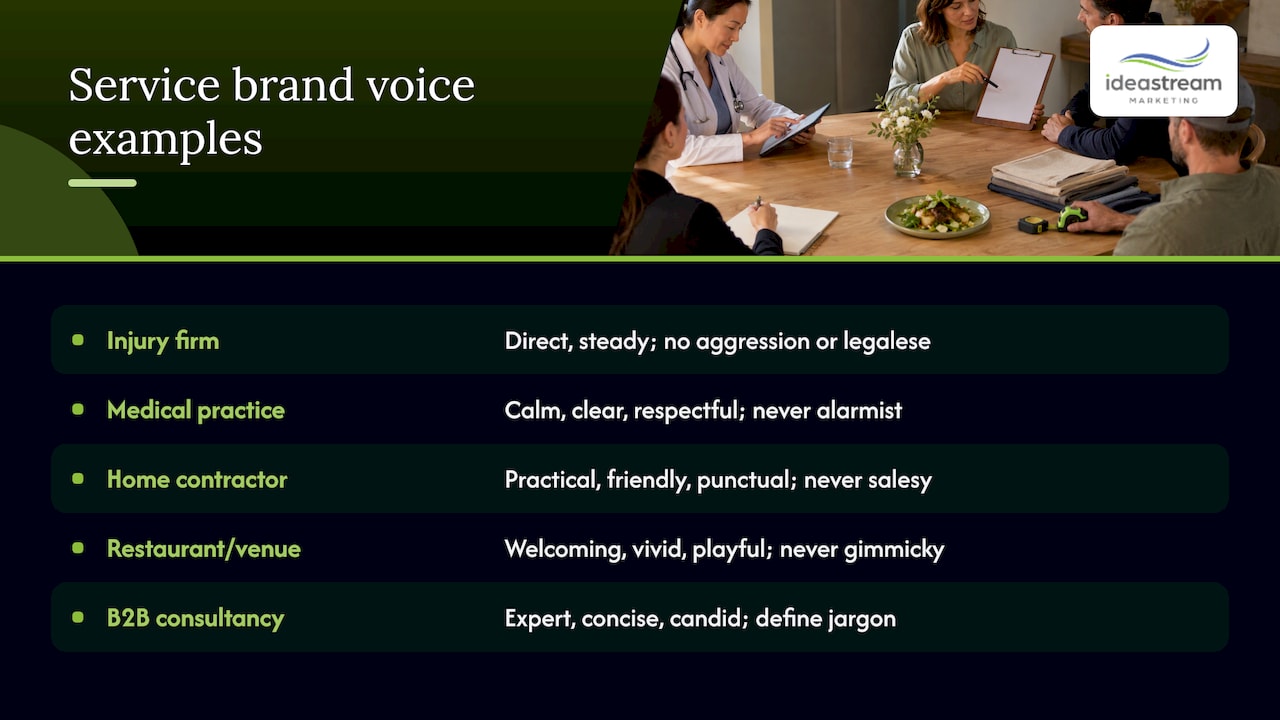
A Long Island personal injury firm. Traits: direct, steady, plainspoken. Limit: never aggressive, never legalese. Say “We will explain every step before we take it,” not “Our firm leverages comprehensive litigation strategies.”
A medical practice. Traits: calm, clear, respectful. Limit: never alarmist, never casual about symptoms. Patients get short sentences and defined terms.
A home service contractor. Traits: practical, friendly, punctual in tone. Limit: never salesy. Say “We’ll be there between 8 and 10, and we’ll text when we’re on the way.”
A restaurant or event venue. Traits: welcoming, vivid, a little playful. Limit: never gimmicky. Menu copy and Reels captions share the same warmth.
A B2B consultancy. Traits: expert, concise, candid. Limit: no jargon without a definition. Your podcast guests should hear the same candor your proposals use.
Notice that the voice, not the industry, makes the difference. Two law firms can sound completely different, and the one whose voice fits its clients wins the trust.
How to define your brand voice in five steps
- Start with the audience, not adjectives. Write down who you serve, what they are worried about and how they speak. A strategist who ran social media for a major dictionary brand, Ryan Shattuck, advises respecting your audience, because that resonance gives the voice confidence, as HubSpot reports. Listen to sales calls and read reviews for the words customers use.
- Choose 3 to 5 traits. More than five blur together. Pair each with a limit, as Slack does.
- Place yourself on the tone dimensions. HubSpot’s style guide template points to four dimensions from Nielsen Norman Group: formal versus casual, serious versus funny, respectful versus irreverent, and matter-of-fact versus enthusiastic. Mark where you sit on each.
- Write “Say this, not that” pairs. The same template recommends codifying the voice this way. Take ten real sentences from your website and rewrite them in your voice.
- List words to use and words to avoid. Search Engine Land gives an example: an approachable brand might swap “leverage,” “optimize,” “synergy” and “robust” for “use,” “improve,” “work together” and “strong.”
If you want the surrounding structure, our guides on a brand messaging framework and a brand guidelines template show where voice sits next to positioning, visuals and key messages.
What a brand voice guide should contain
A useful guide is short enough that people open it. Aim for two to four pages with these parts:
- Voice summary. One paragraph describing the personality in plain language.
- Three to five traits. Each with a definition and a limit.
- Tone by situation. Answer the context questions for social media, customer service, sales materials, technical content and sensitive topics, as Search Engine Land advises.
- Vocabulary list. Words to use and words to avoid.
- Examples by format. HubSpot suggests several examples per content type, including blog posts, social copy and short-form video scripts, and notes that defining the voice is half the battle while enforcement is the other half.
- Spoken guidance. Most guides stop at written copy. Add how your people sound on camera and on a microphone: pace, humor, how to greet a guest, how to explain a technical term.
That last item is where most small-business guides fall short, and it matters more every year as video and audio carry more of the marketing load.
Voice is heard, not only read
A voice guide that lives only in a document is not a voice yet. Customers meet your voice when the owner explains a service on camera, when a podcast host asks a guest a question, or when a 30-second Reel shows how a job gets done.
Video is also where inconsistency shows fastest. A polished website that says “we’re approachable” followed by a stiff, scripted brand video sends mixed signals. The fix is to treat the voice guide as a production brief:
- Brand and corporate video. Scripts, interview questions and on-screen text follow the “say this, not that” list. Our piece on brand story videos and our corporate interview video guide cover how that works in practice.
- Business podcasts. A podcast gives your voice 30 to 60 minutes to breathe. Recording, editing and show notes all reflect the same personality, and each episode can be repurposed into clips.
- Short-form reels. Instagram Reels, Facebook Reels, TikTok videos and YouTube Shorts compress your voice into seconds. A clear hook, a plain sentence and one idea per clip are the voice guide in miniature.
- Repurposing. One podcast episode can become several short clips, a blog summary and a quote graphic, all in the same voice, which saves the effort of inventing new messaging each week.
For tone, adapt by platform the way Salesforce adapts by reader. A TikTok can be looser than a YouTube interview with a partner at your firm, but both should be recognizably you.
Making the voice consistent across channels
Consistency is mostly a process problem. These habits keep a voice from drifting:
- One owner. Someone approves anything public. In a small firm that is often the founder or a marketing manager.
- A review checklist. Does it match our traits? Did we use a word on the avoid list? Does the tone fit this audience?
- A shared examples folder. Save the five best posts, videos and emails as references.
- A quarterly read-through. Pull ten recent pieces and check whether they sound like the same company.
- Brief every vendor the same way. Videographers, editors, designers and ad managers should all receive the same guide.
The same voice also supports search visibility. Content that answers customer questions in clear, natural language is easier for both Google and AI assistants to understand and quote, which is why we plan AI SEO and voice together rather than separately.
Where Idea Stream Marketing fits
We are a full-service digital marketing, AI SEO, website development and professional video production agency based in Kings Park, Long Island. We serve businesses across Suffolk County, Nassau County, New York City and nationwide. Every video and strategy we develop is built for visibility in Google, AI search, YouTube and social platforms, combining creative production with measurable technical marketing.
For a brand voice, that means one team can take your traits and carry them through professional video production, podcast production, short-form social reels and the social media marketing that distributes them.
If you have a voice in mind but not yet on screen, or a guide that never made it into your content, we can help you turn it into video and audio your customers recognize. Schedule a consultation or a studio session with our team.
Our perspective
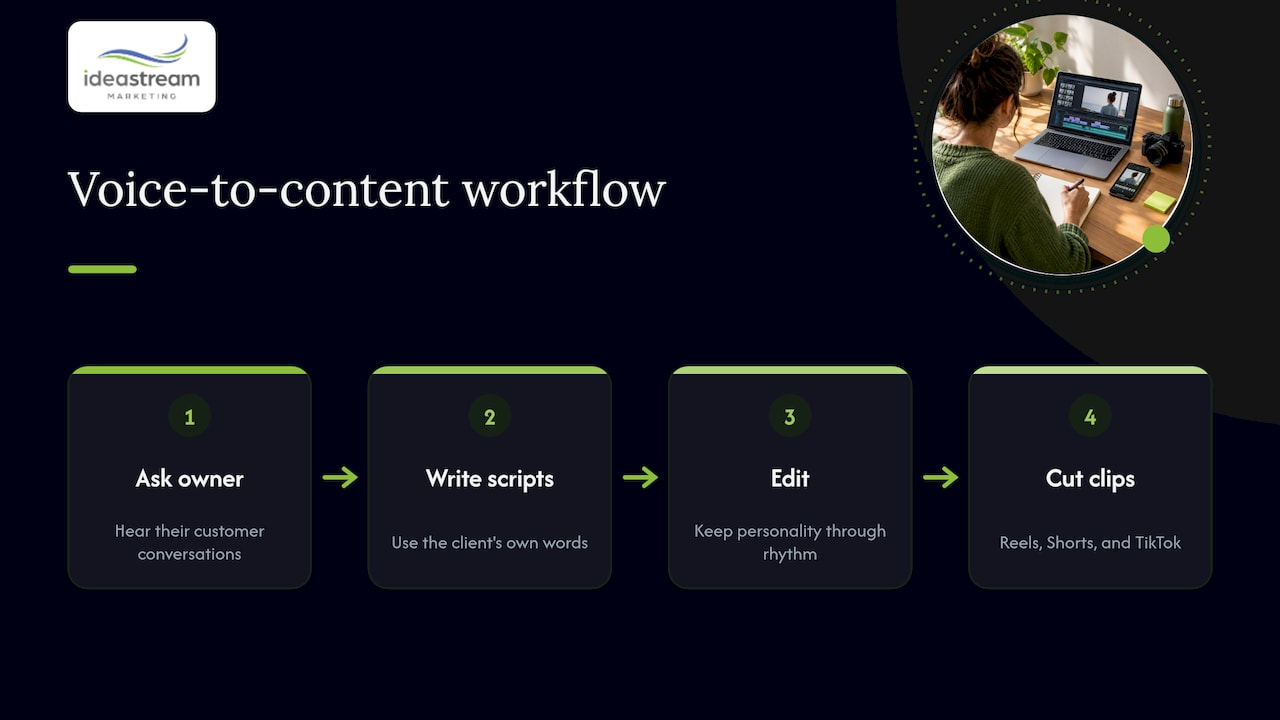
We start every video and podcast project by asking how the owner actually talks to their best customers. Most businesses already have a voice. It shows up in the way a founder explains a service across a table, and it often disappears once the camera turns on or a marketing template takes over.
Our job is to keep it. We write scripts and interview questions in the client’s words, edit for rhythm so the personality comes through, and cut each long recording into Reels, Shorts and TikTok clips that sound like the same company as the full episode. Because we develop every video for visibility in Google, AI search, YouTube and social platforms, the voice does two jobs: it earns trust with the viewer and it makes the content easier to find.
A written guide is the beginning. The proof of a brand voice is what people hear when they press play.
Dean Spinato, CEO & Founder of Idea Stream Marketing
Common mistakes to avoid
- Copying a famous brand. Dove’s warmth works because of Dove’s commitments. Borrow the method, not the personality.
- Listing adjectives with no limits. “Friendly and professional” describes almost every company. Add what you will never do.
- Writing for the brand, not the buyer. Salesforce’s guide works because it names who is reading and what they need.
- Ignoring sound and visuals. Pace, humor and delivery are part of the voice on video.
- Skipping enforcement. A guide nobody checks against becomes a PDF in a folder.
FAQ
What is an example of a brand voice?
Salesforce is a clear B2B example. Its guidelines define the voice as honest, clear, fun and inspiring, then adjust tone for admins, developers, new users and busy salespeople. Slack’s “confident, never cocky” style is another, because each trait carries a limit.
How is brand voice different from brand tone?
Voice is the consistent personality of your company. Tone is how that personality adapts to a situation, such as a product launch versus bad news, or a consumer versus a senior executive. You keep one voice and use many tones.
How do I define a brand voice for a B2B company?
Start with your buyer’s role, pressures and vocabulary. Choose three to five traits, add a limit to each, and write “say this, not that” examples from your real website and sales copy. B2B voices usually flex tone by audience while the personality stays steady.
What should a brand voice guide include?
Include a short voice summary, your core traits with limits, tone guidance by situation, words to use and avoid, and examples for each content type, including video scripts. Add notes on how your people should sound on camera and in podcast recordings.
Can I use my brand voice in video, podcasts and Reels?
Yes, and it is where the voice has the most impact. Scripts, interview questions, editing style and captions can all follow your guide, and one podcast episode can be repurposed into several short clips on Instagram, Facebook, TikTok and YouTube Shorts.
Sources
- How to develop your brand’s tone of voice, Search Engine Land
- What is a Brand Voice? Asana
- Voice & Tone Guidelines, Salesforce
- Craft your best brand voice, HubSpot
- How to create a content style guide, HubSpot
- Frequently Asked Questions, Dove

