



October 16, 2026



A brand story video is a short-form narrative film that puts a human protagonist at the center, not a product feature list, and uses emotional arc to connect a viewer’s values to your brand’s purpose. It differs from an ad (which sells) and a product demo (which explains) by focusing on why the brand exists and who it serves. Research-backed guidance recommends a hero runtime of around one to one and a half minutes, with shorter cuts repurposed for social platforms. The single highest-impact action you can take today: place your hero video above the fold on your homepage and upload it to YouTube for search discoverability. Stories make facts significantly more memorable than data alone, which is exactly why this format outperforms almost every other content type for trust-building.
Table of Contents
- What do the best brand story videos actually look like?
- How is a brand story video different from an ad or demo?
- What core elements make brand story videos land with audiences?
- How do you plan and produce a brand story video?
- Where should you host and distribute your brand story video?
- How do you measure whether your brand story video is working?
- How do brand story videos fit into your overall marketing strategy?
- Key Takeaways
- Why production without distribution is only half the job
- Idea Stream Marketing builds brand story videos that get found and watched
- Useful sources and further reading
- FAQ
What do the best brand story videos actually look like?
The examples below span founder stories, mission films, and customer narratives. Each one illustrates a different technique you can adapt regardless of budget.
- Netflix — “The Comeback Kids” (original member stories): Netflix periodically releases short documentary-style films featuring early subscribers and creators who grew with the platform. The story centers on transformation, not technology. Lesson to copy: Lead with a person’s before-and-after, not the product’s feature set.
- UNTUCKit — founder origin story: UNTUCKit’s brand film opens with co-founder Chris Riccobono describing a simple, relatable frustration: shirts that never looked right untucked. The production is conversational, not cinematic, and that authenticity is the point. Lesson to copy: A founder’s specific, personal problem is more persuasive than any market-size statistic.
- Patagonia — “Don’t Buy This Jacket”: A mission-driven film that leads with the brand’s environmental values before mentioning any product. It created controversy and massive earned media. Lesson to copy: A clear values statement, even a provocative one, attracts the right audience and repels the wrong one.
- Warby Parker — “How Warby Parker Was Founded”: A two-minute animated origin story that uses humor and self-deprecation. Low production cost, high memorability. Lesson to copy: Animation or motion graphics can replace expensive location shoots when the story is strong enough.
- Airbnb — “Wall and Chain”: A short animated film about a man returning to Berlin after the Wall fell, staying in a stranger’s home. Zero product mention for the first 90% of the runtime. Lesson to copy: Delay the brand reveal; let the emotion do the work first.
- Dollar Shave Club — launch video: Founder Michael Dubin walks through a warehouse delivering a deadpan monologue. Shot in one day for roughly $4,500. It generated 12,000 orders in the first 48 hours. Lesson to copy: Personality and a clear value proposition beat production polish every time for early-stage brands.
- Who Gives A Crap — brand story page: The toilet paper company leads with its mission — 50% of profits to build toilets in the developing world — before explaining the product. Lesson to copy: When your mission is genuinely differentiated, lead with it; the product becomes proof of the mission.
- Old Spice — “The Man Your Man Could Smell Like”: A widely studied example of absurdist humor used to reposition a legacy brand for a younger audience. Lesson to copy: Tone is a positioning tool; humor can signal a brand’s confidence and modernity faster than any tagline.
Pro Tip: Before choosing an example to emulate, match it to your objective first. If you need trust (healthcare, law, finance), choose a documentary or founder-story format. If you need awareness and shareability, a humor-driven or mission-led format tends to travel further on social.
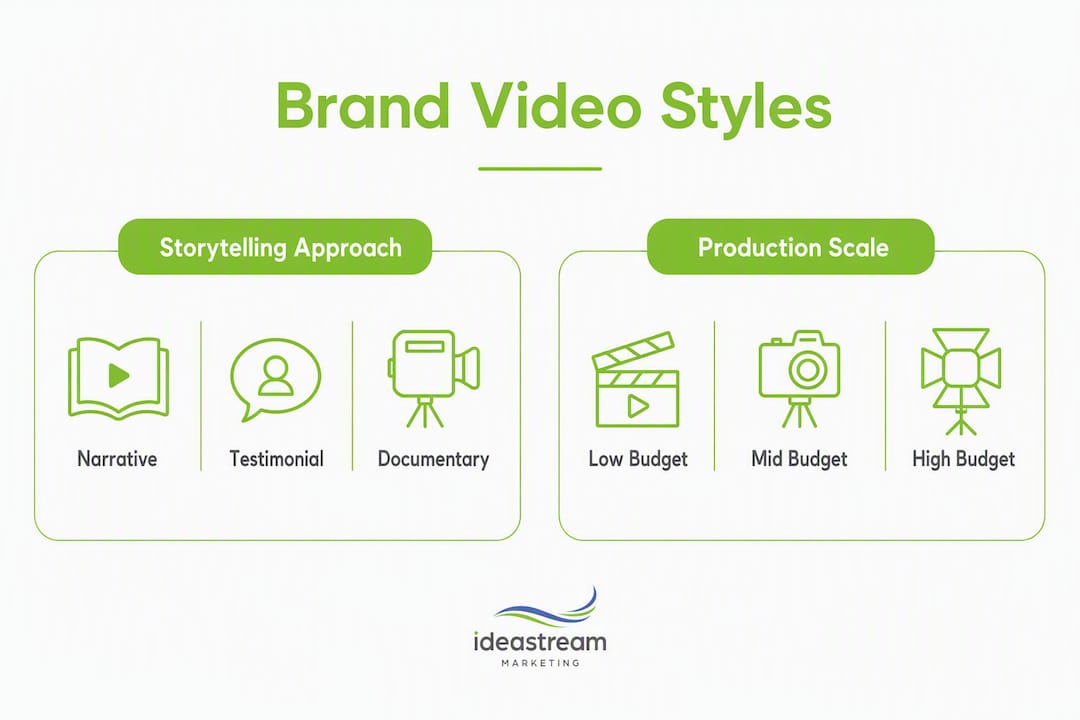
Styles matrix
| Storytelling approach | Ideal runtime | Best platform | Primary objective | Production scale |
|---|---|---|---|---|
| Founder story | 60–90 seconds | Homepage, YouTube | Trust, brand awareness | Low to mid budget |
| Customer story | 60–90 seconds | Homepage, LinkedIn | Conversion, social proof | Low to mid budget |
| Mission-driven | — | YouTube, paid social | Brand positioning | Mid to premium budget |
| Behind-the-scenes | 30–60 seconds | Reels, TikTok, Stories | Discovery, authenticity | Low budget |
| Mixed-media documentary | 2–5 minutes | YouTube, email | Deep engagement, loyalty | Premium budget |
How is a brand story video different from an ad or demo?
The clearest distinction is the protagonist. An ad’s protagonist is the product or the offer. A demo’s protagonist is a feature. A brand story video’s protagonist is a person, whether that’s the founder, a customer, or a community member, and the brand plays a supporting role in that person’s transformation.

Academic research on SME branding draws a useful line between strategic storytelling (the brand itself as a story, expressed through every touchpoint) and tactical storytelling (individual films, posts, or campaigns). A brand story video sits at the intersection: it is a tactical output that must express the strategic narrative.
Quick identifiers: is your concept a brand story video?
- Does the video have a human protagonist with a clear problem or desire?
- Does the narrative follow a recognizable arc: setup, tension, resolution?
- Is the brand’s role to enable the protagonist’s transformation, not to be the hero itself?
- Does the video communicate why the brand exists, not just what it sells?
- Would the video still be compelling if you removed the logo for the first 80% of the runtime?
If you answered yes to most of these, you have a brand story video. If the video leads with a product feature, a price, or a promotional offer, it is an ad, and that is fine — but it serves a different purpose in your funnel.
Common subtypes and their use cases:
- Founder story: Best for homepage hero placement and early-stage brand building. Builds personal trust quickly.
- Customer story: Best for mid-funnel conversion pages and LinkedIn. Provides social proof through a relatable narrative.
- Mission story: Best for YouTube and funded campaigns where longer runtimes are acceptable. Attracts values-aligned audiences.
- Behind-the-scenes: Best for Reels, TikTok, and Stories. Drives discovery and signals authenticity at low cost.
- Mixed-media documentary: Best for YouTube and email nurture sequences. Deepens loyalty with existing audiences.
What core elements make brand story videos land with audiences?
Strong business storytelling videos share a consistent set of structural and sensory ingredients. Miss one and the story loses its grip.
Narrative structure is the foundation. The most reliable arc runs: hook (establish stakes in the first 5 seconds), protagonist introduction (who is this person and what do they want?), conflict (what stands in the way?), and resolution tied to the brand’s purpose. The Stanford Social Innovation Review describes this arc as the core mechanism by which stories transfer meaning between people.
Emotional framing and authenticity are what separate memorable films from forgettable ones. Showing vulnerability, a specific failure, or an honest admission of uncertainty makes a story credible. Vague success narratives (“we worked hard and grew”) generate no emotional response. Specific, concrete details do: the exact year, the city, the number of employees at the time, the moment the founder almost quit.
Pro Tip: Emotionally engaged consumers are 2.4 times more likely to stay with a brand. Build one specific emotional peak into your script, not a general feeling of warmth, but a single moment of tension or relief the viewer can feel.
Visual and sound priorities support the story without competing with it. B-roll should illustrate the narrative, not decorate it. Color grading should match the emotional tone: warm and desaturated for nostalgia, cooler and higher contrast for ambition. Music should enter after the hook is established, not over it, so the opening words land clearly. Voice quality matters more than camera quality; a clear, well-recorded voice on a modest camera outperforms a shaky, muffled voice on a cinema rig.
Accessibility is non-negotiable for reach. Captions increase completion rates on mobile, where most social video plays without sound. Audio descriptions and clear visual cues extend your audience to viewers with disabilities and improve SEO through indexed text.
CTA guidance: the call to action in a brand story video should feel like a natural next step, not a pivot to a sales pitch. “See how we can help” or “Learn more about our work” fits the tone. “Buy now” or “Limited time offer” breaks the emotional contract the story just built.
How do you plan and produce a brand story video?
Production quality is a function of preparation, not budget. The teams that consistently deliver strong work follow a structured workflow from brief to launch.
Pre-production checklist
- Write the creative brief. Define the protagonist, the core conflict, the brand’s role in the resolution, the target audience, and the single emotional takeaway. One page maximum.
- Develop the concept and script. Write a full script or a detailed treatment. Every word spoken on camera should earn its place; aim for roughly 150 words per minute of finished video.
- Build the shot list and storyboard. Map every scene visually before the shoot day. This eliminates on-set guesswork and keeps the crew efficient.
- Secure permissions and releases. Location releases, talent releases, and music licenses must be confirmed before the shoot, not after.
- Cast and rehearse. Whether you use a founder, a customer, or an actor, run a camera test and a rehearsal. Unrehearsed subjects read as nervous on screen, which undermines authenticity.
Production
- Crew by scale: A low-budget shoot can run with a director/DP and one assistant. Mid-budget adds a dedicated audio engineer and a gaffer. Premium adds a full crew with a separate camera operator, art director, and drone operator.
- Shoot days: Low-budget: 1 day. Mid-budget: 1–2 days. Premium: 2–4 days plus pickup days.
- Core gear: Camera (mirrorless or cinema camera), directional microphone or lavalier, three-point lighting kit, and a gimbal or slider for movement. Drone footage adds production value quickly for exterior scenes.
Post-production
- Editing stages: Assembly cut → rough cut → fine cut → picture lock.
- Feedback rounds: Two rounds maximum. Define who has approval authority before editing begins.
- Color grading, motion graphics, and captioning: These happen after picture lock. Captions should be burned in for social versions and provided as a separate SRT file for YouTube and the homepage.
- Versioning: Produce the master (60–90 seconds), a 30–60 second social cut, and a 6–15 second hook clip from the opening.
Budget and timeline benchmarks
| Scale | Approximate budget range | Concept to final delivery |
|---|---|---|
| Low budget (founder-led, 1 crew) | — | 2–4 weeks |
| Mid budget (small crew, 1–2 shoot days) | — | 4–6 weeks |
| Premium (full crew, multiple locations) | — | 6–12 weeks |
Pro Tip: Plan for discoverability during post-production, not after. Write your YouTube title, description, and tags while the editor is working on the fine cut. Video SEO metadata prepared in advance prevents losing the first weeks of search value after launch.
Deliverables list: master file (ProRes or H.264 at 4K), social cuts (1:1 and 9:16 for Reels/TikTok, 16:9 for YouTube), caption files (SRT), thumbnails (custom, not auto-generated), and metadata document (title, description, tags, chapters).
Where should you host and distribute your brand story video?
One well-produced hero video can generate content for every channel in your mix. The key is cutting and optimizing for each platform’s native format rather than posting the same file everywhere.

Research shows that visitors tend to spend substantially more time on websites that feature video stories, and are more likely to buy after watching a story video. Those numbers make homepage placement the highest-priority distribution decision you will make.
Primary placements:
- Homepage above the fold: The hero video (60–90 seconds) should autoplay muted with captions. This is your single most valuable placement for first-impression trust-building.
- YouTube: Upload the full hero with an optimized title, description, chapters, and custom thumbnail. YouTube marketing for SMBs drives compounding search traffic over time; treat it as a long-term SEO asset.
- Google Business Profile: Upload a 30–60 second version. Local businesses see meaningful discovery lift from video on their GBP listing.
- LinkedIn: The 60–90 second hero or a 30–60 second cut performs well for B2B audiences. Native uploads outperform YouTube links in the feed algorithm.
- Reels, TikTok, and Shorts: Use the 30–60 second cut or the 6–15 second hook clip. Short-form social videos drive higher completion and share rates than long formats for discovery audiences.
Platform distribution table
| Platform | Recommended format | Runtime | Primary goal |
|---|---|---|---|
| Homepage | Autoplay muted, captioned hero | 60–90 seconds | Trust, time-on-page |
| YouTube | Full hero, SEO-optimized | 60–90 seconds | Search discovery, watch time |
| Google Business Profile | Short brand intro | 30–60 seconds | Local discoverability |
| Native upload, B2B cut | 30–60 seconds | B2B awareness, conversion | |
| Instagram Reels / TikTok | Hook clip or social cut | 15–60 seconds | Discovery, shares |
| Email newsletter | Thumbnail + link | N/A (link out) | Nurture, click-through |
Distribution schedule: Launch the homepage and YouTube versions simultaneously on day one. Post the social cut to LinkedIn and Reels within the first week. Add the GBP upload in week two. Run a paid social boost on the 30–60 second cut for two to four weeks to seed initial views and gather engagement data. From week four onward, maintain an organic social cadence by pulling quote cards, behind-the-scenes clips, and reaction content from the original shoot footage.
How do you measure whether your brand story video is working?
Measurement starts before launch. Define your primary KPI based on the video’s objective: awareness, trust, or conversion.
Primary KPIs:
- View-through rate (VTR): The percentage of viewers who watch to completion. A strong VTR for a 60–90 second video is above 50% on YouTube and above 30% on paid social.
- Watch time: Total minutes watched on YouTube. This directly influences search ranking.
- Click-through rate (CTR) on CTAs: Measured via UTM parameters on any link in the video description or homepage CTA button.
- Homepage time-on-page: Compare pages with and without the video using Google Analytics 4.
- Assisted conversions: Track how many leads or purchases had a video view in their conversion path, using GA4’s attribution reports.
- Brand lift: Run a simple survey (Google Surveys or a post-visit pop-up) asking “How did you first hear about us?” before and after launch.
Two experiment templates
- Homepage A/B test: Split your homepage traffic 50/50 between a version with the hero video above the fold and a version with a static image. Run for 30 days. Measure time-on-page, scroll depth, and form submissions. Most teams see a meaningful lift in time-on-page within the first two weeks.
- Paid social lift experiment: Run the 30–60 second social cut as a paid ad on Meta or LinkedIn for two weeks. Track click-through to the website and compare organic site traffic from social channels during the same period versus the two weeks prior. This isolates the video’s contribution to site traffic from social.
Reporting cadence: Review VTR and watch time weekly for the first month. Pull assisted conversion data monthly. Present results to stakeholders as a simple before/after comparison: traffic, time-on-page, and leads before launch versus 30 and 90 days after.
How do brand story videos fit into your overall marketing strategy?
A brand story video is not a standalone asset. It is the narrative anchor for your entire content ecosystem. Every other piece of content, from blog posts to email sequences to paid ads, should draw from the same core story.
Research on SME branding recommends treating your brand as a single, coherent story first, then producing tactical content that expresses different facets of that story. The founder video, the customer testimonial, and the behind-the-scenes Reel should all feel like chapters of the same book, not disconnected campaigns.
Practically, this means your video marketing strategies should map each video type to a funnel stage. The hero brand story video builds awareness and trust at the top of the funnel. Customer story videos move prospects through consideration. Product or service explainers close at the bottom. When these three layers are in place and visually consistent, your brand presence compounds across every channel.
SEO and video work together more directly than most teams realize. A YouTube video with a strong title and description can rank on the first page of Google for competitive terms, often faster than a text article. Embedding that video on a relevant service page increases the page’s dwell time, which signals quality to Google. Video SEO best practices should be built into every production workflow, not added as an afterthought.
Paid media amplifies what organic cannot reach. A 15-second hook clip from your hero video, run as a pre-roll ad on YouTube or a paid Reel on Meta, introduces your brand story to cold audiences efficiently. Branded videos report higher recall and purchase consideration than static ads, making the cost-per-impression more defensible in budget conversations.
Finally, brand story videos strengthen every other marketing channel they touch. An email with a video thumbnail generates higher click-through rates than text-only emails. A LinkedIn post with a native video upload reaches more of your network than a link post. A Google Business Profile with a video stands out in local search results. The video does not replace these channels; it makes each of them perform better.
Key Takeaways
The most effective brand story videos combine a 60–90 second hero film placed above the fold on your homepage with platform-specific social cuts, all anchored to a single core narrative that expresses why your brand exists.
| Point | Details | ||||
|---|---|---|---|---|---|
| Runtime and placement | Produce a 60–90 second hero for homepage and YouTube; cut 30–60 second versions for social. | ||||
| Story structure | Lead with a human protagonist and a clear conflict; let the brand play the enabling role, not the hero. | ||||
| Measure what matters | Track view-through rate, homepage time-on-page, and assisted conversions; run an A/B test within 30 days of launch. | ||||
| Integrate across channels | Map each video type to a funnel stage and use consistent visual identity across all cuts and platforms. | ||||
| Ideastreammarketing | Ideastreammarketing provides full-service production plus AI-powered distribution planning, so every video is built for both emotional impact and search discoverability from day one. |
Why production without distribution is only half the job
Most conversations about brand story videos focus on the creative: the script, the shoot, the edit. Those things matter. But the teams that consistently see measurable results treat distribution and SEO as part of the production brief, not a separate project that starts after delivery.
We have seen this play out directly with clients across healthcare, professional services, and hospitality. A well-produced brand story video that launches without an optimized YouTube upload, a homepage placement strategy, and a social repurposing plan loses most of its potential value in the first 30 days. The algorithm rewards early engagement signals. If the video is not set up to capture those signals from day one, it takes months to recover ground that should have been captured at launch.
The other thing most guides understate is the gap between having a brand story and telling it consistently. A single hero video is a starting point. The brands that build real recognition over time are the ones that treat the hero film as a template: same visual language, same emotional tone, same protagonist archetype, expressed across founder clips, customer stories, and behind-the-scenes content throughout the year. Storytelling should function as both strategy and tactic for SMBs, and that only happens when production and marketing are planned together.
If you are deciding between in-house production and a full-service partner, the honest answer is this: in-house works well when you have a dedicated video person, a clear brand narrative already documented, and the bandwidth to manage distribution. If any of those three are missing, a partner who handles both production and marketing will almost always deliver faster results and a stronger return on the investment.
Idea Stream Marketing builds brand story videos that get found and watched
Producing a great brand story video and getting it seen are two different problems. Idea Stream Marketing solves both. As a Long Island video production company and digital marketing agency, we handle everything from concept development and scripting through filming, editing, color grading, and motion graphics, then pair every deliverable with an SEO and distribution strategy designed to maximize visibility across Google, YouTube, and social platforms.
We work with SMBs, healthcare providers, law firms, hospitality groups, and professional service firms on both project-based and retainer engagements. Whether you need a single hero film or a full content series, our team builds each video with brand growth and discoverability in mind from the first creative brief. Every project includes platform-optimized cuts, caption files, thumbnails, and metadata, so your video is ready to perform on day one.
Ready to put your brand story on screen? Explore our video production services or contact us to discuss your project.
Useful sources and further reading
Internal resources from Ideastreammarketing:
- 6 effective video marketing strategies that work in 2026 — Practical repurposing and promotion tactics for getting more from every video you produce.
- YouTube marketing for SMBs: proven steps for more leads — Step-by-step guidance on optimizing YouTube uploads for search and lead generation.
- Video SEO best practices that boost rankings in 2026 — Metadata, thumbnail, and technical SEO guidance specific to video assets.
- What is video marketing? Expert strategies and ROI insights — A broader framework for understanding where video fits in your marketing ROI model.
- Small business marketing: proven strategies for growth in 2026 — Context for integrating video into a complete SMB marketing plan.
External research and authority sources:
- The role of storytelling in the branding of SMEs — Springer Nature / Journal of Brand Management — Peer-reviewed research distinguishing strategic from tactical storytelling for small and medium businesses.
- Harnessing the power of stories — Stanford Social Innovation Review — Explains the cognitive and emotional mechanisms that make narrative more persuasive than data alone.
FAQ
What is a brand story video?
A brand story video is a short narrative film that puts a human protagonist at the center and uses an emotional arc to connect a viewer’s values to a brand’s purpose. It differs from an ad by focusing on why the brand exists rather than what it sells.
How long should a brand story video be?
The recommended hero runtime is 60–90 seconds, with 30–60 second cuts for social platforms and 6–15 second clips for pre-roll and Stories.
Where should you post a brand story video first?
Place the hero video above the fold on your homepage and upload it to YouTube simultaneously on launch day. These two placements deliver the highest trust-building and search discovery value.
How do you measure the success of a brand story video?
Track view-through rate, homepage time-on-page, and assisted conversions in Google Analytics 4. Run a 30-day A/B test comparing a homepage with the video against a static version to isolate its impact on engagement and form submissions.
Does Ideastreammarketing produce brand story videos for small businesses?
Yes. Ideastreammarketing handles full-service production from concept through final delivery and pairs every project with an SEO and distribution strategy, serving SMBs, healthcare providers, law firms, and professional service firms across Long Island and nationwide.

