



October 21, 2026




TL;DR:
- Lead generation is about attracting qualified prospects interested in your offerings.
- Successful SMBs blend inbound and outbound strategies for consistent growth.
- Building a scalable system with proper follow-up and targeting enhances lead conversion.
Lead generation gets a bad reputation. Many business owners picture pushy cold calls, purchased contact lists, or mass emails that go straight to spam. The reality is far more strategic. Modern lead generation is about connecting with people who are already looking for what you offer and guiding them toward a decision. For small and medium-sized businesses (SMBs), a well-built lead generation system can be the difference between unpredictable revenue and consistent, scalable growth. This article breaks down exactly what lead generation means, why it matters, and which strategies actually work for businesses like yours.
Table of Contents
- Defining lead generation: The process and why it matters
- Inbound and outbound: The two main approaches
- Effective lead generation strategies for SMBs
- Building a lead generation framework: Steps and success tips
- Our perspective: What most SMBs get wrong about lead generation
- Ready to amplify your lead generation?
- Frequently asked questions
Key Takeaways
| Point | Details |
|---|---|
| Lead generation basics | It’s about attracting and converting interested prospects—not just cold calling or buying lists. |
| Dual approach power | Combining inbound and outbound methods leads to better lead quality and growth for SMBs. |
| Best strategies for SMBs | Content marketing, email campaigns, lead magnets, and local SEO deliver strong, affordable results. |
| Proven frameworks | Process beats guesswork: A repeatable system with tracking and nurturing boosts success. |
Defining lead generation: The process and why it matters
Now that we’ve set the stage, let’s clarify exactly what lead generation actually means for your business.
Lead generation is the process of attracting and converting prospects into potential customers interested in your products or services. That definition matters because it separates intentional marketing from random outreach. You are not blasting a message at everyone and hoping something sticks. You are building a system that pulls in the right people at the right moment.
Many business owners confuse lead generation with simply getting more contacts. These are not the same thing. A contact is just a name and email. A lead is someone who has shown genuine interest and fits your target profile. Chasing volume without quality wastes time, budget, and your sales team’s energy.
A strong lead generation process does several things for your business:
- Fills your sales pipeline with qualified prospects who are more likely to convert
- Creates predictable revenue by keeping your pipeline consistently active
- Strengthens customer relationships by starting engagement with value, not pressure
- Reduces wasted ad spend by targeting people already interested in your category
As the ultimate lead generation guide explains, the most effective systems are built around understanding your audience deeply before spending a single dollar on ads or content.
“The goal is not to find more people to sell to. The goal is to find the right people and give them a reason to raise their hand.”
This distinction is what separates businesses that grow steadily from those that constantly feel like they are starting from scratch. Lead generation is not a tactic. It is a foundation.
Inbound and outbound: The two main approaches
With the importance of lead generation established, it is critical to understand the dual approaches businesses can use.
Inbound methodology focuses on pulling in prospects via valuable content, while outbound pushes messages via cold outreach. Neither approach is obsolete. Both have a role to play depending on your goals and budget.
Inbound lead generation uses blog posts, SEO, social media content, webinars, and free resources to attract prospects organically. It takes time to build, but the leads it generates tend to be warmer and more qualified. Outbound lead generation involves direct actions like email outreach, paid ads, cold calls, and direct mail. It produces faster results but typically costs more per lead.
Here is a side-by-side comparison to help you decide where to focus:
| Factor | Inbound | Outbound |
|---|---|---|
| Speed to results | Slower (weeks to months) | Faster (days to weeks) |
| Cost per lead | Lower over time | Higher upfront |
| Lead quality | Higher intent | Variable intent |
| Best for | Brand authority, long-term growth | Fast pipeline, new markets |
| SMB suitability | Strong for content-ready teams | Strong for targeted B2B outreach |
For a deeper look at how these approaches differ in practice, the article on inbound vs outbound strategies covers real-world examples and implementation tips.
The most successful SMBs do not choose one or the other. They blend both into what some marketers call an “allbound” approach. You run paid ads to capture demand now while publishing content that builds trust over time. Your B2B marketing techniques strengthen when both channels reinforce each other.

Pro Tip: Start with outbound to generate quick wins, then reinvest that revenue into building an inbound content engine. This sequence lets you grow without betting everything on one channel.
Effective lead generation strategies for SMBs
Once you know the core approaches, here are the best practical strategies your business can deploy for more leads.
Not all strategies are created equal, especially when you are working with a limited budget. Cost per lead (CPL) is the key metric here. It tells you how much you spend to acquire one potential customer. Lower CPL means more leads per dollar.
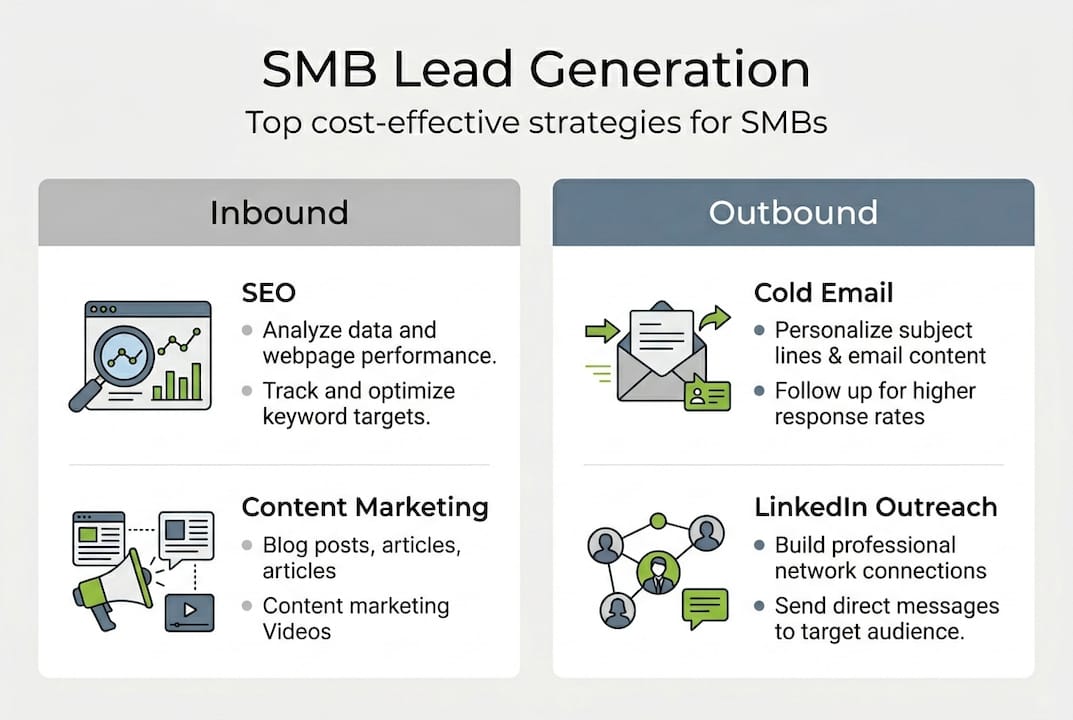
According to research, SMB-effective strategies include SEO and content marketing with the lowest CPL at around $31, followed by email marketing at $53, with social media, referrals, and lead magnets rounding out the top tier. These numbers should guide your priorities.
Here are the top strategies ranked by cost-effectiveness:
- SEO and content marketing ($31 avg CPL): Publishing helpful blog posts, optimizing your website for search, and targeting keywords your buyers use. This builds compounding visibility over time. Explore multi-platform content strategies to extend your reach further.
- Email marketing ($53 avg CPL): Nurture sequences, newsletters, and segmented campaigns keep prospects engaged. Strong subject lines and value-driven content drive opens and clicks. Review email marketing tactics that boost engagement.
- Social media lead ads: Platforms like Facebook and LinkedIn allow precise audience targeting. Lead forms built directly into the ad reduce friction and increase submissions.
- Referral programs: Your current customers are your best salespeople. A simple referral incentive can generate high-quality leads at near-zero cost.
- Lead magnets: Offer a free checklist, template, webinar, or short guide in exchange for an email address. This builds your list while delivering immediate value.
- Local SEO and community engagement: For location-based businesses, optimizing your Google Business Profile and participating in local events drives highly targeted traffic.
Here is a quick reference for CPL benchmarks by channel:
| Channel | Average CPL | Best use case |
|---|---|---|
| SEO/Content | ~$31 | Long-term visibility |
| Email marketing | ~$53 | Nurture and retention |
| Social media | ~$58 | Brand awareness and retargeting |
| Paid search (PPC) | ~$110 | High-intent searches |
| Referral programs | Very low | Trust-based growth |
Stay current with the content marketing trends shaping how buyers discover businesses like yours today.
Building a lead generation framework: Steps and success tips
With top strategies in hand, let’s map out how to put them into a repeatable and scalable process.
Having great tactics without a system behind them leads to inconsistent results. A lead generation framework gives you structure so you can measure, improve, and scale without burning out your team.
Here is how to build yours step by step:
- Define your Ideal Customer Profile (ICP): Who exactly are you trying to reach? Industry, company size, job title, pain points, and buying triggers all matter. Be specific.
- Map the buyer’s journey: Understand how your customers go from unaware to ready to buy. Each stage needs different content and offers.
- Select your tactics: Based on your ICP and journey map, choose two or three channels to start. Do not spread thin across every platform.
- Create your offers: Build lead magnets, landing pages, and calls-to-action that are relevant to each stage of the journey.
- Set up tracking: Use tools like Google Analytics, a CRM, or marketing automation software to measure every touchpoint.
Research consistently shows that allbound strategies blending inbound and outbound drive the best results for SMBs. Blending them does not have to mean doubling your workload. Start with one inbound channel and one outbound channel, then add more as you see results.
Common pitfalls to avoid:
- Ignoring follow-up: Most leads need five or more touchpoints before they convert. Automate your follow-up sequence.
- Weak landing pages: A strong ad with a confusing landing page kills conversions. Keep your pages focused, fast, and clear.
- Poor sales alignment: If your marketing team and sales team are not coordinated, leads fall through the cracks.
For more actionable guidance on marketing your small business and deploying smart digital marketing frameworks, those resources are worth bookmarking.
Pro Tip: Always use a double opt-in for email subscribers. It reduces spam complaints, improves deliverability, and builds a list of people who genuinely want to hear from you. Quality over quantity applies here too.
Our perspective: What most SMBs get wrong about lead generation
After understanding the framework, here is our straight-talk perspective on what really separates winning SMB lead generation efforts.
The biggest mistake we see is treating lead generation as a campaign rather than a system. A business runs a Facebook ad for two weeks, gets a few leads, and calls it a failure. That is not a failure of lead generation. That is a failure of commitment and continuity.
Conventional wisdom says outbound is old-fashioned. We disagree. A well-targeted cold email or LinkedIn outreach sequence still converts, especially in B2B markets. The problem is not the channel. It is the execution. Generic messages sent to unqualified lists will always underperform.
Most SMBs also dramatically underinvest in what happens after capture. Getting someone to fill out a form is only the beginning. The businesses seeing real growth are the ones with multi-touch nurture sequences that educate, build trust, and create urgency over time.
True success comes from measuring what works, cutting what doesn’t, and iterating. Not from chasing the newest platform or trend. We have seen businesses transform their pipeline simply by improving their follow-up process and tightening their ICP, without adding a single new channel.
If you want to see what a focused lead generation effort looks like in practice, the difference is almost always in the details, not the tactics.
Ready to amplify your lead generation?
If you’re ready to put these strategies into action, here’s how you can accelerate your results with proven digital marketing support.
Building a lead generation system that actually works takes strategy, the right tools, and consistent execution. Most SMBs have the drive but not always the bandwidth. That is where Idea Stream Marketing comes in.
We offer digital marketing services built specifically for growing businesses, covering SEO, content, paid advertising, email, and automation all in one place. Whether you need a full system or support in specific areas, our team builds scalable solutions tailored to your goals. Explore our premier digital marketing offerings to see what’s possible, or connect with our experts to start a conversation about your pipeline.
Frequently asked questions
What is a lead in digital marketing?
A lead is a person or business who shows interest in your product or service, often by sharing their contact information. Attracting and converting prospects into potential customers is the core goal of lead generation.
How is inbound lead generation different from outbound?
Inbound attracts customers through valuable content like blogs and SEO, while outbound involves directly reaching out through calls, emails, or ads. The inbound vs outbound distinction comes down to whether you are pulling prospects in or pushing your message out.
Which lead generation strategy is most cost-effective for SMBs?
SEO and content marketing typically offer the lowest cost per lead, averaging around $31 for SMBs, making it the top choice for businesses watching their marketing budget.
How many leads does my business need each month?
The ideal number depends on your sales goals, conversion rates, and business model. Measure your current close rate and work backward from your revenue target to calculate the right number for your pipeline.
What’s one lead generation mistake to avoid?
Failing to nurture leads after capture is the most common pitfall SMBs face. Consistent, value-driven follow-up sequences drive significantly more conversions than a single touchpoint ever will.
Recommended
- Mastering Lead Generation: The Ultimate Guide for Business Growth | Web Design & Marketing Agency
- Exploring the Dual Approaches to Lead Generation Strategies
- Top types of digital marketing for SMB growth and ROI | Idea Stream Marketing
- Commack Public Library | Idea Stream Marketing
- Client engagement strategies for beauty and wellness success | Xolapp
Located at: 252 Indian Head Rd, Kings Park, NY 11754
Call us: (631) 371-0238
Website: https://ideastreammarketing.com
Learn more about our AI SEO services:
https://ideastreammarketing.com/ai-seo/
Explore our web design services:
https://ideastreammarketing.com/web-design/
Contact our team:
https://ideastreammarketing.com/contact/

