



October 21, 2026




TL;DR:
- Scalable growth increases leads and revenue without proportional increases in cost or effort.
- Building owned assets and systems creates long-term value unlike performance marketing’s dependencies.
- SME readiness for scaling depends on product-market fit, stable costs, and a repeatable lead process.
Many marketing managers and business owners assume that scaling digital marketing is simply a matter of spending more. Double the ad budget, double the leads. It sounds logical, but it rarely works that way. What actually separates businesses that grow efficiently from those that constantly chase results is the presence of real systems, not just bigger campaigns. This article breaks down what scalable growth genuinely means in digital marketing, how to tell if your business is ready for it, how it compares to performance-only tactics, and the practical steps you can take to build marketing that compounds over time.
Table of Contents
- Defining scalable growth in digital marketing
- Performance marketing vs. scalable growth: What’s the real difference?
- When is your business ready for scalable digital marketing?
- Frameworks and strategies for achieving scalable growth
- Perspective: Why most digital marketing never truly scales (and what to do differently)
- How Idea Stream Marketing helps unlock scalable growth
- Frequently asked questions
Key Takeaways
| Point | Details |
|---|---|
| Scalable growth defined | True scalability means delivering more leads and impact without rising costs or constant effort. |
| System over spend | Building systems and assets beats simply increasing advertising spend for long-term results. |
| Timing is crucial | Invest in scaling after establishing product-market fit and consistent processes. |
| Leverage AI and automation | AI-powered tools and automation allow SMEs to maximize efficiency even on flat marketing budgets. |
| Avoid dependency treadmill | Relying only on performance marketing can create unsustainable costs and volatility. |
Defining scalable growth in digital marketing
Having set the stage for why scalable growth matters, let’s clarify what the concept really means.
Scalable growth in digital marketing refers to your ability to increase leads, revenue, and brand visibility without requiring a proportional increase in cost or effort. You add more output without adding the same amount of input. That is a fundamentally different goal than just doing more marketing.
Regular growth often looks like this: more campaigns, more spend, more people. It produces results, but costs rise in lockstep. Scalable growth is the alternative model, where the systems you build, like SEO, automation, content libraries, and owned audiences, continue delivering returns long after you have invested in them.
Understanding digital marketing strategies for growth helps you see why this distinction matters practically. SMEs often hit a wall after early wins. An ad campaign works well, leads come in, and the instinct is to pour more money in. But over time, costs per lead creep up, targeting gets saturated, and the results stop improving. That wall is the ceiling of non-scalable marketing.
Here are the most common pitfalls that prevent scalable growth:
- Pursuing scale before your product-market fit is confirmed
- Depending on a single paid channel for the majority of leads
- Measuring only short-term ROI without tracking long-term asset value
- Neglecting to build owned audiences like email lists or organic search presence
- Treating every campaign as isolated rather than part of a connected system
Research confirms the risk of moving too fast. As noted in performance vs. sustainable growth analysis:
“Premature scaling without product-market fit leads to chaos. Performance marketing alone creates a dependency treadmill. System-focused scaling is best for SMEs post-product-market fit with more than $5,000 per month in marketing spend.”
The takeaway is clear. Scale is not a phase you rush into. It is a state you prepare for.
Performance marketing vs. scalable growth: What’s the real difference?
Once you understand what scalable growth is, it’s crucial to see how it differs from other common marketing approaches.
Performance marketing focuses on direct-response results: pay-per-click ads, paid social, retargeting. You spend money, you get measurable output, often quickly. It is a valid tool. But it is not a system. When the budget stops, so do the results.
Scalable growth marketing, by contrast, builds compounding assets. SEO rankings, email subscribers, educational content, and brand authority accumulate value over time. They do not vanish when your ad spend drops.

| Factor | Performance marketing | Scalable growth marketing |
|---|---|---|
| Primary channels | PPC, paid social, display | SEO, content, email, automation |
| Timeline to results | Days to weeks | Months to years |
| Cost profile | Rises with volume | Lowers per lead over time |
| Asset ownership | Rented (platform-dependent) | Owned (lasting value) |
| Risk level | High (spend-dependent) | Lower (compound returns) |
The Gartner 2025 CMO Spend Survey makes this tension explicit: marketing budgets have flatlined at 7% of total company revenue, while AI is increasingly cited as the productivity lever helping lean teams maintain output. Performance marketing accelerates results but must be paired with sustainable assets to avoid rising costs over time.
AI fits naturally into scalable systems. It can automate content distribution, analyze audience data, personalize email sequences, and optimize bids. But AI alone does not create scale. It amplifies the systems you already have. If those systems are fragmented or missing, AI just speeds up the waste.
Building smart digital marketing strategies means treating paid campaigns as a testing ground, not a permanent growth engine.
Pro Tip: Use paid campaigns to test messaging, identify your best-converting audiences, and validate offers. Then reinvest those learnings into SEO, content, and owned channels that do not disappear when you stop paying.
When is your business ready for scalable digital marketing?
Understanding the distinctions sets up the next logical step: figuring out whether your business is actually ready to invest in scalable systems.
Not every SME is at the right stage for scalable digital marketing. Investing in systems before your fundamentals are in place can actually slow you down. The digital marketing for SMEs conversation almost always has to start with readiness, not tactics.
Here are the four conditions you should confirm before shifting to a scalable growth model:
- Product-market fit is established. Your customers consistently see value in what you offer, and you can describe your best buyer clearly.
- Consistent marketing spend above $5,000 per month. Below this threshold, the data needed to optimize systems is thin. You need volume to learn.
- A measurable lead generation process exists. You know where leads come from, what converts them, and what it costs to acquire one.
- Willingness to invest in long-term systems. Scalable growth requires patience. If leadership expects immediate returns from SEO or content, expectations need to be reset first.
The research is direct on what happens when businesses skip these prerequisites. Premature scaling without these conditions in place does not accelerate growth. It creates operational chaos and wastes budget.
“Businesses that scale marketing before confirming product-market fit often find themselves spending more to fix confusion than they would have spent building the right foundation first.”
The clearest signal of readiness is cost stability. If your cost per acquisition (the amount you spend to bring in one new customer) is holding steady or improving, and your lead generation process is repeatable, you have the foundation to scale. If costs are erratic and results vary week to week, focus on fixing the process before scaling it.
Frameworks and strategies for achieving scalable growth
You’ve confirmed your readiness. Here’s how to systematically build scalable growth.
A useful way to think about your strategy mix is to separate what you do for immediate results from what you build for long-term compounding value.
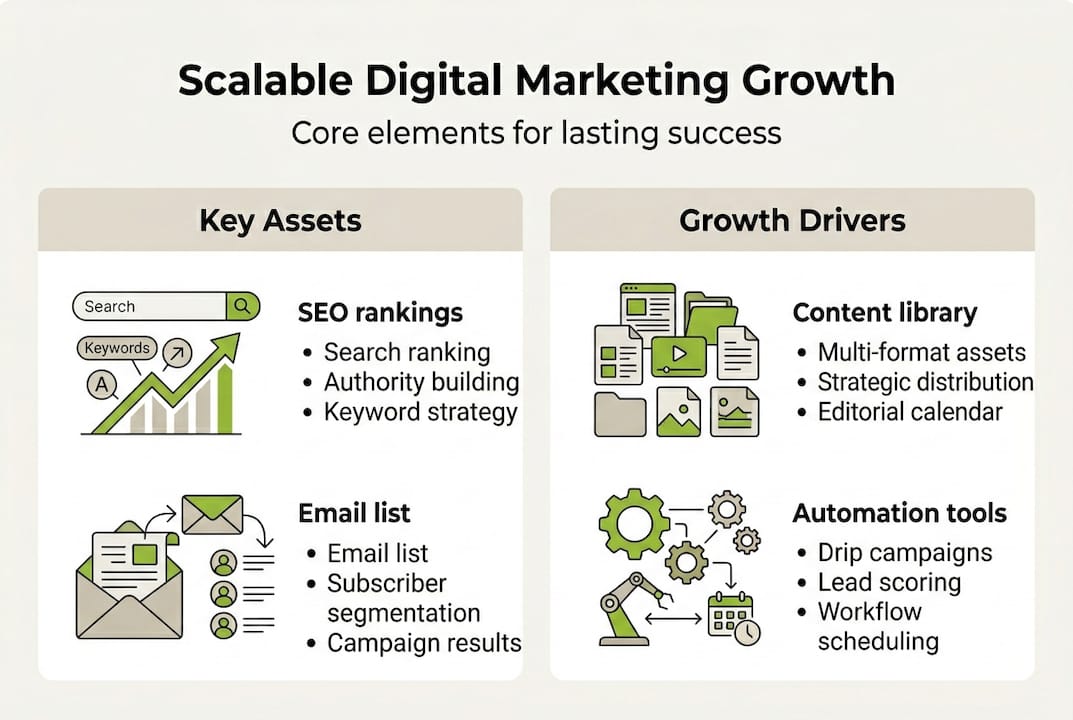
| Strategy type | Approach | Examples |
|---|---|---|
| Do more of what works | Paid and direct-response | PPC, retargeting, paid social |
| Build system value | Owned and earned channels | SEO, content, email, automation |
The businesses that scale effectively run both columns at the same time. Paid channels fund immediate growth while owned systems are built in parallel.
Here are the channels best suited for scalable growth investment:
- SEO: Organic traffic compounds over time and reduces your cost per visitor as rankings improve
- Email marketing: Your list is a fully owned asset that can be activated repeatedly without additional ad spend
- Content marketing: Blog posts, guides, and video content build authority and attract qualified traffic long after publication
- Marketing automation: Automated workflows for lead nurturing, onboarding, and follow-up reduce manual effort and improve conversion rates
- AI-powered tools: Used inside these systems, AI in digital marketing handles repetitive tasks, optimizes targeting, and surfaces insights that help smaller teams punch above their weight
The Gartner CMO data reinforces why this matters: with flat marketing budgets, AI-enhanced efficiency is not a luxury. It is how growth teams compete. Exploring AI-enhanced marketing shows how these tools integrate into a full system rather than operating in isolation.
Assign clear ownership for each channel. Track leading indicators like organic traffic growth, email list size, and pipeline volume, not just closed revenue. These metrics tell you whether your system is building momentum before it converts.
Pro Tip: Start building your owned channel systems at the same time you run paid campaigns. Do not wait until paid performance drops off. By then, you have lost the window to create a smooth transition.
Perspective: Why most digital marketing never truly scales (and what to do differently)
Having reviewed the main strategies, here is an experienced viewpoint on what really holds teams back from scaling and what works instead.
Most marketing teams spend the majority of their time on the tactics themselves, picking platforms, writing ads, tweaking creative. Very little time goes into building the operational infrastructure that makes those tactics repeatable. That is the real reason most digital marketing never scales.
Budget is rarely the actual blocker. The actual blocker is process fragmentation. Campaigns run in silos. Content is created without a distribution plan. Paid ads are not connected to email nurture sequences. Each channel is managed separately, and when you add more, you add more complexity, not more scale.
Sustainable scale requires three things working together: owned assets that compound, cross-channel systems that reinforce each other, and a team culture that values testing and learning over chasing the next platform trend. Following step-by-step growth strategies matters far more than finding the next marketing hack.
The contrarian truth is this: the businesses that scale fastest are rarely the ones with the biggest budgets. They are the ones with the most disciplined systems.
How Idea Stream Marketing helps unlock scalable growth
If you’re ready to build marketing that actually scales, here’s how our agency can help.
At Idea Stream Marketing, we build integrated systems designed to grow with your business, not just deliver short-term results. From SEO and content to paid campaigns and AI-powered automation, every service we offer is built around one goal: reducing your cost per lead over time while increasing brand visibility.
Our approach to digital marketing solutions starts with where your business actually is, not where a generic template says it should be. We use AI tools to help smaller teams produce results that used to require much larger marketing departments. If you want to understand exactly how AI in marketing fits into a scalable strategy for your business, our team is ready to walk you through a tailored assessment. Reach out and let’s build something that lasts.
Frequently asked questions
What is the difference between scalable growth and just getting more leads?
Scalable growth means you can increase leads without costs rising proportionally, because systems and repeatable processes do more of the heavy lifting. Getting more leads without scalability usually just means spending more money and effort each time.
How do I know if my marketing is ready to scale?
You’re ready when your lead generation costs are stable, you’ve confirmed product-market fit, and your core processes can be automated or repeated. Research points to post-PMF SMEs with consistent spend above $5,000 per month as the right profile for shifting to scalable systems.
Why is performance marketing alone not scalable?
Performance marketing creates a dependency on spending, meaning results slow or stop the moment you cut the budget, which makes long-term, sustainable growth structurally difficult to achieve.
How does AI help with scalable growth?
AI helps teams automate repetitive tasks and improve output without adding headcount. With marketing budgets flatlined, AI-driven productivity gains are increasingly what separates growing teams from those stuck at the same output level.
Recommended
- What is digital marketing? Strategies for scalable growth | Web Design & Marketing Agency
- Boost ROI With Smart Digital Marketing Strategies
- Boost ROI With Smart Digital Marketing Strategies
Located at: 252 Indian Head Rd, Kings Park, NY 11754
Call us: (631) 371-0238
Website: https://ideastreammarketing.com
Learn more about our AI SEO services:
https://ideastreammarketing.com/ai-seo/
Explore our web design services:
https://ideastreammarketing.com/web-design/
Contact our team:
https://ideastreammarketing.com/contact/

