



October 21, 2026




TL;DR:
- Full-service agencies manage all digital marketing channels under one strategy for better coordination.
- AI tools used by agencies improve targeting, automation, and analytics, driving measurable growth.
- Choosing an integrated agency can be more cost-effective and efficient than managing multiple specialists.
Small businesses often assume that advanced digital marketing tools and AI-powered strategies are reserved for enterprise brands with deep pockets. That assumption is costing them growth. 87% of agencies now use AI, and SMBs working with agency partners are reporting real productivity gains and revenue increases as a result. If you’re running a small or mid-sized business and relying on scattered, piecemeal marketing efforts, you’re likely leaving results on the table. This article breaks down what a full-service agency actually does, how AI fits into the picture, and how to choose the right partner for long-term growth.
Table of Contents
- What does a full-service agency actually do?
- How full-service agencies integrate AI for SMB growth
- Full-service agency vs. specialist: Which delivers better ROI?
- How to make the most of a full-service agency partnership
- What most SMBs miss when choosing an agency
- Ready to grow with a full-service agency?
- Frequently asked questions
Key Takeaways
| Point | Details |
|---|---|
| Integrated expertise | Full-service agencies provide SMBs with coordinated experts and AI tools that outperform fragmented solutions. |
| AI drives real ROI | Agency-managed AI systems boost SMB productivity and revenue while allowing room to scale efficiently. |
| Best-fit model matters | For most SMBs, an integrated approach offers better outcomes than hiring single-channel specialists. |
| Partnership is key | Choosing the right agency and maintaining collaborative communication maximizes results long-term. |
What does a full-service agency actually do?
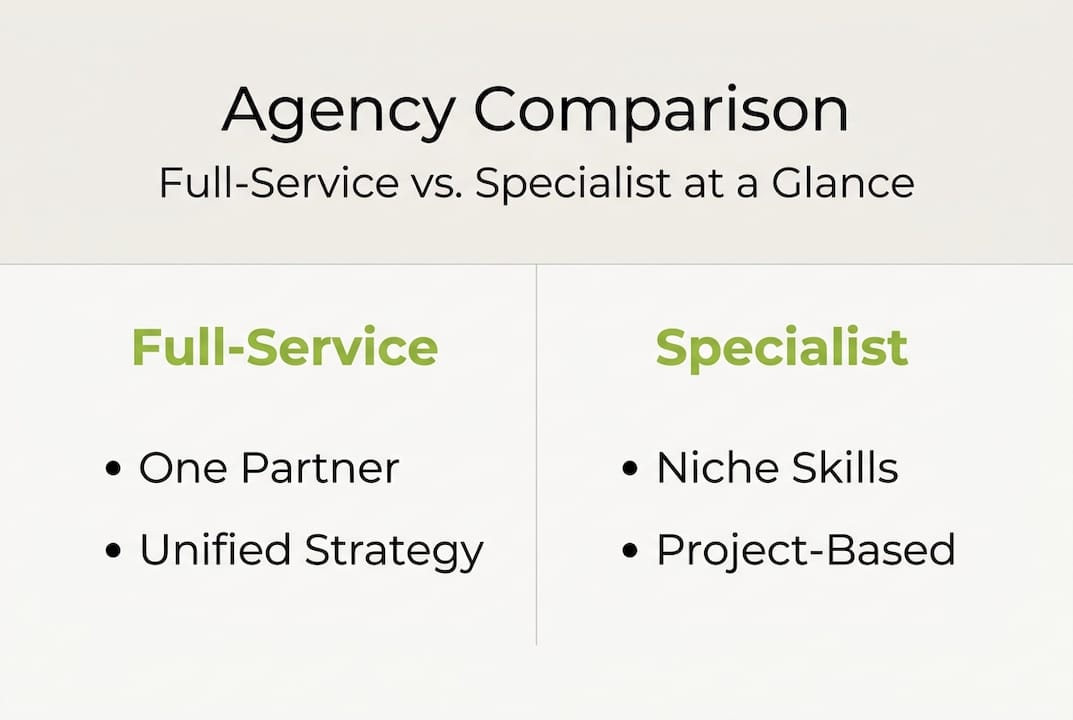
A full-service agency is exactly what it sounds like: one partner handling every aspect of your digital marketing. Instead of hiring a web designer here, an SEO consultant there, and a social media freelancer somewhere else, you work with a single team that manages everything under one strategy.
This is fundamentally different from a niche or specialist firm, which focuses on one channel or discipline. A specialist might be excellent at paid search, for example, but they won’t be thinking about how your ad messaging connects to your website experience or your email follow-up sequence. That gap is where results get lost.
A full-service agency typically covers:
- Web design and development — building fast, conversion-focused websites
- Search engine optimization (SEO) — improving your visibility in organic search results
- Pay-per-click (PPC) advertising — running paid campaigns on Google, Meta, and other platforms
- Social media management — content creation, scheduling, and engagement
- Email marketing — automated sequences and broadcast campaigns
- AI integration — using artificial intelligence to personalize targeting, streamline reporting, and optimize campaigns
- Analytics and reporting — tracking performance across every channel in one place
The real advantage here is coordination. When all of these services are managed by the same team, your messaging stays consistent, your data flows freely between channels, and your strategy adapts quickly. There’s no finger-pointing between vendors when something underperforms.

For resource-strapped SMBs, this model is especially valuable. As research confirms, full-service agencies provide access to specialized expertise, premium AI tools, and analytics without requiring you to build expensive in-house teams. You get enterprise-level capability at a fraction of the cost. Explore what 360° marketing services look like in practice to get a clearer picture of what this model can include.
How full-service agencies integrate AI for SMB growth
AI is no longer a futuristic concept in marketing. It’s a practical tool being used right now to improve targeting, automate reporting, and personalize customer experiences at scale. The question isn’t whether AI belongs in your marketing strategy. It’s whether you have the right team to use it effectively.
Full-service agencies have a clear edge here. 87% of agencies report using AI, with SMB clients seeing positive ROI lifts as a direct result. That’s not a coincidence. Agencies have the infrastructure, training, and experience to deploy AI tools in ways that actually move the needle.
Here’s how that looks in practice:
- AI-powered campaign management — Algorithms analyze performance data in real time and adjust bids, budgets, and targeting automatically.
- Personalized customer targeting — AI segments your audience based on behavior, intent signals, and purchase history to deliver the right message at the right time.
- Streamlined reporting — Automated dashboards pull data from every channel into one view, saving hours of manual work each week.
- Predictive analytics — AI identifies trends before they fully emerge, giving your team a head start on strategy adjustments.
- Content optimization — AI tools analyze what’s working in search and help shape content that ranks and converts.
The critical factor is human oversight. AI is powerful, but it needs strategic direction. 80% of agencies report productivity gains from AI integration, and the agencies delivering the best results are those pairing smart tools with experienced strategists who know how to interpret and act on the data.
Pro Tip: Most SMBs miss out on hidden AI features built into platforms like Google Ads and Meta Business Suite. A seasoned agency partner will activate and optimize these features from day one, while DIY users often leave them untouched.
Understanding small vs. large agency differences can also help you calibrate your expectations before signing a contract. For a deeper look at implementation, the step-by-step AI marketing guide and the future of AI-driven marketing are worth reviewing.
Full-service agency vs. specialist: Which delivers better ROI?
This is one of the most common questions SMBs ask, and the honest answer is: it depends on your situation. But for most growing businesses managing multiple channels, the full-service model has a structural advantage.
Here’s a direct comparison:
| Factor | Full-service agency | Specialist firm |
|---|---|---|
| Strategy integration | Unified across all channels | Limited to one channel |
| Communication | Single point of contact | Multiple vendors to manage |
| Data sharing | Seamless between teams | Siloed by channel |
| Time to results | Faster due to coordination | Slower without alignment |
| Long-term cost | Often lower overall | Can add up with multiple hires |
| Best for | Multi-channel growth goals | Single-channel dominance |
That said, specialists aren’t always the wrong choice. As industry analysis notes, if one channel is driving the vast majority of your growth, a specialist may outperform. But for most SMBs juggling SEO, paid ads, social, and web, full-service minimizes fragmentation risk significantly.
“The biggest cost of working with multiple specialists isn’t the invoices. It’s the time lost coordinating between them and the results lost when they’re not aligned.”
Watch for these red flags when evaluating any agency:
- Vague reporting with no clear KPIs
- No defined onboarding or strategy process
- Promises of overnight results
- Resistance to sharing data or access
- No mention of AI tools or modern marketing technology
For a broader look at how smart digital marketing strategies are being built in 2026, that resource offers useful context alongside this comparison.
How to make the most of a full-service agency partnership
Choosing the right agency is only the first step. Getting real value from the relationship requires active participation from your side too. Here’s how to set yourself up for success.
Step-by-step approach to evaluating and onboarding an agency:
- Define your goals clearly — Know whether you’re focused on lead generation, brand awareness, e-commerce revenue, or all three before your first meeting.
- Assess their reporting process — Ask to see a sample report. You should be able to understand it without a translator.
- Evaluate their onboarding — A strong agency has a structured onboarding process that captures your brand voice, customer data, and competitive landscape.
- Check for AI capabilities — Ask specifically how they use AI and which tools they deploy. Vague answers are a warning sign.
- Establish shared KPIs — Agree on the metrics that matter most to your business before work begins.
Here are key questions to ask before signing any agency contract:
| Question | Why it matters |
|---|---|
| How do you report on performance? | Ensures transparency and accountability |
| What AI tools do you use and why? | Reveals technical depth and strategic thinking |
| Who is our primary point of contact? | Prevents communication breakdowns |
| How do you handle strategy pivots? | Shows flexibility and responsiveness |
| Can we see case studies from similar businesses? | Validates real-world results |
Transparency and shared KPIs are non-negotiable. U.S. SMBs benefit most from comprehensive digital solutions with AI when multi-channel coordination is built into the engagement from the start.
Pro Tip: One of the most common SMB mistakes is under-communicating goals during onboarding. Don’t assume your agency knows your priorities. Write them down, share them clearly, and revisit them quarterly. You can also explore AI SEO services to understand how search-specific AI tools fit into a broader agency engagement.
What most SMBs miss when choosing an agency
Most business owners evaluate agencies on price and portfolio. Those matter, but they’re not the whole picture. The real cost of a bad agency relationship isn’t the monthly retainer. It’s the months of slow pivots, misaligned messaging, and missed opportunities that compound over time.
Fragmented marketing efforts are more expensive than most SMBs realize. When your SEO team doesn’t talk to your paid ads team, and neither talks to your web developer, you end up with a disconnected customer experience that quietly erodes trust and conversion rates.
The best agencies don’t just execute tactics. They act as growth partners, bringing outside perspective and fresh thinking that internal teams often can’t generate because they’re too close to the business. That outside innovation is frequently where the biggest wins come from.
Here’s a contrarian take worth sitting with: sometimes the greatest ROI from a full-service agency isn’t the campaigns they run. It’s the strategic clarity they force you to develop. When you have to articulate your goals, your audience, and your differentiators to an outside team, you often discover gaps in your own thinking.
Don’t sacrifice strategic oversight for hyper-specialized technique. Balance matters. Explore AI strategies that work to see how integrated thinking drives better long-term outcomes.
Ready to grow with a full-service agency?
If you’ve been managing marketing across multiple vendors or trying to handle it in-house, there’s a better path forward. Idea Stream Marketing offers end-to-end digital marketing agency services designed specifically for SMBs that want scalable, AI-powered growth without the complexity of coordinating a dozen different partners.
From SEO and paid advertising to web development and automation, our team builds integrated strategies that grow with your business. If AI-enhanced marketing is a priority, our AI enhanced marketing solutions are built to deliver measurable results across every channel. Reach out today to start a conversation about what a tailored strategy could look like for your business.
Frequently asked questions
What is a full-service agency in digital marketing?
A full-service agency offers end-to-end digital marketing solutions, including strategy, web design, SEO, social media, and advanced AI tools, giving SMBs an integrated approach without the need to build in-house teams. Specialized expertise and premium tools are accessible through the agency relationship rather than costly internal hiring.
How do full-service agencies use AI differently than DIY tools?
Full-service agencies deploy AI within a coordinated strategy, providing oversight, customization, and continuous optimization that standalone DIY tools simply can’t replicate. 80% of agencies report productivity gains from AI integration, backed by the strategic direction that makes those tools effective.
Are full-service agencies more expensive than hiring specialists?
Not necessarily. Full-service agencies often reduce duplicated work and long-term costs through coordinated efforts. As fragmentation risks show, managing multiple specialists adds hidden costs in time, misalignment, and missed results.
What should an SMB look for when selecting a full-service agency?
Prioritize transparent reporting, clear communication, industry experience, and a defined approach to AI and data-driven strategy. U.S. SMBs gain the most when their agency delivers true multi-channel integration backed by advanced technology.
Recommended
- Why Partnering with a Social Media Management Agency is Key.
- Best Graphic Design Agency in Long Island for Brand Success.
Located at: 252 Indian Head Rd, Kings Park, NY 11754
Call us: (631) 371-0238
Website: https://ideastreammarketing.com
Learn more about our AI SEO services:
https://ideastreammarketing.com/ai-seo/
Explore our web design services:
https://ideastreammarketing.com/web-design/
Contact our team:
https://ideastreammarketing.com/contact/

