



October 21, 2026




TL;DR:
- AI-powered lead generation uses machine learning and automation to identify and nurture potential customers efficiently. Most marketing organizations now consider AI essential rather than optional, with tools improving prospecting, targeting, and conversion rates. Success depends on clean data, a well-defined target profile, and proper integration of AI with human judgment.
AI-powered lead generation is defined as the use of machine learning, predictive analytics, and automation to identify, score, and nurture potential customers at scale. The role of AI in lead generation has shifted from experimental to essential. As of Q2 2026, 75% of marketing organizations use at least one form of AI to automate key marketing tasks. That number tells you AI in marketing is no longer a competitive edge. It is the baseline. Tools like ZoomInfo, Salesforce Einstein, and HubSpot AI are already helping businesses cut prospecting time, sharpen targeting, and convert more leads with less manual effort.
How does AI improve lead identification and qualification?
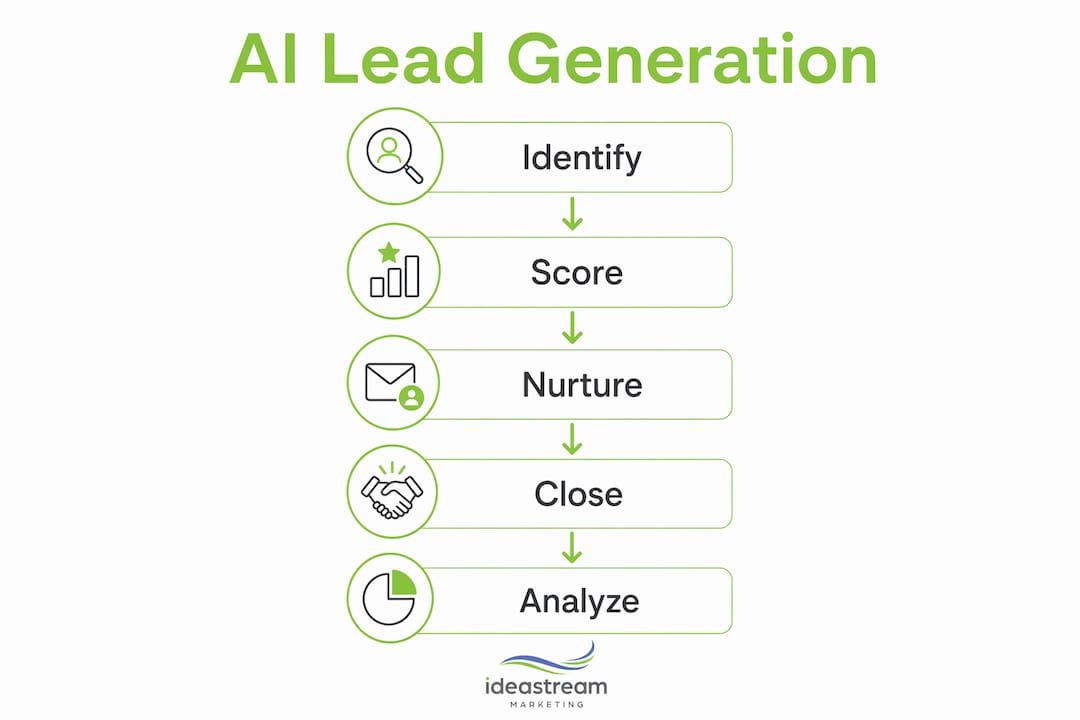
Traditional lead identification means hours of manual list building, spreadsheet sorting, and gut-feel scoring. AI replaces that process with data-driven precision and speed.

AI-powered systems use predictive analytics to analyze behavioral signals, firmographic data, and historical conversion patterns. The result is a ranked list of prospects most likely to buy, delivered in real time. AI lead generation tools can scan multiple databases and deliver prioritized, researched prospect briefs within minutes. That means a sales rep who once spent three hours building a call list now starts the day with a ready-to-work queue.
Here is what AI does at the identification and qualification stage:
- Predictive lead scoring: Assigns a conversion probability to each lead based on behavior, company size, industry, and past engagement patterns.
- Intent detection: Monitors signals like content downloads, pricing page visits, and search behavior to flag leads who are actively researching a purchase.
- Data enrichment: Automatically fills in missing contact details, job titles, and company data using sources like LinkedIn, ZoomInfo, and public business databases.
- Real-time qualification: Filters inbound leads the moment they enter your CRM, routing high-value prospects to sales and low-fit contacts to nurture sequences.
Automated prospecting reduces manual prospecting from hours per day to minutes. That time savings compounds fast. A team of five sales reps each recovering two hours per day gains 50 additional selling hours every week.
Pro Tip: Clean your CRM data before deploying any AI scoring tool. AI amplifies whatever data it trains on. Dirty data produces confidently wrong scores, and your team will chase the wrong leads faster than ever.
What AI tools are essential for lead nurturing?
Identifying a lead is only the first step. Nurturing that lead from awareness to purchase requires consistent, personalized communication at scale. AI handles this without burning out your team.
AI drafts personalized outreach emails based on a lead’s industry, behavior, and stage in the buying cycle. Tools like Grammarly’s AI writing assistant and agentic AI platforms help marketing teams produce high-quality, on-brand content at a volume that would be impossible manually. The key difference from generic email blasts is context. AI pulls from CRM data to reference a lead’s specific pain points, recent activity, or company news.
Key AI applications in lead nurturing include:
- AI chatbots: Platforms like Drift and Intercom deploy chatbots that qualify website visitors 24 hours a day, seven days a week. A visitor who lands on your pricing page at 11 p.m. gets an immediate, intelligent response instead of waiting until morning.
- Behavior-triggered sequences: AI monitors when a lead opens an email, revisits your website, or watches a video, then automatically sends the next most relevant message. No human has to watch for those signals.
- Personalized content delivery: AI recommends blog posts, case studies, or product pages based on what a specific lead has already engaged with, keeping them moving through the funnel.
- AI-assisted email marketing: AI-driven email outreach adjusts send times, subject lines, and content blocks based on individual engagement history, improving open and click rates without manual A/B testing cycles.
The practical result is a nurture system that feels personal to the lead but requires minimal daily management from your team. That is the core promise of AI-enhanced marketing applied to the middle of the funnel.
What are the best practices for implementing AI in lead generation?
Getting AI working in your lead generation process requires more than buying a tool. Most implementations that fail do so because of process gaps, not technology gaps.
Follow these steps to build a foundation that actually works:
- Define your Ideal Customer Profile first. Avoid chasing lead quantity over quality. A tightly defined ICP tells the AI exactly who to target. Without it, you get a high volume of low-fit leads that waste sales time and inflate your customer acquisition cost.
- Audit your data before you automate. Poor data hygiene undermines AI success by automating flawed targeting and outreach. Run a data audit on your CRM before connecting any AI tool. Fix duplicates, outdated contacts, and missing fields first.
- Set measurable goals with a realistic timeline. Effective AI initiatives focus on defined metrics like customer acquisition cost and sales cycle time, with results expected within a 12–18 month window. Set those benchmarks before launch so you can measure progress honestly.
- Calibrate task ownership between AI and humans. Autonomy calibration means defining which tasks AI handles independently, which tasks need human review, and which stay fully human-led. This prevents errors and keeps your team from either micromanaging the AI or trusting it blindly.
- Review AI outputs regularly. AI models drift over time as market conditions change. Schedule monthly reviews of lead quality, scoring accuracy, and email performance to catch problems before they compound.
Pro Tip: Document your best past outreach emails and sales briefs before training any AI tool. That library becomes the grounding foundation the AI learns from. The better your examples, the better its output.
How does AI fit into your broader marketing and sales workflow?
AI does not replace your marketing and sales team. It changes what that team spends its time doing.
Marketing teams are shifting from campaign-based cycles to always-on systems that continuously test, activate, and optimize. Instead of launching a campaign, waiting 30 days, and reviewing results, AI-powered systems adjust targeting and messaging in real time. This is a fundamental change in how growth-focused businesses operate. You can read more about this shift in AI-driven marketing strategies that apply these principles step by step.
The table below shows how AI and human roles divide across the lead generation workflow:
| Workflow Stage | AI Role | Human Role |
|---|---|---|
| Prospecting | Scans databases, scores leads, flags intent signals | Reviews top prospects, approves outreach lists |
| Outreach | Drafts personalized emails, triggers sequences | Approves messaging, handles complex replies |
| Lead Qualification | Scores and routes inbound leads automatically | Conducts discovery calls with high-fit prospects |
| Nurturing | Delivers content based on behavior triggers | Builds relationships with high-value accounts |
| Reporting | Generates performance dashboards in real time | Interprets data and adjusts strategy |
Leadership roles are evolving alongside these changes. CMOs and marketing directors are now focused on AI governance, brand quality guardrails, and enabling rapid experimentation at scale. The job is less about executing campaigns and more about designing the systems that run them. For SMBs, this means the business owner or marketing lead needs to think like a systems architect, not just a campaign manager.
AI-driven customer acquisition works best when AI surfaces the leads and humans close them. That division of labor keeps the process efficient without removing the human judgment that high-value sales require.
Key takeaways
AI-powered lead generation delivers measurable results only when built on clean data, a defined Ideal Customer Profile, and a clear division of tasks between AI tools and human judgment.
| Point | Details |
|---|---|
| AI adoption is mainstream | 75% of marketing organizations already use AI for key tasks, making it the baseline for competitive lead generation. |
| Data quality comes first | Clean CRM data before deploying AI tools, or you will automate flawed targeting at scale. |
| Define your ICP before automating | A tightly defined Ideal Customer Profile focuses AI on high-fit leads and reduces wasted sales effort. |
| Calibrate human and AI ownership | Assign specific tasks to AI, human review, or full human control to prevent errors and bottlenecks. |
| Plan for a 12–18 month timeline | Measurable AI-led outcomes require defined metrics and a realistic window to see results. |
What i have learned about AI and lead generation for smbs
The biggest mistake I see SMBs make is treating AI as a shortcut rather than a system. They buy a tool, connect it to a messy CRM, and expect the leads to improve. They do not. The AI just finds the wrong people faster.
What actually works is starting with your best customers and working backward. Who are they? What did they have in common before they converted? What signals did they show? That analysis becomes the foundation for your ICP, and the ICP becomes the instruction set for your AI tools. The best AI adopters anchor their strategy to specific sales bottlenecks rather than copying what worked for someone else’s business model.
I also think most businesses underestimate how much the human side of the workflow still matters. AI can score a lead, draft an email, and trigger a follow-up sequence. It cannot read the room on a discovery call or build the kind of trust that closes a $50,000 contract. The businesses I have seen get the most from AI are the ones that use it to free up their best people for exactly those high-value moments.
The future is moving toward integrated AI agents that handle entire lead generation workflows autonomously. That is coming. But right now, the SMBs winning with AI are the ones who treat it as a disciplined tool, not a magic system. Start with lead generation best practices built for businesses your size, then layer AI on top of a process that already works.
— Dean
How Idea Stream Marketing helps you generate better leads with AI
At Idea Stream Marketing, we build AI-powered marketing systems designed specifically for SMBs that want more qualified leads without adding headcount. Our services include AI SEO, chatbot-integrated marketing, and conversion-focused web design that works together as a connected growth system.
We start every engagement by understanding your business model, your best customers, and where your current lead process breaks down. From there, we build the right combination of tools and strategy to fix it. Whether you need AI SEO services to improve your organic visibility or a full automated lead generation system, we have the team and the technology to make it happen. Schedule a consultation with Idea Stream Marketing today and let us show you what AI-powered lead generation looks like for your specific business.
FAQ
What is the role of AI in lead generation?
AI in lead generation automates the identification, scoring, and nurturing of potential customers using machine learning and predictive analytics. It reduces manual prospecting time and improves the accuracy of targeting by analyzing behavioral and firmographic data.
How does AI improve lead quality?
AI improves lead quality by scoring prospects against a defined Ideal Customer Profile and filtering out low-fit contacts before they reach your sales team. This means your team spends time on leads most likely to convert rather than working through unqualified lists.
What AI tools are commonly used for lead generation?
Tools like ZoomInfo, Salesforce Einstein, HubSpot AI, Drift, and Intercom are widely used for prospecting, lead scoring, chatbot qualification, and personalized outreach automation.
How long does it take to see results from AI lead generation?
Effective AI initiatives typically show measurable results within a 12–18 month window when built around defined metrics like customer acquisition cost and sales cycle time.
Can small businesses afford AI lead generation tools?
Many AI lead generation tools offer tiered pricing that fits SMB budgets, and the time savings from automation typically offset the cost quickly. Starting with one focused tool, such as an AI chatbot or a CRM with built-in scoring, is a practical entry point for smaller teams.

