



October 21, 2026




TL;DR:
- Video production is essential for modern marketing, boosting brand visibility and measurable revenue. High-quality, platform-specific videos with verified transcripts and metadata improve AI search citations and engagement. Most businesses now produce video content in-house or through hybrid teams to adapt to AI-driven search optimization effectively.
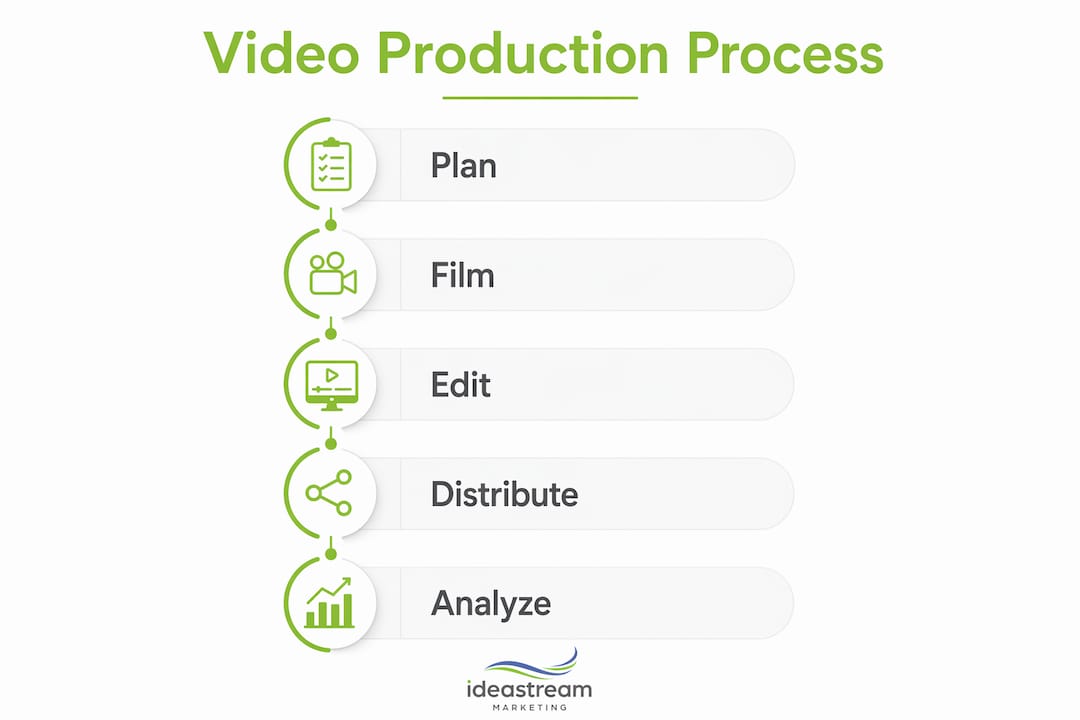
Video production is defined as the full process of planning, filming, editing, and distributing visual content to communicate a brand’s message to a target audience. The role of video production in modern marketing goes far beyond content creation. It is now a core business function that drives brand visibility, audience engagement, and measurable revenue. 91% of businesses use video as a central part of their marketing strategy in 2026. That near-universal adoption means the competitive edge no longer comes from simply having video. It comes from producing video that is high-quality, platform-specific, and built for AI-powered search discovery. Agencies like Ideastreammarketing have built their entire model around this reality, combining professional production with SEO and AI optimization from the first frame to final delivery.
What is the role of video production in marketing ROI?
Video production directly increases marketing ROI by converting brand messages into content that audiences watch, share, and act on. 75% of marketers report positive ROI within six months of investing in video content. That timeline is faster than most other content formats, which makes video one of the most efficient marketing investments available.
Short-form video leads on ROI, but format selection matters enormously. Videos under one minute achieve 50% engagement rates, while videos in the 30-to-60-minute range double engagement for educational content. This means a law firm explaining a complex legal process benefits from a longer format, while a restaurant promoting a weekend special should stay under 60 seconds.
The video production benefits for marketing teams extend well beyond engagement metrics:
- Brand trust: Video puts a face and voice to your business, which builds credibility faster than written content alone.
- Reduced support load: Product and tutorial videos answer common customer questions before they become support tickets.
- Higher conversion rates: Landing pages with video consistently outperform text-only pages.
- Longer site sessions: Visitors spend more time on pages that include video, which signals quality to search engines.
- Wider reach: Video content is shared at higher rates across social platforms than any other format.
Video ad spending is projected to exceed $236 billion globally in 2026. That figure reflects how seriously businesses across every industry treat video as a paid and organic growth channel.
How do video production team roles work in 2026?
The modern video production team looks very different from what it did five years ago. Traditional roles like camera operator, editor, and casting director still exist, but they now sit alongside newer responsibilities tied to SEO, metadata strategy, and AI discoverability.

Producers today manage far more than scheduling and budgets. Modern video producers require SEO and AI fluency because success is measured by AI citations and search rankings, not just view counts. A producer who understands how to structure a video for AI indexing delivers more long-term value than one focused only on visual quality.
| Traditional video production role | Modern video production role |
|---|---|
| Producer manages scheduling and budget | Producer also oversees SEO strategy and AI optimization |
| Editor focuses on cuts and color grading | Editor adds chapters, captions, and metadata for AI parsing |
| Camera operator handles framing and lighting | Camera operator coordinates with drone and multi-format capture |
| Casting director sources on-screen talent | Casting director also considers subject matter authority for credibility |
| Post-production is the final step | Post-production includes transcript verification and platform formatting |
Around 59% of marketers create video in-house, 32% use a hybrid approach, and 10% rely solely on external vendors. High-volume producers are more likely to maintain dedicated in-house teams, reserving external partners for premium campaigns that require specialized equipment or expertise.
Pro Tip: If you are building an in-house team, hire your editor and SEO strategist before your camera operator. The technical and distribution side of video production now determines results more than raw production quality alone.
How does video production integrate with AI and SEO?
Video production is now the primary source of authoritative content for AI-powered search engines. YouTube generated over 188,000 AI search citations in may 2026 alone, with Google AI Mode producing 73,813 of those citations from YouTube content. That scale establishes YouTube not just as a video platform but as foundational AI infrastructure.
AI models do not watch video. They read transcripts and parse metadata. Human-verified transcripts and timestamped chapters increase AI parsing accuracy and citation likelihood significantly. A video without a clean transcript is effectively invisible to AI search engines, no matter how well-produced it is.
Video content also serves as a defense against AI misinterpretation. When your business publishes authoritative, verified video content, AI models use it as a reference point. That reduces the risk of AI generating inaccurate information about your products or services.
Here are the production practices that make video content AI-friendly:
- Write and verify a full transcript for every video before publishing.
- Add timestamped chapter markers every two to three minutes.
- Write descriptive titles and metadata that match the exact language your audience searches.
- Refresh video titles and descriptions regularly. Updated content earns higher citation rates in AI-driven search.
- Keep video content factually accurate and current, since AI models prioritize verified, up-to-date sources.
Pro Tip: Treat your video description like a blog post introduction. Write 150–250 words that summarize the video’s key claims, include your primary keyword, and answer the question the video addresses. AI models pull from this text directly.
For a deeper look at how video metadata and video SEO work together to improve search visibility, the technical details matter as much as the creative ones.
Platform-specific video production strategies that drive results
Different platforms reward different video formats, and a one-size-fits-all approach wastes both budget and opportunity. Understanding how video production works across platforms is what separates brands that grow from brands that post without results.
- YouTube: Publish long-form educational content (10–20 minutes) with full transcripts, chapters, and keyword-rich descriptions. YouTube is the highest-value platform for AI citations and long-term search visibility.
- LinkedIn: Post leadership updates, case studies, and educational clips. Live video on LinkedIn generates 24 times more comments than standard video, making it the top format for B2B engagement.
- Instagram and TikTok: Produce short-form content under 60 seconds. Hook viewers in the first two seconds. These platforms reward entertainment and relatability over production polish.
- Facebook: Use a mix of short-form clips and live broadcasts. Facebook’s algorithm favors video that generates comments and shares within the first hour of posting.
- Your website: Embed video on landing pages, product pages, and your homepage. Video on landing pages increases time-on-page and supports SEO signals.
Budget allocation follows the same logic. Short-form social content can be produced in-house at lower cost. YouTube and LinkedIn long-form content benefits from professional production, scripting, and post-production editing. 63% of video marketers use AI tools for automated editing and localization to speed up workflows without increasing costs. That means even smaller teams can maintain consistent output across multiple platforms.
Social media video content strategy requires matching format to platform behavior, not just repurposing the same file everywhere. A 15-minute YouTube video becomes a 60-second Instagram reel, a 30-second TikTok clip, and a 2-minute LinkedIn post. Each version requires its own edit, caption, and metadata.
For brands that want to optimize content for AI search, the platform strategy and the AI strategy are the same strategy. Content that is well-structured, clearly titled, and regularly updated performs better everywhere.
Key Takeaways
Professional video production drives brand visibility, AI search citations, and marketing ROI when content is built with platform fit, verified transcripts, and current metadata from the start.
| Point | Details |
|---|---|
| Video production drives fast ROI | 75% of marketers see positive returns within six months of investing in video content. |
| Format determines engagement | Videos under one minute hit 50% engagement; long-form doubles engagement for educational topics. |
| AI reads transcripts, not video | Verified transcripts and timestamped chapters are required for AI citation and search visibility. |
| Platform strategy multiplies reach | Each platform requires a distinct format, edit, and metadata approach for maximum performance. |
| In-house and hybrid models dominate | 59% of marketers produce video in-house; hybrid teams balance cost and quality for premium content. |
Why video production strategy is the conversation most brands are having too late
I have worked with enough business leaders to recognize a pattern. They invest in video production after a competitor’s video goes viral, or after they notice their search rankings slipping. The decision to produce video is reactive, not planned. That timing problem costs them more than they realize.
The brands that consistently win with video treat production as infrastructure, not a campaign. They build a content calendar, assign ownership of transcripts and metadata, and publish on a schedule. They do not wait for a perfect concept. They ship, measure, and improve. That discipline compounds over time in a way that one-off productions never do.
The AI search shift makes this even more urgent. YouTube’s role as AI infrastructure means that every video your business publishes is either building or missing an opportunity to be cited by Google AI Mode, Perplexity, and ChatGPT. Most businesses have no idea their video library is a citation asset. The ones that do are pulling ahead fast.
My honest recommendation: start with YouTube and LinkedIn. Those two platforms offer the highest return on professional production investment right now. Get your transcripts verified, add chapters, and refresh your descriptions every quarter. Then build out your short-form library for Instagram and TikTok. The sequence matters because it matches where AI citation volume is highest.
The creative side of video production still matters enormously. Storytelling, pacing, and visual quality determine whether someone watches past the first 10 seconds. But the technical side, the metadata, the transcript, the update cadence, is what determines whether anyone finds the video in the first place. Both sides require attention. Neither one is optional anymore.
— Dean
Professional video production services from Idea Stream Marketing
Idea Stream Marketing works with businesses across Long Island, New York City, and nationwide to produce video content that performs on every platform and in every AI-powered search environment. From concept and scripting through filming, editing, color grading, and final delivery, the team handles the full production process with discoverability built in from day one.

Whether you need corporate videos, commercials, testimonials, drone footage, or a complete video production strategy, Idea Stream Marketing combines creative production with AI SEO and digital marketing expertise. Every video is built to support search visibility, audience engagement, and long-term brand growth. Explore our video advertising services to see how we help businesses turn video content into a measurable growth channel.
FAQ
What is the role of video production in digital marketing?
Video production transforms brand messaging into visual content that drives engagement, builds trust, and improves search visibility. It is a core marketing function, not a supplementary one, with 91% of businesses using video as part of their strategy in 2026.
How does video production affect AI search results?
AI models index video through transcripts and metadata, not the video itself. Verified transcripts, timestamped chapters, and updated descriptions increase the likelihood that your video content is cited by Google AI Mode, Perplexity, and similar platforms.
What video format drives the highest ROI?
Short-form video under one minute drives the highest engagement on social platforms, while long-form video in the 30-to-60-minute range doubles engagement for educational content. The best format depends on the platform and the goal.
Should businesses produce video in-house or outsource it?
59% of marketers produce video in-house, and 32% use a hybrid model. In-house production works well for consistent short-form content, while professional external production delivers better results for premium campaigns, commercials, and YouTube content.
How often should businesses update their video content?
Video titles, descriptions, and metadata should be refreshed at least quarterly. Updated content earns higher citation rates in AI-driven search and signals freshness to both search engines and AI models.

